
Why Lead Generation is the Lifeblood of Personal Injury Practices
Lead generation for personal injury lawyer practices is the process of attracting and converting potential clients who need legal representation after an accident or injury into signed cases. With over 60% of law firms citing lead generation as their biggest challenge and the personal injury market projected to reach $57.3 billion in 2024, mastering this process is critical for sustainable growth.
Core Lead Generation Channels:
- Search Engine Optimization (SEO) – Ranking for terms like “car accident lawyer near me”
- Pay-Per-Click Advertising (PPC) – Immediate visibility through Google Ads and Local Services Ads
- Content Marketing – Building trust through educational blog posts and resources
- Social Media Marketing – Engaging potential clients on platforms they use daily
- Online Directories – Visibility on reputable legal platforms
- Referral Networks – Partnerships with medical providers and other attorneys
Key Success Factors:
- Rapid response time (within minutes increases conversion)
- Mobile-optimized website (60% of searches happen on mobile)
- Local SEO presence (70% of clicks go to top 3 map listings)
- Lead qualification system (filtering for case viability)
- Multi-channel follow-up (email, SMS, phone)
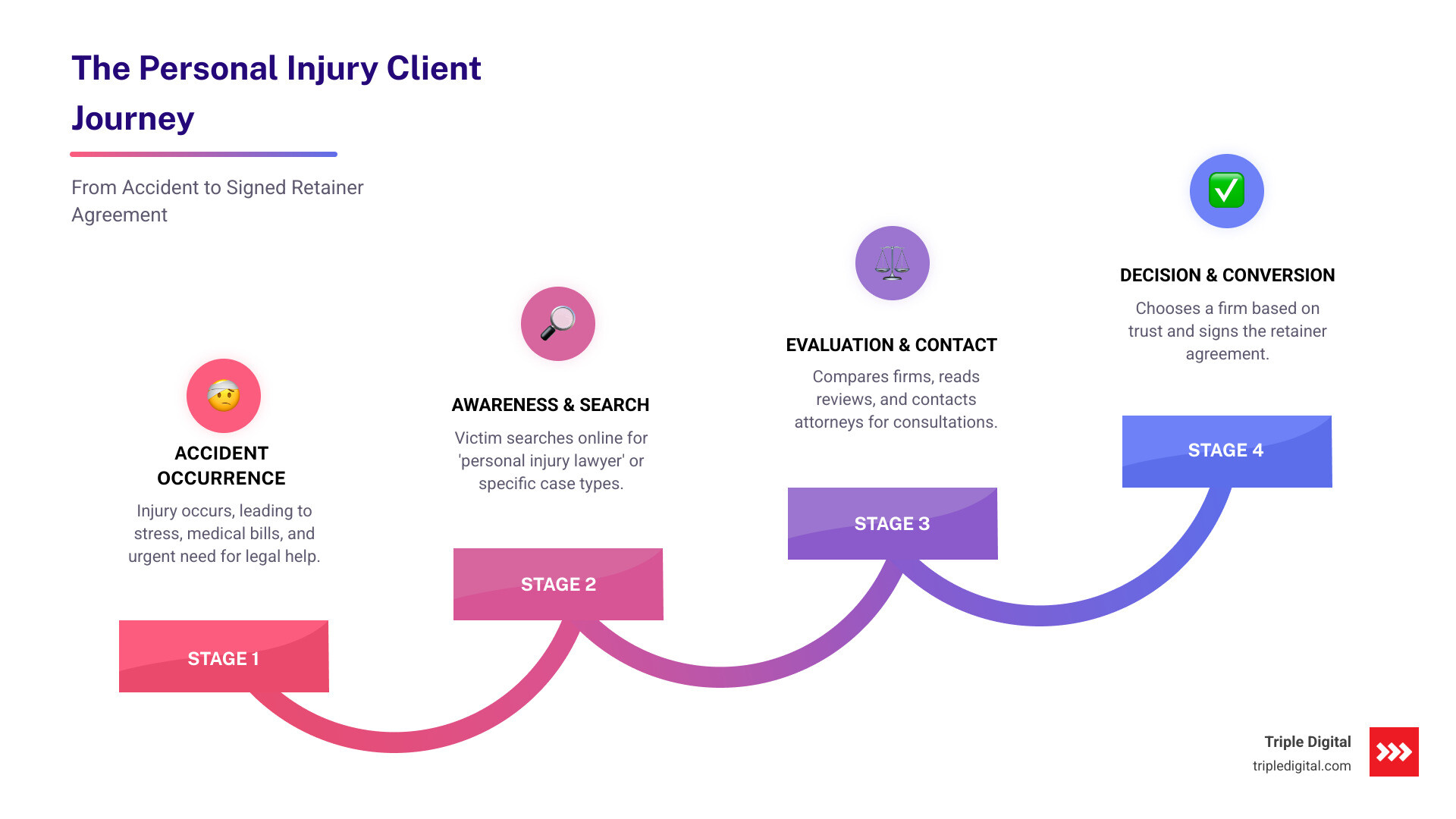
Personal injury lead generation is fundamentally different from other practice areas. When someone searches for a lawyer after an accident, they are often injured, stressed about medical bills, and need to make a decision quickly. The challenge is steep – the average personal injury lead often costs between $100 and $350, with some high-value cases like auto accidents ranging from $300 to $1,500 per lead.
Yet many firms still rely on outdated methods like referrals alone or expensive traditional advertising that does not reach people at the exact moment they need help. The firms that thrive are those that build scalable, data-driven lead generation systems that create a consistent pipeline of qualified cases.
Understanding the Types and Costs of PI Leads
Common types of personal injury leads include:
- Car Accident Leads: High-urgency leads that can range from $300 to $1,500 per lead, reflecting their high demand and potential case value.
- Medical Malpractice Leads: Complex cases that can be as low as $40 per lead, though the legal work involved is substantial.
- Slip and Fall Leads: Premises liability leads typically range from $175 to $425 each.
- Workers’ Compensation Leads: Cost between $75 and $550 per lead, depending on injury severity.
The cost of a personal injury lead is influenced by:
- Exclusivity: Exclusive leads cost more but offer higher ROI
- Geographic Area: Urban markets have higher lead costs
- Type of Personal Injury: Auto accidents command higher prices
- Quality vs. Cost: Pre-screened leads cost more but convert better
Personal injury lawyers can expect to pay close to $160 per lead on average, with other sources putting that number closer to $240. To truly understand what is working, track every lead. Learn more about Why Tracking Numbers Are So Important to Track Leads.
The Engine: Core Strategies for Effective Lead Generation for Personal Injury Lawyers
In today’s competitive legal landscape, personal injury lawyers need a robust, multi-channel approach to lead generation. Building an in-house lead generation system gives firms full control over their pipeline, rather than relying solely on external vendors.

Triple Digital’s approach centers on “less fluff, more cases.” That means implementing precise, data-driven strategies so every marketing effort contributes directly to your firm’s growth. For a deeper dive, explore Digital Marketing Strategies Law Firm.
Mastering SEO for Long-Term Lead Generation for Personal Injury Lawyer
Search Engine Optimization (SEO) is the cornerstone of any successful long-term lead generation for personal injury lawyer strategy. If your firm is not visible on the first page, you are practically invisible to potential clients.
Key areas for personal injury SEO include:
- Local SEO: Ensures your firm appears prominently in “near me” searches. Optimizing your Google Business Profile is crucial. For quick wins, review 5 GMB Hacks Not To Miss To Generate More Leads.
- On-page SEO: Optimizing content and structure to rank for relevant keywords. Learn more about On-page SEO.
- Technical SEO: Ensuring your website is fast, mobile-friendly, and easily crawlable.
- Content Quality: High-quality, authoritative content remains essential.
Triple Digital digs deeper into this in Law Firm SEO: What Are The Most Important SEO Ranking Factors?.
Leveraging Content Marketing to Build Trust and Attract Leads
Content marketing builds trust and authority, invaluable assets in lead generation for personal injury lawyer practices. When individuals search for legal help after an injury, they seek reliable information.
- Blogging for Lawyers: Educational content addressing victim questions boosts SEO by targeting relevant keywords.
- E-A-T and YMYL Content: Google treats legal content as “Your Money or Your Life” (YMYL) and scrutinizes it for Expertise, Authoritativeness, and Trustworthiness.
- Video Marketing: Increases engagement and conversion rates.
- Downloadable Resources: Free guides work as lead magnets.
To understand why this strategy is vital, review Why Do Law Firms Need a Content Marketing Strategy?. Triple Digital also leverages AI efficiently – learn more in The Key to AI-Written Content.
Driving Immediate Traffic with Paid Advertising
While SEO builds long-term equity, paid advertising offers immediate visibility for lead generation for personal injury lawyer firms.
- Pay-per-click (PPC) Advertising: Targets high-intent keywords for immediate visibility.
- Google Local Services Ads (LSAs): Pay-per-lead model with “Google Screened” badge.
- Geo-targeting: Limits ads to your specific service area.
- Landing Page Optimization: Dedicated pages aligned with ad copy improve conversion.
- Social Media Ads: Excellent for retargeting and brand awareness. See How Facebook Advertising Can Bring Traffic to Your Website.
Using Social Media and Directories for Added Visibility
Social media and online legal directories build reputation and provide additional pathways for potential clients. Maintaining an active presence allows you to engage with your community and manage your online reputation. Learn more in Law Firm Marketing with Social Media.
The System: Qualifying, Converting, and Managing Your Leads
Generating leads is only half the battle; the real progress happens when those leads are efficiently qualified, nurtured, and converted into paying clients.

Firms that respond within minutes to an inquiry stand a significantly higher chance of converting that lead. For a comprehensive look at optimizing this crucial stage, review Enhancing Client Satisfaction and Firm Profitability: Optimizing the Intake Process.
Defining Your Ideal Client and Qualifying Leads
Not all leads are created equal. Focus on:
- Ideal Client Persona: Create detailed profiles of your ideal clients.
- Intake Questions: Use strategic questions to gather critical information upfront.
- Lead Scoring: Prioritize incoming leads based on case value and viability.
- Filtering Criteria: Check statute of limitations, injury severity, jurisdiction, and insurance coverage.
For more on lead filtering, see Probate Leads Filter.
The Role of Technology in Lead Management
Technology streamlines every aspect of lead management:
- Client Relationship Management (CRM) System: Central hub for all lead data.
- Automation: Sends immediate follow-up emails and SMS messages.
- Live Chat and AI Chatbots: Pre-qualify leads 24/7. Learn more about AI Overviews.
- Call Tracking: Monitor which marketing channels generate phone calls.
Best Practices for Converting Leads into Signed Cases
- Rapid Response Time: Contact leads within minutes.
- Persistent Follow-Up: Multiple attempts over several days using different channels.
- Multi-channel Communication: Phone, email, live chat, and text.
- Intake Team Training: Emphasize empathy, active listening, and professionalism.
- Empathy and Professionalism: Critical when prospects are seeking legal representation.
The Scorecard: Measuring ROI and Refining Your Approach
In lead generation for personal injury lawyer firms, guesswork quickly leads to wasted resources. To master the process, you must continuously measure, analyze, and refine your strategies.
Triple Digital emphasizes making data-driven decisions. By analyzing funnel drop-offs and testing new variables, you can improve performance over time. Robust Law Firm Lead Tracking underpins this work.
The Buy vs. Build Dilemma in Lead Generation for Personal Injury Lawyer
One significant decision is whether to buy leads from external providers or build an in-house lead generation system. Triple Digital strongly favors the “build” approach for long-term, sustainable growth.
| Feature | Buying Leads | Generating In-House |
|---|---|---|
| Speed | Quick access to leads | Takes time to ramp up |
| Control | Limited visibility | Full control over quality |
| Competition | Leads contacted by multiple firms | Leads come directly to you |
| Cost Structure | Ongoing spend | Builds lasting asset |
| Data Ownership | Restricted data | Complete access |
Building your own system through SEO, content, and targeted ads is like paying a mortgage instead of rent: it is an investment that creates a valuable, sustainable asset for your firm.
Key Metrics to Track for Success
- Cost Per Lead (CPL)
- Client Acquisition Cost (CAC)
- Conversion Rate
- Return on Investment (ROI)
- Lead-to-Client Rate
Understanding these numbers is crucial for knowing How Much Do Small Law Firms Spend on Marketing?.
Common Mistakes to Avoid
- Slow Follow-Up: Speed is critical
- No Tracking System: You cannot improve what you do not measure
- Generic Messaging: Address specific client pain points
- Not Qualifying Leads: Focus on viable cases
- Ignoring Online Reputation: Manage reviews actively
- Giving Up Too Early: SEO and content marketing require patience
The Foundation: What Are Personal Injury Leads and Why They Matter
Lead generation for personal injury lawyer practices is the process of attracting and converting potential clients who need legal representation after an accident or injury into signed cases. With over 60% of law firms citing lead generation as their biggest challenge and the personal injury market projected to reach $57.3 billion in 2024, mastering this process is critical for sustainable growth.
Personal injury leads represent people at a particularly vulnerable point in their lives. They may be dealing with medical treatment, lost wages, property damage, and uncertainty about the future. For law firms, these leads are the pipeline that drives new cases and revenue. For clients, effective lead generation means finding a qualified attorney quickly when they need help most.
A strong lead generation system does more than just capture contact information. It aligns your marketing, intake, and follow-up processes so prospects can move smoothly from initial search to signed agreement, with clear communication at every step.
Why Lead Generation is the Lifeblood of Personal Injury Practices

Lead generation for personal injury lawyer practices is the process of attracting and converting potential clients who need legal representation after an accident or injury. With over 60% of law firms citing lead generation as their biggest challenge and the personal injury market projected to reach $57.3 billion in 2024, mastering this process is critical for sustainable growth.
Unlike other practice areas, personal injury leads are often urgent and emotional. Victims are stressed, injured, and need help fast. This urgency, combined with the fact that a large majority of people start their legal search online, makes digital marketing the most effective way to connect with them at their moment of need.
Understanding the Types and Costs of PI Leads
Personal injury leads vary in type and cost. Common categories include car accidents, medical malpractice, and slip and fall cases. The cost per lead can range from around $100 to over $1,500, depending on several factors:
- Case Type: High-value cases like truck accidents often command higher prices.
- Geographic Area: Competitive urban markets tend to have higher lead costs.
- Exclusivity: Exclusive leads, sent to only one firm, cost more but often have significantly higher conversion rates.
- Lead Quality: Pre-screened and qualified leads are more valuable than raw inquiries.
While many firms still rely on methods like referrals alone, the most successful practices build scalable, data-driven lead generation systems to create a predictable pipeline of high-quality cases. To understand what is working, it is crucial to track every lead.
The Engine: Core Strategies for Effective Lead Generation for Personal Injury Lawyers
To build a sustainable practice, personal injury lawyers need a robust, multi-channel approach to lead generation. An in-house system gives firms full control over lead quality, cost, and data. This means implementing precise, data-driven strategies so every marketing dollar contributes to your firm’s growth. For a deeper dive, see Digital Marketing Strategies Law Firm.
Mastering SEO for Long-Term Lead Generation for Personal Injury Lawyer
With most consumers using search engines to find legal services, Search engine optimization (SEO) is the cornerstone of long-term lead generation.
A comprehensive SEO strategy includes:
- Local SEO: Capture “near me” searches by optimizing your Google Business Profile (see 5 GMB Hacks Not To Miss To Generate More Leads) and building local citations.
- On-page SEO: Align your website content with relevant keywords and search intent. Learn more about On-page SEO.
- Technical SEO: Ensure your site is fast, secure, and mobile-friendly so visitors stay and engage.
- Authority Building: Consistently publish high-quality, authoritative content. See Law Firm SEO: What Are The Most Important SEO Ranking Factors?.
Leveraging Content Marketing to Build Trust and Attract Leads
Content marketing establishes your firm as a trusted authority. By creating educational blog posts, videos, and downloadable resources (like checklists or guides), you answer potential clients’ questions and build credibility. This is especially important for legal topics, which Google classifies as “Your Money or Your Life” (YMYL) and holds to high E-A-T standards.
A strong content marketing strategy attracts organic traffic and nurtures leads by providing genuine value. Triple Digital also uses AI to help create high-quality content efficiently while maintaining your firm’s unique voice.
Driving Immediate Traffic with Paid Advertising
For immediate results, pay-per-click (PPC) advertising is a powerful tool. Campaigns on Google Ads and Google Local Services Ads (LSAs) can place your firm at the top of search results for high-intent keywords like “car accident lawyer” in your market. Because cost per lead can be high, precise geo-targeting and optimized landing pages are essential for maximizing return on investment.
Social media ads on platforms like Facebook can also be effective for building brand awareness and retargeting potential clients. Learn more about how Facebook advertising can drive traffic.
Using Social Media and Directories for Added Visibility
Social media and online legal directories are crucial for reputation management and building trust. Maintaining an active presence on platforms like Facebook allows you to engage with your community and build brand awareness. Since many people trust online reviews as much as personal recommendations, managing your profiles on legal directories and encouraging positive client reviews is essential for converting prospects who are in the final stages of choosing an attorney. Learn more in Law Firm Marketing with Social Media.
The System: Qualifying, Converting, and Managing Your Leads
Generating leads is only half the battle. A systematic approach to lead management is what turns inquiries into signed cases. The three biggest mistakes firms make are waiting too long to follow up, giving up too easily, and not using enough communication channels. A streamlined intake process avoids these pitfalls and maximizes your conversion rate. For more on this, see Optimizing the Intake Process.
Defining Your Ideal Client and Qualifying Leads
Not all leads are good leads. To ensure your team’s time is spent effectively, it is crucial to define your ideal client and pre-qualify inquiries.
This involves:
- Ideal Client Persona: Clarifying the types of cases, injuries, and clients that are the best fit for your firm.
- Intake Questions: Using structured questions to quickly assess key facts, such as when and where the injury occurred.
- Lead Scoring: Assigning values to different answers and behaviors so your team can prioritize the most promising opportunities.
- Filtering Criteria: Screening for statute of limitations, injury severity, jurisdiction, and other key factors.
The principles of lead filtering are universal, whether for personal injury or Probate Leads.
The Role of Technology in Lead Management
Modern lead management relies on technology to ensure speed and efficiency. A Client Relationship Management (CRM) system acts as a central hub for all lead data. Marketing automation can trigger instant email and SMS follow-ups. AI-powered chatbots can qualify leads 24/7, and call tracking provides invaluable data on which marketing channels are driving calls. Triple Digital’s use of AI Overviews helps refine this process for precise client targeting.
Best Practices for Converting Leads into Signed Cases
Converting a qualified lead into a signed case requires a specific set of actions:
- Rapid Response: Contact leads quickly, ideally within minutes.
- Persistent Follow-Up: Use a planned sequence of touchpoints over several days.
- Multi-channel Communication: Offer various ways for prospects to connect, including phone, email, SMS, and live chat.
- A Trained Intake Team: Equip staff with scripts, empathy skills, and knowledge of common personal injury scenarios.
- Empathy and Professionalism: Prospects are often in a stressful situation. A compassionate, professional approach is key when they are seeking legal representation.
The Scorecard: Measuring ROI and Refining Your Approach
Effective lead generation is not about guesswork; it is about data. By continuously measuring, analyzing, and refining your strategies, you can ensure you are getting more cases, not just more clicks. This requires a commitment to making data-driven decisions and implementing robust Law Firm Lead Tracking systems.
The Buy vs. Build Dilemma in Lead Generation for Personal Injury Lawyer
A firm can either buy leads from a third-party service or build its own in-house lead generation engine. Buying leads offers a quick fix but often comes with high costs, shared or inconsistent-quality leads, and no long-term asset.
Building your own system through SEO, content, and targeted ads is like paying a mortgage instead of rent. While it requires more upfront effort, it gives you full control over lead quality, can lower your cost-per-lead over time, and creates a valuable, sustainable asset for your firm.
Key Metrics to Track for Success
To measure the effectiveness of your marketing, focus on these key performance indicators (KPIs):
- Cost Per Lead (CPL): The cost to generate one inquiry.
- Client Acquisition Cost (CAC): The total cost to sign one new client.
- Conversion Rate: The percentage of leads that become clients.
- Return on Investment (ROI): The ultimate measure of profitability for your marketing spend.
- Lead-to-Client Rate: The percentage of initial inquiries that result in a signed case.
Understanding these numbers is crucial for knowing How Much Do Small Law Firms Spend on Marketing? and for allocating your budget effectively.
Common Mistakes to Avoid
Many firms make preventable errors that hurt their lead generation. Be sure to avoid:
- Slow Follow-Up: Speed is critical. Delays can quickly erode interest.
- No Tracking System: You cannot improve what you do not measure.
- Generic Messaging: Messages that fail to address specific client pain points are less effective.
- Not Qualifying Leads: Wasting time on unqualified prospects drains resources.
- Ignoring Your Online Reputation: Negative or unmonitored reviews can deter potential clients.
- Giving Up Too Early: SEO and content marketing are long-term investments that require patience and consistency.
Frequently Asked Questions about Personal Injury Lead Generation
How much should a personal injury law firm expect to pay for a lead?
The cost varies widely, from around $100 to over $1,500 per lead. The price depends on case type (car accidents are typically more expensive), geographic competition, lead quality, and whether the lead is exclusive or shared.
Are exclusive leads worth the higher cost?
In many cases, yes. Exclusive leads eliminate direct competition and often have significantly higher conversion rates. While the upfront cost is higher, the improved ROI and lower client acquisition cost can make them more profitable long-term.
What is the most effective first step for a firm new to digital lead generation?
Start with your foundation: Ensure you have a professional, mobile-friendly website optimized for conversions, then claim and optimize your Google Business Profile for local SEO. These steps should come before heavy investment in paid campaigns. Explore Reasons to Use Law Firm SEO.
Conclusion: Building a Sustainable Case Pipeline
Mastering lead generation for personal injury lawyer practices is essential for growth. The key is to move beyond simply buying leads and instead build a sustainable, in-house system that you control.
By combining long-term strategies like SEO and content marketing with immediate-impact tactics like paid advertising, you create a predictable pipeline of high-quality cases. Layering in smart intake processes, technology, and continuous measurement keeps that pipeline efficient and profitable.
This data-driven approach lowers acquisition costs, strengthens your brand, and builds a valuable marketing asset you own. Learn how Triple Digital’s digital marketing strategies for law firms can help you get more cases and see why we are a top law firm marketing agency.