





Content Creation 101 and What You Actually Need to Know
Content Creation 101: What You Actually Need to Know Before You Start
Content creation 101 is the foundation of every successful digital marketing strategy — and if you’re a business trying to generate more leads online, understanding it is non-negotiable.
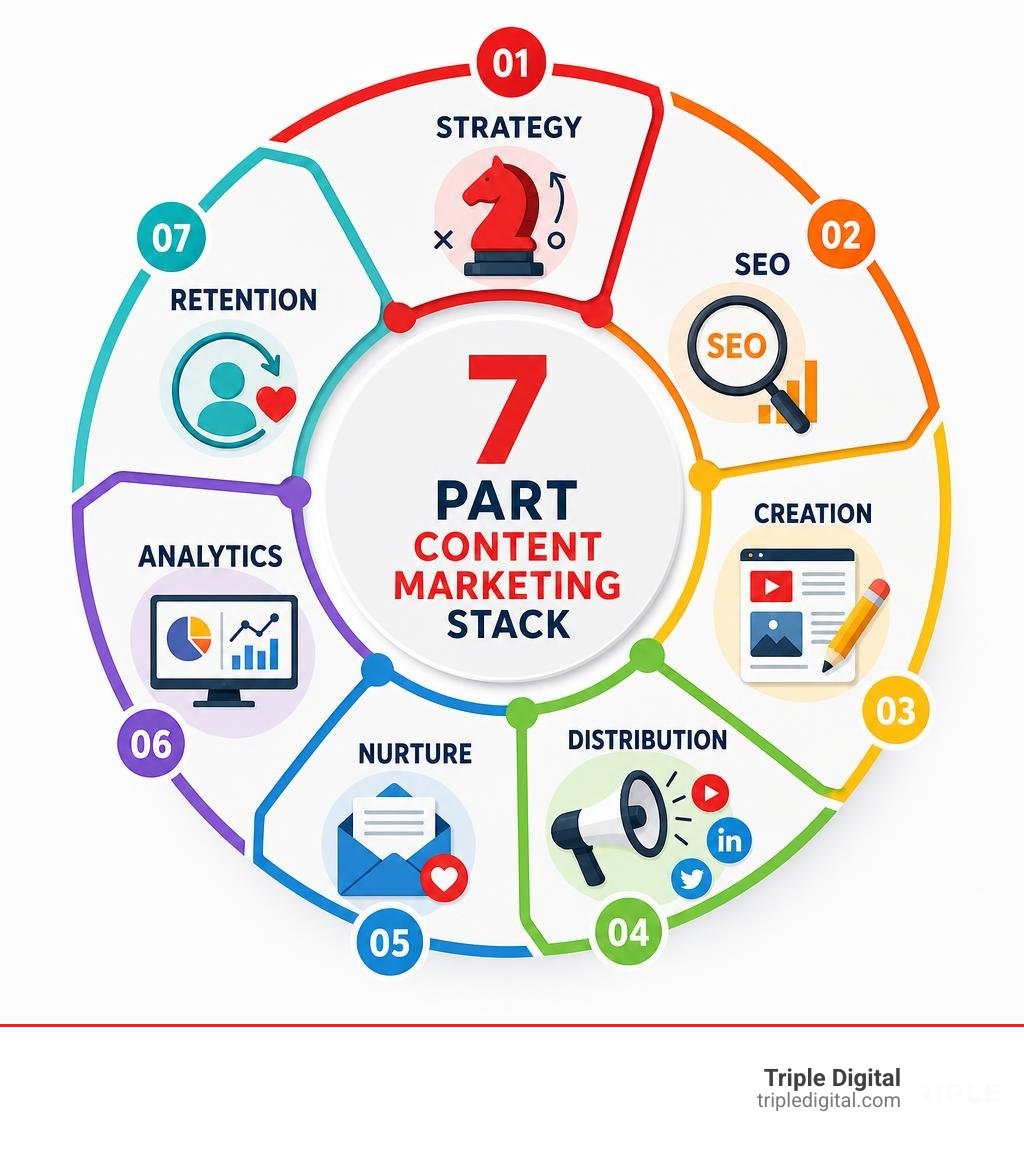
Here’s a quick breakdown of what content creation actually involves:
- Define your audience — Know exactly who you’re creating for and what problems they need solved.
- Pick your niche — Focus on a specific topic area where you have real knowledge and your audience has real demand.
- Choose your formats — Blog posts, videos, podcasts, and social content all serve different purposes.
- Build a strategy — Set your content pillars, publishing schedule, and goals before you create anything.
- Optimize for SEO — Make your content findable by using the right keywords and structure.
- Distribute and repurpose — Get your content in front of your audience across multiple channels.
- Measure and improve — Track what works and double down on it.
The global digital content creation market was valued at $32.28 billion in 2026 and is projected to hit $69.80 billion by 2030. That’s not a trend — that’s a fundamental shift in how businesses earn attention and generate revenue.
The problem? Most businesses jump straight into creating content without a plan. They publish a few blog posts, get no traction, and give up. The issue isn’t the content itself — it’s the missing strategy behind it.
This guide walks you through everything from finding your niche to building a repeatable workflow that actually drives results.
What is Content Creation and Why Does Your Business Need It?
At its core, content creation is the process of researching, generating strategic ideas, turning those ideas into valuable visual, written, or audio assets, and distributing them to a target audience.
Many people look at the modern internet and assume it is run purely by social media influencers. But the truth is, the modern internet consists almost entirely of content creators. Every time a business publishes a blog post to answer a client’s question, records a quick video demonstrating their services, or sends out an educational newsletter, they are engaging in content creation.

Why is this so critical for your business? Because content is the single pillar on which any modern marketing strategy rests. Paid advertising rents attention; strategic content earns it.
When you build a robust library of high-quality content, you are actively pulling prospects down your marketing funnel:
- Awareness: A prospective client experiences a problem and searches for a solution online. They find your educational blog post or video.
- Consideration: They realize you understand their pain points deeply. They read your case studies, comparison guides, and specialized resources.
- Decision: Having established immense trust and industry authority without a single pushy sales pitch, they choose to hire you.
- Loyalty & Retention: Even after the initial transaction, your ongoing content keeps them engaged, turning them into lifelong brand advocates.
This compounding value is exactly Why Do Law Firms Need A Content Marketing Strategy and why professional service providers across the country are shifting their budgets away from traditional, outdated marketing tactics. High-quality content works 24/7 to build trust, establish your authority, and generate highly qualified leads without requiring a continuous ad spend.
Finding Your Niche and Defining Your Target Audience
The most common advice given to beginners is to “just follow your passion.” Frankly, this is terrible business advice. A sustainable, profitable niche does not exist solely because you enjoy a topic. Instead, your niche must sit at the exact intersection of three key elements:
- Your Knowledge: What do you have actual, verifiable expertise in?
- Audience Interest: Are people actively searching for answers in this space?
- Monetization Potential: Can this audience actually afford to pay for your products or services?
To find your sweet spot, we recommend using a simple Niche Scorecard. Rate your potential topics from 1 to 10 on Passion, Knowledge, Search Volume, and Commercial Intent. If a topic scores highly across all four, you have found a viable niche.
Once you have identified your niche, you must define your target audience by building detailed buyer personas. Do not settle for generic demographics like “adults aged 30 to 50.” Go deeper. Ask yourself:
- What is their specific job title and industry?
- What is their single biggest professional or personal struggle today?
- What are their day-to-day tasks, and where do they experience friction?
- What do they need to know, feel, or believe before they are ready to buy from you?
For example, if you are a legal professional, your target client isn’t just “someone who needs a lawyer.” It might be a business owner who is overwhelmed by regulatory changes and terrified of compliance issues. When you Write Your Way To Clients Effective Legal Content Strategies must speak directly to that specific anxiety, offering clear, actionable solutions rather than dry legal jargon.
The Essential Steps to Build a Content Creation 101 Strategy
Throwing content at the wall to see what sticks is a recipe for creative burnout. To build a sustainable digital presence, you need a documented, structured strategy.
We recommend starting with a realistic 90-day beginner plan broken down into manageable phases:
- Weeks 1–2 (Strategy & Setup): Define your core audience hypothesis, set up your hosting platforms, and establish your analytical tools (like Google Analytics and Google Search Console).
- Weeks 3–4 (Research & First Content): Conduct keyword research to validate your first 10 topics and draft your first 3 foundational pieces of long-form content.
- Weeks 5–8 (Rhythm): Establish a sustainable publishing cadence and focus on building consistency.
- Weeks 9–12 (Optimize & Scale): Analyze your early performance data, refine your approach, and begin repurposing your best assets.
During the strategy phase, you must define your content pillars. These are 3 to 4 broad, high-level topics that your brand will become known for. For instance, a boutique law firm might have pillars like “Contract Pitfalls,” “Intellectual Property Protection,” and “Growth Strategies for Startups.” Every piece of content you produce should map directly back to one of these pillars.

Additionally, you must balance your distribution between owned channels and rented channels.
- Owned Channels (Your Website, Email List): You have complete control over these platforms. No algorithm change can take away your email subscribers or delete your website. These channels offer long-term compounding returns.
- Rented Channels (LinkedIn, YouTube, Instagram): These platforms offer massive organic reach and are fantastic for discovering new audiences, but you must play by their rules and adapt to their constantly shifting algorithms.
A smart strategy uses rented channels to drive traffic directly back to your owned channels. To make this process seamless, we highly recommend utilizing The Ultimate Guide To Blog Writing For Law Firms to structure your written assets for maximum audience retention.
Choosing the Right Content Formats for Your Platform
As you launch your strategy, you must decide which formats best suit your strengths and your audience’s preferences.
- Written Content (Blogs, Newsletters): This is often the easiest and most powerful starting point. Written content clarifies your thinking, serves as the ultimate foundation for search engine optimization (SEO), and can be easily broken down into scripts, social posts, or email campaigns. If you want to build a library of evergreen assets, writing is your best friend. Explore our blog for deep dives into how written media drives business growth.
- Video Production (Long-Form & Short-Form): Video is incredibly engaging. In the United States, 85% of internet users watch video content every month, and YouTube alone commands an estimated 211 million American viewers. Short-form vertical videos (TikTok, Reels, Shorts) are currently the fastest way to build organic reach, while long-form videos build deep trust.
- Audio Content (Podcasts): Podcasts are highly intimate and perfect for building a loyal community of listeners who will spend 30 to 60 minutes with your brand while commuting or exercising.
- Interactive Content (Quizzes, Calculators): These assets boast incredibly high conversion rates because they provide personalized, immediate value to the user.
Optimizing Your Content for SEO and Search Visibility
You can write the most brilliant article in the world, but if search engines can’t find it, it won’t generate leads. Search Engine Optimization (SEO) is the art and science of aligning your content with what search engines want to show their users.
First, you must understand search intent. When a user types a query into Google, what are they actually trying to achieve?
- Informational Intent: They want to learn something (e.g., “how to file a trademark”).
- Navigational Intent: They want to find a specific website.
- Commercial Intent: They are researching options before buying (e.g., “best corporate attorneys in Houston”).
- Transactional Intent: They are ready to buy or hire right now.
To rank highly, analyze the search results page for your target terms in an incognito window. See what formats Google is already prioritizing (blogs, videos, or product pages) and make sure your content matches that intent.
Next, focus on long-tail keywords. These are highly specific, multi-word search phrases that have lower search volumes but incredibly high purchase intent (e.g., “how to protect intellectual property as a Texas startup” instead of just “intellectual property”). If your website is relatively new, targeting keywords with lower difficulty scores is the fastest way to secure organic traffic.
Once you have your keywords, integrate them naturally. Avoid keyword stuffing at all costs. Instead, place your target terms in your page title, headings (H2s and H3s), introduction, and meta description. Ensure your site is fast, responsive, and completely optimized for mobile devices, as user experience is a major search engine ranking factor. For advanced strategies on building topical authority, refer to our guide on Advanced Seo Authoritative Content.
Leveraging AI Tools Safely in Content Creation 101
By now, you’ve certainly heard about the power of artificial intelligence in marketing. In 2026, AI tools have completely raised the floor for basic content production. However, they have also flooded the internet with generic, low-quality text. Because of this, unedited, pure AI-generated content has zero business value. Google actively devalues repetitive, low-effort AI writing, treating it as spam.
To stand out, you must use AI as a collaborative assistant rather than a replacement for human expertise. Here is how to use AI tools safely:
- Outline and Ideate: Use AI to brainstorm titles, structure complex outlines, and overcome writer’s block.
- Master Prompt Engineering: Write highly specific prompts. Give the AI a clear role (e.g., “Act as an expert B2B editor”), define the exact target audience, and outline the precise format you need.
- Maintain Strict Confidentiality: Never input sensitive client details, proprietary business data, or confidential information into public AI models.
- Inject Human Originality: Always edit, fact-check, and rewrite AI drafts. Add your unique perspective, real-world case studies, and brand voice.
As search engines evolve into AI-driven conversational platforms, optimizing for Search Generative Experience (SGE) and Generative Engine Optimization (GEO) requires deep, authentic, human-vetted information. To learn how to strike the perfect balance, read about The Key To Ai Written Content.
Building a Repeatable Workflow and Repurposing Your Assets
The secret to long-term content success isn’t raw creative motivation; it is a structured, repeatable system. If you try to write, edit, design, and publish a piece of content all in one sitting, your brain will quickly leave the group chat.
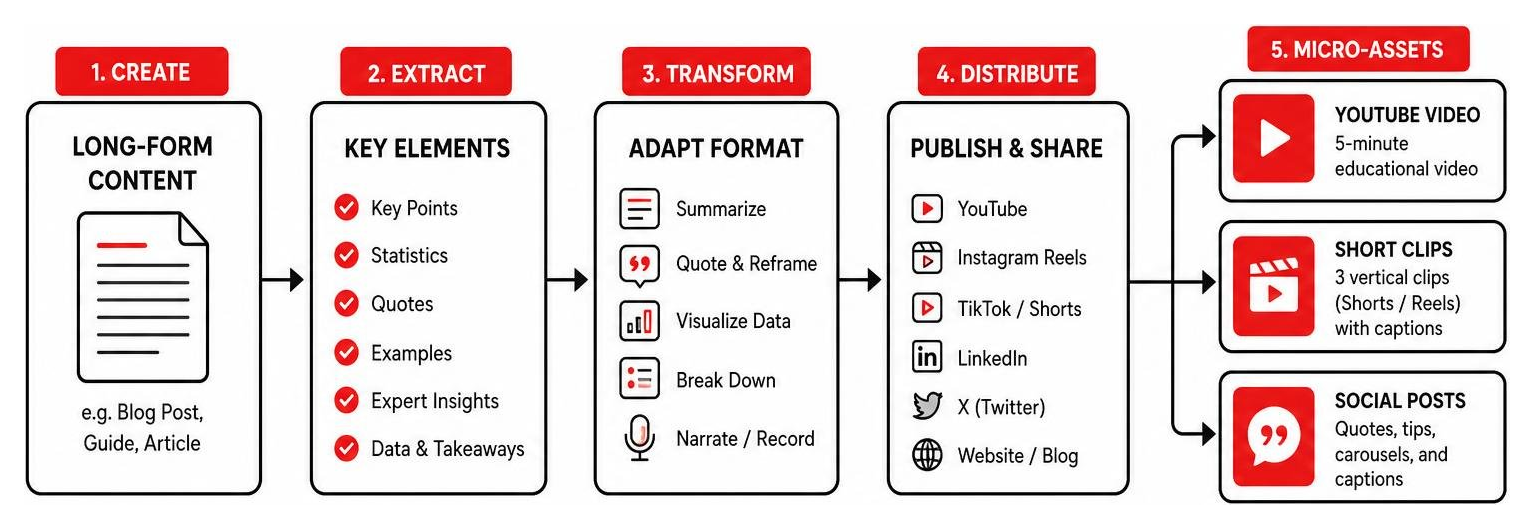
Instead, break your content creation process down into bite-sized, specialized tasks:
To scale your production without losing your mind, establish Standard Operating Procedures (SOPs) for every step of your workflow. This allows you to delegate tasks easily, whether you are hiring in-house coordinators or outsourcing to specialists.
One of the smartest ways to maximize your return on investment is through smart repurposing. Never publish a high-performing asset just once. Instead, turn a single comprehensive blog post into:
- A 5-minute educational YouTube video.
- Three vertical clips (Shorts or Reels) with on-screen captions for social media.
- An engaging email newsletter sent directly to your subscribers.
- Multiple text-based social media posts highlighting key quotes.
This multi-channel approach ensures your message reaches different segments of your audience on their preferred platforms. For a deep dive into setting up these systems for professional services, check out our resource on Content Creation For Attorneys.
Measuring Success and Turning Content into a Sustainable Business
To know if your content is actually working, you must ignore vanity metrics (like raw views or superficial “likes”) and focus on data that directly impacts your bottom line.
| Metric Type | What It Tracks | Why It Matters |
|---|---|---|
| Vanity Metrics | Raw Views, Likes, Social Follows | Great for ego, but do not guarantee revenue or business growth. |
| Engagement Metrics | Audience Retention, Saves, Shares, Comments | Signals that your content is genuinely useful and resonates emotionally. |
| Business KPIs | Email Subscribers, Click-Through Rate (CTR), Leads, Attributed Revenue | Directly measures how effectively your content converts readers into paying clients. |
If you want to turn your content into a sustainable business or a powerful revenue driver, you must establish clear monetization pathways:
- Direct Lead Generation: Using educational content to attract high-value clients to your service-based business.
- Affiliate Marketing: Recommending tools or resources you trust and earning a commission on sales.
- Sponsorships & Brand Deals: Partnering with brands that want to reach your highly targeted audience.
- Passive Income Products: Packaging your unique expertise into digital courses, templates, or premium newsletters.
Frequently Asked Questions
What are the most common mistakes beginners should avoid in content creation 101?
The single biggest mistake is publishing without a strategy. Beginners often post random topics on random schedules, which confuses both search engines and audiences. Another common pitfall is tool obsession — spending thousands of dollars on high-end cameras, microphones, and complex software before validating their content ideas. Finally, many beginners give up too early. Content marketing is a compounding asset; expecting viral success in your first 30 days is unrealistic. Focus on value over raw frequency, and prioritize quality over rushed consistency.
How long does it take to see results from content creation?
Typically, you will see early signals (like positive comments, saves, and minor traffic bumps) within the first 3 months. Meaningful organic search visibility, compounding traffic, and consistent inbound lead generation generally take 6 to 12 months of structured publishing. Think of content marketing like an investment portfolio — it starts slow, but the compounding returns over time far outperform short-term paid campaigns.
Do I need expensive gear to start creating content?
Absolutely not. The smartphone in your pocket is more than powerful enough to record high-definition video and capture clear audio. Many of the most successful digital publishers in 2026 started with nothing more than a phone, natural window light, and a budget-friendly lavalier microphone. Your audience cares infinitely more about the value and clarity of your information than high-budget production aesthetics.
Dominate Your Market With High-Performance Content Strategy
Building a successful digital presence requires a rare blend of creative storytelling, technical search engine optimization, and robust data analytics. At Triple Digital, we help businesses cut through the digital noise. As a premier Houston-based digital marketing agency specializing in lead generation and client acquisition, we reject fluff in favor of measurable cases.
We leverage cutting-edge AI workflows, deep search engine intelligence, and precise data mining to put your brand directly in front of the people who need your services most.
Ready to turn your website into a client-generating engine? Check out our GMB profile to learn more about Triple Digital, or schedule a meeting with our team today to build a custom content strategy designed to scale your business.