





Lawyer Up Your Online Presence: A Digital Marketing Playbook
Why Most Law Firms Are Invisible Online (And How to Fix It)
Digital marketing for law firms is no longer optional — it’s how clients find you, evaluate you, and decide whether to call.
Here’s a quick breakdown of what effective legal digital marketing looks like in 2026:
The Core Digital Marketing Channels for Law Firms:
- SEO — Rank in Google search and the local map pack for high-intent queries like “personal injury lawyer near me”
- PPC & Local Services Ads — Generate immediate leads while organic rankings build
- Content Marketing — Build trust and topical authority through practice area guides and FAQs
- Reputation Management — Collect and manage reviews that convert prospects into consultations
- AI Search Optimization — Get cited by ChatGPT, Perplexity, and Google AI Overviews
- Social Media & Video — Educate your audience and stay top of mind
- Website Conversion — Turn traffic into signed cases through fast, mobile-friendly design and clear calls to action
There are over 1.3 million licensed attorneys in the United States. Tens of thousands of law firms compete for the same clients in the same cities. And 96% of people searching for legal help start that search online.
The old playbook — referrals, Yellow Pages, a basic website — simply doesn’t cut it anymore.
Even clients who were referred to your firm will Google you before they ever pick up the phone.
Legal marketing is also uniquely complex. Your content is held to higher standards by Google (more on that shortly). State bar ethics rules restrict what you can say in ads. And the stakes for your potential clients are high — they’re dealing with accidents, divorces, criminal charges, or business disputes. They’re not impulse buyers.
That means trust isn’t just a nice-to-have. It’s the conversion mechanism.
This playbook walks you through every layer of a modern legal marketing strategy — from SEO and paid ads to AI search optimization and review management — so your firm shows up where clients are looking and converts that attention into real cases.
Key terms for digital marketing for law:
- legal marketing analytics
- legal content marketing
- ethical legal advertising
Why Digital Marketing for Law is Unique
Marketing a law firm isn’t like marketing a local bakery or an e-commerce store. In general retail, a silly meme or a flashy discount code can drive impulse purchases. In the legal world, you are dealing with high-stakes, life-altering decisions.
Google categorizes legal websites under its strict YMYL (Your Money or Your Life) guidelines. This means search engine algorithms hold legal content to a much higher standard of accuracy, truthfulness, and authority. If your website offers inaccurate legal information, search engines will actively suppress your visibility to protect users.
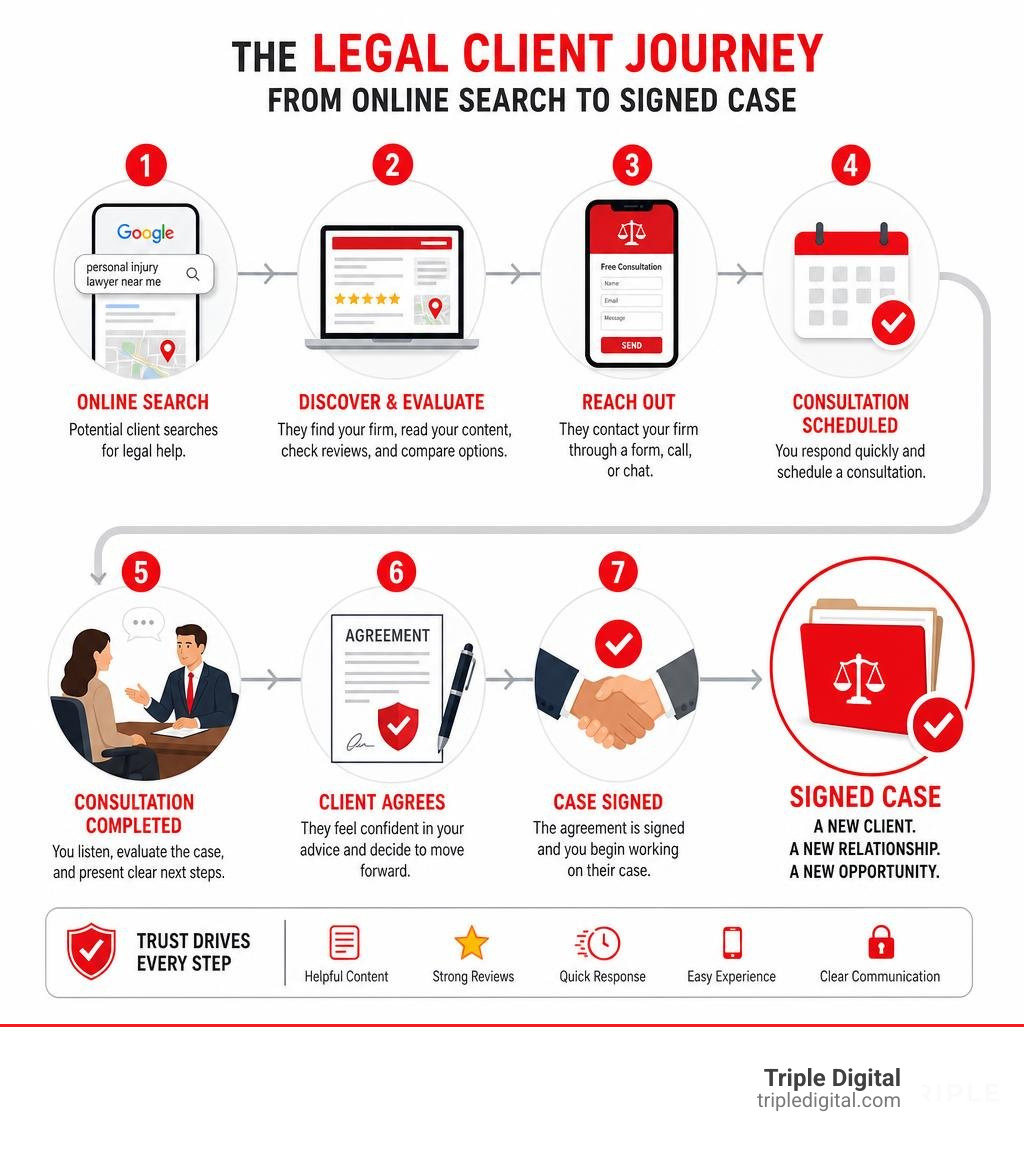
Furthermore, the legal client journey features a much longer sales cycle. A business owner looking for a corporate litigation team or a family dealing with an estate dispute will research multiple firms, read dozens of reviews, and verify credentials before booking a consultation. This makes trust signals—such as transparent case results, detailed attorney bios, and clear explanations of the legal process—critical to your success.
Additionally, client confidentiality must be maintained at all costs. You cannot simply share the details of a major win on social media without explicit consent and careful editing to protect client identities. This high-stakes environment requires a strategic, deliberate approach to digital marketing that prioritizes professional authority over cheap clicks.
Ethical Guardrails in Digital Marketing for Law
Before you write a single line of ad copy or publish a blog post, you must understand the strict ethical boundaries established by state bar associations. In the United States, and specifically under Texas disciplinary rules, attorney advertising is heavily regulated to protect the public from misleading claims.
- No Guarantees of Outcomes: You cannot state or imply that you will win a case. Phrases like “We always win” or “Guaranteed settlement” are major ethical violations.
- Testimonials and Past Results: While sharing client reviews is highly effective, many state bars require explicit disclaimers. You must clearly state that past results do not guarantee a similar outcome in future cases.
- Misleading Specialized Claims: In many jurisdictions, you cannot refer to yourself as a “specialist” or “expert” unless you hold a formal board certification in that specific practice area.
- Confidentiality and General Advice: Any educational content you publish must contain a clear disclaimer: This information is for educational purposes only and does not constitute formal legal advice or establish an attorney-client relationship.
Violating these rules doesn’t just get your ads taken down; it can lead to formal bar investigations and disciplinary action. That is why every campaign we design balances high-performance lead generation with absolute ethical compliance.
The Core Channels of a Modern Legal Marketing Mix
Relying on a single marketing channel is a recipe for volatile lead volume. If you rely solely on paid search, your lead flow stops the moment you pause your budget. If you rely solely on organic SEO, you might wait months for a new practice area page to gain traction.
A modern marketing strategy for law firms requires a hybrid, multi-touch model. Potential clients often need to see your firm across multiple touchpoints before they take action. They might discover your blog through an organic search, see a retargeting ad on social media, see your Google Business Profile in the local map pack, and finally read a review before calling.
In 2026, over 54% of total marketing budgets are allocated to digital channels. To help you visualize how to balance your budget, let’s compare the economics of organic SEO and paid search:
| Marketing Metric | Organic SEO | Paid Search (PPC & LSAs) |
|---|---|---|
| Primary Goal | Long-term authority & consistent organic leads | Immediate visibility & high-intent case acquisition |
| Cost Structure | Upfront content & technical investment | Pay-per-click or pay-per-lead |
| Time to Results | 4 to 12 months | 7 to 10 days |
| Sustainability | High (leads continue even if spending slows) | Low (visibility stops when budget runs out) |
| Typical Conversion Rate | Highly dependent on website UX & trust signals | ~7% higher conversion rate than other industries |
High-Intent Search Engine Optimization
Organic search engine optimization remains the absolute foundation of long-term firm growth. When a user searches for a specific legal issue, they are actively looking for a solution. Unlike social media users, search engine users have high intent.
To win at legal SEO, your website must build deep topical authority. This means structuring your site around highly detailed practice area pages rather than broad, generic service descriptions. If you practice family law, you shouldn’t just have a single “Family Law” page. You need dedicated pages for “High-Asset Divorce,” “Child Custody Modifications,” and “Mediation Services.”
This structure signals to search engines that you possess deep, specialized knowledge. Furthermore, local SEO is critical. The Google Local Map Pack appears above organic listings for 93% of searches with local intent. Optimizing your Google Business Profile, securing consistent local citations, and building location-specific landing pages are non-negotiable steps to winning local cases.
To dive deeper into structuring your campaign, budgeting, and understanding the value of search, explore our guides on:
- Why SEO is Important for Attorneys
- Mastering Law Firm SEO: Your Blueprint for Online Success
- How Much Should Lawyers Pay for SEO?
Paid Advertising and Local Services Ads
While SEO builds your long-term digital asset, paid advertising fills the immediate gap. The two most powerful paid channels for lawyers are Google Search Ads (PPC) and Google Local Services Ads (LSAs).
Google Ads allow you to bid on high-intent keywords so your firm appears at the very top of search results. However, legal keywords are some of the most expensive in the world. For highly competitive niches like personal injury or mass torts, a single click can cost hundreds of dollars.
To avoid burning through your budget on unqualified clicks, you must implement a massive, legal-specific negative keyword library. This ensures your ads do not trigger for searches like “free legal aid,” “how to become a lawyer,” or “law school rankings.”
Google Local Services Ads (LSAs) operate on a pay-per-lead model rather than pay-per-click. These ads appear at the absolute top of the search page, featuring a “Google Screened” badge, your star rating, and your phone number. Because you only pay for actual phone calls or messages from qualified prospects, LSAs often deliver a highly competitive cost-per-lead.
For a comprehensive breakdown of how to build, optimize, and scale profitable paid campaigns, read The Definitive Guide to Paid Advertising for Lawyers.
Social Media and Video Marketing for Attorneys
Social media is no longer just for lifestyle brands. For lawyers, platforms like LinkedIn, Facebook, and Instagram are powerful tools for building brand awareness, showcasing firm culture, and nurturing professional referral networks.
Video content is the single most engaging medium available today. In fact, video content consumption is expected to grow significantly, with over 91% of businesses actively utilizing video as a primary marketing tool. For law firms, video allows you to humanize your attorneys and explain complex legal concepts in simple, accessible terms.
Consider creating short-form educational videos answering common questions, such as “What should you do immediately after a car accident to protect your rights?” or “How do you protect your business assets during a partnership split?” These videos build immediate familiarity and trust, making prospects feel like they already know you before they ever walk into your office.
To master these platforms while maintaining your professional credibility, check out:
Optimizing for the AI Search Era
The search landscape is undergoing a massive shift. Potential clients are no longer just browsing the traditional “10 blue links” on Google. Instead, they are increasingly using conversational AI search tools to research legal options and find local representation.
This shift requires a new approach: Generative Engine Optimization (GEO). GEO is the practice of optimizing your firm’s digital footprint so that AI models recognize your practice as a leading authority and recommend your attorneys in conversational search results.
To be recommended by AI, your digital footprint must be highly consistent. AI models analyze patterns across the web, including legal directories, social media profiles, local citations, and review platforms. If your practice areas, office address, or attorney names are inconsistent across these platforms, AI models will lack the confidence to recommend your firm.
The Future of Digital Marketing for Law: Generative AI Search
AI platforms like ChatGPT, Perplexity, Gemini, and Google’s AI Overviews act as digital gatekeepers. When a user asks, “Who is a highly rated estate planning attorney in Houston specializing in high-net-worth trusts?” the AI does not just return a list of websites. It synthesizes a direct recommendation, citing specific firms and explaining why they are qualified.
To earn these coveted citations, your website content must move away from generic, surface-level summaries. You must publish deep, comprehensive answers to complex legal questions. AI tools look for structural signals, unique data, and clear expert perspectives to cite in their answers.
Structuring your content with clear schema markup—specifically defining your business entity, local office addresses, and the specific legal services you offer—helps AI engines easily read and verify your firm’s credentials.
Learn more about adapting your strategy to this new era by reading:
Balancing SEO, PPC, and LLM Optimization
Success in 2026 requires a balanced approach. You cannot abandon traditional SEO and PPC in favor of AI optimization, nor can you ignore the rapid rise of conversational search. Instead, you must integrate these strategies into a single, cohesive system.
Traditional SEO fuels your AI visibility; the deep content you write to rank on Google is the exact training data and retrieval source that LLMs use to generate their conversational answers. Meanwhile, PPC campaigns capture immediate, urgent search intent while your organic and AI optimization strategies mature.
When creating content to support this hybrid model, authenticity is key. While AI can draft basic educational definitions, it cannot replicate real human legal expertise, unique case studies, or the nuances of local courtroom procedures. To understand how to balance modern technology with authentic legal authority, read The Key to AI Written Content.
Reputation Management and Website Conversion Tactics

Driving traffic to your website is only half the battle. If your site is slow, confusing, or lacks trust signals, those visitors will leave and call your competitors. In the legal industry, your website must function as a high-performance conversion tool.
This starts with reputation management. An incredible 97% of consumers read online reviews before choosing a local business. For law firms, your review profile is your digital handshake. Prospects are looking for both volume and sentiment; they want to see that you have helped dozens of people in situations just like theirs, and that your team was responsive, compassionate, and professional.
Building Trust Through Online Reviews
Your Google Business Profile is the single most important asset for local conversion. To build a powerful review profile, you must establish a consistent, systematic process for requesting reviews:
- Ask at the Right Time: The best time to ask for a review is immediately after a successful outcome—whether that is a signed settlement, a dismissed charge, or a finalized contract. This is when client satisfaction is at its absolute peak.
- Make it Simple: Send a direct, personalized SMS or email link that takes the client straight to your Google review page.
- Respond Professionally to All Reviews: Always reply to reviews. When responding to positive feedback, thank the client for their trust. When responding to negative reviews, maintain absolute professionalism. Never get defensive, and never reveal confidential case details. A calm, professional response to a bad review can actually build more trust with prospective clients than a perfect 5.0 rating.
Turning Website Clicks into Signed Cases
Once a user lands on your website, you have mere seconds to capture their attention and guide them toward taking action. A conversion-focused legal website must feature clean, intuitive design, lightning-fast mobile performance, and prominent, accessible calls to action.
To ensure your website is built to convert clicks into signed contracts, use this checklist of essential elements:
- Prominent, Clear CTAs: Place a clickable phone number and a simple contact form above the fold on every single page.
- Mobile-First Design: Over 60% of legal searches occur on mobile devices. Your site must load instantly and be incredibly easy to navigate on a smartphone screen.
- Trust Signals and Social Proof: Proudly display your overall star rating, client testimonials, and professional affiliations (such as state bar memberships or local legal association badges) on your homepage.
- Dynamic Call Tracking: Implement keyword-level call tracking to identify exactly which organic search queries or paid ads are generating phone calls, allowing you to optimize your budget for real leads.
- Streamlined Intake Process: Make it as easy as possible for a prospect to book an initial consultation, whether through a simple scheduler, a live chat feature, or a direct click-to-call button.
Measuring ROI and Data-Driven Success
The biggest mistake a law firm can make is treating marketing as an unmeasurable expense. To scale predictably, you must treat your marketing as an investment and track your return on investment (ROI) with absolute precision.
This requires overcoming the “attribution challenge.” In 2026, the legal client journey is rarely linear. A client might see your social media post, search for your firm name on Google, read a review, and then call your office. If you only track the final click, you might undervalue the channels that introduced the client to your firm in the first place.
By implementing advanced call tracking, CRM integrations, and self-reported attribution (such as asking every new lead, “How did you first hear about us?” on your intake form), you can shine a light on the “dark funnel” and understand exactly where your best cases are coming from.
To learn how to turn raw analytics into actionable growth strategies, explore our guide on Data-Driven Legal Marketing.
Key Metrics for Case Acquisition
Instead of focusing on vanity metrics like impressions, clicks, or general website traffic, your firm should track the key performance indicators (KPIs) that directly impact your bottom line.
Keep a close eye on these critical legal marketing metrics:
- Cost Per Lead (CPL): The total marketing spend on a specific channel divided by the number of qualified leads generated.
- Cost Per Signed Case (CPA): The ultimate metric of success. How much does it actually cost your firm to sign a new, paying client?
- Lead-to-Sign Conversion Rate: The percentage of incoming leads that turn into retained clients, helping you evaluate the performance of your intake team.
- Qualified Phone Calls: The number of unique, high-intent phone calls from prospects seeking representation within your practice areas.
- Consultation Bookings: How many prospects successfully take the next step to schedule a formal case evaluation with an attorney?
Frequently Asked Questions About Legal Marketing
What is the most effective digital marketing channel for law firms?
There is no single “best” channel; the most effective strategy is an integrated, hybrid approach. For immediate, high-intent lead generation, paid search (Google Ads and LSAs) is unmatched. For long-term, sustainable growth and lower cost-per-case, organic SEO and content marketing are the most powerful drivers. Combining these channels ensures you capture immediate demand while building a lasting digital asset.
How much do law firms typically spend on digital marketing?
Marketing budgets vary widely based on your practice area, geographic location, and growth goals. A solo practitioner in a smaller market might spend $1,000 to $3,000 per month, while a large personal injury firm in a highly competitive metro area like Houston can easily invest tens of thousands of dollars monthly. As a general rule, a revenue-to-cost ratio of 5:1 is considered acceptable for legal marketing spend.
How long does it take to see results from legal SEO?
Legal SEO is a long-term strategy that compounding over time. While technical fixes and local Google Business Profile optimization can yield improvements in lead quality within the first 1 to 3 months, it typically takes 6 to 12 months of consistent content creation, link building, and authority development to secure stable, highly competitive organic rankings for major practice area terms.
Scale Your Practice with Triple Digital
If you are ready to stop chasing vanity metrics and start signing high-value cases, we are here to help.
Triple Digital is a premier Houston-based digital marketing agency specializing in lead generation and case acquisition for law firms. We reject the generic, fluff-heavy strategies of generalist agencies. Instead, we deliver a highly precise, results-driven, “less fluff, more cases” approach.
By leveraging cutting-edge artificial intelligence and advanced data mining, we pinpoint and target high-intent prospects actively seeking legal representation in your specific practice areas. We don’t just deliver clicks; we build integrated marketing systems designed to scale your practice predictably.
Are you ready to transform your online presence and sign more cases? Schedule a consultation with our team of legal marketing experts today.