





Beginner’s Guide to AI Overview for Attorneys
How AI Overview Is Changing the Way Clients Find Attorneys in 2026
AI overview for attorneys is reshaping how potential clients discover legal help — and how much traffic law firm websites actually receive.
Here’s a quick summary of what you need to know:
- What it is: Google’s AI Overview is an AI-generated summary that appears at the very top of search results, above all paid ads and organic rankings, powered by Google Gemini.
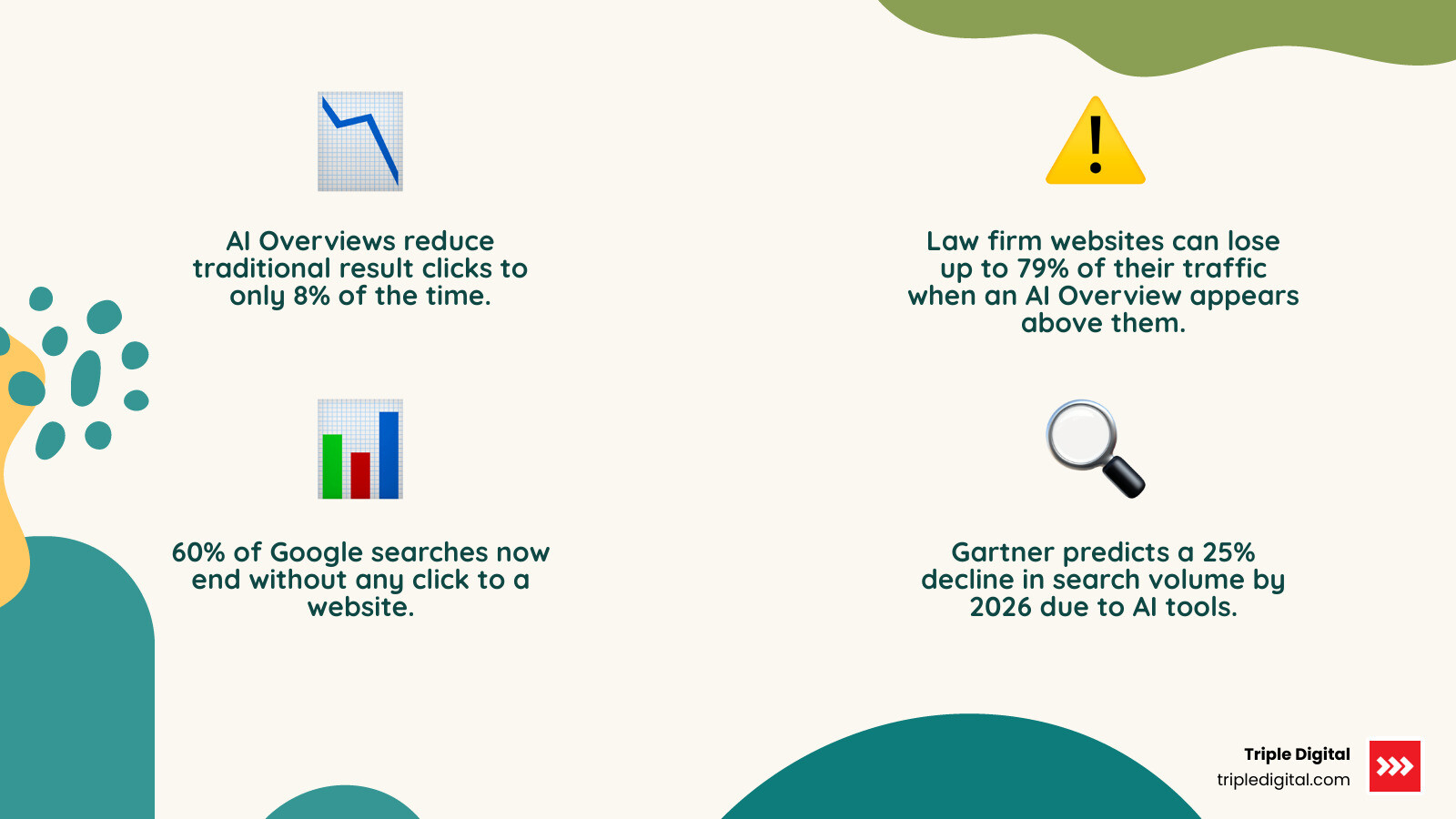
- Why it matters: When an AI Overview appears, users click traditional results only 8% of the time — compared to 15% when no summary is shown.
- The traffic risk: A law firm website previously ranked #1 can lose up to 79% of its traffic if results appear below an AI Overview.
- The opportunity: Firms whose content gets cited inside the AI Overview capture client attention before any competitor link is even seen.
- What drives citations: Structured content, clear answers to client questions, E-E-A-T signals, and third-party credibility markers like peer-reviewed recognition.
- The ethical layer: Attorneys also need to understand how AI tools interact with professional responsibility rules — including confidentiality, competence, and supervision duties.
Think about how most people search for a lawyer today. They type a question like “Do I need an attorney for a first DUI in Texas?” — and Google now answers that question directly, without requiring a click.
About 60% of all Google searches already end without a single click to any website. And according to Gartner, overall search engine volume could decline by as much as 25% by 2026 as AI chatbots and virtual agents take over more of that discovery process.
For law firms still relying on traditional SEO rankings alone, that’s a serious problem. But it’s also a solvable one.
This guide breaks down exactly how AI Overview works for attorneys, what it means for your firm’s visibility, and what steps you can take to stay discoverable — and competitive — in an AI-first search environment.
What is Google’s AI Overview for Attorneys?
Google’s AI Overview is a feature within Google Search that uses generative AI to provide a synthesized, multi-source answer to a user’s query. Formerly known during its testing phase as the Search Generative Experience (SGE), it was rebranded and fully integrated into the search results page in May 2024. By May 2026, it has become the primary way Google handles complex, informational queries.
When a potential client searches for legal information, Google Gemini (the underlying AI model) scans the web to create a cohesive summary. Unlike a traditional “featured snippet” that pulls from a single site, the ai overview for attorneys pulls from multiple authoritative sources simultaneously.
For attorneys, this is particularly significant because legal queries fall under Google’s “Your Money or Your Life” (YMYL) content category. Google applies a higher standard of accuracy to these results because incorrect legal information can lead to serious real-world consequences. To be featured in these summaries, your content must demonstrate high levels of E-E-A-T (Experience, Expertise, Authoritativeness, and Trustworthiness).
Crucially, these overviews include citation cards. If your firm is cited, your brand is presented as a verified authority. Achieving high Attorney Generative AI Rankings 2026 is no longer just about keywords; it is about “entity clarity”—ensuring Google’s AI understands exactly who you are, what you practice, and why you are a trusted source. You can dive deeper into the mechanics of these summaries on our page about AI Overviews.
Impact on Law Firm Visibility and Website Traffic
The numbers are startling. We are seeing a massive shift in how users interact with the search page. Historically, the top organic result captured the lion’s share of clicks. Today, if that result is pushed down by an AI-generated summary, the traffic drop-off is steep.
Research shows that a site previously ranked first could lose roughly 79% of its traffic if the results appear below an AI overview. This is largely because the AI provides the answer immediately. When an AI summary is present, users click on traditional organic results only 8% of the time. This contributes to the “zero-click” phenomenon, where 60% of searches end without the user ever leaving Google.
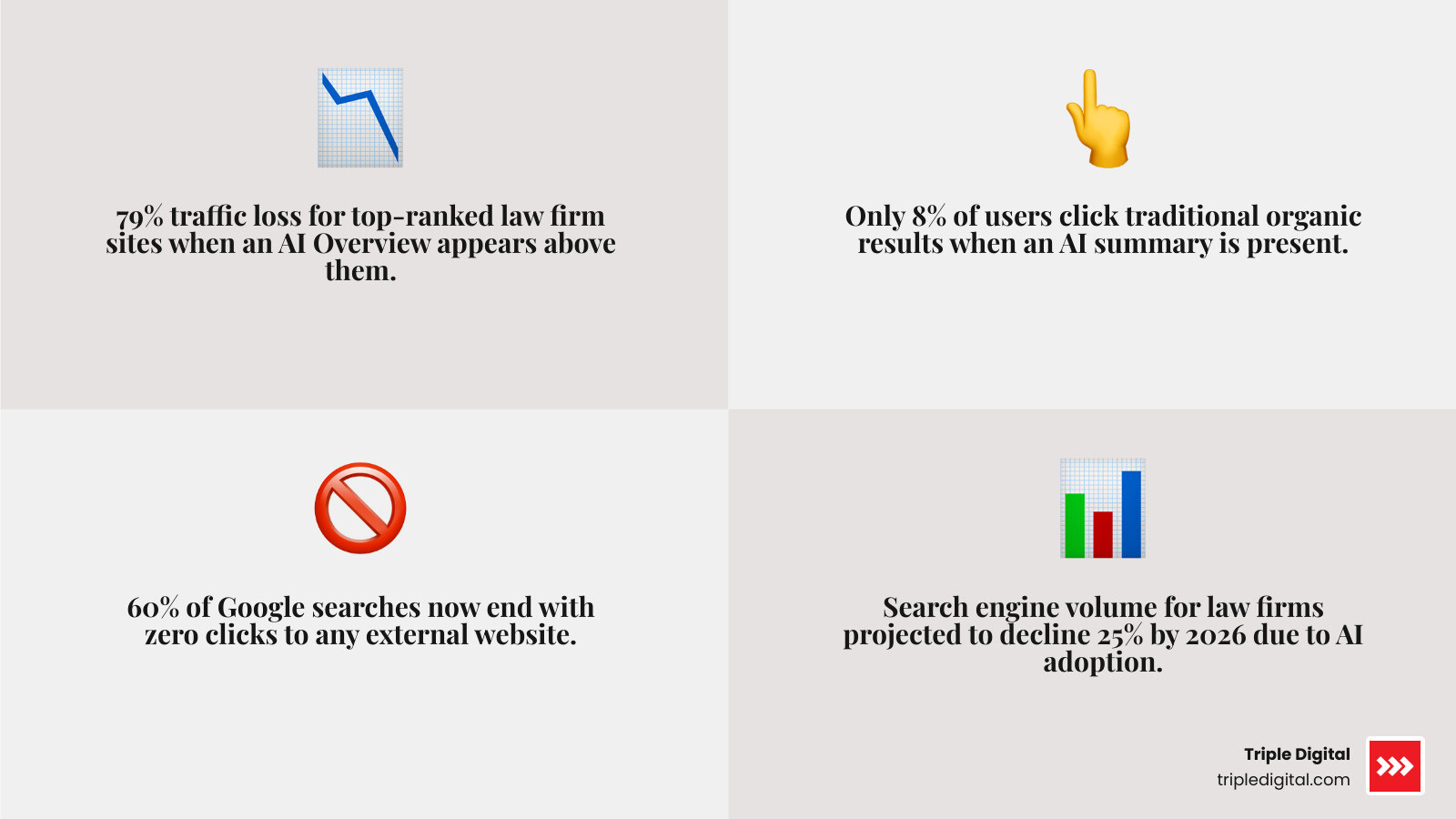
Gartner’s prediction that search engine volume could decline 25% by 2026 is becoming a reality. This doesn’t mean people aren’t looking for lawyers; it means they are finding them through “answer engines” rather than “search engines.” To stay relevant, you must understand AI Digital Marketing for Law Firms and learn to Future-Proof Your Firm: The AI Advantage in Legal Marketing.
How to Optimize Your Content for AI-Generated Summaries
Optimizing for ai overview for attorneys is not a total departure from traditional SEO, but it requires a more clinical, structured approach. The AI isn’t just looking for keywords; it is looking for the most direct, authoritative answer to a specific question.
To win these citations, you need to build “topical authority.” This means instead of writing one-off blog posts, you should create content clusters—a cornerstone page on a broad topic (like “Texas Personal Injury Law”) supported by dozens of detailed sub-pages answering specific questions (like “How long do I have to file a car accident claim in Houston?”).
Key technical levers include:
- FAQ Schema: This is one of the most powerful tools for AI visibility. It tells the AI exactly which question is being answered.
- Structured Data: Use schema markup for LegalService, Attorney, and LocalBusiness to give the AI clear data points about your firm.
- Third-Party Validation: The AI cross-references information. If you are listed in peer-reviewed rankings or prestigious directories, the AI is more likely to trust your site as a citation source.
For more specific tactics, check out our Top SEO Tips for Criminal Defense Lawyers in the AI Search Era and our broader Guide to Law Firm AI Strategies. We also recommend exploring various AI Tools for Law Firm Marketing to help automate these technical audits.
Structuring Content for AI Overview for Attorneys
The way you write matters just as much as what you write. Google’s AI favors content that is easy to parse. If you bury the answer to a question under three paragraphs of marketing fluff, the AI will ignore you.
We recommend the “Answer-First” model:
- Direct Answers: Place the core legal answer in the first one or two sentences of the section.
- Plain Language: Avoid heavy legalese. The AI is looking for content that is accessible to the average person.
- Jurisdiction-Specific Details: Since we are focusing on areas like Houston, TX, including local court procedures or specific state statutes helps the AI understand your local relevance.
- H2/H3 Organization: Use headers that are phrased as questions.
- Bulleted Lists: AI loves lists. They are easy to summarize.
At Triple Digital, we’ve seen how The Key to AI Written Content lies in this balance of human expertise and machine readability. In fact, Triple Digital LLC Unveils Groundbreaking AI Tool to Help Law Firms Outrank Competitors Online to help firms automate this specific type of content structuring.
Measuring Success in an AI Overview for Attorneys Environment
If website traffic is down but your firm is busier than ever, your metrics need to catch up. In an ai overview for attorneys world, “clicks” are no longer the only KPI that matters.
You should begin tracking:
- Branded Discovery: Are more people searching for your firm by name after seeing you cited in an AI summary?
- AI Referral Mentions: Using tools to see how often your firm is mentioned in LLM responses (like ChatGPT or Perplexity).
- Qualified Call Rate: Are the leads coming in more informed? (AI summaries often “pre-qualify” clients by answering their basic questions).
- Blended Attribution: Tracking how AI assists in the client journey, even if it doesn’t result in a direct click.
Advanced firms are even looking Beyond the Gavel: Using AI for Predictive Analytics in Legal Proceedings to measure how AI impacts their overall case success and ROI.
Ethical Obligations and Professional Responsibility
As we integrate these tools, we cannot ignore our professional duties. The ABA and state bars have been active in providing guidance. ABA Formal Opinion 512 (2024) is the foundational text here, reminding us that while we can use AI, we cannot delegate our professional judgment to it.

- Rule 1.1 (Competence): You must understand the tools you use. This includes knowing that AI can “hallucinate” (invent fake cases). As of 2026, over 200 cases of sanctions for AI-generated fake citations have been documented.
- Rule 5.3 (Supervision): AI is treated as “non-lawyer assistance.” You are responsible for every word it produces.
- Duty to Verify: You must personally verify every citation and factual claim before it goes to a client or a court.
Despite these risks, the rewards are significant. Law firms have seen a 344% ROI over three years from generative AI adoption when implemented correctly.
Maintaining Confidentiality in an AI Overview for Attorneys Context
Confidentiality is the cornerstone of the attorney-client relationship. When using ai overview for attorneys or internal AI tools, you must be hyper-vigilant about where your data goes.
Standard consumer AI tools (like the free version of ChatGPT) often use your inputs to train their models. This is a massive risk for client privilege. To maintain a secure workflow, firms should:
- Use Enterprise Versions: These typically have “opt-out” clauses for data training.
- Execute Data Processing Agreements (DPAs): Ensure your vendors are legally bound to protect your data.
- Anonymize Inputs: Never put real client names or sensitive case details into a prompt. Use placeholders like “Client A” or “Company X.”
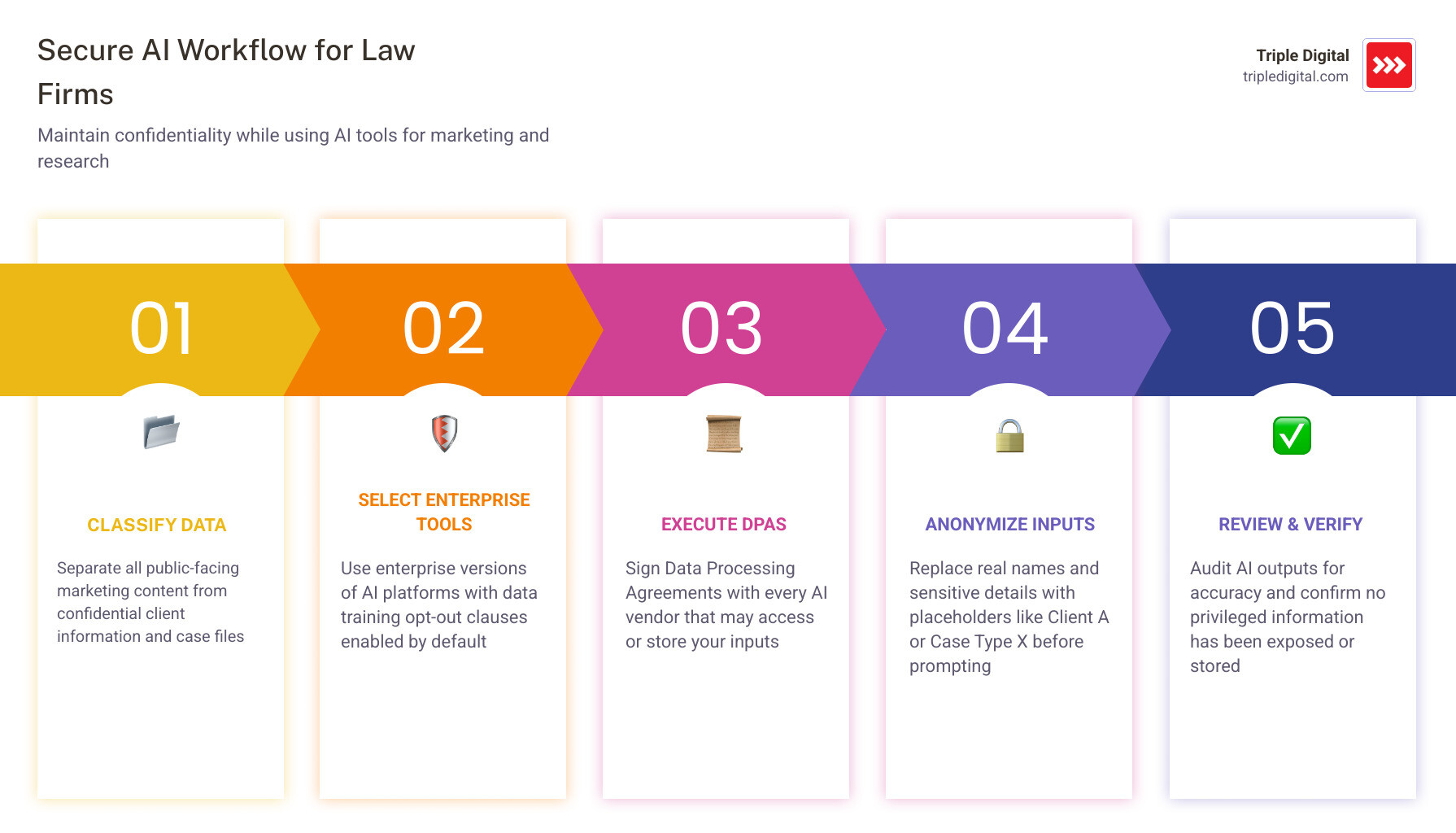
By separating your public-facing data (for marketing) from your internal-only data (for research), you can leverage AI without compromising your ethical standing.
Frequently Asked Questions about AI Search
Will AI Overviews replace traditional law firm SEO?
No, it is an evolution, not a replacement. While ai overview for attorneys handles informational queries, local SEO remains dominant for “near me” searches. Potential clients still look at the Map Pack and read reviews before making a final decision. We recommend a hybrid strategy: traditional SEO for local intent and Answer Engine Optimization (AEO) for informational intent.
How do I get my law firm cited in an AI summary?
Focus on topical depth. You need to be the definitive source for a specific topic in your jurisdiction. Use clear FAQ sections, earn authoritative backlinks from legal publications, and ensure your firm’s name, address, and practice areas are consistent across the entire web.
Is it ethical to use AI for legal research and drafting?
Yes, provided you maintain a “lawyer-in-the-loop.” You can use AI to create a first draft or summarize a deposition, but a human attorney must review, edit, and take final responsibility for the work product. Following ABA Formal Opinion 512 and local state bar guidance is essential.
Conclusion
The shift toward ai overview for attorneys is the most significant change to legal marketing in a generation. It requires us to move away from “tricking” search engines with keywords and toward providing genuine, structured value to potential clients.
At Triple Digital, we specialize in helping law firms navigate this new reality. Based in Houston, TX, we focus on a results-driven, “less fluff, more cases” approach. We use advanced AI and data mining to ensure your firm isn’t just “online”—it’s the first authority a client sees when they need help.
Ready to adapt your firm to the AI-first world? Learn more about AI Overviews and how we can help you capture the traffic that matters most.