





No Objections Allowed: Your Go-To Guide for Online Marketing for Law Firms
Why Most Law Firms Are Invisible Online (And How to Fix It)
The most effective digital marketing strategies for law firms in 2026 combine several core channels working together:
- Local SEO – Rank in Google’s Map Pack for “[practice area] lawyer near me” searches
- Website optimization – Convert visitors into consultation bookings with fast, mobile-friendly design
- Content marketing – Build trust and authority through educational blog posts and video
- Paid advertising (PPC/LSAs) – Generate immediate leads while organic rankings build
- Reputation management – Collect and showcase reviews to win undecided prospects
- Social media – Build awareness and humanize your firm across LinkedIn, Facebook, and video platforms
- Email marketing – Nurture leads who aren’t ready to hire yet
Here’s a reality check: 96% of people use a search engine when looking for legal advice. Not a referral. Not the Yellow Pages. Google.
Yet many law firms still rely almost entirely on word-of-mouth. That worked twenty years ago. In 2026, it leaves enormous opportunity on the table — and hands those cases directly to competitors who show up online.
The shift isn’t just about being online. It’s about being found, trusted, and chosen before a potential client ever picks up the phone.
Consider this: prospects now complete 78% of their buying journey before contacting any attorney. By the time someone calls your firm, they’ve already read your website, checked your reviews, and compared you to at least two competitors. If your digital presence isn’t making a strong case for you during that research phase, you’ve likely already lost the client.
The good news? Most law firms haven’t figured this out yet. That gap is your opportunity.
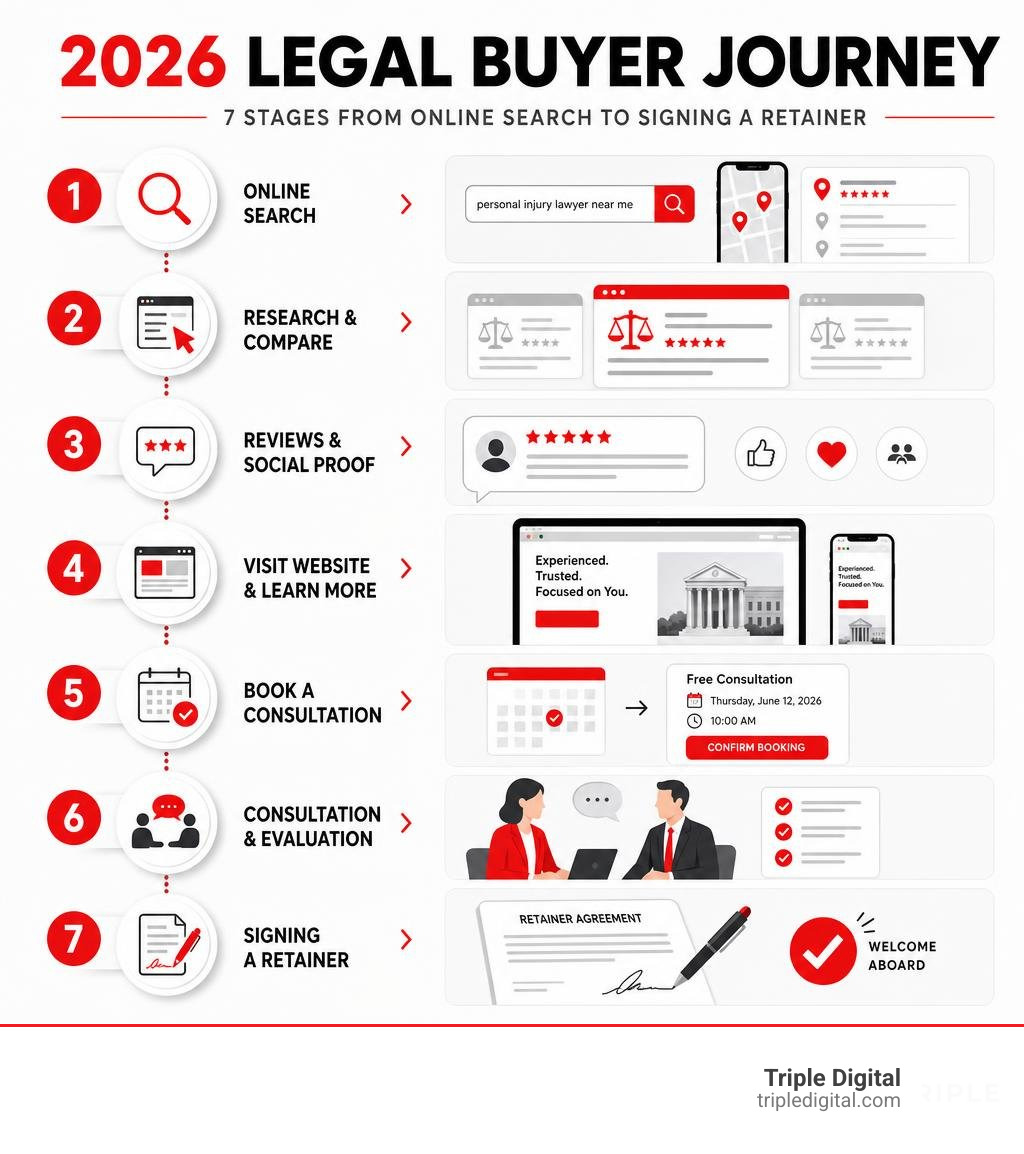
Why Digital Marketing Strategies for Law Firms Outperform Traditional Methods in 2026
For decades, the standard recipe for legal marketing was simple: buy a billboard on the side of the highway, run a late-night television spot, and wait for the phone to ring. While those methods built massive local brands in the past, they are incredibly inefficient in 2026.
Traditional marketing is a “spray and pray” approach. You are paying to show your message to thousands of people who do not need a lawyer right now—and hopefully never will.
Digital marketing, on the other hand, is high-precision. Instead of shouting at everyone, you are quietly positioning your firm directly in front of the exact person who is actively searching for your help.
When you align your brand with modern search behavior, you build a predictable client acquisition engine. To understand how we navigate this shift, read our breakdown on Strategic Moves: Your Blueprint for Legal Marketing Success.
Here is how the economics of traditional marketing stack up against a modern digital approach in 2026:
| Marketing Metric | Traditional (Billboards & TV) | Digital (SEO & Targeted PPC) |
|---|---|---|
| Average Monthly Cost | $8,000 – $15,000 per billboard/spot | $3,000 – $10,000 (Scalable) |
| Audience Targeting | Geographic only (Everyone driving by) | Hyper-targeted by intent, location, and demographics |
| Tracking & Attribution | Estimated impressions (Hard to verify) | Exact tracking from first click to signed case |
| Long-Term Asset Value | Zero (Visibility stops when payment stops) | High (Content and rankings compound over time) |
| Average Cost Per Lead | $400 – $800+ | $80 – $250 (SEO) / $150 – $400 (PPC) |
Transitioning from Referrals to Predictable Digital Systems
Relying solely on word-of-mouth referrals is a dangerous way to run a business. Referrals are highly unpredictable. They fluctuate based on seasons, economic shifts, and whether your professional network happens to remember you this month.
Furthermore, today’s consumers vet referred attorneys online anyway. Even if a trusted friend recommends your firm, the very next thing that prospect does is search your name on Google. If your website looks like it was built in 2012, or if you only have three Google reviews, that referred lead will quietly slip away to a competitor with a stronger digital presence.
By implementing a compounding digital flywheel, your marketing efforts build on themselves. High-quality educational content ranks on search engines, attracts organic traffic, earns authoritative backlinks, and feeds search engine algorithms. Over time, this system generates a steady stream of incoming leads without requiring you to constantly purchase more ads. It turns your marketing from a monthly business expense into a valuable, sellable asset.
Implementing Digital Marketing Strategies for Law Firms to Maximize ROI
To run a highly profitable law firm, you must shift your focus from vanity metrics (like website clicks or social media “likes”) to downstream business outcomes. The only metric that truly matters is your cost per signed case.
A healthy law firm marketing program should aim for a revenue-to-cost ratio of 5:1 at a minimum. This means that for every $1,000 you invest in marketing, you should generate at least $5,000 in fee revenue. In highly optimized campaigns, elite firms regularly see returns of 10:1 or higher.
Achieving these returns requires a balanced budget. While SEO and local search build long-term equity, paid acquisition channels can bridge the gap to provide immediate case flow. For a deeper dive into managing your ad spend efficiently, explore The Definitive Guide to Paid Advertising for Lawyers.
The Core Pillars of Modern Legal Marketing
To build a digital marketing system that consistently signs high-value cases, you must focus on the core pillars of online visibility and conversion.

A law firm’s website is no longer just a digital brochure; it is your primary conversion tool. If your site takes longer than two seconds to load, you will lose roughly 32% of your visitors before they even see your name.
Because over 58% of global internet traffic originates from mobile devices, your website must be built with a mobile-first design. It should feature clean navigation, prominent click-to-call buttons, secure contact forms, and interactive trust signals—such as badges from professional associations, clear case results, and real client testimonials.
Search Engine Optimization and Local SEO for Attorneys
When prospects need legal help immediately, they rarely scroll past the first page of search results. In fact, only 2% to 3% of users ever click on page two.
For local legal services, the absolute most valuable digital real estate is Google’s Local Map Pack. This feature appears in 93% of local searches and captures roughly 44% of all clicks.
To rank in the Map Pack, your local SEO strategy must be flawless. Google holds legal websites to incredibly high standards under its “Your Money or Your Life” (YMYL) guidelines. This means your content must demonstrate exceptional E-E-A-T (Experience, Expertise, Authoritativeness, and Trustworthiness).
For a complete framework on building search visibility, check out our comprehensive guide on Digital Marketing Strategies for Law Firms.
To dominate local search, focus on these essential local SEO ranking factors:
- Google Business Profile Optimization: Ensure your profile is fully claimed, categorized correctly, and updated weekly with fresh posts and photos.
- Name, Address, and Phone (NAP) Consistency: Your firm’s contact details must be identical across your website, social media, and third-party legal directories.
- Review Velocity and Diversity: Consistently collect positive client reviews on Google, Yelp, and legal-specific directories.
- Local Structured Data: Implement local business schema markup to help search engine crawlers understand your exact location and practice areas.
- Localized Content: Build dedicated pages for every city, county, or neighborhood you serve, referencing local courts and municipal guidelines.
Tailoring Digital Marketing Strategies for Law Firms by Practice Area
Digital marketing is not a one-size-fits-all endeavor. The strategies that work for a high-volume personal injury practice are vastly different from those required by a boutique estate planning firm.
For instance, personal injury keywords are among the most competitive and expensive in the entire digital advertising space. Some highly specific search terms can cost hundreds of dollars per click. For these firms, a heavy investment in organic SEO, local map rankings, and aggressive review acquisition is critical to lowering their long-term client acquisition costs.
Conversely, family law or criminal defense firms often deal with prospects experiencing high-stress, emotionally charged situations. These users search using highly specific, long-tail questions (e.g., “how is child support calculated in Texas if I am self-employed?”).
By focusing on niche specialization and targeting these high-intent, question-based keywords, smaller firms can bypass expensive head-term competition and connect directly with motivated, qualified clients.
Content Marketing, Blogging, and Social Media Engagement
Blogging is no longer optional for modern law firms. However, mass-producing shallow, AI-generated blog posts will only hurt your rankings. Search engines reward topical depth. You should aim to build comprehensive “content clusters”—one highly detailed pillar page for each practice area, supported by 15 to 20 shorter, question-answering blog posts that link back to the main pillar.
Social media serves as your firm’s brand-building and trust-verification engine. While platforms like Facebook and Instagram are excellent for local community engagement and sharing client success stories, LinkedIn remains the premier network for professional positioning and referral networking.
Video has also become the most engaging marketing tool available. Websites that feature video are 53 times more likely to rank on Google’s first page, and adding video to your landing pages can drive an 80% increase in conversion rates.
To learn how to utilize these platforms without wasting hours of billable time, see our guide on Law Firm Marketing with Social Media.
Compliance, Ethics, and Emerging 2026 Trends
Marketing a law firm comes with a unique set of challenges that traditional businesses never have to face. You must balance aggressive business growth with strict adherence to professional conduct rules.

When marketing legal services online, you must remain strictly compliant with ABA Model Rules 7.1 and 7.2, along with your specific state bar regulations.
Never make misleading claims, offer absolute guarantees of success, or refer to your firm as “specialists” or “experts” unless you hold a formally recognized, state-approved certification.
Furthermore, you must protect client confidentiality at all costs. Never share specific case details or client identities in testimonials or social posts without explicit, written consent. Always include clear, prominent disclaimers on your website stating that your content is for general informational purposes only and does not establish an attorney-client relationship.
Generative Engine Optimization (GEO) and AI Visibility
In 2026, search is no longer limited to a simple list of blue links. AI-driven search experiences, such as Google’s AI Overviews and conversational answer engines, now capture over 50% of legal queries in high-intent categories.
These AI-enhanced experiences have reduced traditional organic click-through rates by approximately 34% to 35% for top positions. To survive in this new landscape, law firms must optimize for Generative Engine Optimization (GEO).
AI engines do not just scrape keywords; they analyze relationships between concepts, entities, and authoritative sources. To ensure AI engines cite and recommend your firm, you must structure your website’s data using advanced schema markup, write in clear, natural language, and publish highly comprehensive answers to complex legal questions. If the AI models cannot easily read and understand your firm’s areas of expertise, your website will become completely invisible to conversational search users.
Video Dominance and Voice Search Optimization
With the rapid rise of smart speakers and mobile digital assistants, voice search has grown by 28% year-over-year. When people use voice search, they do not speak in short keywords; they ask full, conversational questions (e.g., “Who is the best car accident lawyer near me right now?”). Optimizing for voice search requires structuring your content in a natural, conversational Q&A format.
Simultaneously, indexable video has taken over search results. Search engine crawlers can now read, index, and rank video transcripts directly in both video and text-based search results.
By producing short FAQ videos, “what to expect” process walkthroughs, and attorney introduction videos, you can build immediate human connection. Remember: clients retain 95% of a message delivered via video, compared to just 10% when reading text.
Frequently Asked Questions about Legal Marketing
How much should a law firm budget for digital marketing in 2026?
A standard rule of thumb for established law firms looking to maintain their market share is to allocate 7% to 8% of their gross revenue to digital marketing. However, if your firm is in an aggressive growth phase, launching a new practice area, or operating in a highly competitive metro area like Houston, you should expect to invest 15% to 20% of your gross revenue to scale your case acquisition predictably.
How long does it take to see results from legal SEO?
SEO is a long-term, compounding investment. While paid campaigns (like PPC and Local Services Ads) can generate leads within days, a professional SEO and content strategy typically takes 3 to 6 months to start producing a consistent flow of organic leads. By months 6 through 12, the digital flywheel begins to compound, lowering your average cost per lead and delivering a highly sustainable, long-term return on investment.
Do lawyers need a specialized marketing agency?
While it is entirely possible to handle some basic social media posting or blogging in-house, managing a comprehensive, multi-channel digital marketing system is incredibly time-consuming. Hiring a specialized agency that understands legal ethics, conversion psychology, and advanced search algorithms allows you to focus on practicing law while experts build your growth systems.
For answers to more common questions regarding timelines, costs, and campaign setups, read our Digital Marketing FAQ for Lawyers (2026 Edition).
Conclusion
In 2026, digital marketing is no longer a luxury reserved for the nation’s largest personal injury firms. It is an absolute necessity for any law practice that wants to remain competitive, build predictable revenue, and grow sustainably.
At Triple Digital, we help law firms bypass the marketing fluff and focus entirely on what matters: signing more high-value cases. As a premier Houston-based digital marketing agency, we specialize in high-precision lead generation and case acquisition.
Our unique, results-driven approach leverages cutting-edge AI and advanced data mining to target your ideal clients with surgical precision. We build durable, compliant, and highly profitable digital marketing systems tailored specifically to your firm’s goals.
Ready to dominate your local market and build a predictable stream of signed cases? Let’s build your growth engine together. Top-Rated Digital Marketing Agency for Law Firms