
Why Your Firm Can’t Afford to Ignore SEO
SEO for attorneys lawyers is the process of optimizing your law firm’s website and online presence to rank higher in search engine results, making it easier for potential clients to find you when they need legal help. It combines keyword research, content creation, local optimization, technical improvements, and link building to increase your visibility and attract more qualified leads.
Quick Answer: What Law Firms Need to Know About SEO
- 96% of people search online for legal advice when they need a lawyer
- The top 3 results get 75.1% of all clicks – if you’re not there, you’re invisible
- SEO drives 40-60% of new cases for established law firm programs
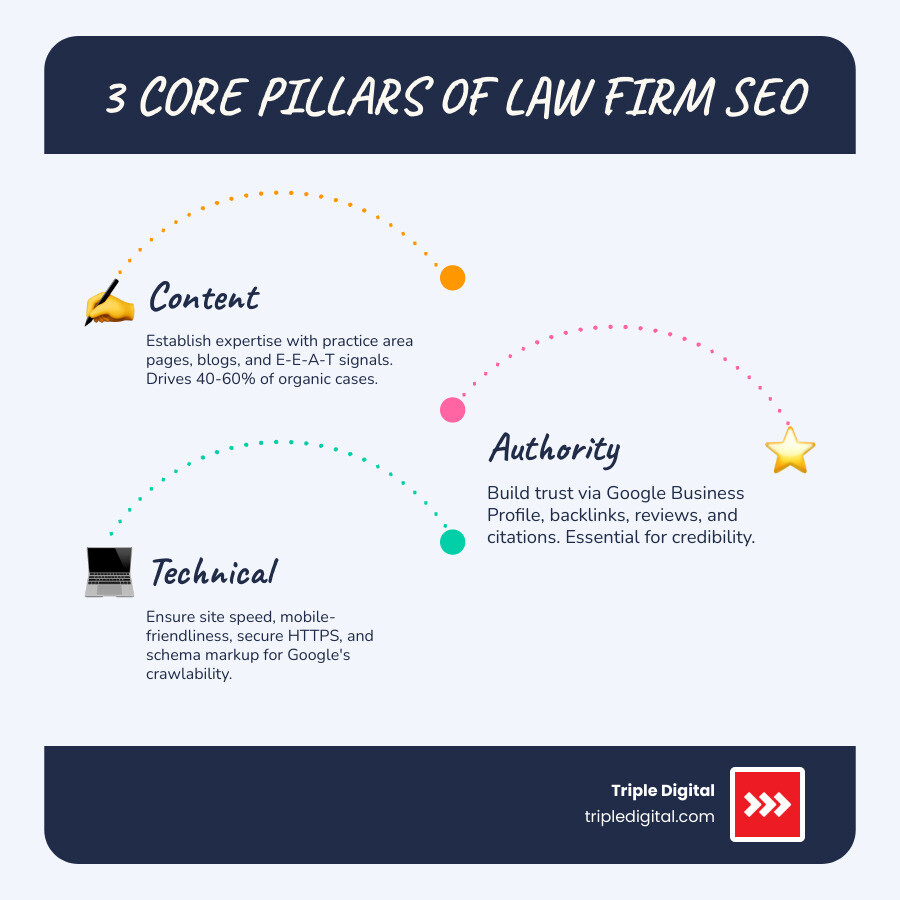
- Three core pillars: Content authority, local presence, and technical performance
- Timeline: Expect initial results in 3-6 months, significant impact in 6-12 months
- ROI: Well-measured programs return $7-$12 for every dollar invested
Most law firms still rely on referrals, word of mouth, or expensive paid ads to get clients. But here’s the reality: when someone needs a lawyer right now, they don’t flip through a phone book or wait for a referral. They open Google and type “divorce lawyer near me” or “personal injury attorney in Houston.”
If your firm isn’t showing up on that first page, you’re losing cases to competitors who are. And it’s not just about being visible – it’s about being visible at the exact moment someone needs your help.
The days of legal clients poring over huge local directories are over. Almost two-thirds of prospective clients head straight to online search engines when they need legal advice. Google was the highest lead source for law firms in 2023, and that trend is only accelerating.
SEO isn’t a luxury anymore. It’s the foundation of a modern law firm’s growth strategy. The firms that master it will dominate their local markets. The ones that ignore it will watch their competitors steal their potential clients, one Google search at a time. For more on why this is so critical, check out our insights on Why SEO is Important for Attorneys.
Key terms for seo for attorneys lawyers:
The Core Pillars of SEO for Attorneys Lawyers
At Triple Digital, we believe in a “less fluff, more cases” approach. This means focusing on the foundational elements of SEO for attorneys lawyers that genuinely move the needle. These elements work synergistically to boost your ranking in Google, stonewall your competitors, and boost every point of your sales funnel, from awareness to conversion rates. Understanding these pillars is your blueprint for online success.
Here’s how we break it down:
- On-page SEO: This refers to all the optimizations you make directly on your website. It’s about making your content and HTML source code easy for search engines (and humans!) to understand.
- Off-page SEO: These are actions taken outside of your website to impact your rankings. Think of it as building your firm’s reputation and authority across the web.
- Technical SEO: This is the behind-the-scenes work that ensures search engines can efficiently crawl, index, and understand your website. It’s the engine that powers your visibility.
- Local SEO: A specialized subset focusing on ranking in local search results, crucial for law firms attracting clients in specific geographic areas like Houston.
- User Experience (UX): How easily and enjoyably visitors interact with your site. A good UX keeps people on your site longer, signaling to Google that your site is valuable.
- Keyword Research: The process of identifying the terms and phrases your potential clients use when searching for legal services.
- Content Creation: Developing high-quality, relevant, and engaging content that answers client questions and showcases your expertise.
- Link Building: Acquiring hyperlinks from other reputable websites to your own, signaling authority to search engines.
These pillars are not isolated; they are interconnected. For example, great content (On-page) is more likely to earn backlinks (Off-page), and a technically sound website allows both to perform optimally. Mastering this interconnectedness is key to Mastering Law Firm SEO: Your Blueprint for Online Success.
Pillar 1: Content is Your Digital Expert Witness
In the legal world, credibility and expertise are paramount. The same holds true for your website content. Google prioritizes sites that demonstrate Experience, Expertise, Authoritativeness, and Trustworthiness (E-E-A-T). This is especially critical for legal topics, which fall under the “Your Money or Your Life” (YMYL) content category, meaning inaccurate or poor information can have serious consequences for users.
Your content needs to answer the inquiry or search term used by the user. If a potential client in Houston searches for “Houston personal injury lawyer,” your website needs specific content that tells them about your practice area, your location, and how you can help. Think about it from their perspective:
- Is this law firm located in Houston?
- Does this law firm practice personal injury law?
- Can this law firm service my particular need?
- Is this law firm any good?
- Do I want to do business with this law firm?
Your website content should provide preliminary answers to these questions.
Key Content Elements:
- Practice Area Pages: These are dedicated pages for each legal service you offer (e.g., “Houston Car Accident Lawyer,” “Houston Family Law Attorney”). They should be comprehensive, ideally 1,500-2,500 words, explaining the legal process, answering common questions, and showcasing your experience.
- Location Pages: For multi-office firms, or even single-location firms wanting to target surrounding areas, specific location pages help you rank for “lawyer in Houston” searches.
- Blog Posts: A blog is a fantastic way to answer common client questions, establish thought leadership, and target long-tail keywords (e.g., “what to do after a car accident in Houston”). Consistent blogging (even once a month) builds authority and keeps your site fresh.
- Attorney Bios: These are often underrated traffic magnets. Detail your qualifications, bar admissions, notable case experiences, and even your work philosophy to build credibility and trust.
On-page Optimization for Content:
Once you have great content, we optimize it to make sure Google understands its value. This involves strategic keyword placement:
- Title Tags: The single most important on-page ranking factor. It should be concise (50-60 characters), include your primary keyword, and a value proposition (e.g., “Houston Personal Injury Lawyer | Free Consultation | Your Firm Name”).
- Meta Descriptions: While not a direct ranking factor, a compelling meta description (150-160 characters) influences click-through rates. It should summarize the page and include your primary keyword.
- Header Tags (H1, H2, H3): These structure your content, making it readable for both users and search engines. Your H1 should contain your primary keyword, and H2/H3 tags should break down subtopics.
- Keyword Placement: Integrate your primary keywords and 10-15 semantic variations naturally throughout your content, aiming for a 1-2% keyword density. Avoid keyword stuffing – quality always wins over quantity.
For more detailed strategies on optimizing your content, explore our guide on Top 3 Digital SEO Strategies for Law Firms.
Pillar 2: Building Authority with Local SEO and Backlinks
If your law firm primarily serves clients in a specific area like Houston, local SEO is your bread and butter. Local inquiries account for around 46% of all Google searches, and 76% of mobile users contact a business within 24 hours of a local search. This means appearing in the “local map pack” (the first three local businesses that appear in relevant search results) is incredibly valuable.
Google Business Profile (GBP): Your Local Hub
Your Google Business Profile (formerly Google My Business) is a free, essential tool for local SEO. It’s often the first thing potential clients see when searching for local legal services.
Here are the essential elements for a stellar Google Business Profile:
- Claim and Verify: This is step one. Google needs to confirm you’re a legitimate business.
- Complete Profile: Fill out every section: firm’s name, address, phone number (NAP), website, hours, services, and a detailed description. Ensure your business name matches your website exactly.
- Categories: Choose the most accurate categories for your practice areas (e.g., “Personal Injury Attorney,” “Family Law Attorney”).
- Photos: Upload high-quality photos of your office interior, exterior, and team.
- Posts: Use GBP posts to share news, updates, or special offers.
- Q&A: Monitor and answer questions from potential clients.
Online Reviews: Your Digital Word-of-Mouth
Client reviews are the most influential factor in getting hired. Google reviews appear directly on your GBP and help boost your ranking. They also build trust with potential clients.
- Encourage Reviews: Implement a system to ask happy clients for reviews.
- Respond to Reviews: Respond professionally to all reviews, positive or negative. This shows you’re engaged and care about client feedback.
- Diversity: While Google reviews are paramount, reviews on other legal directories (Avvo, FindLaw, Justia) also bolster your reputation.
NAP Consistency and Citations:
Your Name, Address, and Phone number (NAP) must be consistent across all online platforms. Inconsistencies can confuse search engines and diminish your rankings. Citations are mentions of your NAP on other websites, even without a direct link.
- Legal Directories: Ensure your firm is listed accurately on all major legal directories (e.g., Avvo, Justia, FindLaw).
- Local Directories: List your firm on general local directories and business associations in Houston.
- Social Profiles: Maintain consistent NAP on social media platforms like Facebook and LinkedIn.
Backlinks: Votes of Confidence
Backlinks are referral links from other websites to yours. For SEO, they act like a popularity contest. If reputable websites link to your firm, Google sees these as “votes,” indicating that your attorneys know what they’re talking about. The more high-quality backlinks you have, the more authority your site gains.
- Quality over Quantity: Not all links are created equal. We prioritize links from authoritative, relevant websites, especially those in the legal industry or local Houston community.
- Link Building Strategies:
- Content that Earns Links: Create unique, valuable resources (e.g., a guide to Houston’s court system, a local legal aid directory) that other sites will naturally want to reference.
- Guest Posting: Offer to write articles for other legal blogs or local news sites, including a link back to your firm.
- Unlinked Mentions: Use tools to find mentions of your firm online that don’t link back to you, then reach out to request a link.
- Professional Relationships: Seek out linking opportunities from legal associations, bar organizations, or local businesses you partner with.
- Anchor Text Diversity: Vary the text used for your links (anchor text). Mix exact match keywords, partial match, branded terms, and generic calls to action to keep it natural.
Pillar 3: The Technical Foundation for a High-Ranking Website
Think of technical SEO as the sturdy foundation of your law firm’s online skyscraper. Without it, even the most beautiful content and authoritative backlinks won’t stand tall. Technical SEO ensures search engines can efficiently crawl, index, and understand your site. It’s often the hardest part to get right, which is why many firms partner with experts.
Key Technical Elements:
- Site Speed: Your website needs to load fast. Google states that for a good user experience, a page should load within 2.5 seconds. Around 61% of people searching via mobile prefer contacting businesses with mobile-friendly websites, and a slow site is a client killer. We optimize images, minimize code, and ensure efficient hosting.
- Core Web Vitals: These are specific metrics Google uses to measure user experience:
- Largest Contentful Paint (LCP): Measures loading performance. Aim for under 2.5 seconds.
- First Input Delay (FID): Measures interactivity. Aim for less than 100 milliseconds.
- Cumulative Layout Shift (CLS): Measures visual stability. Aim for less than 0.1.
- Mobile-Friendliness: More than 50% of all web traffic arrives via mobile devices. Your website must be responsive, adapting seamlessly to all screen sizes. Google prioritizes mobile versions of websites for indexing, so a mobile-friendly site is non-negotiable.
- Site Structure: A clear, logical site hierarchy helps both users and search engines steer your content. We aim for a “flat” structure, where all important pages are reachable within a few clicks from the homepage. This makes it easier for Google’s robots to find and understand all your pages.
- HTTPS Security: Your website must be secure. Using HTTPS (instead of HTTP) encrypts data, protecting user privacy. Google favors secure sites, and a “Not Secure” warning can deter potential clients.
- Schema Markup for Lawyers: This is a specialized code vocabulary added to your website’s HTML that helps search engines understand the context of your content. For law firms, schema markup (e.g.,
LegalService,Attorney,LocalBusiness,FAQPage,Review) can enable rich snippets in search results, making your listings more attractive and informative. - Crawlability & Indexing: We ensure Google’s bots can access all your important pages and add them to its index. This involves submitting XML sitemaps and fixing issues like broken links or redirect chains.
- Broken Links: These are dead ends for both users and search engines. We regularly audit your site to identify and fix any broken internal or external links.
A robust technical foundation allows your content and authority signals to shine, making it easier for Google to rank your firm higher. Tools like Google Search Console are invaluable for monitoring site health and identifying issues. For more details on leveraging this powerful tool, explore How Can Google Search Console Help With Law Firm Marketing?.
Measuring SEO Success and Deciding Your Next Move
At Triple Digital, we’re all about results. We know that for law firms, the ultimate measure of success isn’t just traffic—it’s signed cases. Measuring your SEO for attorneys lawyers efforts is crucial to understanding what’s working, where to optimize, and how your investment translates into tangible growth.
Key Performance Indicators (KPIs):
We track a range of KPIs to give you a comprehensive view of your SEO performance:
- Organic Traffic: How many visitors are coming to your site directly from search engines? This indicates your visibility and reach.
- Keyword Rankings: Where do you rank for your target keywords? More rankings at the top mean more traffic. Tools like Semrush or Ahrefs help track progress across your most valuable keywords.
- Google Business Profile Performance: For law firms, local search is everything. We monitor your visibility in the Google Business Profile map pack, Google Maps, and local listings. Higher local rankings translate into more calls from nearby clients.
- Form Submissions & Phone Calls: These are direct leads. We implement tracking to attribute these conversions back to your SEO efforts.
- Signed Cases: This is the ultimate metric. We work with you to integrate SEO data with your CRM to show a clear path from search query to new client.
- Return on Investment (ROI): Nearly half of digital marketers confidently claim that organic search brings in the highest returns on their investment. Well-measured SEO programs for law firms can demonstrate a $7-$12 return per dollar invested over 12-18 months.
We use tools like Google Analytics 4 to set up goal tracking for key conversions: contact forms, phone calls, chat initiations, and consultation bookings. This allows us to create dashboards highlighting your legal marketing KPIs and show you the direct impact of our work.
Understanding these metrics helps us continually refine your strategy. If your law firm isn’t bringing in business from organic search at the moment, you’re leaving a lot of money on the table. For more reasons to invest, read our article on Reasons to Use Law Firm SEO.
DIY vs. Hiring an Expert for seo for attorneys lawyers
So, you’ve grasped the importance of SEO for attorneys lawyers. Now for the million-dollar question: should you tackle it yourself or bring in an expert?
Doing it Yourself (DIY):
- Pros: Cost-effective initially, full control over your strategy.
- Cons:
- Time Commitment: SEO is a time-intensive task. Many lawyers simply don’t have the time or inclination to learn a new, complex discipline while managing their practice.
- Technical Complexity: Technical SEO, especially, can be hard to get right if you aren’t an expert. Google’s Webmaster Guidelines are extensive, and algorithm updates are frequent.
- Learning Curve: It’s an ongoing education. You’ll need to stay current with frequent algorithm updates, master keyword strategy, and understand content optimization.
- Opportunity Cost: The time you spend learning and implementing SEO is time you could be spending on billable work or with clients.
Hiring an Expert (Triple Digital!):
- Pros:
- Expertise: We specialize in SEO for attorneys lawyers and understand the unique challenges and ethical considerations of the legal industry. We leverage AI and data mining for precise client targeting, ensuring “less fluff, more cases.”
- Efficiency: We save you the thousands of hours it would take to do your law firm SEO in-house, ensuring best practices are applied from day one.
- Results-Driven: Our approach focuses on tangible outcomes like increased leads and signed cases, not just vanity metrics. We provide clear reporting on Google Impressions, Clicks, Calls, Form Submissions, Leads, & New Signed Cases.
- Mitigated Risk: We stay updated on Google’s ever-changing algorithms and best practices, reducing the risk of penalties.
- Cons: Investment cost. For monthly retainer rates, $501-$1,000 per month is fairly standard, though comprehensive legal SEO services can range from $1500 to $5000 per month, depending on scope.
The 2022 ABA Legal Technology Survey Report found that 28% of law firms have hired a consultant or agency to assist with SEO. A great middle-ground option is to handle simpler SEO work yourself while outsourcing some of the more time-intensive or technical work to an expert.
Vetting an Agency: Ask the Right Questions
If you choose to hire, be diligent. The best SEO experts often don’t have time to work on their own websites, so ask other lawyers in your network for referrals. When speaking with potential agencies:
- Ask about their understanding of content, backlinks, and technical SEO.
- Request examples of their experience, particularly with law firms.
- Check their references, especially from other legal practices.
- Ensure they are willing to explain their process and be upfront about expected efforts and results.
Red Flags to Avoid:
- Guaranteed Results: No one can guarantee specific rankings. If they do, look elsewhere.
- Focus on Vanity Metrics: Be wary if they only talk about clicks and traffic without a clear path to leads and signed cases.
- Paid Search Instead of SEO: Ensure you’re not paying for paid search advertising (PPC) when you asked for SEO. While PPC is viable, it’s a different service.
At Triple Digital, we pride ourselves on a results-driven approach, leveraging AI and data mining for precise client targeting, ensuring “less fluff, more cases.” We are committed to getting your firm to rank #1. Explore our insights on Don’t Get Sued by Bad SEO: Finding Top Agencies for Your Law Firm.
Frequently Asked Questions about SEO for Law Firms
What are the most important ranking factors for seo for attorneys lawyers?
The most important ranking factors for SEO for attorneys lawyers are a combination of elements that signal to Google that your website is credible, authoritative, and provides an excellent user experience. These include:
- Content Quality & E-E-A-T: High-quality, in-depth content that demonstrates your Experience, Expertise, Authoritativeness, and Trustworthiness. This is crucial for YMYL legal topics.
- Backlink Profile: The quantity and quality of links from other reputable websites. These act as “votes of confidence” for your site.
- Local SEO Signals: A complete and verified Google Business Profile, positive client reviews, and consistent Name, Address, Phone (NAP) information across online directories.
- Technical Health: A fast, mobile-friendly, secure (HTTPS) website with a clear site structure and proper schema markup.
- User Experience (UX): How easily and enjoyably visitors interact with your site, measured by factors like bounce rate, dwell time, and Core Web Vitals.
For a deeper dive into these factors, check out our article on Law Firm SEO: What are the Most Important SEO Ranking Factors?.
How long does it take for law firm SEO to work?
SEO for attorneys lawyers is definitely a marathon, not a sprint. You should set realistic expectations:
- Initial Results (3-6 months): You might start to see improvements in keyword rankings for less competitive terms, increased organic traffic, and perhaps a few new leads. This phase typically involves site audits, technical fixes, and foundational content creation.
- Significant Impact (6-12+ months): This is when you’ll likely see substantial growth in high-value keyword rankings, a noticeable increase in qualified leads, and a stronger online presence. For new or smaller firms, plan for at least 6-12 months to gain real traction.
- Ongoing Effort: SEO never “finishes.” It requires consistent effort, content updates, link building, and adaptation to algorithm changes to maintain and improve rankings over time.
The timeline can vary significantly based on factors like your competition, budget, the aggressiveness of your strategy, and the age and current health of your website.
Can I just do Pay-Per-Click (PPC) instead of SEO?
While both PPC (Pay-Per-Click) and SEO for attorneys lawyers are effective digital marketing strategies, they serve different purposes and offer different benefits:
- PPC: Provides immediate visibility. You pay for each click, and your ads appear at the top of search results almost instantly. It’s great for quick campaigns and targeting specific keywords. However, once you stop paying, your visibility disappears.
- SEO: Builds long-term, organic authority. It takes time to rank, but once you achieve high rankings, you continue to receive traffic without directly paying for each click. SEO is generally more cost-effective over the long term, as it builds an appreciating asset (your website’s authority). Organic results are also often more trusted by clients than paid listings.
A combined approach is often best. PPC can provide immediate leads while your SEO strategy matures, and SEO builds sustainable growth. Ignoring SEO means missing out on the long-term benefits of organic traffic, which often has a higher conversion rate because users inherently trust organic results more. To understand more about the long-term benefits, read Why SEO is Great for Your Business.
Conclusion: Your Verdict on a Winning Digital Strategy
In today’s digital-first world, effective SEO for attorneys lawyers is no longer optional—it’s essential for any law firm aiming for sustained growth in Houston and beyond. It’s the engine that drives visibility, builds credibility, and ultimately, brings in the cases you need to thrive.
We’ve seen that success hinges on a multi-faceted approach: focusing on high-quality, E-E-A-T-driven content, building strong local authority through an optimized Google Business Profile and strategic backlinks, and ensuring your website has a rock-solid technical foundation. These pillars work together to create an online presence that Google loves and potential clients trust.
SEO is a long-term investment that yields compounding returns. It requires patience, expertise, and a commitment to continuous improvement. But the payoff—consistent leads, increased brand recognition, and a growing caseload—is invaluable.
Don’t let your competitors capture the clients you deserve. Take the next step towards dominating your market. For insights into future marketing trends, check out Top Law Firm Marketing Agency: How Firms Will Get More Cases in 2026 and Beyond.
Ready to transform your online presence and attract more qualified clients? Let us help you craft a custom Digital Marketing Strategies Law Firm plan custom to your firm’s unique goals.