





Step-by-Step Guide to Lead Tracking Tools
Why Most Law Firms Are Flying Blind on Their Marketing Budget
Lead tracking is the process of monitoring every potential client from their very first interaction with your firm — an ad click, a Google search, a phone call — all the way through to a signed case.
Here’s the quick answer if you need it:
What is lead tracking?
- It records where each lead came from (Google Ads, organic search, referral, etc.)
- It follows what that lead does at every step of your sales pipeline
- It connects marketing spend to actual closed cases and revenue
- It tells you which channels are worth your budget — and which are wasting it
For law firms specifically, this matters more than most people realize. Channels like tradeshows can cost up to $811 per lead, while email averages just $53. Without tracking, you have no way to know which number applies to you — or whether any of your spending is actually producing cases.
The problem is that most firms think they’re tracking leads when they’re really just counting form fills. A form submission is not a client. It’s a signal. Real lead tracking connects that signal to a closed matter and a dollar figure.
In 2026, 40% of marketers say lead quality is their most important success metric — not volume. And 79% of marketing leads never convert to sales at all. That gap between leads generated and cases won is exactly where lead tracking earns its value.
The sections below walk through every tool, method, and best practice you need — from UTM parameters and call tracking to CRM setup and multi-touch attribution. This guide is designed to provide general legal marketing information and guidance to help firms understand their data.
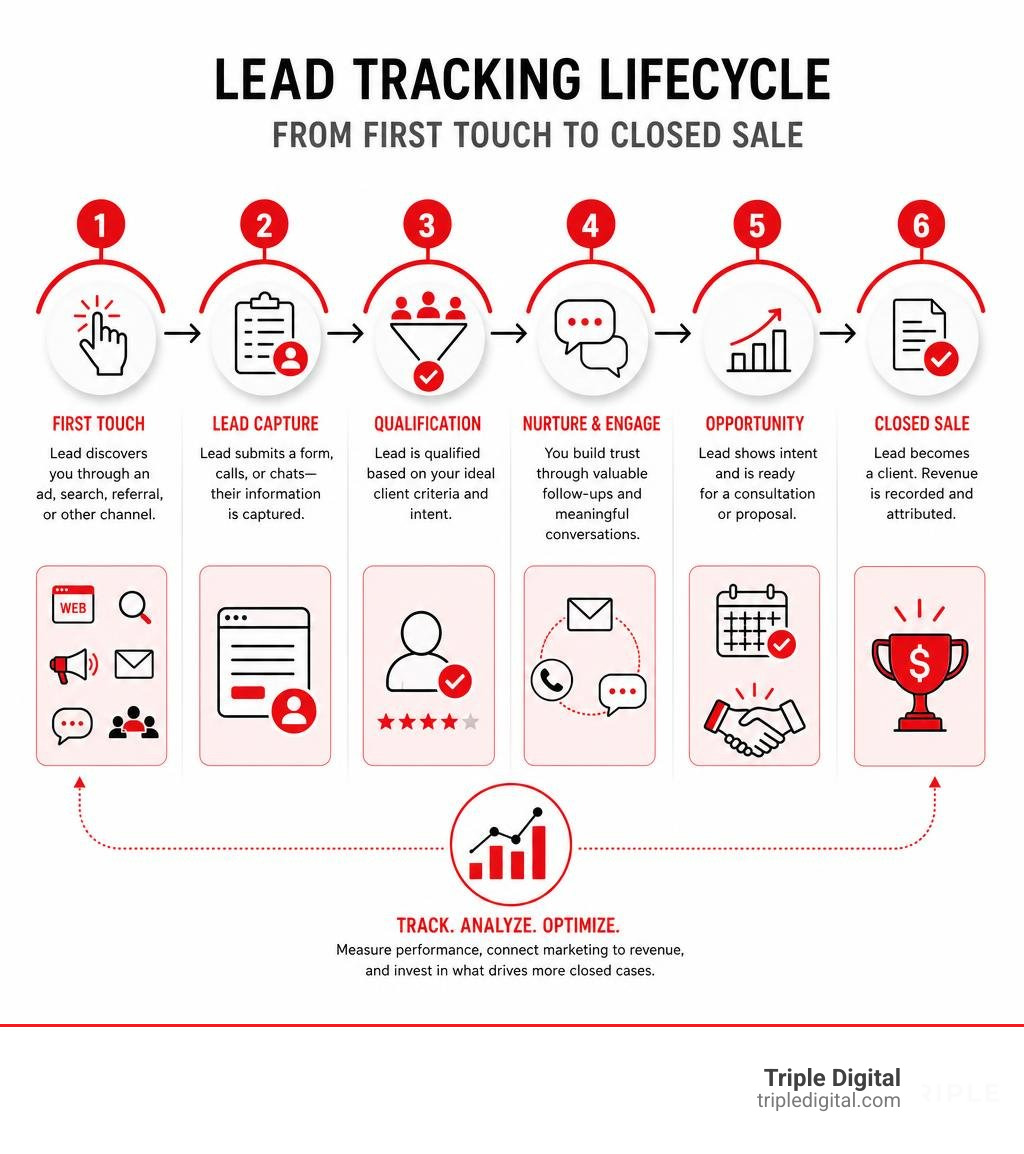
What is Lead Tracking and Why Does It Matter?

To truly optimize a marketing budget, we must understand the entire journey of a prospective client. Lead tracking serves as the digital thread connecting a user’s initial curiosity to their final signature on a retainer agreement. Without this thread, we are simply throwing money at various platforms and hoping something sticks.
When we track leads properly, we categorize them based on where they stand in their journey. This categorization prevents us from treating a casual website browser the same way we treat someone who is actively looking to hire an attorney. Here are the core lead stages we monitor:
- Inbound Leads: These are prospects who initiate contact with our firm. In modern marketing, 84% of marketers use form submissions to capture these leads, while 50% use phone calls, and 33% rely on live chat.
- Marketing Qualified Leads (MQLs): An MQL is a lead that has shown enough engagement to suggest they have real interest. For example, someone who downloads a specialized legal guide or spends significant time reading your practice area pages.
- Sales Qualified Leads (SQLs): These are leads that our intake team has vetted and deemed ready for a direct consultation. They meet our basic criteria regarding case type, geographic location, and conflict-of-interest checks.
- Product Qualified Leads (PQLs) / Service Qualified Leads (ServQL): In the legal space, a ServQL is a prospect who has undergone a preliminary evaluation (like an automated case assessment tool) and met the precise parameters required for our firm to take on their case.
By distinguishing these stages, we can dramatically accelerate the sales cycle. For instance, research shows that companies responding to leads within an hour are seven times more likely to have meaningful conversations and qualify those leads. If we don’t track where a lead is in real time, we cannot respond with the speed required to win the case. To learn more about structuring this journey, check out our guide on how to Stop Leaking Leads With A Better B2B Marketing Funnel.
Lead Tracking vs. Lead Scoring and Management
It is common to hear the terms lead tracking, lead scoring, and lead management used interchangeably, but they perform entirely different roles in our marketing stack:
- Lead Tracking: This is the foundational data layer. It records the mechanics of how a lead found us (e.g., clicking a Google Ad for “personal injury attorney Houston”) and what pages they visited.
- Lead Scoring: This is the quantitative layer built on top of tracking. It assigns numeric points to specific behaviors. For example, viewing a case results page might add 15 points, while downloading a basic PDF adds 5 points. Once a lead crosses a certain point threshold, they are automatically flagged for immediate follow-up.
- Lead Management: This is the operational framework. It dictates how leads are organized, routed to intake specialists, and nurtured over time.
- Revenue Attribution: This is the final financial layer. It ties the closed-won case back to the original marketing touchpoints so we can calculate our exact return on investment (ROI).
To manage this complex web of data, selecting the right software is critical. You can explore the top tools available today in our review of 10 Lead Tracking Software.
Key Metrics for Measuring Lead Quality
If we only measure lead volume, we risk incentivizing campaigns that produce cheap, unqualified form fills. Instead, we must focus on metrics that directly impact our bottom line:
- Cost-Per-Lead (CPL): The total marketing spend on a channel divided by the number of leads generated.
- Qualified Lead Rate: The percentage of total inbound leads that actually meet our criteria to become MQLs or SQLs.
- Revenue Per Lead: The total fee revenue generated by a channel divided by the total number of leads from that channel.
- Marketing ROI: The net profit generated from cases divided by the total marketing spend.
To put these metrics into perspective, let’s look at how typical costs per lead compare across different channels:
| Marketing Channel | Average Cost-Per-Lead (CPL) | Conversion Potential |
|---|---|---|
| Email Marketing | $53 | High (Nurtured audience) |
| Pay-Per-Click (PPC) | Up to $181 | Extremely High (Active search intent) |
| Tradeshows / Events | Up to $811 | Variable (Requires long-term follow-up) |
While PPC has a higher upfront cost, the active search intent often yields a much higher qualified lead rate than passive channels. Email remains an incredibly cost-effective nurturing tool, while offline events like tradeshows require significant capital and robust tracking to justify their high cost.
Core Methods and Tools for Modern Attribution

To build a reliable lead tracking engine, we need to implement a standardized system for capturing traffic source data. The most fundamental tool for this is the UTM (Urchin Tracking Module) parameter.
UTM parameters are short text codes added to the end of your URLs. When a user clicks a link containing these codes, your analytics tools and CRM read the parameters to identify exactly where the visitor came from.
By appending these parameters to every paid ad, social media post, and email campaign, we remove the guesswork. We can instantly see which specific ad creative or keyword prompted the user to visit our site.
However, relying solely on standard browser-based tracking (client-side tracking) is becoming increasingly difficult in 2026. Browser privacy updates, ad blockers, and cookie restrictions often strip away UTM data before it reaches our CRM. To combat this, modern firms are transitioning to server-side tracking. By running tracking scripts on our own first-party domain, we bypass browser-level blocks and achieve over 95% data accuracy.
For offline channels or partner referrals, we can employ custom promo codes. When a lead enters a specific code during intake or on a landing page, our system automatically attributes them to the correct source. To dive deeper into how this infrastructure works, read our detailed guide on Why Tracking Numbers Are So Important To Track Leads.
Call Tracking and Offline Conversions
For law firms, phone calls are often the most valuable conversion channel. In fact, phone calls convert at 10 to 15 times the rate of web form submissions because callers are usually in immediate need of legal assistance.
Without call tracking software, your intake team has to ask, “How did you hear about us?” This manual method is notoriously unreliable. Most callers will simply say “Google” or “the internet,” which doesn’t tell you whether they clicked a paid ad, a local map listing, or an organic blog post.
Call tracking solves this by using Dynamic Number Insertion (DNI). When a visitor lands on your website, the software automatically swaps out the phone number with a unique tracking number tied to their specific session. When they call, the software links their phone number to their online journey, capturing:
- The exact search keyword they typed
- The ad campaign they clicked
- The specific pages they viewed before calling
Once the call is complete, we can push this data back to our ad platforms as an offline conversion. When our CRM marks a lead as “qualified” or “case won,” that event is sent back to Google Ads or Meta Ads. This teaches the advertising algorithms exactly which search terms yield paying clients, allowing the platforms to automatically optimize our bidding for higher-quality leads. For a deeper look at this process, see our resource on Law Firm Lead Tracking.
Best Practices for Lead Tracking in Long Sales Cycles
Legal matters rarely close overnight. A prospective client might click an ad, read a blog post, leave, return via organic search three weeks later, and finally call your office after seeing a retargeting ad. This multi-touch journey can span weeks or even months.
If we rely solely on last-click attribution, we will attribute 100% of the case value to the final retargeting ad. This is a mistake; it completely undervalues the initial search ad that brought the prospect to our site in the first place. Conversely, first-click attribution ignores the secondary touchpoints that actually pushed them to convert.
To accurately measure marketing performance across long cycles, we must:
- Capture both first-click and last-click data on every lead record in our CRM.
- Lock the original source fields so they cannot be accidentally overwritten by subsequent visits or manual intake edits.
- Perform regular pipeline reviews to clean out stale leads and ensure our attribution data remains accurate over time.
To understand how data-driven analytics can reshape your firm’s approach to these long cycles, read Measure Up: How Analytics Can Transform Your Legal Marketing.
How to Connect Lead Source Data to Closed Revenue
The ultimate goal of lead tracking is closed-loop reporting: connecting the dollar spent on marketing directly to the dollar earned in legal fees. To achieve this, our CRM must serve as the single source of truth.
When a lead submits a form or places a call, their contact details and tracking data (UTMs, click IDs, referrer) must be packaged together and sent directly to our CRM via API integrations. This prevents data from being siloed in separate marketing tools.
Once the lead is in our CRM, we can use lead enrichment tools to automatically pull in additional data, such as the prospect’s company size, industry, or public social profiles. This gives our intake team complete context before they even pick up the phone.
When a case is won, the revenue generated must be tied directly back to that original contact record. By maintaining this closed loop, we can run reports showing exactly how much revenue was generated by “Google PPC” versus “Organic Local SEO.” To master the art of turning casual inquiries into valuable client partnerships, explore From Prospects To Partners: The Lawyer’s Playbook For Lead Gen.
Overcoming Common Tracking Mistakes
Even sophisticated firms make critical errors that compromise their data integrity. Here are the most common mistakes we see and how to avoid them:
- Treating Form Fills as Final Conversions: A form submission is only an intent signal. If we optimize our ad campaigns purely for form fills, we risk training ad algorithms to find people who love filling out forms but never actually sign a retainer. We must optimize for qualified offline conversions instead.
- Letting UTM Data Slip: If your website has broken links or redirects that strip out URL parameters, you will lose your attribution data. We recommend auditing your UTM setup monthly by checking for “not set” traffic in your analytics platform.
- Keeping Marketing and Sales Data Separate: When marketing data lives in Google Analytics and sales data lives in your legal practice management software, you cannot calculate true ROI. Integrate these systems so they speak to each other automatically.
- Ignoring Data Privacy Compliance: With strict regulations like GDPR and CCPA, we must ensure our tracking methods respect user privacy. Using first-party, server-side tracking allows us to maintain compliance while still gathering the accurate data we need.
For an in-depth guide on using data to avoid these pitfalls and win more cases, check out Crunching Numbers Winning Cases: Your Guide To Data Powered Lead Gen.
Frequently Asked Questions about Lead Tracking
How can businesses get started with lead tracking for free?
You don’t need a massive budget to start tracking your leads. You can begin by setting up a free CRM to centralize your contact data. Pair this with Google Analytics 4 (GA4) to monitor website traffic, and use a free UTM builder to tag all your marketing links. For a simple starting point, you can even use a structured spreadsheet template to manually record lead sources during intake. To explore your options further, read Finding Your Next Client: A Guide To Lead Generation Services.
What is the difference between first-click and last-click attribution?
First-click attribution credits 100% of a conversion to the very first channel a user interacted with, which is excellent for measuring brand awareness and demand generation. Last-click attribution credits the final channel the user clicked before converting, which helps measure direct-response effectiveness. Because real-world customer journeys are complex, relying on just one of these metrics can distort your budget planning. For strategies on capturing leads proactively across the entire journey, read Don’t Just Wait For Cases: Strategies For Proactive Legal Lead Generation.
Why is server-side tracking more accurate than client-side tracking?
Client-side tracking relies on the user’s browser to send data to your analytics tools. If a user runs an ad blocker, has strict cookie restrictions, or uses an iOS device with App Tracking Transparency enabled, their data is often blocked or deleted. Server-side tracking sends data directly from your website’s server to your analytics and CRM tools. This first-party approach bypasses browser-level blocks, resulting in significantly cleaner data and more reliable attribution. To learn how to leverage these advanced tracking methods for your firm, read our guide on Invest In Growth: The Best Lead Generation Services For Lawyers.
Turn Your Marketing Data Into Signed Cases Today
At Triple Digital, we believe that every marketing dollar you spend should be directly accountable to a signed case. We are a Houston-based digital marketing agency specializing in high-intent lead generation and case acquisition for law firms across the United States.
Our philosophy is simple: “less fluff, more cases.” We don’t care about vanity metrics like impressions or clicks. Instead, we leverage advanced AI and data mining to target high-value clients with surgical precision, ensuring your firm gets the exact cases it wants.
By implementing robust lead tracking frameworks, we help our clients identify exactly which campaigns drive revenue, allowing them to scale their firms with confidence. If you’re ready to stop guessing and start growing based on real, actionable data, Schedule a meeting with our team today.