
Why Your Next Client is Searching for You Locally
Local SEO for law firm success means showing up when potential clients search for legal help in your area. Here’s what you need to do:
- Claim and optimize your Google Business Profile – This is your primary tool for appearing in local search results
- Ensure NAP consistency – Keep your Name, Address, and Phone number identical across all online listings
- Generate client reviews – 90% of people read reviews before choosing a lawyer
- Build local citations – Get listed on legal directories like Avvo, Justia, and local business directories
- Create location-specific website content – Optimize pages with local keywords and practice areas
- Earn local backlinks – Connect with local organizations and legal associations
If someone needs a lawyer, there’s a 93% chance they’ll start with Google. And when they search for “criminal defense attorney near me” or “divorce lawyer in [city],” your law firm needs to be visible.
The stakes are high. Businesses ranking in Google’s Local Pack see a 400% increase in views and 113% more clicks compared to those that don’t. For law firms, this translates directly into more consultations and signed cases.
Traditional marketing channels like Yellow Pages, billboards, and print ads are losing ground. Meanwhile, up to 46.5% of prospective clients use Google search when researching which law firm to choose. They’re not just browsing—they’re ready to hire.
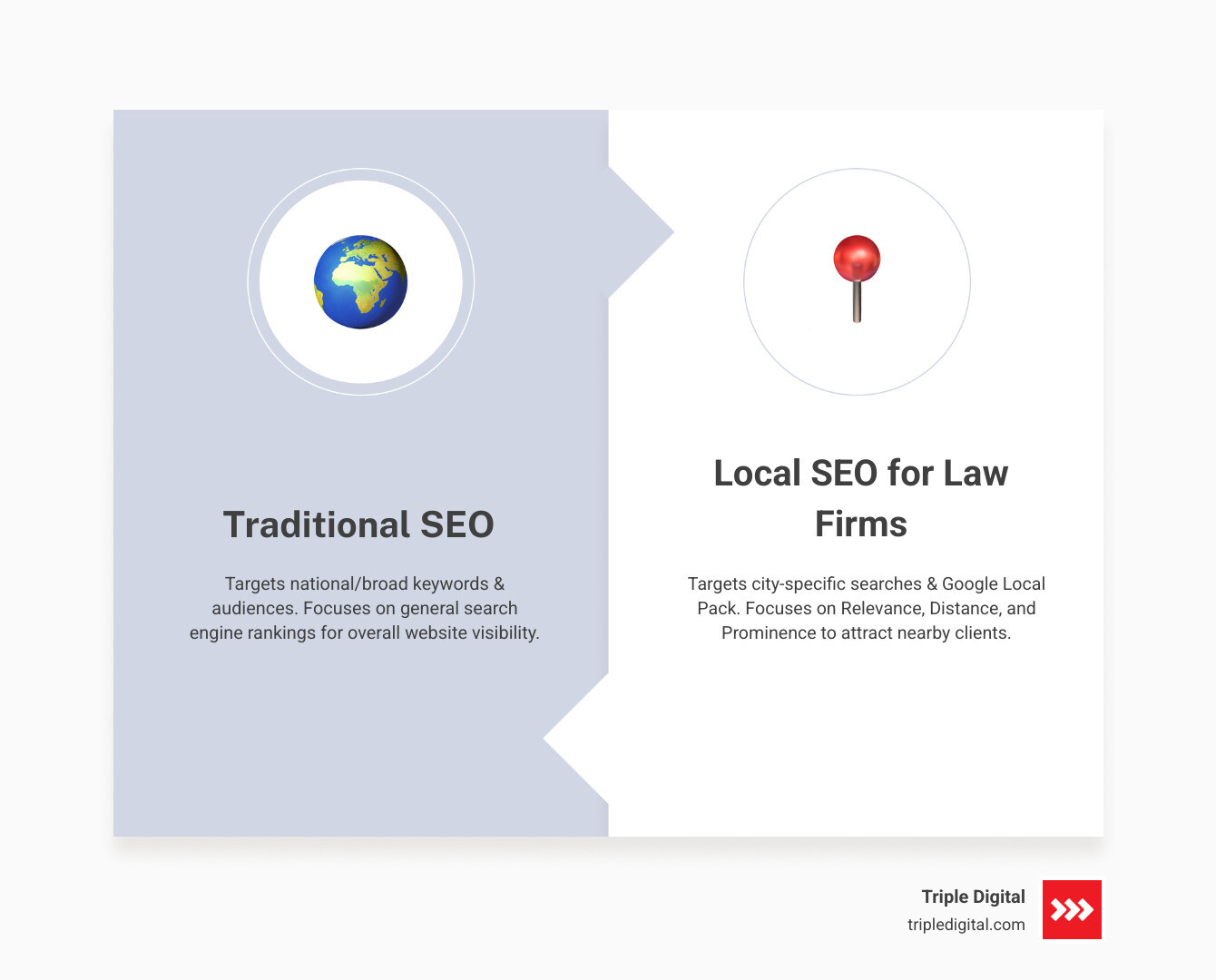
Google determines local rankings based on three factors:
- Relevance – How well your listing matches what someone is searching for
- Distance – How close you are to the searcher’s location
- Prominence – How well-known and reputable your firm appears online
The good news? Unlike traditional SEO where you’re competing nationally, local SEO lets you dominate your specific geographic market. You’re not trying to outrank every law firm in America—just the ones in your city or county.
Step 1: Build Your Local Foundation with Google Business Profile
If you’re a law firm in Houston, TX, and you want to be found by local clients, your first and most critical step is to master your Google Business Profile (GBP). Think of your GBP as your law firm’s digital storefront on Google. It’s often the first thing potential clients see, appearing prominently in local search results and Google Maps. Optimizing this free tool is non-negotiable for any serious local SEO for law firm strategy.

First things first: claim and verify your Google Business Profile. If you haven’t already, Google will walk you through a simple verification process, usually by mail or phone, to confirm you’re the legitimate owner. Once verified, it’s time to make your profile shine.
We need to fill out every single field with accurate, detailed, and keyword-rich information. This includes your business name, address, phone number, website, hours of operation, and a compelling business description. Google uses this information to understand what your firm does, where it’s located, and who it serves. An optimized GBP is like a mini-website, providing crucial information directly within search results. For more detailed tips on maximizing this powerful tool, check out our guide on 5 GMB Hacks Not to Miss to Generate More Leads.
The Critical Importance of NAP Consistency
Imagine Google as a highly efficient, but slightly obsessive, librarian. It wants all its information to be perfectly organized and consistent. That’s where NAP consistency comes in. NAP stands for Name, Address, Phone Number. For law firms, we often expand this to NAP+W, including your Website.
Everywhere your law firm is mentioned online – on your website, social media, online directories, legal listings – your Name, Address, and Phone Number (and website) must be identical. Even small discrepancies, like using “St.” instead of “Street” or including a suite number on one listing but not another, can confuse search engines. When Google sees inconsistent information, it questions the legitimacy and accuracy of your business, which can negatively impact your local search rankings.
To ensure your NAP+W is consistent, start by auditing your current online presence. There are free online presence checkers that can help identify where your information might be inconsistent. Once you find discrepancies, systematically correct them across all platforms. This meticulous attention to detail signals to Google that your Houston law firm is legitimate, established, and trustworthy.
Leveraging GMB Features for Maximum Visibility
Beyond the basic information, your Google Business Profile offers a suite of features that, when actively used, can significantly boost your visibility and engagement.
- GMB Posts: Think of these as mini-blog posts directly on your GBP. You can use them to announce new services (e.g., “New Houston Personal Injury Service!”), share firm news, promote events, or highlight recent successes. Regular posting keeps your profile active and provides fresh content for Google to index. Always include a clear call-to-action and a link back to relevant pages on your website.
- Q&A Feature: This section allows users to ask questions directly on your profile, and anyone can answer. We highly recommend proactively asking and answering common questions about your Houston law firm or practice areas yourself. This ensures accurate information is provided and demonstrates your expertise and responsiveness.
- Enabling Messaging: Allow potential clients to message your firm directly through GBP. This provides an immediate, low-barrier way for them to connect with you, especially for those who prefer texting over calling.
- Showcasing Practice Areas: Clearly list all the legal services your firm offers. Be specific! Instead of just “Litigation,” list “Houston Car Accident Lawyer,” “Houston Family Law,” or “Houston Criminal Defense.”
- High-Quality Photos: Visuals are incredibly important. Businesses with photos get 42% more driving direction requests and 35% more clicks through to their website. Upload professional photos of your office interior and exterior, your team, and even relevant local landmarks in Houston. Before uploading, rename your image files with keywords and your location (e.g.,
houston-criminal-defense-lawyer-office.jpg). This helps Google understand the context of the images.
By actively engaging with these GBP features, your law firm isn’t just a static listing; it’s a dynamic, informative, and engaging presence that Google loves to show to local searchers. To dive deeper into the elements that truly move the needle, explore our insights on Law Firm SEO: What Are the Most Important SEO Ranking Factors?.
Step 2: The Core Strategies for Local SEO for Law Firm Success
Once your Google Business Profile is a gleaming guide for potential clients, it’s time to extend that light to your entire online presence. A comprehensive local SEO for law firm strategy involves several interconnected components, all designed to make your firm the most visible and reputable choice in Houston. These core strategies include meticulous on-page SEO, a robust content strategy, strategic off-page SEO, effective link building, foundational technical SEO, and an exceptional user experience (UX). Each piece plays a vital role in Google understanding and trusting your firm’s authority. For a broader perspective on these interconnected efforts, take a look at our Top 3 Digital SEO Strategies for Law Firms.
Optimizing Your Website: The On-Page Local SEO for Law Firm Checklist
Your law firm’s website is your 24/7 digital salesperson. For local SEO, it needs to be custom to attract and convert clients specifically from the Houston area.

- Geo-Specific Keyword Research: This is where we identify the exact phrases Houstonians are typing into Google when they need legal help. We don’t just look for “personal injury lawyer”; we dig for “Houston personal injury lawyer,” “car accident attorney near me Houston,” or “divorce lawyer downtown Houston.” Tools like Google’s Keyword Planner, autocomplete suggestions, and the “People Also Ask” section in search results can uncover these high-intent local keywords.
- Creating Location-Specific Landing Pages: If your firm serves different areas within Houston or specializes in various practice areas, dedicated landing pages are a game-changer. For example, instead of one generic personal injury page, create “Houston Car Accident Lawyer,” “Houston Truck Accident Lawyer,” and “Houston Motorcycle Accident Lawyer” pages. Each page should be unique, detailed, and optimized for its specific keyword and location. We’ve seen firms achieve incredible results; for instance, one firm drove 25% of their total traffic and 46% of their conversions through just three local pages in three months.
- Optimizing Title Tags, Meta Descriptions, and Headers: These are critical on-page elements. Your page’s title tag (what appears in the browser tab) and meta description (the short blurb under the title in search results) should include your primary local keyword and a compelling call to action. Keep title tags under 60 characters and meta descriptions under 160 characters. Use header tags (H1, H2, H3) to structure your content, including relevant keywords naturally throughout.
- Mobile-First Design & Website Speed: With over 60% of searches happening on mobile devices in the United States, your website must be mobile-friendly and lightning-fast. Google uses Core Web Vitals (metrics like loading speed, interactivity, and visual stability) as ranking factors. A slow, clunky mobile experience will send potential clients straight to your competitors. Ensure your site loads quickly and looks great on all devices. A well-designed website isn’t just pretty; it’s profitable. Find more about How Web Design Can Make Your Business More Profitable.
- Implementing LegalService Schema Markup: This is a bit more technical, but incredibly powerful. LegalService schema is a type of structured data that tells Google specific details about your law firm – your office locations, service areas, practice areas, and lawyer credentials. By implementing this, you can trigger “rich snippets” in search results, making your listing stand out with extra information like star ratings or business hours. Always test your schema implementation using Google’s Structured Data Testing Tool to ensure it’s correctly interpreted.
Building Authority with Citations, Reviews, and Backlinks
- The Role of Online Reviews: 90% of people read online reviews from previous clients before choosing a lawyer. This isn’t just about social proof; reviews are a significant local ranking factor. 82% of potential clients check online reviews before choosing a lawyer, and 80% trust firms that have 4.0 to 5.0-star ratings the most. More positive, keyword-rich reviews (e.g., “Attorney Smith is the best divorce lawyer in Houston!”) signal to Google that your firm is reputable and provides excellent service.
- How to Ask for Reviews: Make it easy! After a successful case, send a polite email with a direct link to your Google Business Profile review page. You can also use review cards in your office.
- Responding to Reviews: Always respond to all reviews, positive or negative. For positive reviews, a simple “Thank you!” suffices. For negative ones, respond professionally and empathetically. Offer to discuss their concerns offline without revealing client-specific details. This shows potential clients that you’re responsive and care about client satisfaction.
- Building Citations on Reputable Legal and Local Directories: Citations are mentions of your law firm’s Name, Address, and Phone Number (NAP) on other websites. These can be legal directories, local business listings, or even social media profiles. The more consistent and accurate your NAP information is across these sites, the more legitimate Google perceives your firm to be.
- Legal Directories: Prioritize authoritative legal directories like Avvo, Justia, and FindLaw. Ensure your profiles are complete, accurate, and optimized with your targeted keywords and practice areas.
- Local Business Directories: Don’t forget general directories like Yelp, BBB, and your local Houston Chamber of Commerce. These reinforce your local presence.
- Local Link Building Strategies: Backlinks (links from other websites to yours) are still a major ranking factor. For local SEO, we focus on acquiring links from locally relevant and authoritative websites.
- Sponsoring Local Events: Sponsoring a local charity event or community initiative in Houston can lead to mentions and links from local news sites or event pages.
- Local Outreach: Partner with other local businesses (non-competing, of course!), offer to write a guest blog post for a local publication, or connect with local legal groups.
- Content That Earns Links: Create valuable, localized content that others in Houston might want to link to. This could be a guide to “Houston DUI Laws,” a “Guide to Divorce in Harris County,” or local legal statistics. A strong content marketing strategy is essential for earning these valuable links.
Step 3: Measuring Success and Upholding Ethical Standards
Implementing a robust local SEO for law firm strategy is an investment of time and resources. To ensure this investment pays off, we must diligently measure our success and always operate within the strict ethical guidelines of the legal profession.
Measuring ROI: Is local SEO for law firms worth it?
Absolutely! Local SEO is not just about vanity metrics like rankings; it’s about tangible business growth. The goal is to convert local searches into signed cases.
- Tracking Keyword Rankings: We monitor where your Houston law firm ranks for its target local keywords. Are we showing up in the Local Pack for “Houston personal injury lawyer”? Are we climbing the organic search results for “family law attorney Houston”?
- Monitoring Organic Traffic: Google Analytics is our best friend here. We track how many people are visiting your website from organic search results, where they’re coming from, and what pages they’re engaging with.
- Using Google Search Console: This free tool helps us understand how your site performs in Google Search. We can see which keywords are bringing traffic, monitor your click-through rates, and identify any technical issues.
- Call Tracking: For law firms, phone calls are often the lifeblood of lead generation. We implement sophisticated call tracking systems to attribute phone calls directly to your local SEO efforts. This lets us know precisely which strategies are driving those valuable client inquiries. Understanding why tracking numbers are so important to track leads is crucial for accurate ROI measurement.
- Form Submission Tracking: We also track form submissions on your website, allowing us to see how many potential clients are reaching out through your contact forms.
- Comparing Costs: When you compare the cost per lead from local SEO to traditional marketing channels like billboards or print ads, the ROI for local SEO is often significantly higher. Firms using local SEO for law firms generate leads at a 50-75% lower cost than pay-per-click (PPC) advertising. This means your marketing dollars go further, bringing in more cases for less.
Navigating Ethical Waters in Legal Marketing
While the digital landscape offers immense opportunities, law firms must always adhere to the strict ethical guidelines governing attorney advertising. The American Bar Association (ABA) Model Rules of Professional Conduct (and by extension, the Texas Bar Association rules) are paramount.
- Truthful Advertising: All claims made in your local SEO content, GMB profile, and website must be truthful and not misleading. Avoid language that guarantees results or promises specific outcomes.
- Disclaimers for Specializations: If your firm claims a specialization (e.g., “Board Certified in Personal Injury Law”), ensure you include any necessary disclaimers as required by your state bar.
- Client Confidentiality: When responding to online reviews, be extremely careful not to reveal any confidential client information. Professional, generic responses are always best.
- Ethical Keyword Use: Focus on naturally incorporating location-specific terms that accurately reflect your practice areas and jurisdiction. For instance, “Houston criminal defense attorney serving downtown” is ethical. Claims like “Best criminal lawyer in Houston” or “Highest success rate in divorce cases” can be problematic without objective substantiation.
- Maintaining Professionalism: Your online presence, from your GMB photos to your website content, should always reflect the professionalism and integrity of your law firm.
Adhering to these ethical considerations not only protects your firm from potential disciplinary action but also builds a foundation of trust and credibility with potential clients. As we often say, Why SEO is Important for Attorneys goes beyond just rankings – it’s about building a respected and thriving practice.
Frequently Asked Questions about Local SEO for Lawyers
How long does it take for local SEO to show results?
Local SEO, like all good things, takes time. It’s not a sprint; it’s a marathon. While you might see some initial improvements in your Google Business Profile visibility within 3-6 months, achieving significant local pack rankings and consistent lead flow often requires 6-12 months or even longer of sustained effort. Factors like the competitiveness of your practice area in Houston, your current online presence, and the budget allocated to your strategy all influence the timeline. Consistency in optimizing your GBP, building citations, generating reviews, and creating local content is key. It’s an ongoing process, not a one-time fix, because Google’s algorithm is constantly evolving, and your competitors aren’t standing still!
What’s more important: my website or my Google Business Profile?
This is a bit of a trick question, as they are both incredibly important and work hand-in-hand! Your Google Business Profile (GBP) is undeniably crucial for local visibility. It’s what gets you into the coveted Local Pack and Google Maps results, often appearing above traditional organic listings. For “near me” searches, your GBP is often the first point of contact.
However, your website is equally essential. While your GBP gets you seen, your website is where potential clients go for detailed information, to understand your expertise, read attorney bios, explore practice areas, and ultimately, to convert into a client. A strong, well-optimized website also significantly boosts your GBP’s “prominence” factor, helping it rank higher. Think of your GBP as the billboard that grabs attention, and your website as the welcoming office where you close the deal. Both must be optimized in tandem for maximum local SEO for law firm success.
Can I do local SEO myself or should I hire an agency?
You can absolutely handle some basic local SEO for law firm tasks yourself, especially if you have the time and a keen interest in learning. Setting up and optimizing your Google Business Profile, encouraging reviews, and even basic on-page website optimization are achievable DIY tasks.
However, local SEO is complex, constantly evolving, and incredibly time-consuming. It requires ongoing keyword research, content creation, technical adjustments, link building, and performance analysis. For busy law firms in a competitive market like Houston, dedicating the necessary hours can be challenging.
Hiring a specialized agency like Triple Digital can accelerate your results and provide a significant return on investment. We bring expert knowledge, advanced tools, and a dedicated team focused solely on driving leads and cases for law firms. We can steer the complexities, stay updated on algorithm changes, and execute comprehensive strategies more efficiently, allowing you to focus on what you do best: practicing law. If you’re wondering about the investment, explore Should I Hire a Marketing Agency to Run My Law Firm?.
Conclusion: Turn Local Searches into Signed Cases
The digital landscape has fundamentally changed how clients find legal representation. For law firms in Houston, local SEO for law firm strategies are no longer optional—they are absolutely essential for survival and growth. We’ve explored the core components: building a robust Google Business Profile, optimizing your website with geo-specific content, and building authority through reviews, citations, and quality backlinks.
The message is clear: local SEO is the most cost-effective way to attract high-intent clients who are actively searching for legal help right in your backyard. Potential clients are looking for “the best attorney near me,” and your firm needs to be the answer.
The future of legal marketing is local and digital. At Triple Digital, we specialize in a results-driven, “less fluff, more cases” approach, leveraging AI and data mining for precise client targeting right here in Houston. We’re dedicated to helping law firms like yours dominate their local market and convert those local searches into valuable signed cases.
Don’t let your next client find your competitor. Take the next step towards a powerful online presence. Develop your law firm’s digital marketing strategy with us today.