





Web Design for Law Firms: The Features That Drive More Cases
Why Your Law Firm’s Website Is Your Most Important Marketing Tool
Web design for law firms is one of the highest-leverage investments a practice can make — because for most potential clients, your website is your first impression.
Here’s what effective law firm web design includes:
- Essential pages: Home, About, Attorney Bios, Practice Areas, Contact, Testimonials
- Design principles: Simple layout, mobile-friendly, fast loading, clear navigation
- Conversion elements: Visible CTAs, intake forms, trust signals, client reviews
- Technical requirements: ADA compliance, schema markup, Core Web Vitals, local SEO
- Compliance: State bar advertising rules, disclaimer requirements, ethical copy review
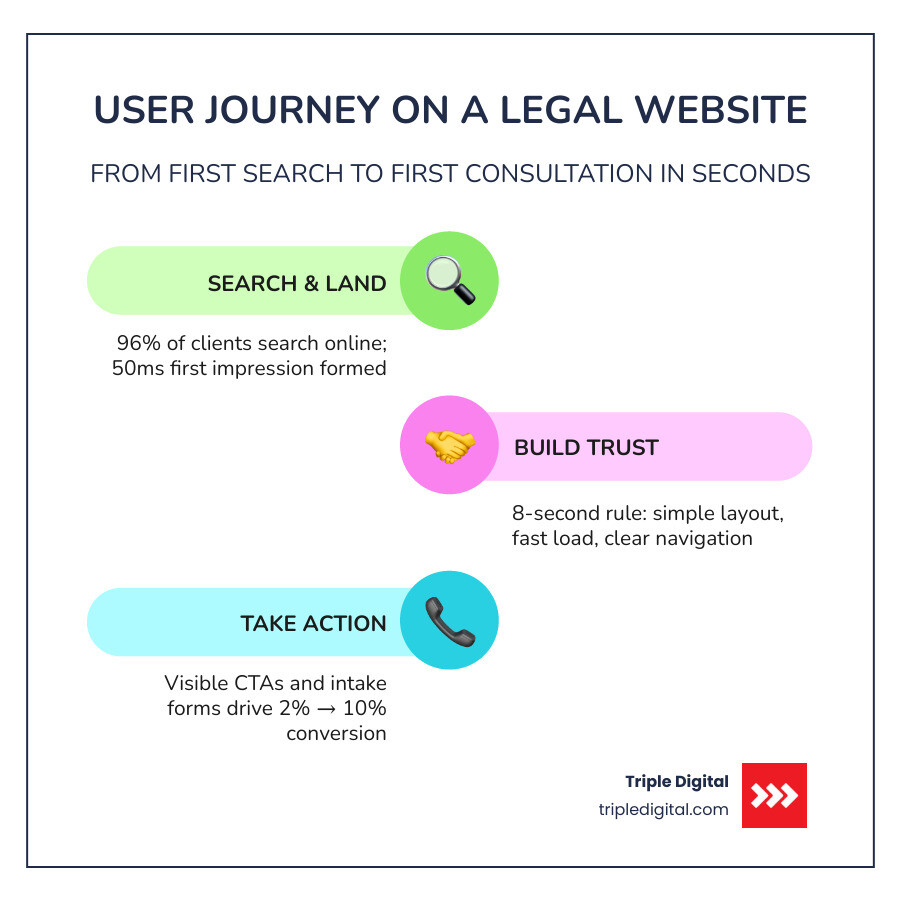
The numbers tell a clear story. 96% of potential clients search online before hiring an attorney. And when they land on your site, you have almost no time to make your case — research shows it takes just 50 milliseconds for a visitor to form an opinion about your website. That’s faster than a blink.
After those first 50 milliseconds, you get roughly 8 seconds to show them they’re in the right place. If your site is slow, confusing, or looks outdated, they’re gone — and your competitor gets the call.
The gap between average and great is massive. Most attorney websites convert around 2% of visitors into consultations. The best-performing ones hit 10% or higher. That’s five times more clients from the exact same traffic.
Your website isn’t a digital brochure. It’s a client acquisition machine — or it should be.
Web design for law firms vocab to learn:
Essential Elements of Web Design for Law Firms
When someone needs a lawyer, they are often dealing with a stressful, high-stakes situation. Whether they are seeking guidance on a business merger or navigating a complex family matter, they want to feel reassured the second they land on your page. Your website serves as your “digital handshake” — a firm, professional greeting that immediately establishes trust, authority, and approachability.
To build this trust online, we must design with the user’s emotional state in mind. A chaotic layout with flashing banners and tiny, unreadable text communicates disorganization. On the other hand, a clean, structured, and fast-loading site tells a prospect that you handle your legal cases with the exact same level of precision and care.
To turn casual browsers into actual consultations, you must look Beyond the Homepage: Maximizing Your Legal Website’s Potential and construct a cohesive user experience across every single subpage.
Key Principles of Web Design for Law Firms
To design a high-performing legal website in 2026, we follow several fundamental visual and structural design principles:
- Keep it Simple and Clean: White space is your friend. Do not overwhelm visitors with walls of dense legal jargon. Keep layouts spacious, readable, and highly purposeful.
- The F-Pattern Layout: Eye-tracking studies show that web users read content in an “F” pattern — scanning horizontally across the top, then down the page, and across a second horizontal line. We place your most critical value propositions, contact numbers, and call-to-action (CTA) buttons along these natural visual paths.
- Mobile-First Responsiveness: Over 60% of all legal web traffic comes from mobile devices. If your website looks great on a desktop but breaks on a smartphone, you are alienating more than half of your potential client base. Every button, form, and menu must function flawlessly on smaller screens.
- Intuitive Navigation: Your menu should sit clearly at the top of the page. Visitors should never have to guess how to find your practice areas, attorney bios, or contact details.
- High-Quality Imagery Over Boring Stock Photos: Avoid generic, cheesy stock photos of plastic-looking handshakes or wooden mallets. Instead, invest in high-resolution, professional photography of your actual team and office. It makes your firm feel real, approachable, and authentic.
Core Pages Every Attorney Website Needs
A comprehensive, trust-building law firm website requires a strategic page architecture. Each page has a specific job to do in moving the user closer to booking a consultation:
- Homepage: Your digital storefront. It must immediately communicate who you are, what practice areas you focus on, who you serve, and exactly what action the visitor should take next.
- About Us: This is where you tell your firm’s story, share your mission, and explain what sets your team apart from the sea of competitors.
- Practice Area Pages: Dedicated pages for each area of law you practice. These pages should be educational, explaining complex legal concepts in simple, everyday language while proving your deep expertise in that specific niche.
- Attorney Bios: Often the most-visited pages on a legal website. Prospective clients want to know exactly who will be handling their sensitive matters. Include professional headshots, credentials, education, community involvement, and a touch of personality to build human connection.
- Contact Page: A streamlined page featuring your physical office address, phone number, email, interactive map, and a secure contact form.
- Testimonials & Reviews: Social proof is incredibly persuasive. Spotlighting positive feedback from past clients builds immediate credibility.
- Case Results & Disclaimers: Sharing successful outcomes is a powerful marketing tool, but it must always be accompanied by clear, legally compliant disclaimers stating that past results do not guarantee future outcomes.
Balancing Aesthetics with Conversion Architecture
A beautiful website is useless if it does not generate actual business. To bridge the gap between stunning visuals and real-world profitability, we employ “conversion architecture.” This refers to the deliberate layout of design elements to guide a user toward a single, clear action: contacting your firm.
To move a user from reading to reaching out, we implement several key conversion elements:
- Sticky Headers: Keep your phone number and “Book a Consultation” button visible at the top of the screen even as users scroll down.
- Simplified Intake Forms: Only ask for essential information (Name, Email, Phone, and a brief description). Long, invasive forms with dozens of fields kill conversion rates.
- Prominent Call-to-Actions (CTAs): Use contrasting colors for your CTA buttons so they naturally pop out from the background.
- Trust Signals Above the Fold: Display badges of legal organizations, peer ratings, or local business awards near the top of your homepage to establish instant authority.
Moving your website’s conversion rate from a standard 2% to an optimized 10% effectively quintuples your leads without spending an extra dime on driving traffic. This is precisely How Web Design Can Make Your Business More Profitable over the long haul.
Technical and Compliance Requirements for Legal Sites
Behind the beautiful colors and elegant layouts lies the engine of your website. In 2026, search engines and users demand ultra-fast, secure, and highly accessible digital experiences. If your site fails on a technical level, Google will bury your rankings, and users will bounce before your homepage even finishes loading.
To build a strong foundation, we design with modern technical requirements in mind. For a deep dive into our development process, explore our approach to Website Development Design.
SEO, Schema, and AI Search Readiness
To win cases, you first have to win the search engine results page. Law firm SEO relies heavily on clean code, fast load times, and structured data that helps search engines understand exactly who you are and where you practice.
- Sub-2-Second Load Times: Page speed is a critical ranking factor. If your site takes longer than two seconds to load, your bounce rate will skyrocket. We optimize all images, leverage clean coding practices, and use high-performance hosting to keep your site lightning-fast.
- Local SEO Foundation: Most legal clients look for representation close to home. Your web design must make your geographic focus completely clear to search engines through localized landing pages and consistent NAP (Name, Address, Phone Number) data.
- Legal Schema Markup: Schema is a specialized microdata code added to your website that helps search engines understand your content. By implementing
LegalService,Attorney, andFAQPageschema, you make it easier for search engines to display your firm’s operating hours, reviews, and physical locations directly in search results. - GEO & AEO Readiness: In 2026, search has evolved. AI search platforms and generative engines pull direct answers from websites to answer user queries. By structuring your content with clear, authoritative headings, direct answers, and structured FAQ schema, we ensure your firm is the one recommended by AI search assistants.
State Bar Advertising Rules and Ethics
Unlike generic e-commerce or lifestyle websites, law firm websites operate under strict ethical guidelines. Most marketing agencies are completely unaware of the unique challenges posed by state bar advertising rules, which can lead to costly compliance headaches.
When designing and writing copy for your site, we always keep the following ethical rules in mind:
- No Misleading Claims: Avoid using terms like “specialist,” “expert,” or “the best” unless you hold specific, state-sanctioned certifications that permit those terms.
- Mandatory Disclaimers: Case results and testimonials must be paired with clear, prominent disclaimers explaining that past success does not guarantee a similar outcome in future cases.
- Honest Testimonials: Reviews must be genuine, and in many jurisdictions, you cannot pay or provide incentives to clients in exchange for reviews.
- Attorney-Reviewed Content: Every piece of copy on your website should be thoroughly vetted by a licensed attorney to ensure absolute compliance with local bar rules.
Custom vs. Template Web Design for Law Firms
When planning a website redesign, law firms generally face a choice: build a custom website from scratch, or use a template-based platform or agency subscription service.
While templates can seem appealing for their low upfront costs, they often come with hidden downsides that can hurt your firm’s growth in the long run.
| Feature | Custom Web Design | Template / Agency Subscriptions |
|---|---|---|
| Upfront Cost | Moderate to High | Low |
| Ongoing Monthly Fees | None (you only pay for basic hosting) | High monthly subscription costs |
| Ownership & Control | 100% yours; you own the code and files | You lease the site; if you cancel, you lose it |
| Site Speed & Performance | Ultra-fast; built with clean, custom code | Often bloated with heavy, unnecessary code |
| SEO & Rankings | Highly optimized for local SEO & schema | Harder to customize for advanced SEO needs |
| Design Uniqueness | Fully tailored to your brand & target audience | Looks identical to hundreds of other law firms |
Using an open-source content management system (CMS) like WordPress for a custom build gives your firm absolute ownership and control over your digital storefront. To help you weigh your options and find the right fit for your practice, read our guide on How to Choose the Best Lawyer Website Design Firm for Your Practice.
Frequently Asked Questions About Legal Web Design
How long does it take to see results from a new law firm website?
While a new website is live immediately upon launch, search engine indexing and organic traffic growth take time. Generally, you can expect search engines to crawl and index your new structural changes within a few weeks.
However, when a site is designed with conversion architecture from day one, the impact on your business can be incredibly rapid. For example, a comprehensive redesign can result in a +42% increase in consultation requests within just one month of launching, alongside a +60% increase in overall website traffic as search engines reward the faster, more user-friendly experience.
Why is ADA compliance critical for law firm websites?
ADA (Americans with Disabilities Act) compliance is no longer optional. Law firms across the United States are increasingly being targeted by web accessibility lawsuits. To protect your firm and ensure all potential clients can access your services, your site must align with WCAG 2.1 AA (Web Content Accessibility Guidelines) standards.
This includes technical requirements such as full keyboard navigation support (for users who cannot use a mouse), clear heading hierarchies, high color contrast ratios for readability, and descriptive alt text for all images so screen readers can interpret them accurately.
How do we measure the performance of our legal website?
We measure success using real, bottom-line data, not vanity metrics. The most critical metrics to track include:
- Conversion Rate: The percentage of website visitors who actually reach out via phone, chat, or intake form.
- Bounce Rate: The percentage of visitors who leave your site after viewing only one page. A high bounce rate usually indicates slow load times or confusing design. (Our optimized redesigns frequently cut bounce rates by 30% or more).
- User Behavior Tracking: Using tools to analyze where users click, how far they scroll, and where they get stuck.
- Source of Leads: Tracking exactly which search terms or local landing pages are driving your highest-value consultation calls.
Conclusion
At the end of the day, your website should not just look pretty — it needs to bring in cases.
At Triple Digital, we are a Houston-based digital marketing agency specializing in high-performance lead generation and case acquisition for law firms. We do not believe in vanity metrics or empty promises. Our unique selling proposition is a results-driven, “less fluff, more cases” approach. By leveraging cutting-edge AI and advanced data mining, we pinpoint and target the exact clients your firm is looking to serve.
If you are ready to stop losing potential clients to outdated design and slow load times, let’s build a digital storefront that works as hard as you do. Explore our Triple Digital Services today, and let’s turn your website into a 24/7 client acquisition machine.