





Lawyer website developer: A Complete Guide to Law Firm Web Development
Your Law Firm’s Website Is Your Most Important Marketing Asset
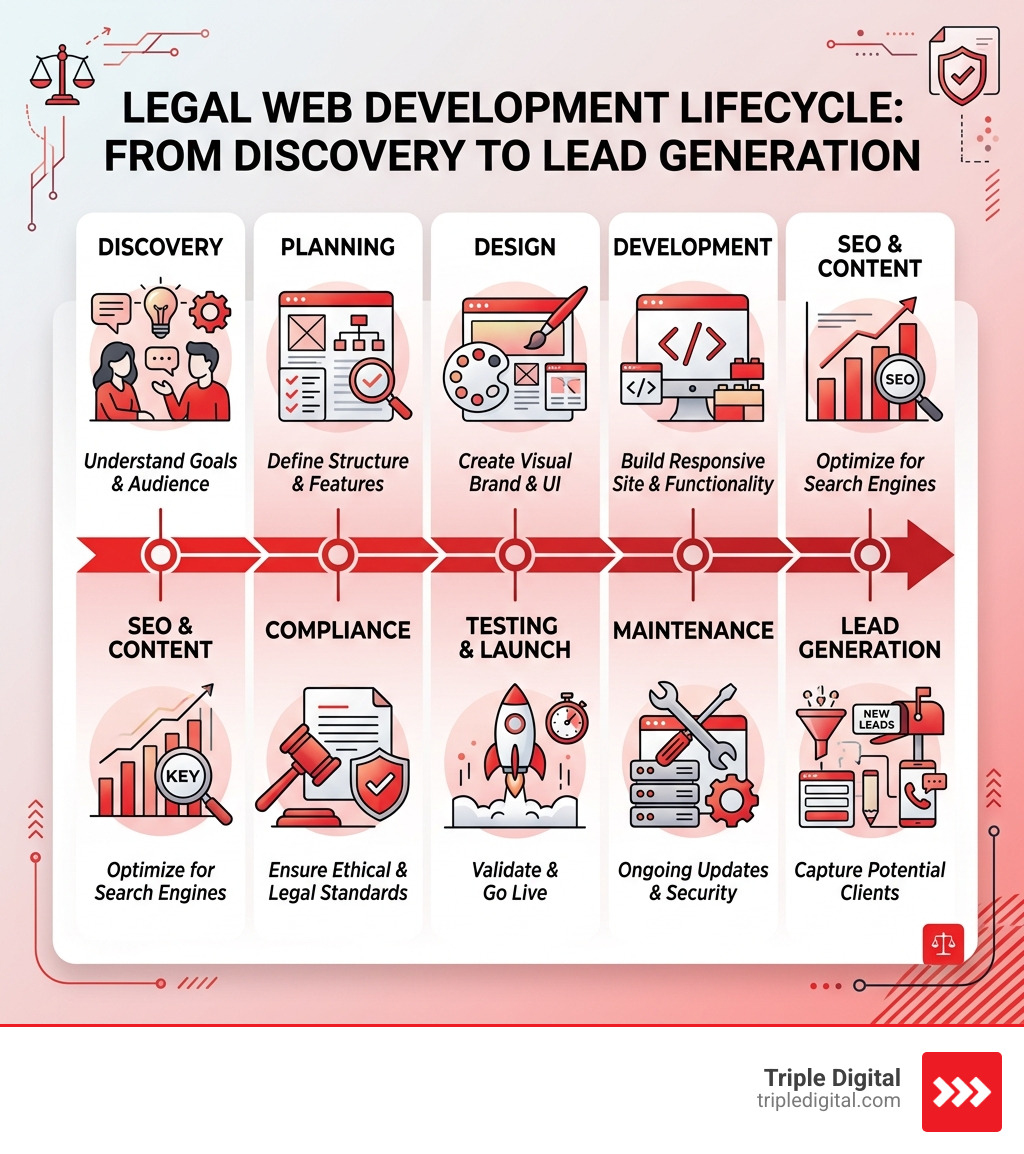
A lawyer website developer is a web professional who specializes in building websites specifically for law firms and attorneys — handling everything from design and technical SEO to ABA compliance and lead generation.
Here’s what they typically do for your firm:
- Build and design your website to reflect your practice areas and brand
- Optimize for search engines so clients can find you on Google
- Ensure compliance with attorney advertising rules and state bar requirements
- Set up lead capture tools like contact forms, chat, and intake integrations
- Maintain and secure your site after launch
Your potential clients are forming opinions about your firm before they ever call you. In most cases, your website is the first thing they see.
Think of it as a digital handshake. A weak one loses the case before it starts.
According to the ABA’s 2023 Websites & Marketing TechReport, 42% of law firms that hired outside marketing help did so specifically for website design — making it the single most outsourced marketing activity in the legal industry. That tells you something: attorneys know their website matters, but most don’t have the time or expertise to get it right.
The problem? Many law firms either rely on outdated sites, hand the job to a generalist developer who doesn’t understand legal marketing, or try to DIY it with a basic website builder. The result is a site that looks unprofessional, ranks poorly, and converts almost no visitors into actual clients.
Getting this right requires a specialist — not just any web developer.
Defining the Role of a Lawyer Website Developer
When we talk about a lawyer website developer, we aren’t just talking about someone who knows how to write HTML or CSS. In the legal world, a developer must wear multiple hats: part technologist, part marketing strategist, and part ethics consultant.
The legal industry is unique. Unlike a local bakery or a retail shop, law firms are governed by strict state bar rules and ABA guidelines regarding how they can present themselves online. A specialized developer understands that “the best lawyer in Houston” might be a great search term, but using it could land you in hot water with ethics committees if not handled correctly.
Beyond coding, these professionals focus on How Web Design Can Make Your Business More Profitable by creating a frictionless path from a Google search to a signed retainer.
Why Generalists Fail Where a Lawyer Website Developer Succeeds
We often see firms hire a generalist agency or, worse, their “nephew who is good with computers.” While these folks might build a site that “looks nice,” they often miss the nuances of legal practice. Here is where the specialists win:
- Attorney Advertising Rules: Specialists know how to include required disclaimers and avoid prohibited “specialist” terminology unless the attorney is board-certified.
- Client Confidentiality: They implement bank-level security and encrypted contact forms to protect sensitive intake data.
- Legalese Accuracy: They understand the difference between “personal injury” and “wrongful death” and ensure the site architecture reflects these distinct practice areas.
- Conflict Checking & Intake: A specialized developer can integrate your site directly with case management software (like Clio) to streamline the conflict-check process.
Essential Services Beyond Basic Coding
A high-quality developer offers a suite of services that ensure your firm stays relevant long after the site launches. This includes:
- Branding: Developing logos, typography, and color schemes that instill confidence.
- Content Strategy: Creating practice area pages that answer the specific questions your clients are asking.
- Managed Hosting: Providing secure, fast servers specifically optimized for WordPress or high-performance frameworks.
- Ongoing Maintenance: Keeping plugins updated and security patches applied to prevent hacking.
To see more about the visual and structural side of these projects, you can explore our Category Web Design section.
Essential Features of High-Performance Legal Sites
In April 2026, a “good” website isn’t enough. To compete in crowded markets like Houston, your site needs to be a high-performance machine. This starts with mobile-responsiveness. With more than half of all web traffic now coming from mobile devices, a site that doesn’t work perfectly on a smartphone is essentially invisible.
Furthermore, search engines like Google now prioritize “Core Web Vitals.” This is a fancy way of saying they reward sites that load quickly, remain stable while loading, and respond instantly to user input. If your site takes more than two seconds to load, potential clients will bounce back to the search results and click on your competitor.
Critical Pages for Your Lawyer Website Developer to Build
Your website’s structure should be intuitive. While every firm is different, there are several “non-negotiable” pages every legal site needs:
- Individual Practice Area Pages: Don’t just list your services on one page. Each area (e.g., “Car Accidents,” “Divorce,” “Probate”) needs its own dedicated, SEO-optimized page.
- Attorney Bios: People hire people, not firms. High-quality photos and detailed bios are essential for building trust.
- Case Results/Testimonials: Within the bounds of your state bar’s ethics rules, showing your track record is the most powerful way to convert a visitor.
- Contact/Intake Forms: These should be visible on every page, making it as easy as possible for a lead to reach out.
For a deeper dive into these elements, check out Beyond the Homepage: Maximizing Your Legal Website’s Potential.
Custom vs. Template-Based Websites
Many firms face the dilemma of choosing between a custom build and a template. Here is a quick breakdown:
| Feature | Template-Based Site | Custom Law Firm Website |
|---|---|---|
| Cost | Lower upfront (few thousand) | Higher investment ($20k+) |
| Speed to Launch | 2–4 weeks | 8–12 weeks |
| SEO Potential | Limited by code bloat | High (built for performance) |
| Uniqueness | Looks like other firms | 100% unique brand identity |
| Scalability | Hard to add complex features | Built to grow with the firm |
Technical Optimization for Speed and Conversion
The “Two-Second Rule” is real. Research shows that law firm websites must load in under two seconds to prevent losing potential clients. A professional lawyer website developer uses tools like Google Lighthouse to ensure scores stay in the 90+ range. They also integrate lead capture tools and CRM systems so that when a form is filled out, it immediately notifies your intake team, ensuring no lead goes cold.
The Economics of Legal Web Development in 2026
How much should you actually pay for a website? In 2026, the range is wide.
Basic, template-based sites for solo practitioners can start at a few thousand dollars. However, for mid-to-large firms looking for a competitive edge, custom designs often range from $20,000 to $40,000+.
While that might seem like a “sticker shock” moment, consider the ROI. If the industry standard cost per lead is around $200, but a high-performance site can deliver leads at an average of $86 (as seen with top-tier agencies), the website pays for itself within months.
When hiring a developer, always ensure you have full ownership rights. Some “lease-to-own” models exist in the legal world where the agency owns the code and content. Avoid these. You should own your digital assets outright.
Choosing the Right Partner and Avoiding Common Pitfalls
Choosing a partner is about more than just looking at a portfolio. You need to know if they can scale with you. We recommend looking for developers who use flexible Content Management Systems (CMS) like WordPress. It is the gold standard because it allows you to make simple edits (like adding a new blog post) without needing a degree in computer science.
Questions to Ask Your Developer Before Signing
- Do you have experience with my specific practice areas?
- Will the site be fully mobile-responsive and ADA/WCAG compliant?
- Who owns the website, the code, and the content once it’s finished?
- How do you handle ABA and state bar advertising compliance?
- What is your average post-launch support response time?
- Can you integrate my existing CRM or intake software?
One of the biggest mistakes firms make is failing to plan for the “day after launch.” A website is a living thing; it needs updates, security patches, and fresh content to maintain its rankings. Ensure your developer offers a clear maintenance and support plan.
Frequently Asked Questions About Legal Web Design
How much does a custom law firm website cost in 2026?
Most custom law firm websites fall between $15,000 and $40,000. The price varies based on the number of pages, the complexity of the design, and the level of integration with third-party tools like intake software or multilingual translation services.
How long does the development process typically take?
A standard high-quality build takes between 4 and 8 weeks. This includes the discovery phase (learning about your firm), design, content creation, technical development, and rigorous testing before the site goes live.
Do I need a separate SEO agency and web developer?
While you can hire them separately, it is often more efficient to work with an integrated team. A lawyer website developer who understands SEO will bake the “technical SEO” (site architecture, schema markup, and speed) into the very foundation of the site, making it much easier for an SEO team to rank you later.
Boost your Law Firm with Triple Digital
At Triple Digital, we know that for Houston attorneys, a website isn’t a luxury — it’s a lead-generation tool. We specialize in a “less fluff, more cases” approach, using AI and data mining to ensure your website doesn’t just look pretty but actually wins cases.
If you’re ready to stop losing potential clients to firms with better digital handshakes, it’s time to Work with a professional lawyer website developer. Let’s build a site that reflects the quality of your practice and drives the growth your firm deserves.