




What Do Acquisition Marketing Case Studies Reveal About Law Firms?
What Acquisition Marketing Case Studies Teach Law Firms
Acquisition marketing case studies show what turns interest into customers, not just clicks. For law firms, the useful lessons are to target people with a relevant legal need, choose channels that reach them, and track each step from inquiry to signed client. A campaign with fewer leads may be the better one if more of those leads become qualified cases.
The examples ahead cover paid ads, search, email, creative testing, and campaigns that use more than one channel. Their results are worth studying, but they are not benchmarks for law firms. The key question is: Which parts of each approach could improve your firm’s targeting, intake, or cost per signed client?
I’m Paul Taylor, President of Triple Digital, with more than 28 years of experience in marketing and business growth. I use that background to help law firms assess acquisition marketing case studies against the outcome that matters most: retained clients.

Quick look at acquisition marketing case studies:
What Acquisition Marketing Case Studies Reveal About Scalable Growth
When we study growth stories across multiple sectors, five cross-industry examples reveal foundational patterns for customer acquisition. While these figures represent performance in tech, consumer goods, and financial services rather than direct legal-sector benchmarks, their underlying frameworks offer valuable insights for modern law firms.
- Paid growth efficiency: Optimizing ad spend around deeper funnel milestones reduces acquisition waste.
- Omnichannel expansion: Diversifying across search, social, and video generates sustained lead volume.
- Structured intake funnels: Transitioning from founder-led consults to standardized pipeline stages lowers the cost per qualified opportunity.
- Iterative creative testing: High-volume, modular video testing unlocks previously underperforming demographic segments.
- Integrated direct channels: Coordinating physical touchpoints with digital campaigns reinforces ad recall and trust.
Acquisition marketing case studies: paid growth with tighter economics
In a prominent fintech campaign, a consumer savings app scaled ad spend 4x while sustaining a 126% Return on Ad Spend (ROAS) and reducing its Cost Per Acquisition (CPA) by 20%. The turning point came when the growth team stopped optimizing campaigns for top-of-funnel free trial signups and shifted focus to a deeper downstream milestone: connecting a bank account. Data revealed that 91.3% of users who connected their accounts converted into paying users.
For law firms, the lesson is clear: optimizing ad campaigns purely for low-cost phone inquiries or form fills often generates low-intent inquiries. When campaigns optimize for deeper conversion milestones—such as a completed intake questionnaire or a scheduled consultation—intake teams spend less time sifting through unviable leads.
Acquisition marketing case studies: omnichannel expansion and lead growth
A national student-loan refinancing brand scaled its lead volume 40x over five years by systematically expanding from two initial platforms to more than 10 dedicated acquisition channels, including search, paid social, and programmatic video.
Relying on a single acquisition source leaves an organization vulnerable to algorithm shifts and rising ad costs. By engineering platform-specific messaging for distinct user mindsets across search and social, the company captured prospects across every phase of their evaluation journey.
Founder-led growth to a repeatable acquisition engine
A workflow SaaS platform cut its cost per qualified opportunity by 44% (dropping from $720 to $403) while increasing marketing-sourced pipeline value by 86% across two quarters. The team achieved this by addressing a common bottleneck: the founder handling every initial sales interaction.
By defining shared customer relationship management (CRM) stages between marketing and intake, aligning landing page copy directly with specific search queries (which lifted landing page conversions from 3.4% to 5.8%), and standardizing qualification criteria (increasing demo-to-opportunity conversions from 31% to 45%), the business built a predictable conversion machine independent of executive oversight.
Modular creative and audience testing
A direct-to-consumer wellness brand increased its paid acquisition volume by 972% year-over-year by adopting modular video creative and image-based targeting. Rather than creating expensive, single-concept brand commercials, the team produced modular video components (testing separate hooks, explanations, and calls to action) alongside authentic user-generated style footage.
This rapid testing protocol uncovered specific visual hooks that drove a 4.2x purchase-volume increase within an audience demographic that had previously underperformed.
Physical mail as a digital amplifier
Data across multi-channel campaigns highlights the enduring power of tangible communication. Research indicates that 90% of physical mail is opened, read, or filed, while direct mail engagement rates reach 94%. Crucially, ad recall for digital campaigns rises by 44% when audiences encounter direct mail prior to seeing digital ads. In real-world testing, targeted postcode mailings achieved a 38% lower CPA compared to unsegmented cold outreach.
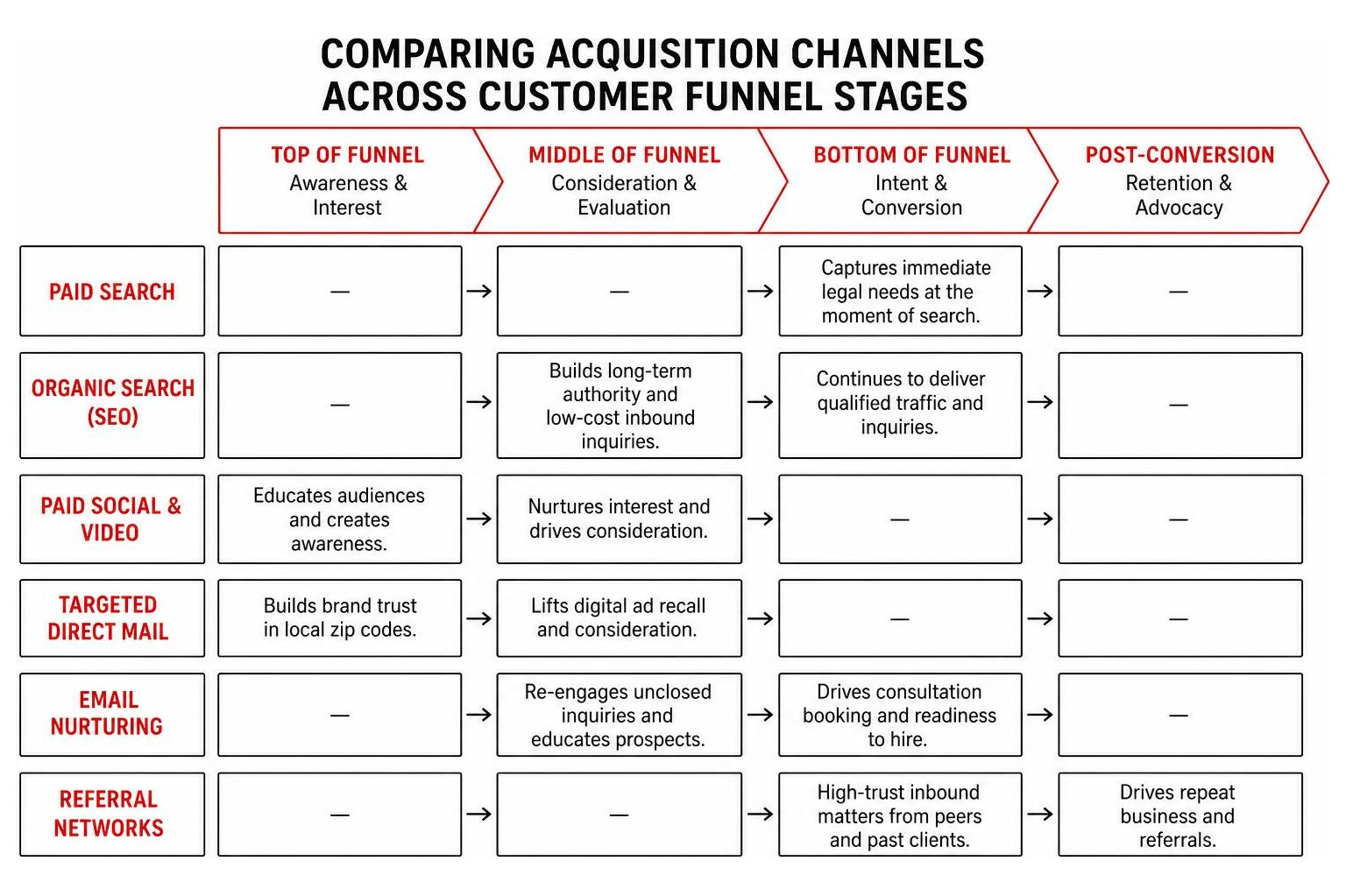
| Acquisition Channel | Primary Funnel Stage | Core Metric to Track | Role in Law Firm Client Acquisition |
|---|---|---|---|
| Paid Search | High-Intent Bottom | Cost Per Qualified Case | Captures immediate legal needs at the moment of search. |
| Organic Search (SEO) | Middle to Bottom | Qualified Organic Traffic | Builds long-term authority and low-cost inbound inquiries. |
| Paid Social & Video | Top to Middle | Engagement & Form Starts | Educates audiences and creates practice-area awareness. |
| Targeted Direct Mail | Top to Middle | Response & Conversion Rate | Amplifies brand trust and lifts digital ad recall in local zip codes. |
| Email Nurturing | Middle Funnel | Consultation Booking Rate | Re-engages unclosed inquiries and educates prospective clients. |
| Referral Networks | Bottom Funnel | Sign-Up Conversion Rate | High-trust inbound matters from professional peers and past clients. |
How Law Firms Can Apply These Acquisition Lessons
Applying broader commercial strategies to legal services requires translating high-volume sales tactics into professional, ethics-compliant practices. A law practice needs predictable caseloads without sacrificing case quality or attorney time.

Choose channels around client intent and firm capacity
Not every practice area functions on the same marketing channel. High-urgency matters, such as emergency criminal defense or commercial litigation defense, demand high-intent search visibility where prospects require immediate assistance. Conversely, estate planning, corporate counsel, and specialized civil claims benefit from educational content, nurture sequences, and paid social campaigns that inform prospective clients before urgent needs arise.
Reviewing structured digital marketing strategies for lawyers helps ensure your marketing budget targets channels where prospective clients actively seek counsel. Selecting the right platform mix prevents intake teams from being overwhelmed by unvetted inquiries.
Use data to improve targeting and reduce waste
Broad geographic targeting and generic keyword selection drain marketing budgets quickly. Law firms must apply rigorous negative keyword strategies, geo-fencing around relevant local jurisdictions, and audience exclusions to eliminate clicks from out-of-market consumers.
Implementing advanced data-powered lead generation allows practices to pinpoint prospects based on jurisdiction, demographic relevance, and specific intent signals. Rather than reviewing raw click volume, firms should measure their cost per qualified lead to safeguard profitability.
Align marketing, intake, and attorneys around shared outcomes
A marketing campaign is only as effective as the intake process that answers the initial call. When marketing agencies report on lead volume while attorneys evaluate retained cases, misalignment occurs.
Firms should integrate their intake software directly with their marketing attribution platforms. Tracking milestones such as initial contact speed, consultation attendance, and matter qualification bridges the gap between ad spend and retained revenue. For a deeper look at pipeline alignment, explore our guide to legal marketing lead generation.
How to Measure and Present a Credible Acquisition Case Study
Evaluating internal marketing campaigns or third-party case studies requires looking beyond vanity metrics like impressions, clicks, or raw lead counts.

Define success beyond clicks and raw lead volume
A successful campaign is defined by firm revenue and caseload quality, not website traffic spikes. True marketing efficiency requires tracking:
- Cost Per Qualified Lead (CPQL): Cost incurred strictly for inquiries that meet practice criteria.
- Consultation Scheduled Rate: Percentage of inquiries that transition into formal attorney discussions.
- Client Retention Rate: Final percentage of qualified leads that sign retainer agreements.
- Average Matter Value: Total fee revenue generated relative to the cost of acquisition.
Firms seeking higher-value casework can review our detailed guide to qualified PI case leads to understand how strict filtering impacts down-funnel retention economics.
Show the full story, including challenges and evidence
Trustworthy acquisition studies present complete context rather than isolated percentage gains. When documenting or reviewing marketing performance, ensure the analysis includes baseline historical numbers, exact timeframes, software attribution models, and practical constraints. Transparent reporting acknowledges challenges—such as seasonal search dips or local ad auction inflation—providing clear insight into true campaign performance.
Frequently Asked Questions About Acquisition Marketing Case Studies
Which acquisition channels are most effective for law firms?
The most effective channels depend directly on client intent and practice area. Bottom-funnel paid search captures immediate legal demand, while localized search engine optimization builds sustainable organic authority over time. Practice areas like estate planning or business formation also benefit from email nurturing, targeted direct mail, and educational social video content.
How can a law firm tell whether a campaign produces qualified cases?
A law firm tracks lead quality by connecting CRM intake stages to ad platform attribution. By standardizing the criteria for what constitutes a viable case—and evaluating campaigns based on cost per signed retainer rather than cost per click—firms can immediately identify which campaigns drive profitable caseloads.
How can a firm scale beyond founder-led marketing?
Firms transition away from founder bottlenecks by documenting standard intake protocols, utilizing dedicated CRM automation for immediate lead response, and deploying standardized qualification scorecards for intake specialists. This allows the firm to handle increased lead flow without requiring senior partners to screen every incoming call.
Build a Predictable Acquisition Engine for Your Practice
Transitioning your firm away from unpredictable referral cycles requires a systematic, data-led approach to client acquisition. By studying proven growth frameworks, optimizing for downstream qualified actions, and unifying your marketing data with intake operations, your practice can build a dependable pipeline of high-value cases.
As a results-oriented team, Triple Digital focuses on delivering measurable caseload growth through precise targeting, eliminating ad waste, and maximizing retained clients. Explore our full suite of law firm lead generation services to see how modern acquisition strategies can elevate your practice, or schedule a meeting with our team today to evaluate your firm’s growth potential.