




How Do Personal Injury Lawyers Get Clients Now?
Personal injury lawyers now get clients by combining fast, empathetic intake with a multi-channel digital presence. This includes generating referrals from past clients and medical providers, maintaining a highly optimized Google Business Profile for local search, running targeted pay-per-click and Local Services Ads, publishing authoritative content that ranks in both traditional and AI-driven search results, and systematically collecting verified online reviews.
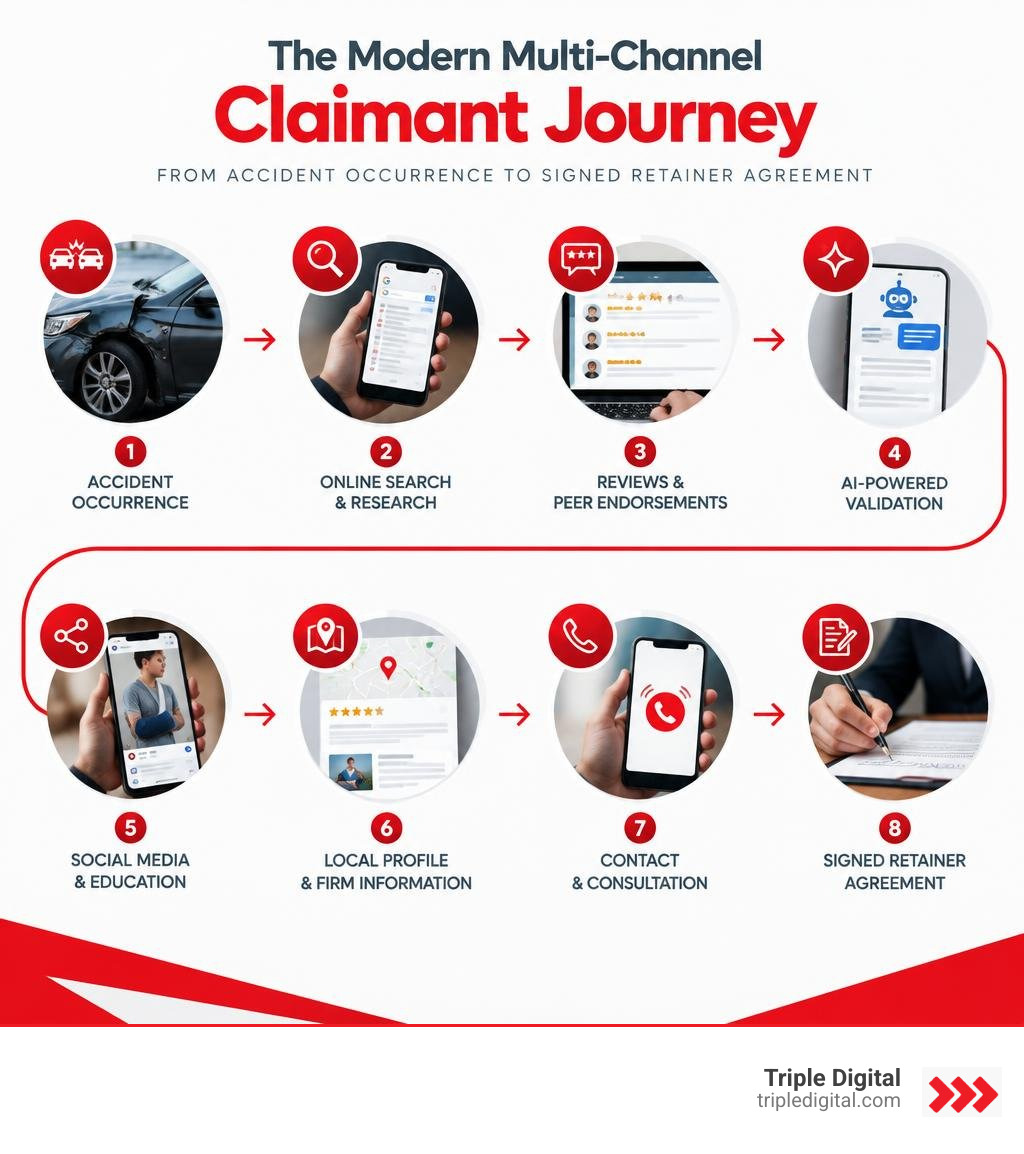
Claimant behavior has undergone a profound transformation. Injured individuals no longer flip through yellow pages or trust a billboard slogan without running a comprehensive background check on their smartphones. In 2026, prospective claimants demand instant validation across multiple touchpoints before they ever dial an office or submit a form.
Legacy marketing playbooks that rely solely on passive word-of-mouth or highway billboards cannot sustain a modern personal injury firm. While broad brand awareness still has a place, it fails to capture high-intent claimants who actively evaluate choices during their moment of vulnerability. Today’s claimants conduct cross-channel research simultaneously: they search Google for local counsel, read verified client testimonials, examine third-party peer endorsements, and even prompt generative AI tools to assess an attorney’s local standing.
Operating successfully in personal injury law requires mastering this fragmented, multi-touch journey. An accident victim might notice an educational social post on their phone, review a firm’s Google Business Profile after an accident, check peer accolades, and review informative online resources before committing to a call.
Firms that treat marketing as isolated silos—running pay-per-click ads detached from intake workflows, or publishing blog posts that fail to answer immediate medical and legal questions—leak cases at every step. Transitioning to a unified client acquisition engine ensures that every dollar invested in brand awareness, organic search, or paid ads channels directly into signed retainer agreements.
Why Must Personal Injury Firms Fix Intake and Response Speed Before Scaling Marketing?
The most expensive mistake a firm can make is pouring capital into lead generation while ignoring a broken intake department. Doubling lead volume into a leaking intake funnel merely doubles wasted ad spend. If prospective claimants call after 5:00 PM and reach an unmonitored voicemail, or wait four hours for an email response, marketing dollars are actively subsidizing competing practices.
Injured people are urgent, stressed, and facing unexpected medical bills and lost wages. Consequently, they rarely contact just one attorney. The firm that responds first is often the one they retain. When an individual reaches out, prompt engagement provides immediate emotional reassurance that the firm is organized, attentive, and capable of handling their case.
Capturing every opportunity requires around-the-clock intake protocols:
- 24/7/365 Live Coverage: Every call must be answered by a trained, empathetic specialist—never an answering machine or a generic, robotic message.
- Instant Digital Response: Web form submissions and chat inquiries must trigger instant, human-sounding confirmation texts within seconds.
- Standardized Qualification: Using the complete guide to the intake management process helps intake staff screen for liability, damages, and insurance coverage without creating administrative friction.
- Conversion-Focused Digital Experiences: Applying principles from from clicks to clients the ultimate law firm cro strategy removes confusing fields and cognitive overload from intake forms.
- Automated CRM Integration: Intake data should sync seamlessly into your case management platform, eliminating manual data entry and preventing dropped inquiries.
What Does an Elite Law Firm Intake Cadence Look Like?
Signing cases predictably demands an aggressive, disciplined outreach cadence. Research confirms that inbound leads lose their conversion momentum dramatically after the first five minutes.
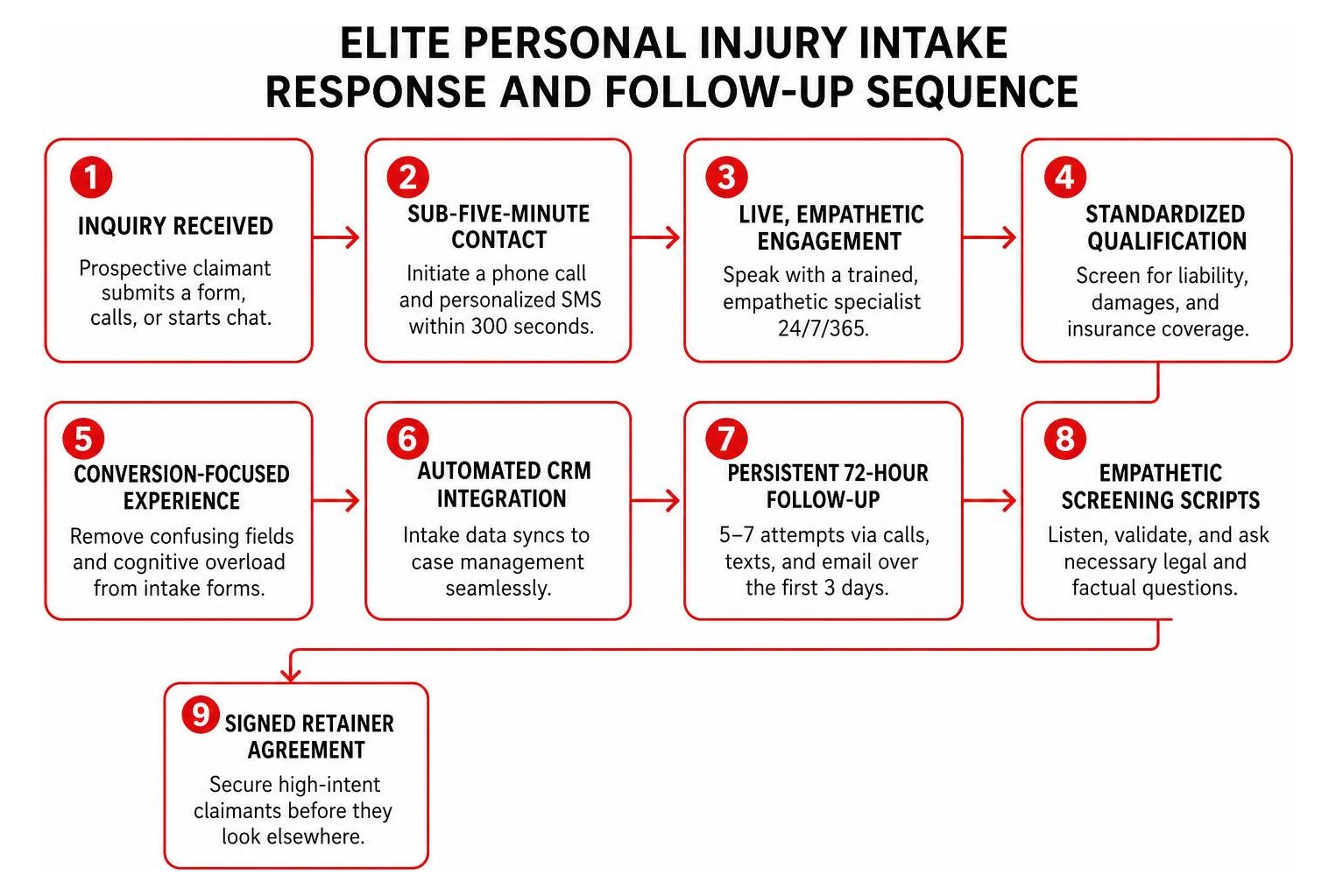
To secure high-intent inquiries before they look elsewhere, elite intake departments adhere to a strict protocol:
- Sub-Five-Minute Contact: Initiate a phone call and personalized SMS within three hundred seconds of form submission.
- Persistent 72-Hour Follow-Up: If the claimant does not answer initially, implement a multi-channel sequence of five to seven attempts across calls, text messages, and email over the first three days.
- Empathetic Screening Scripts: Train intake personnel to listen attentively to the claimant’s experience, validating their concerns before running through necessary legal and factual questions regarding liability and treatment status.
- Immediate Digital Retainer Deployment: Send electronic fee agreements via mobile-friendly e-signature tools directly during the initial call while the prospect’s intent is at its peak.
What Are the Most Effective Channels for Generating Personal Injury Leads?
A resilient personal injury practice balances immediate case acquisition with sustainable, compounding channels. Rather than chasing every novelty platform, firms must sequence their marketing efforts in order of trust, cost efficiency, and case quality.
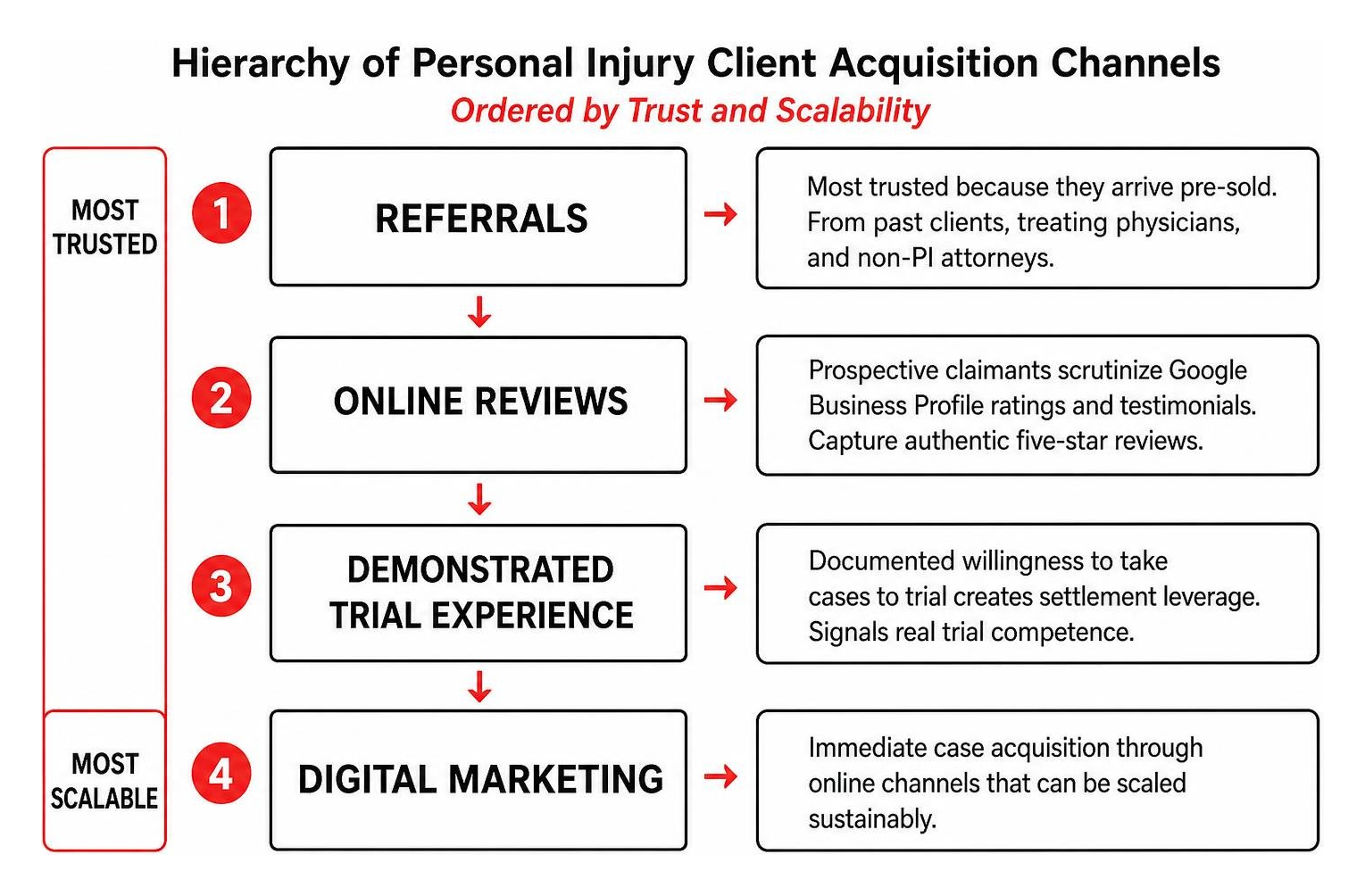
Referrals remain the most trusted channel because they arrive pre-sold. An individual referred by a past client, a treating physician, or a non-PI attorney already trusts your advocacy before the first consultation begins.
Right behind personal endorsements are online reviews. Prospective claimants scrutinize Google Business Profile ratings to validate that a firm actually delivers on its promises. A systematic post-resolution review process captures authentic five-star testimonials when client gratitude is highest. When occasional dissatisfaction arises, knowing how to handle negative reviews for law firms in legal marketing helps preserve hard-earned local trust.
Demonstrating courtroom experience further elevates a firm’s authority. While most personal injury claims settle, an attorney’s documented willingness to take complex matters to trial creates settlement leverage. For example, membership in the American Board of Trial Advocates (ABOTA) requires an attorney to have served as lead counsel in at least 10 civil jury trials to conclusion—a verifiable benchmark that signals real trial competence to prospective clients and referring counsel alike.
| Acquisition Channel | Average Cost Per Signed Case | Conversion Speed | Claimant Trust Level | Long-Term Scalability |
|---|---|---|---|---|
| Past Client & Peer Referrals | Extremely Low (Relationship-based) | Immediate (< 24 hours) | High | Capped by network size |
| Local SEO & Google Business Profile | Low to Moderate | Fast (1–3 days) | High | High (Compounding equity) |
| Google Local Services Ads (LSA) | Moderate to High | Fast (1–2 days) | High (Google Screened) | Moderate (Budget-dependent) |
| Pay-Per-Click Search (Google Ads) | High | Immediate (Hours) | Moderate | High (Instantly adjustable) |
| Organic Content & Informational SEO | Low (Upfront asset creation) | Moderate (Days to weeks) | High | High (Compounds indefinitely) |
| Community Sponsorships & Civic PR | Moderate | Slow (Long-term branding) | Moderate to High | Moderate (Geographically limited) |
How Can Attorneys Build Sustainable Referral Partnerships?
Building a dependable referral network requires consistent professional outreach rather than sporadic holiday cards. High-performing practices systematically build relationships with:
- Medical Professionals: Chiropractors, physical therapists, orthopedic specialists, and diagnostic imaging centers who regularly evaluate accident trauma.
- Non-Competing Legal Counsel: Family law, criminal defense, probate, and business litigation attorneys who routinely encounter personal injury matters they cannot accept.
- Community Leaders and Civic Organizations: Neighborhood business associations, local unions, and civic groups that value reliable legal guidance.
Maintain ongoing communication by sharing helpful legal updates, offering informative resources on insurance regulations, and providing prompt status updates whenever an attorney refers a matter. Ensure all referral arrangements comply strictly with state ethics rules, including written fee disclosures and client consent.
How Do SEO, Paid Media, and AI Search Drive Retained Cases Today?
Digital search remains the primary avenue through which injured individuals find legal representation without a personal referral. To secure a steady flow of retained clients, firms must dominate the search engine results page (SERP) across organic, local, and paid placements.
Capturing search demand starts with specialized seo for personal injury attorneys. High-intent search terms like “car accident lawyer” or “truck accident attorney” carry immense commercial value. Securing top organic rankings requires a solid technical foundation, fast mobile loading speeds, comprehensive topical depth, and quality local backlinks.
Firms must also dominate the Google 3-Pack by implementing local seo for law firms. Claiming, optimizing, and maintaining your Google Business Profile ensures prominent placement when nearby searchers seek urgent legal assistance.
Complementing organic visibility, personal injury law ppc campaigns and Google Local Services Ads (LSA) capture top-of-page real estate instantly. Local Services Ads provide the “Google Screened” badge, creating an immediate trust signal that converts searchers directly into verified inbound phone leads.
To maximize paid and organic traffic, firms must direct searchers to conversion-optimized destinations modeled on the best websites for law firms. Clean navigation, clear credentials, prominent click-to-call buttons, and accessible contact forms ensure paid clicks translate into retained clients rather than high bounce rates.
How Does Generative Engine Optimization Impact Case Acquisition?
As prospective claimants increasingly consult AI tools for legal research, law firms must optimize for generative search engines. Gaining visibility in conversational interfaces requires mastering how personal injury law firms can rank in google ai overviews.
Generative engines do not evaluate web pages purely on keyword density. Instead, they extract information from structured, entity-dense content that directly and authoritatively resolves complex questions. To capture citations in generative summaries:
- Publish direct, plain-language resources addressing common post-accident concerns, such as how comparative negligence works, how insurance adjusters evaluate property damage, or what medical documentation claims require.
- Implement structured schema markup (LegalService, Attorney, FAQPage) to help search algorithms clearly categorize your practice areas, attorneys, and geographic service locations.
- Secure verified mentions across reputable legal directories, local news publications, and industry associations to establish cross-validated digital authority.
How Should Law Firms Track Marketing Metrics to Ensure Real Case Acquisition?
Managing a marketing budget based on vanity metrics like impressions, clicks, or raw form fills leads to misallocated resources. Digital agencies often celebrate an influx of traffic, but an increase in website visitors means nothing if intake spends all week fielding non-viable inquiries. The only metric that truly reflects marketing performance is cost per signed case.
Accurate performance measurement requires dedicated law firm lead tracking systems that connect initial marketing touchpoints directly to your case management software. Dynamic Number Insertion (DNI) assigns unique, trackable phone numbers to individual traffic sources—distinguishing organic local search, pay-per-click ads, directory listings, and offline campaigns.
When tracking data identifies which campaigns generate qualified matters and which generate administrative clutter, firms can reallocate capital with surgical precision. To cut through marketing noise and eliminate wasted spend, firms partner with specialized legal growth agencies like Triple Digital. By combining data mining with AI-assisted lead qualification, our team helps practices filter out low-value inquiries so attorneys can focus strictly on high-value, viable personal injury claims.
Applying the benchmarks outlined in our guide to qualified pi case leads enables partners to evaluate lead sources by signed contract value, ensuring marketing investments generate tangible revenue and sustainable growth.

What Are the Most Frequently Asked Questions About Getting Personal Injury Clients?
Why is speed to lead critical for personal injury law firms?
Injured individuals facing mounting medical expenses and property damage rarely contact a single firm. The first competent, empathetic firm to speak directly with the claimant secures the signed retainer in the vast majority of inquiries. If an office allows an intake call to roll to voicemail, that prospective client is usually on the phone with another attorney within minutes.
What is the most cost-effective marketing channel for a new personal injury practice?
Cultivating organic referral networks alongside a fully optimized Google Business Profile offers the highest return on investment for growing firms. Connecting with non-competing attorneys, treating medical providers, and satisfied past clients generates pre-sold, high-trust inquiries without the intense cash flow demands of pay-per-click bidding wars.
How many touches does it take to convert an unconverted personal injury inquiry?
High-performing personal injury intake teams average five to seven contact attempts across phone, text, and email over the first 72 hours. Claimants are often busy with medical visits, vehicle repairs, or work disruptions; stopping after a single unanswered call forfeits more than half of all viable cases.
Dominating Personal Injury Case Acquisition
Generating high-value personal injury cases is neither a mystery nor a matter of outspending every competitor on television. It is an operational discipline. Sustainable law firm growth relies on an integrated client acquisition engine: disciplined intake that answers inquiries within minutes, earned local reputation, multi-channel search visibility, and rigorous data tracking that accounts for every dollar spent.
By aligning marketing investments with retained case value rather than superficial clicks, your firm secures high-value matters while maintaining healthy operational margins. When you’re ready to modernize your intake pipeline and build a predictable case acquisition engine, schedule a meeting with our growth team to audit your current workflow and scale your practice.