





Beginner’s Guide to AI Digital Marketing for Law Firms
Why AI Digital Marketing for Law Firms Is a Game-Changer in 2026
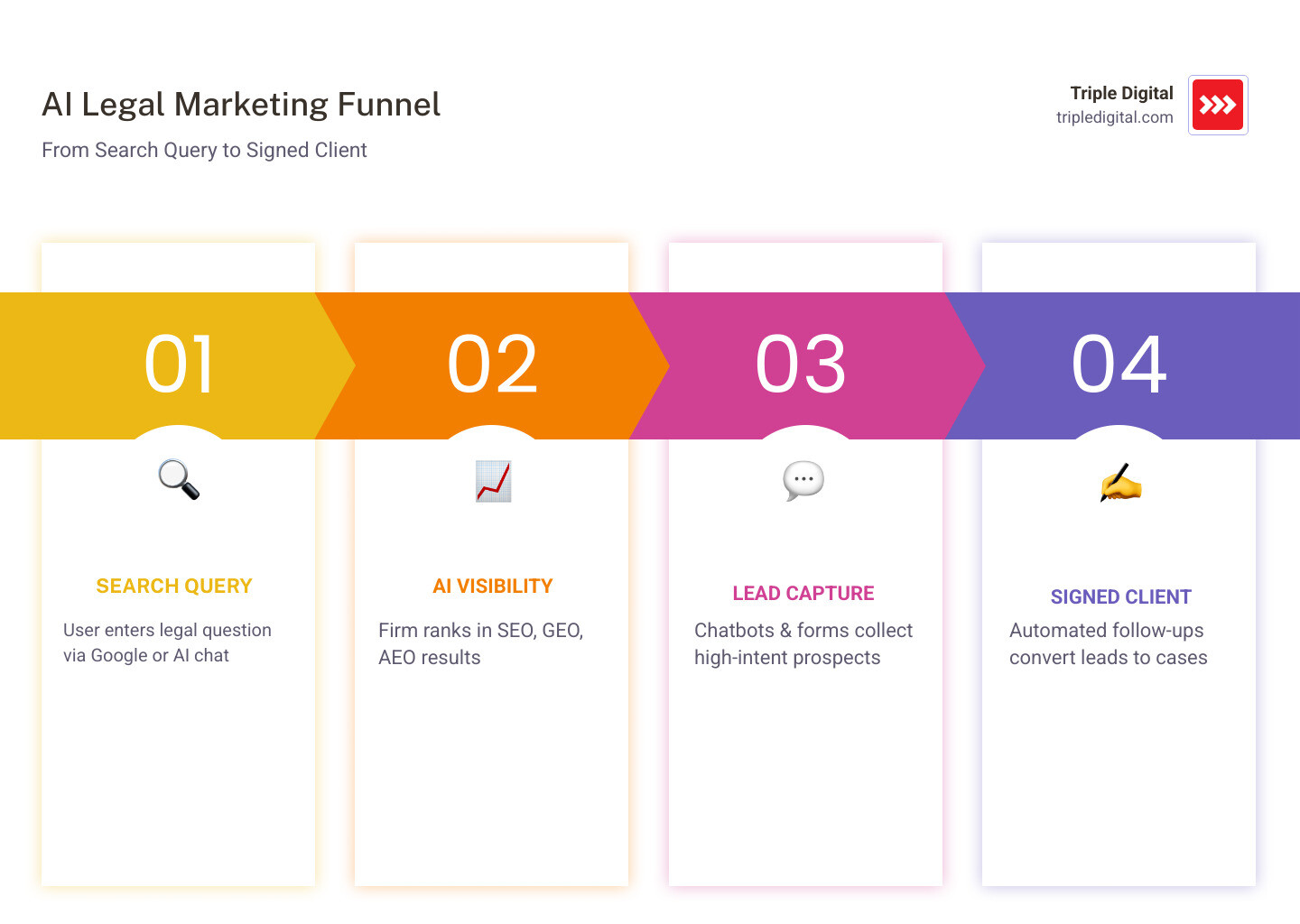
AI digital marketing for law firms is the use of artificial intelligence tools — like ChatGPT, Gemini, and Claude — to attract more clients, rank higher in search results, and automate time-consuming marketing tasks.
Here’s what it covers at a glance:
| AI Marketing Area | What It Does for Law Firms |
|---|---|
| SEO & GEO | Helps your firm appear in Google and AI-generated search results |
| Content Creation | Drafts practice area pages, blogs, and FAQs faster |
| Lead Generation | Identifies high-intent prospects and automates follow-up |
| Competitive Analysis | Monitors rival firms and surfaces ranking opportunities |
| Client Engagement | Uses chatbots and personalized outreach to convert visitors |
Law firms are watching something unsettling happen to their website traffic. Month after month, the numbers slide — and it’s not a technical glitch.
It’s AI.
Search behavior has fundamentally shifted. Four out of five people now rely on AI-generated summaries for at least 40% of their searches. And 60% of those searches end without a single click to a website.
For law firms still relying on traditional marketing — keyword-stuffed blog posts, generic landing pages, and “gut feeling” ad spend — this shift is costly. Research shows that firms slow to adopt AI have seen revenue drop by as much as 50% over four years. Meanwhile, firms that embraced AI nearly doubled their revenue over the same period, with only a 50% increase in clients and matters.
The gap between those two groups is widening fast.
This guide is built for law firms that want to be on the right side of that gap — whether you’re a solo practitioner, a small regional firm, or a growing multi-location practice. You don’t need a massive marketing budget. You need the right strategy.
How AI Digital Marketing for Law Firms is Transforming the Legal Industry
As we navigate May 2026, the legal industry is no longer “preparing” for a digital transformation; we are in the middle of a full-scale revolution. Artificial intelligence has fundamentally altered how potential clients find and hire lawyers. The most staggering shift is the rise of AI search referrals.
In the first half of 2025, search referrals from AI platforms like ChatGPT, Perplexity, and Gemini surged by over 500%. For firms in high-intent practice areas like personal injury or family law, this means the “old way” of ranking on page one of Google is no longer the only goal. We now have to optimize for AI Overviews, where Google provides a summarized answer to a user’s legal question before they ever see a blue link.
This shift has created a “zero-click” environment. If a user asks, “What is the statute of limitations for a car accident in my state?” and an AI summary gives them the answer, they may never visit your website. However, if your firm is the source cited by that AI, you gain an immediate trust signal that traditional SEO simply cannot replicate. We’ve seen that firms embracing these shifts aren’t just surviving; they are thriving.
Leveraging AI Digital Marketing for Law Firms to Compete with Big Law
One of the most exciting aspects of AI digital marketing for law firms is how it levels the playing field. Historically, large firms with massive budgets dominated the market through sheer volume—more billboards, more TV spots, and more SEO content than a solo practitioner could ever hope to produce.
AI changes that math. By using AI-driven market analysis and competitive blueprinting, a small firm can now identify exactly where the “Big Law” competitors are vulnerable. For example, AI agents can monitor competitor rankings and ad spend 24/7, surfacing specific long-tail keywords or niche practice areas that are being underserved.
This efficiency allows smaller teams to reclaim hundreds of hours annually. Instead of spending 16 hours drafting a basic litigation response or a blog post, AI can help produce a high-quality first draft in minutes, allowing the attorney to focus on strategic analysis. This “80/20 inversion”—where 80% of the time is spent on strategy and 20% on information gathering—is the key to how small firms can Future-Proof Your Firm: The AI Advantage in Legal Marketing.
Core Strategies: SEO, GEO, and AEO for Modern Law Firms
To win in 2026, we have to look beyond traditional SEO. While keywords still matter, the way search engines understand those keywords has evolved. We now focus on three distinct but overlapping pillars: Search Engine Optimization (SEO), Generative Engine Optimization (GEO), and Answer Engine Optimization (AEO).
| Strategy | Primary Goal | Target Platform |
|---|---|---|
| SEO | Rank pages for specific keywords | Google Search, Bing |
| GEO | Get cited as a source in AI summaries | ChatGPT, Gemini, Perplexity |
| AEO | Provide direct, conversational answers | Voice assistants, Featured Snippets |
The common thread here is search intent. Potential clients are no longer just typing “Houston divorce lawyer.” They are asking conversational questions like, “How do I protect my business assets during a divorce?” or “Who is the best personal injury lawyer near me for a truck accident?”
Our approach involves targeting these conversational queries through long-tail keywords and “entity-rich” details. This is especially critical for local visibility. Since over 60% of searches happen on mobile devices and 32% of consumers use voice assistants weekly, your content must be scannable and direct. For more specific tactics, see our Top SEO Tips for Criminal Defense Lawyers in the AI Search Era.
Technical SEO and Structured Data for AI Visibility
Making your website “AI-friendly” requires a strong technical foundation. AI models don’t just “read” your website like a human; they parse data to understand relationships between entities.
This is where structured data and schema markup become your best friends. By implementing Legal Service, Attorney, and Local Business schema, you are essentially giving AI a roadmap of your firm. You’re telling the AI: “This is who we are, this is where we practice, and this is the specific expertise we offer.”
Beyond schema, site architecture and mobile-first design are non-negotiable. AI systems prioritize sites that load fast and provide a seamless user experience. If your site is slow or difficult to navigate, AI engines are less likely to cite you as a trusted source, regardless of how good your content is.
Essential AI Tools and Implementation for Content Creation
The market is flooded with tools, but for AI digital marketing for law firms, four names stand out: ChatGPT, Gemini, Perplexity, and Claude. Each has its own strength. ChatGPT is excellent for brainstorming and outlining; Gemini integrates deeply with Google’s ecosystem; Perplexity is a powerhouse for real-time research and citations; and Claude is often praised for its natural, human-like writing tone.
We use these tools not just for writing, but for predictive analytics. AI can analyze years of search data to predict which legal topics will trend in the coming months, allowing us to create content before the competition even realizes there is a demand.
Furthermore, AI-driven lead generation and automated follow-ups have transformed the “intake” side of marketing. AI chatbots can handle simple inquiries 24/7, filtering out unqualified leads and ensuring that high-potential clients are connected to an attorney immediately. This responsiveness is often the difference between signing a case and losing it to the firm down the street. You can explore more about these in our guide on AI Tools for Law Firm Marketing.
The Role of Content in AI Digital Marketing for Law Firms
Content is still king, but the “crown” has changed. In 2026, generic informational content is a commodity that AI can generate for free. To stand out, law firms must lean into legal storytelling and experience-driven content.
We recommend a “Topic Cluster” model. This involves creating a massive “Pillar Page” (like a comprehensive guide to personal injury law) and surrounding it with 8-12 “Spoke Articles” that answer specific, nuanced questions.
Key elements of AI-optimized content include:
- Extractable Answers: Start your sections with a 40-60 word direct answer to a question. This makes it easy for AI Overviews to “clip” your content.
- Legal Storytelling: Use real-world examples (anonymized, of course) to show how you solved a complex problem. AI can’t replicate your lived experience.
- Content Repurposing: Use AI to turn one long-form blog post into five social media updates, a video script, and an email newsletter.
The secret to success is human oversight. As we discuss in The Key to AI-Written Content, AI should be the assistant, not the author. Every piece of content must be reviewed for tone, accuracy, and brand voice.
Ethical Considerations and E-E-A-T in AI-Driven Marketing
Using AI in legal marketing isn’t just a technical challenge; it’s an ethical one. Law firms have professional obligations that other businesses don’t. Bar compliance is paramount. You must ensure that AI-generated content does not make “guarantees” of results or create an unintended attorney-client relationship.
Confidentiality is another major risk. You should never input sensitive client data into a public AI tool. Most AI models learn from the data they receive, meaning anything you type could potentially be surfaced to someone else.
Accuracy is the third pillar of ethics. “Hallucinations”—where AI confidently states a fact that is completely false—can lead to sanctions or malpractice claims if they end up in legal marketing materials. This is why we advocate for Beyond the Gavel: Using AI for Predictive Analytics in Legal Proceedings as a tool for internal insight, while maintaining strict human review for anything public-facing.
Implementing E-E-A-T in AI-Optimized Content
Google’s E-E-A-T (Experience, Expertise, Authoritativeness, and Trustworthiness) guidelines are more critical than ever for “Your Money or Your Life” (YMYL) topics like legal advice. AI content that lacks these signals will struggle to rank.
To demonstrate E-E-A-T:
- Experience: Include attorney bylines and links to detailed bios that highlight years in practice.
- Expertise: Use case studies and results (where permitted by state bar rules) to prove you know your stuff.
- Authoritativeness: Build a backlink profile from reputable legal directories and news outlets.
- Trustworthiness: Be transparent. Include clear contact information, office locations, and privacy policies.
By combining AI efficiency with human authority, you create content that both robots and humans trust.
Measuring Success and Future-Proofing Your Firm
You cannot manage what you do not measure. In the era of ai digital marketing for law firms, we move past “vanity metrics” like website traffic or social media likes. Instead, we focus on metrics that impact the bottom line:
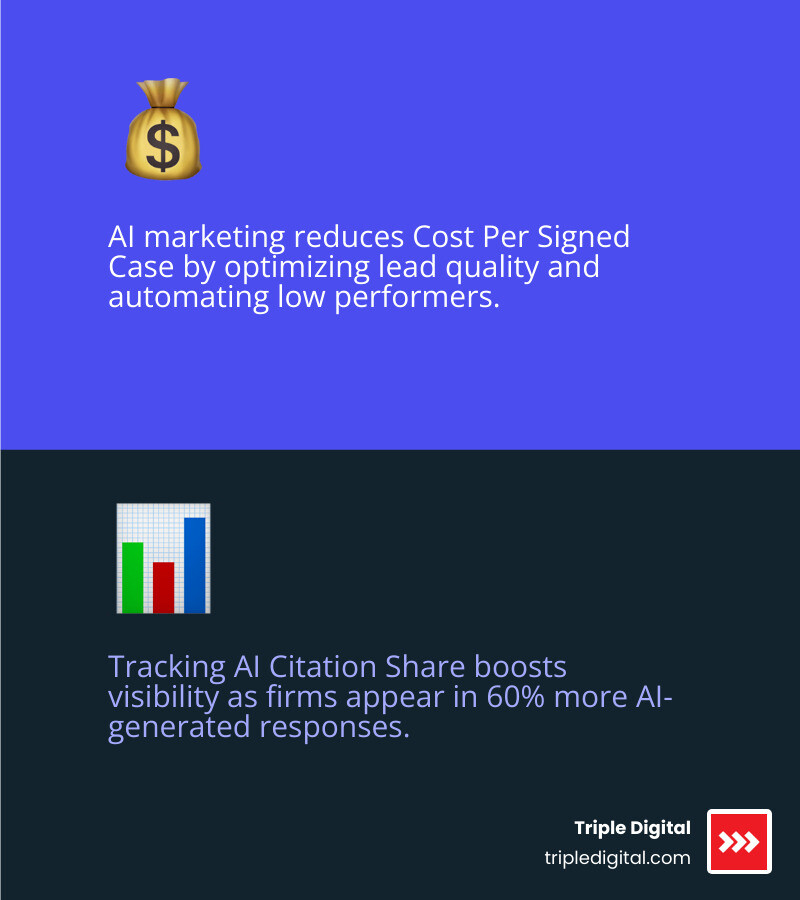
- Cost Per Signed Case: How much are you actually spending to get a new client?
- Qualified Lead Volume: How many of your leads actually meet your firm’s criteria?
- Form-to-Intake Conversion Rate: How fast are you turning a website visitor into a consultation?
- AI Citation Share: How often is your firm being cited in AI Overviews or ChatGPT responses?
Real-time dashboards allow us to make data-driven decisions on the fly. If an ad campaign isn’t performing, the AI detects it and reallocates the budget to the tactics that are working. This is the core of our “less fluff, more cases” philosophy. We recently highlighted this in our announcement: Triple Digital LLC Unveils Groundbreaking AI Tool to Help Law Firms Outrank Competitors Online.
Frequently Asked Questions about AI Legal Marketing
Will AI replace traditional SEO for lawyers?
No, but it is reshaping it. Traditional SEO helps you rank in search engines, while GEO (Generative Engine Optimization) helps you get cited by AI. You need both to be visible in 2026. Think of AI as an evolution of SEO, not a replacement.
How can small law firms afford AI marketing tools?
Many AI tools offer scalable pricing. By using AI to automate tasks that used to require a large agency or multiple staff members, small firms often find that AI marketing is actually cheaper and more effective than traditional methods. It’s about reallocating your existing budget to smarter tools.
What are the biggest ethical risks of using AI in marketing?
The biggest risks are “hallucinations” (inaccurate information), potential breaches of client confidentiality, and failing to include proper attorney advertising disclaimers. Always have a qualified attorney review AI-generated content before it goes live.
Don’t Let Your Firm Get Left Behind in the Zero-Click Era
The landscape of legal marketing has changed forever. The firms that will dominate the next decade are those that see AI not as a threat, but as a powerful ally. At Triple Digital, we specialize in helping law firms navigate this new reality.
Our approach is simple: we use data mining and AI to cut through the noise and deliver high-quality cases. We don’t care about clicks; we care about your caseload. If you’re ready to stop guessing and start growing, it’s time to leverage the power of AI digital marketing for law firms.
Get more info about our AI marketing services and let’s build your firm’s future together.