
Stop Losing Leads: How to Optimize Your Landing Page for Maximum Conversions
Why Most Marketing Campaigns Fail at the Last Step
Website landing page optimization is the process of improving the key elements of a landing page — headlines, forms, CTAs, images, and page speed — to convert more visitors into leads or customers.
Here’s a quick breakdown of what it involves:
- Define your goal — one clear action per page (sign-up, call, download)
- Match your message — align the page to the ad or link that brought the visitor
- Remove friction — cut distractions, shorten forms, speed up load times
- Build trust — add testimonials, logos, and security signals
- Test and improve — use A/B testing and data to make smarter changes over time
You’re paying to drive traffic. Whether it’s Google Ads, social media, or SEO — every click costs something. But here’s the problem: the average landing page converts at just 5.89%. That means more than 94 out of every 100 visitors leave without taking any action.
That’s not a traffic problem. That’s a landing page problem.
For law firms especially, this gap between clicks and clients is where marketing budgets quietly disappear. A visitor lands on your page with real intent — they need legal help right now — and a slow, cluttered, or confusing page sends them straight to a competitor.
The good news? Small, focused improvements to your landing pages can have a dramatic impact. Pages with load times under two seconds consistently outperform slower pages. Removing distractions alone can boost conversions by 10%. And optimized landing pages can generate up to 160% higher conversion rates for sign-ups compared to other tools like pop-ups.
This guide walks you through exactly how to do it.
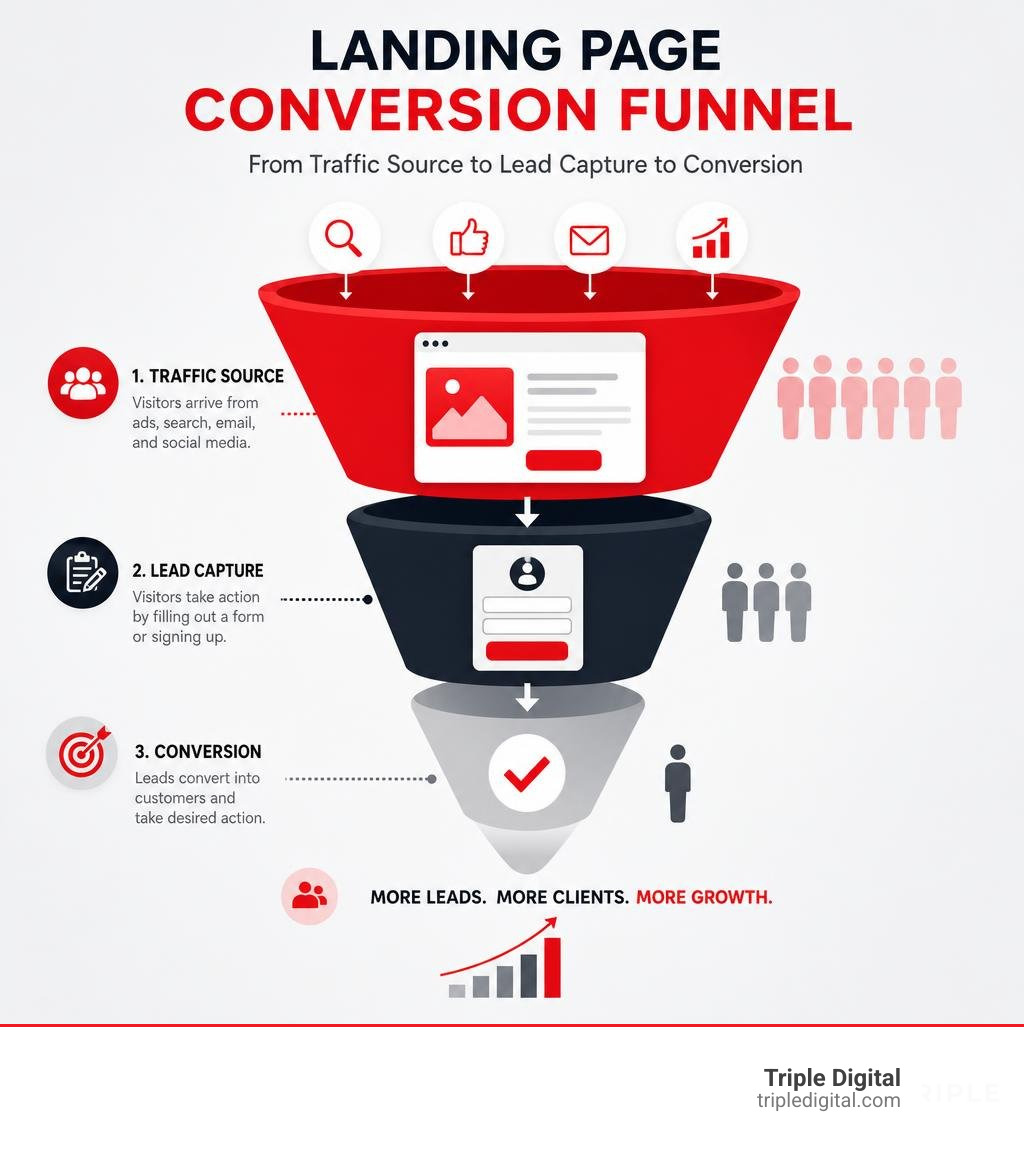
Terms related to website landing page optimization:
What is Website Landing Page Optimization?
At its core, website landing page optimization (LPO) is the systematic process of improving every customer-facing and technical element on your landing page to maximize the number of visitors who take action. Rather than relying on gut feelings or aesthetic preferences, LPO uses real data, user behavior analysis, and targeted experiments to guide design and copy decisions.
When done correctly, LPO acts as a high-performing bridge between your paid campaigns and your intake pipeline. It ensures that the promise made in your advertising matches the experience delivered on your website, leaving zero room for user confusion.
The Core Differences Between LPO and CRO
While they are closely related, landing page optimization and conversion rate optimization (CRO) are not identical. Understanding the difference is key to structuring your marketing campaigns effectively:
- Conversion Rate Optimization (CRO): This is a broad, holistic strategy that looks at the entire user journey across your entire digital presence. It analyzes how users move from your homepage to your blog, through your practice area pages, and finally to your contact form. CRO involves site-wide technical audits, overall information architecture, and complex user flow mapping.
- Landing Page Optimization (LPO): This is a highly targeted subset of CRO. LPO focuses strictly on campaign-specific, standalone web pages. These pages are designed with a single objective in mind (like getting a visitor to call your office or submit a case evaluation form). Because landing pages have a 1:1 attention ratio—meaning there is only one primary action a user can take—LPO is highly tactical, focusing heavily on page-level elements like headlines, form fields, layout, and copy.
To dive deeper into how site-wide optimization works, you can read our comprehensive Guide to Conversion Optimization. For law firms looking to build an overall conversion system, check out From Clicks to Clients: The Ultimate Law Firm CRO Strategy.
Why Landing Page Optimization Matters for Marketing ROI
If you are running paid search or social campaigns in 2026, you already know that ad costs are rising. In highly competitive fields like personal injury or criminal defense, a single click can cost dozens or even hundreds of dollars.
When your landing page fails to convert, your Customer Acquisition Cost (CAC) skyrockets. Conversely, when you improve your landing page conversion rate, you instantly lower your CAC and increase your return on investment (ROI) without spending an extra dime on ad platforms.
Furthermore, search engines like Google evaluate your landing page experience when calculating your Quality Score. A highly relevant, fast-loading landing page that matches the user’s search intent leads to higher Quality Scores. This directly translates to lower costs per click (CPC) and better ad placements, making your entire marketing budget work significantly harder for you.
Anatomy of a High-Converting Landing Page
A successful landing page is not designed by accident; it follows a precise, conversion-centered architecture. Every element on the page must serve a specific psychological purpose, guiding the visitor’s eyes naturally from their initial search intent directly to your call to action.
When we design pages for high-intent audiences, we build them around five foundational elements: the headline, the benefit statement, the hero shot, trust indicators, and the call to action. For a deeper look at how this applies to legal websites, read our guide on How to Design the Best Websites for Law Firms That Actually Convert.
Crafting Headlines for Website Landing Page Optimization
Your headline is the single most important piece of copy on your landing page. You have roughly three to five seconds to convince a visitor that they are in the right place and that your business can solve their specific problem.
To achieve maximum impact, prioritize clarity over cleverness. A headline like “Understanding Your Legal Rights and Options” is clear and helpful, telling the user exactly what you offer and what pain point you solve.
Additionally, maintain strict message match. If your Google Ad promises “Free Case Evaluation with a Houston Injury Attorney,” your landing page headline must mirror that exact offer and language. If a visitor clicks your ad and lands on a generic homepage, they will experience cognitive dissonance, hit the back button, and bounce.
Designing Frictionless Forms and CTAs
Your call to action (CTA) and form are where the actual conversion happens. Any friction here will cause your conversion rates to plummet. Keep these best practices in mind:
- Ruthlessly minimize form fields: Only ask for the absolute essentials (such as name, email, phone number, and a brief message). Industry data shows that keeping forms to 3-4 fields maximizes completion rates. If you need more information to qualify a lead, consider using a multi-step form, which can actually increase conversions by breaking the process into smaller, bite-sized steps.
- Use high-contrast design: Your CTA button should jump off the page. Use a contrasting color that isn’t used anywhere else on the page, surrounded by plenty of whitespace to draw the eye.
- Write action-oriented, first-person copy: Move away from boring, passive words like “Submit” or “Click Here.” Instead, use active, first-person phrasing that focuses on the value the user receives. Phrases like “Get My Free Consultation” or “Start My Case Evaluation” consistently outperform generic alternatives by up to 90%.
For more visual design tips, explore our breakdown of How to Design a High Performing Law Firm Website Without Losing Your Mind.
Leveraging Social Proof and Trust Signals
People buy from businesses they trust, and this is especially true when they are looking for professional services. Because visitors are naturally skeptical of self-promotional marketing copy, you must back up your claims with verifiable social proof.
- Specific, Named Testimonials: Anonymous praise like “Great service! – John D.” looks fabricated. Instead, use real customer testimonials that highlight specific, quantifiable results.
- Video Testimonials: If possible, incorporate short video testimonials. They are incredibly powerful, often converting up to 80% better than standard text reviews because they convey genuine emotion.
- Industry Logos and Badges: Display prominent trust indicators, such as professional association logos, awards, and security badges near your form. For a law firm, displaying badges from recognized legal directories instantly establishes authority.
Proven Best Practices for Landing Page Success
To truly master website landing page optimization, you must design with user behavior in mind. Mobile and desktop users interact with your pages in fundamentally different ways, and your design choices must reflect those differences.
| Metric / Behavior | Desktop Landing Pages | Mobile Landing Pages |
|---|---|---|
| Average Traffic Share | ~30% – 40% | ~60% – 70% |
| Attention Span | Moderate; users will read longer copy | Extremely short; users scan quickly |
| Navigation & Layout | Multi-column layouts; larger visuals | Single-column layouts; vertical scrolling |
| Primary Interaction | Mouse clicks; hover states | Thumb taps; requires large tap targets (min 44px) |
| CTA Strategy | Above-the-fold and inline placements | Sticky footer CTAs that stay visible while scrolling |
Because mobile visitors make up the majority of your traffic, a “mobile-friendly” responsive design is no longer enough. You must build your landing pages with a mobile-first mindset. To learn more about optimizing your entire digital footprint beyond just the landing page, check out Beyond the Homepage: Maximizing Your Legal Websites Potential.
Technical Performance and Core Web Vitals
No matter how beautiful your landing page is, it won’t convert if it doesn’t load. A page load time of over three seconds can increase your bounce rate by over 32%, while pages that load in under two seconds enjoy the highest conversion rates.
To keep your technical performance in peak condition, focus on these core areas:
- Compress and Convert Images: Large image files are the primary cause of slow landing pages. Always compress your images and use modern formats like WebP.
- Implement Lazy Loading: Defer the loading of non-critical elements (like images or videos lower down the page) until the user actually scrolls to them.
- Minify Code: Clean up your HTML, CSS, and JavaScript by removing unnecessary spaces, comments, and formatting.
- Leverage a Content Delivery Network (CDN): Distribute your page’s assets across global servers so visitors load your site from the server closest to their physical location.
Aligning Traffic Sources with Website Landing Page Optimization
A common mistake is treating all traffic sources the same. To maximize your conversion rates, you must tailor your landing page experience to the specific context and intent of the visitor:
- PPC Traffic (Google Ads): These visitors have incredibly high intent. They are actively searching for a solution to a specific problem. Keep your landing page highly focused, match the ad’s keyword exactly in your headline, and make the primary conversion action immediate and obvious.
- Organic Search (SEO): Unlike paid landing pages which are completely hidden from navigation, SEO landing pages must balance conversion elements with rich, informative content to rank on search engines. You can achieve this through vertical separation—keeping the top of the page highly conversion-focused while placing long-form, keyword-rich informational content further down the page.
- Social Media Traffic: Visitors coming from platforms like Facebook or Instagram are in a passive browsing mindset. They weren’t actively looking for your services when they clicked. These pages require “warming” strategies, such as engaging videos or low-friction lead magnets, to capture their information.
- Email Marketing: Since these users already know your brand, you don’t need to spend as much space introducing who you are. Focus the page entirely on the specific promotion, event, or resource mentioned in your email.
To see how to structure your overall web presence for maximum search engine performance, check out our guide on the Best Websites for Law Firms.
A/B Testing and AI-Driven Experimentation
The golden rule of website landing page optimization is simple: never stop testing. What works for one audience or industry might fail for another. The only way to know for certain what drives conversions is to let your visitors tell you through their behavior.
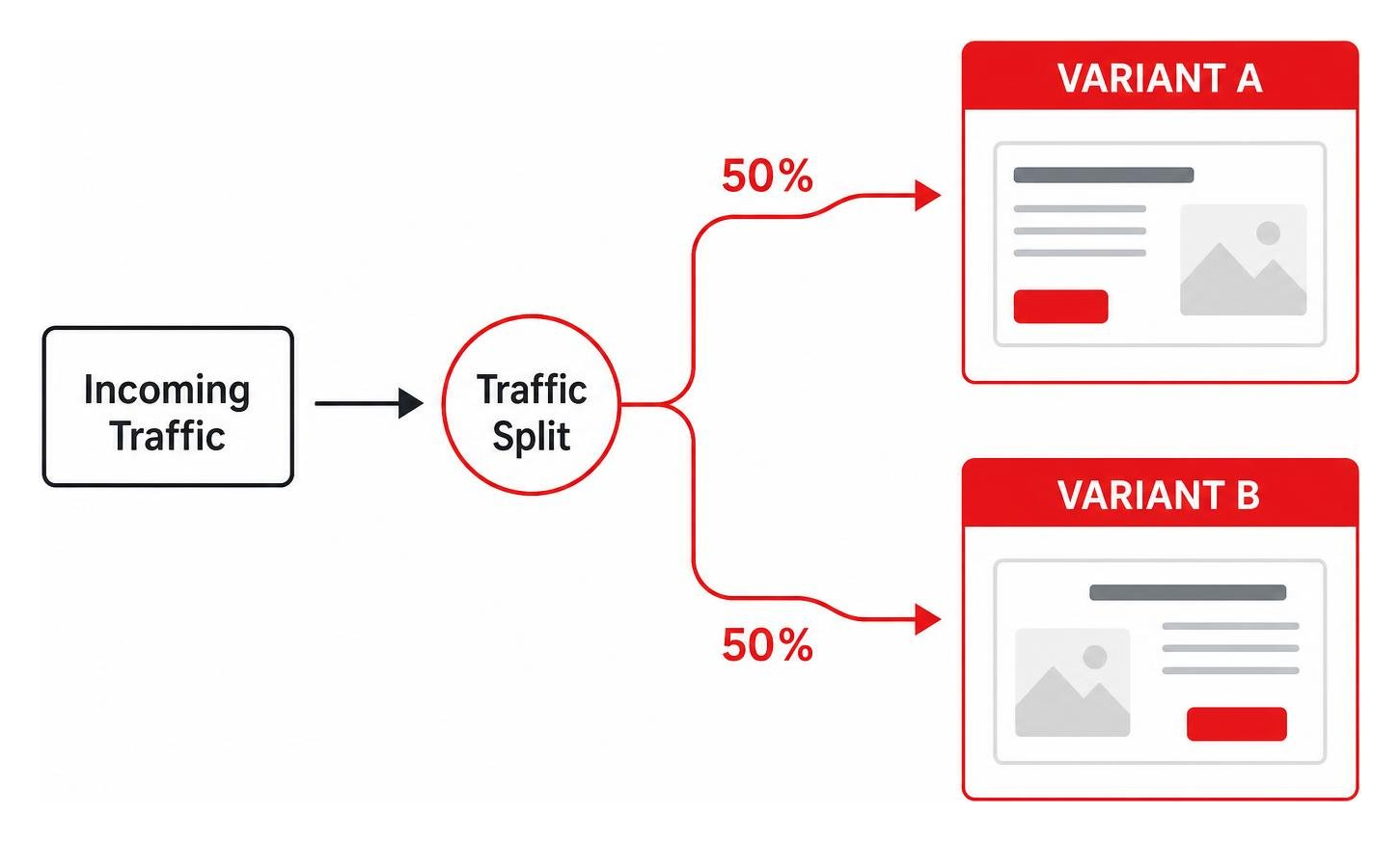
By running continuous, structured experiments, you turn your landing page into a self-improving asset. If you are looking for professional assistance to manage this process, explore our Website Conversion Rate Optimization Services.
Establishing a Testing Framework and Hypothesis
To get meaningful results from your testing, you must move away from random guessing. Every test should be guided by a clear, data-backed hypothesis. Use this simple formula to write your hypotheses:
“We believe that changing [element] from [current state] to [new state] will increase [metric] because [user behavior insight].”
For example: “We believe that changing our CTA button copy from ‘Submit’ to ‘Get My Free Case Review’ will increase form completions because it clearly communicates the immediate value the visitor receives.”
When deciding what to test, follow a logical testing hierarchy. Start with high-impact, above-the-fold elements before moving to minor details:
- The Headline: This has the single largest impact on visitor retention.
- The Primary CTA: Test button colors, placement, and copy phrasing.
- Social Proof: Test video testimonials vs. written quotes or placement of trust badges.
- Form Length: Test a single-step short form against a multi-step interactive form.
- Layout & Visuals: Test different hero images or video background elements.
To ensure your tests are statistically valid, always set a 95% confidence level before calling a winner, and make sure your sample size is large enough to prevent false positives.
The Role of AI and Personalization in 2026
In 2026, landing page optimization has evolved far beyond static, manual testing. Advanced AI tools and personalization engines allow us to deliver tailored experiences to individual users in real-time.
- Automated Traffic Routing: Instead of splitting traffic evenly (50/50) for weeks, modern AI optimization engines automatically analyze visitor attributes (like location, device, and referral source) and route them to the specific landing page variant where they are most likely to convert.
- Dynamic Content Replacement: AI tools can automatically swap out headlines, images, and benefit statements based on the exact search term the user typed into Google. If a user searches for “accident lawyer,” the page dynamically adapts to showcase relevant imagery and copy. If they search for “motorcycle accident,” the page instantly updates to match.
- Audience Presets and Smart Segments: By leveraging localized data and user behavior history, AI personalization tools allow us to create custom-tailored landing page journeys for different segments of our target market without requiring us to manually build hundreds of separate pages.
Frequently Asked Questions about Landing Page Optimization
What is a good conversion rate for a landing page?
While the absolute average landing page conversion rate sits around 5.89%, a “good” conversion rate is highly dependent on your industry, traffic source, and the friction of your offer. The top 25% of landing pages convert at 5.31% or higher, while the top 10% of elite performers reach conversion rates of 11.45% or more.
If you are asking users for highly sensitive information or a large financial commitment, your conversion rates will naturally be lower than a page offering a simple, free digital download. Always measure your performance against your own historical baseline and focus on continuous, incremental improvements.
Should landing pages have navigation menus?
Generally, no. A high-converting landing page should have a 1:1 attention ratio, meaning there is only one link or action for the user to take. Including a standard website navigation menu at the top of your landing page gives visitors dozens of exit routes to wander off, read blog posts, or browse social links, which dilutes your conversion rate.
Minimizing distractions on your page can boost your conversion rate by up to 10%. Keep your header clean, remove standard navigation, and limit external links strictly to legally required pages (like your Privacy Policy) in the footer.
How often should you A/B test landing pages?
A/B testing should be an ongoing, iterative process rather than a one-time project. However, the frequency of your tests depends entirely on your traffic volume.
To achieve statistical significance (usually a 95% confidence level), you need a sufficient number of conversions and visitors per variant. If your page receives thousands of visitors a day, you can run and conclude tests every week or two. If you have lower traffic, you may need to run tests for a month or more to collect enough data before making a decision.
Transform Your Digital Presence and Capture More Leads
At the end of the day, driving traffic is only half the battle. If your landing pages aren’t built to convert that traffic into active leads and signed cases, you are leaving substantial revenue on the table.
At Triple Digital, we help businesses and law firms cut through the marketing fluff to capture more clients. Based in Houston, Texas, our digital marketing agency specializes in high-impact lead generation and case acquisition. Our unique approach focuses on “less fluff, more cases,” leveraging cutting-edge AI, data mining, and rigorous website landing page optimization to target your ideal clients with mathematical precision.
Stop letting valuable clicks slip through the cracks of an unoptimized website. Ready to see how we can transform your digital marketing performance and scale your client intake? Schedule a Meeting with our team of optimization experts today, or visit our Contact Page to get in touch.