





A Comprehensive Guide to AI Automation for Lawyers
AI Automation Is Reshaping Legal Practice in 2026
AI automation for lawyers is no longer a future concept — it’s happening right now, across firms of every size.
Here’s a quick summary of what it means and why it matters:
| What | How AI Helps |
|---|---|
| Legal research | Finds relevant case law and citations in minutes |
| Document review | Flags risks and extracts key clauses automatically |
| Contract analysis | Redlines and compares against standard language |
| Litigation support | Predicts outcomes, builds timelines, preps motions |
| Admin and billing | Automates time tracking, intake, and invoicing |
As of May 2026, 79% of legal professionals report using AI in some capacity at their firm. That’s not a fringe trend. That’s an industry in the middle of a major shift.
The pressure is real. Clients expect faster turnaround and higher quality. Competition is fierce. And the firms that are pulling ahead are the ones using AI to do more — without burning out their teams.
One finding sums it up well: AI has reduced complaint response time from 16 hours down to 3-4 minutes in high-volume litigation settings. That’s not a small efficiency gain. That’s a fundamental change in how legal work gets done.
This guide breaks down everything you need to know — from the best tools available today, to ROI, ethics, security, and how to actually implement AI in your firm.
Must-know AI automation for lawyers terms:
The Core Pillars of AI Automation for Lawyers

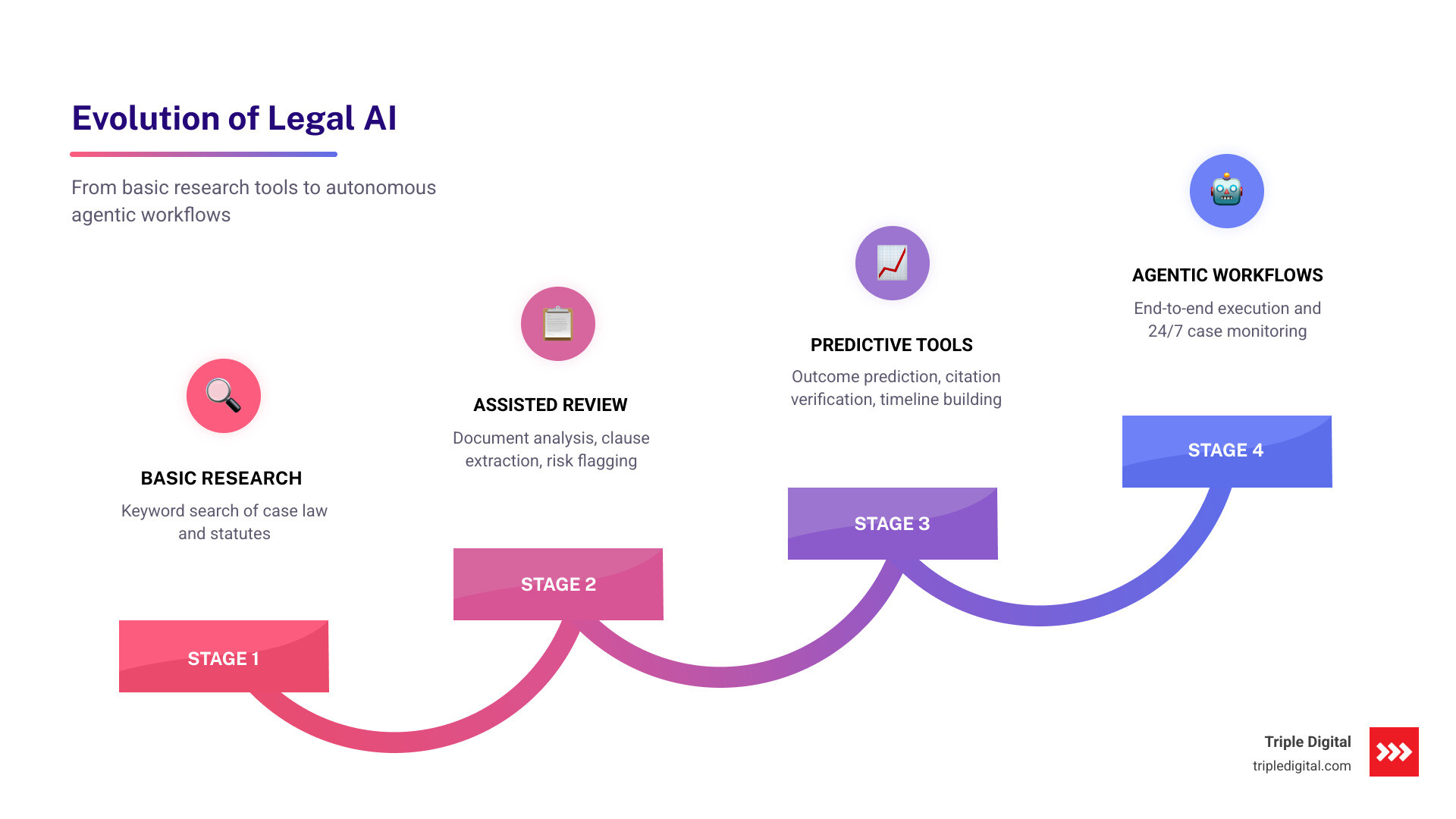
The legal industry has moved beyond simple chatbots. In 2026, AI automation for lawyers is built on several core pillars that touch every part of the practice. We see firms moving away from “wrapper” tools—generic AI with a legal logo slapped on—toward multi-layered architectures designed specifically for legal reasoning.
These pillars include:
- Legal Research: Moving from keyword searches to natural language queries that understand the nuances of case law.
- Document Review: Systems that don’t just find words but understand intent and context.
- Contract Analysis: Comparing new drafts against your firm’s “gold standards.”
- Litigation Support: Automating the heavy lifting of discovery and trial preparation.
Smart firms are also realizing that these tools aren’t just for the courtroom; they are essential for business growth. For instance, AI Tools for Law Firm Marketing are helping firms identify high-value leads before the competition even knows they exist.
Streamlining Document Review and Contract Analysis
Document review used to be the “rite of passage” for junior associates—which is a polite way of saying it was a soul-crushing, manual slog. Today, AI handles automated redlining and clause extraction with a level of precision humans struggle to maintain after hour eight of a review session.
AI tools can now instantly flag risks in a 50-page contract by identifying language that deviates from market standards or firm-approved templates. This shift is critical because it ensures consistency across the entire firm. When you use AI to generate or review text, the focus moves from “typing” to “editing and strategy.” To get the best results, understanding The Key to AI Written Content is essential: it’s about using the AI as a high-powered engine while you remain the driver.
Enhancing Litigation Support and Research
In litigation, speed is often as important as accuracy. Modern AI automation for lawyers allows for deep precedent analysis and citation verification against millions of federal and state opinions. Instead of spending 20 hours finding the “needle in the haystack” case, an attorney can surface it in seconds.
Furthermore, case outcome prediction has become a reality. By analyzing judge behavior, jurisdiction trends, and historical data, AI can give you a statistical “weather report” for your case. This helps in managing client expectations and informing overall case strategy. For a look at which platforms are leading the pack this year, check out the Attorney Generative AI Rankings 2026.
Measurable ROI and Productivity Gains in Modern Firms
The question we often hear at Triple Digital isn’t “Does AI work?” but “Is it worth the investment?” The data from 2026 says a resounding yes. We aren’t just talking about saving a few minutes here and there; we are talking about a fundamental shift in the firm’s bottom line.
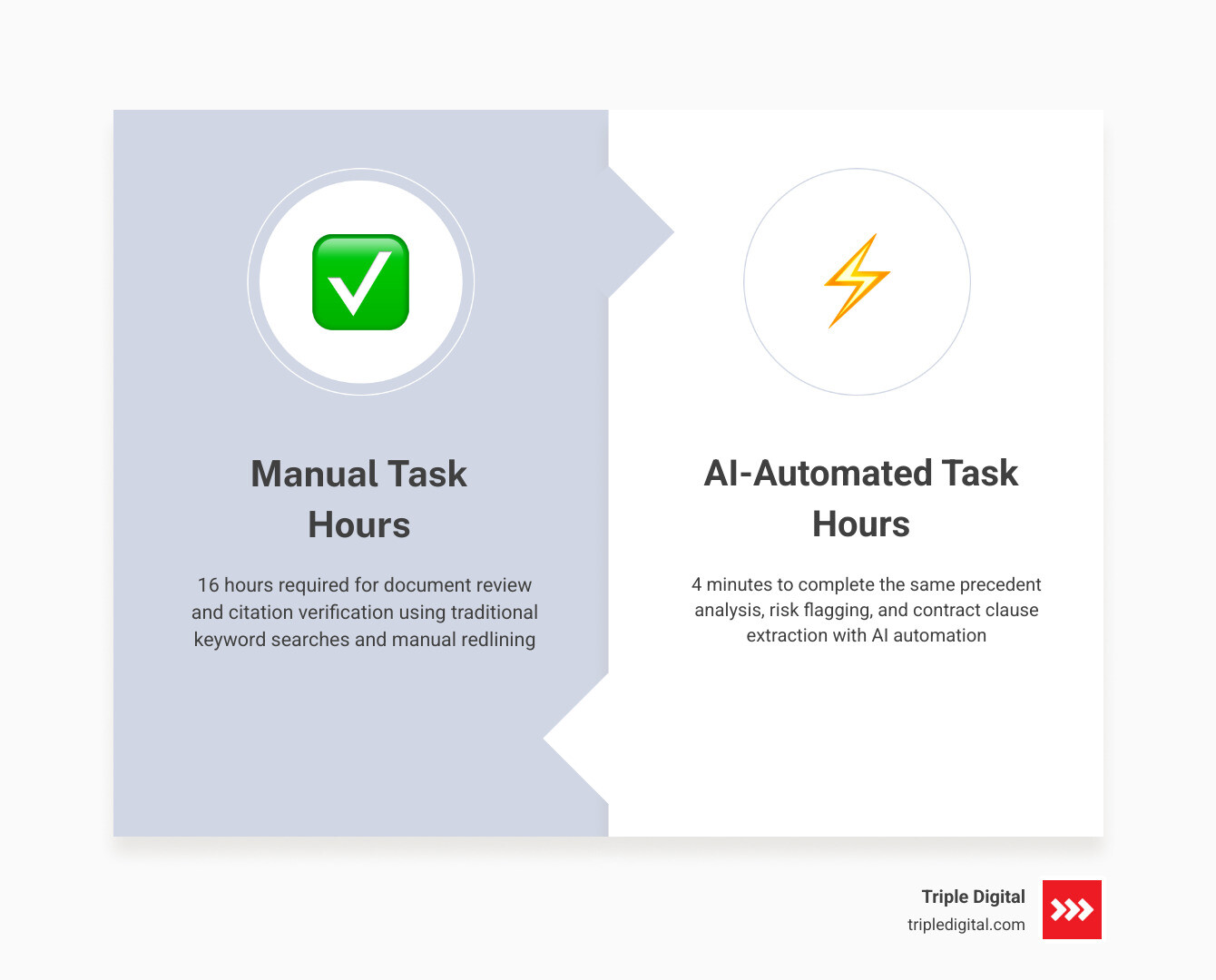
The financial impact is staggering. Research indicates a potential $2.0 million in additional yearly billing per 100 lawyers by reclaiming time previously lost to non-billable administrative tasks. In some high-volume litigation matters, productivity gains have exceeded 100 times the manual baseline. When associates can do in four minutes what used to take 16 hours, the firm’s capacity to take on new cases explodes. This is a core part of how we help firms Future-Proof Your Firm: The AI Advantage in Legal Marketing.
Reducing Administrative Overhead
Non-billable hours are the “silent killer” of law firm profitability. AI automation tackles this by handling:
- Automated Billing: AI can suggest billing codes and draft narrative descriptions based on your actual work throughout the day.
- Client Intake: Conversational AI can qualify leads at 2:00 AM, capturing details and routing them to the right department without a human lifting a finger.
- Time Tracking: No more trying to remember what you did last Tuesday; AI monitors your workflow to ensure every minute is accounted for.
By automating these “drudge” tasks, you aren’t just saving money; you’re saving your team’s sanity. This efficiency is a major component of modern AI Digital Marketing for Law Firms, as it allows firms to respond to new leads instantly.
Improving Accuracy and Quality of Service
Human error is inevitable, especially under the pressure of tight deadlines. AI doesn’t get tired. It can perform consistency checks across thousands of documents, catching a missed clause or a contradictory statement that a human eye might skip.
In fact, 90% of firms interviewed in recent studies expect AI to improve the overall quality of service provided to clients. Clients are noticing, too—they are increasingly demanding the efficiency that AI provides. To help our clients stay ahead of these expectations, we’ve even seen how Triple Digital Unveils Groundbreaking AI Tool to Help Law Firms Outrank Competitors Online, proving that AI is just as powerful for firm growth as it is for case management.
Navigating Ethics, Security, and Compliance in the AI Era
With great power comes great responsibility—and a lot of paperwork. You can’t just plug client secrets into a public AI and hope for the best. In 2026, the gold standard for AI automation for lawyers involves rigorous security protocols.
We look for “Legal-Grade” AI that meets these standards:
- SOC2 Type II & ISO 27001: For operational security.
- GDPR & HIPAA: For data privacy and medical record handling.
- Zero Data Retention: Ensuring your firm’s data is never used to train the provider’s general models.
Maintaining attorney-client privilege is non-negotiable. If you’re looking for a deep dive on how to set these guardrails, our Guide to Law Firm AI Strategies covers the essentials of secure deployment.
Addressing Hallucinations and Verification
We’ve all heard the horror stories of AI making up cases. In 2026, we solve this through “Grounding.” Modern legal AI doesn’t just “guess” the next word; it queries a verifiable database of actual law.
The ABA Formal Opinion 512 reminds us that lawyers have a “supervisory duty” over AI, much like they do over a paralegal or a junior associate. You must always have a human-in-the-loop to verify citations and ensure the logic holds up. Never submit an AI-generated brief without checking the primary sources first!
Data Privacy and Confidentiality Standards
Generic AI tools often treat your data as “fuel” for their next update. Professional legal tools do the opposite. They use end-to-end encryption and isolated data environments. This ensures that your firm’s proprietary knowledge—your “secret sauce”—stays within your firm. State bar ethics opinions are increasingly clear: using consumer-grade AI on active matters may risk waiving attorney-client privilege entirely. Stick to enterprise-grade tools that offer zero-retention policies.
Strategic Implementation: Choosing the Right AI Automation for Lawyers
Choosing a tool because it has a cool demo is a recipe for a “shelfware” disaster. Implementation requires a strategic approach. You need to start with a needs assessment: Where is the bottleneck? Is it intake? Is it medical record summaries? Is it 50-state legal research?
When evaluating a vendor, consider:
- Security: Do they have the certifications mentioned above?
- Integrations: Does it work with iManage, Clio, or Microsoft 365?
- Reputation: Are other AmLaw 100 or respected boutique firms using it?
- UI/UX: If it’s too hard to use, your staff won’t use it.
Selecting the Best AI Automation for Lawyers
Different practice areas have different needs. A personal injury firm needs an AI that can summarize 2,000 pages of medical records and find the “missing” diagnosis. A corporate firm needs an AI that can handle M&A due diligence and fund formation.
We recommend starting with a pilot program. Test the tool with a small group of “power users” before a firm-wide rollout. This allows you to work out the kinks and build internal “success stories” that make broader adoption easier. For more on how these shifts are changing the game, see Beyond the Bench: Key Trends Shaping the Legal Landscape.
Training and Change Management
The best tool in the world is useless if your team doesn’t know how to talk to it. Prompt engineering is the new “legal writing.” Training your staff on how to provide context, specify formats, and iterate on AI outputs is vital.
Change management isn’t just about technical training; it’s about culture. You need to reassure your team that AI is there to help them, not replace them. It’s a digital colleague that handles the boring stuff so they can focus on the high-level strategy they went to law school for.
The Future of Legal Practice: Business Models and Trends
The “billable hour” has been the bedrock of law for decades, but AI automation for lawyers is forcing a conversation we can no longer avoid. If a task that used to take 10 hours now takes 10 minutes, the old model starts to look a bit shaky.
We are seeing a rise in Alternative Fee Arrangements (AFAs). Firms are increasingly comfortable charging for value and outcomes rather than just time. This shift allows firms to capture the profit from their efficiency gains rather than passing all the savings to the client and losing billable revenue.
Agentic AI and Autonomous Workflows
The biggest trend in 2026 is the move from “AI Assistants” to “AI Agents.” An assistant waits for you to ask a question. An agent is proactive.
- Proactive Auditing: AI “Auditors” can scan your entire caseload every night to find missed value—like an overlooked TBI in a personal injury file.
- End-to-End Execution: Agents can plan, execute, and review complex multi-step workflows, streamlining the technical organization and preparation of legal documents for final attorney review.
Impact on Staffing and Recruitment
The “AI-powered firm” looks different. We are seeing firms maintain their associate hiring but change the roles. New positions like “Legal Data Scientists” and “AI Prompt Engineers” are appearing in the mastheads of major firms.
The apprenticeship model is also evolving. Instead of associates learning by doing the “grunt work,” they are learning by reviewing AI-generated drafts—accelerating their development into strategic thinkers. This efficiency is especially helpful in remote work environments, where AI can help bridge the gap in collaboration.
Frequently Asked Questions about AI Automation for Lawyers
Will AI automation replace junior associates or paralegals?
No. AI is a tool for task augmentation, not human replacement. It replaces the repetitive, low-value tasks that lead to burnout. This allows junior staff to focus on high-value strategy, client relationships, and complex judgment calls that AI simply cannot make. The goal is to make a first-year associate as productive as a third-year associate.
How do law firms ensure AI-generated citations are accurate?
By using legal-specific platforms that use “Retrieval-Augmented Generation” (RAG). These tools ground their answers in verifiable databases like Westlaw, LexisNexis, or specialized internal repositories. They provide “clickable” citations so you can instantly verify the primary source.
What is the typical ROI timeline for implementing legal AI?
Many firms see immediate time savings in administrative tasks. For more complex workflows, a 30% reduction in non-billable hours is typically achieved within the first 6 months. When you factor in the ability to handle a larger caseload without increasing headcount, the long-term revenue growth is substantial.
Get Help from Triple Digital
At Triple Digital, we live at the intersection of legal expertise and technological innovation. Based in Houston, TX, we specialize in helping law firms turn these efficiency gains into actual growth through precise lead generation and case acquisition.
The May 2026 outlook for the legal industry is bright for those who embrace change. AI automation for lawyers isn’t about removing the human element from the law; it’s about freeing lawyers to be more human—spending more time with clients, more time on strategy, and less time buried in paperwork.
Ready to take your firm to the next level? Transform your firm’s growth with expert AI services and see how we use data mining and AI to help you win more cases.