





Everything You Need to Know About AI SEO Services
Search Has Changed — Here’s What AI SEO Services Actually Do
AI SEO services help businesses get found inside AI-generated answers — not just traditional Google search results.
If you’re a law firm trying to figure out whether this is worth your attention, here’s the short version:
What AI SEO services typically include:
- Optimizing your content to be cited in Google AI Overviews, ChatGPT, Gemini, and Perplexity
- Structuring pages with schema markup, FAQs, and clear entity signals so AI systems can read and reference your content
- Building topical authority across practice areas so AI tools recognize your firm as a credible source
- Tracking citation frequency and share of voice — not just keyword rankings
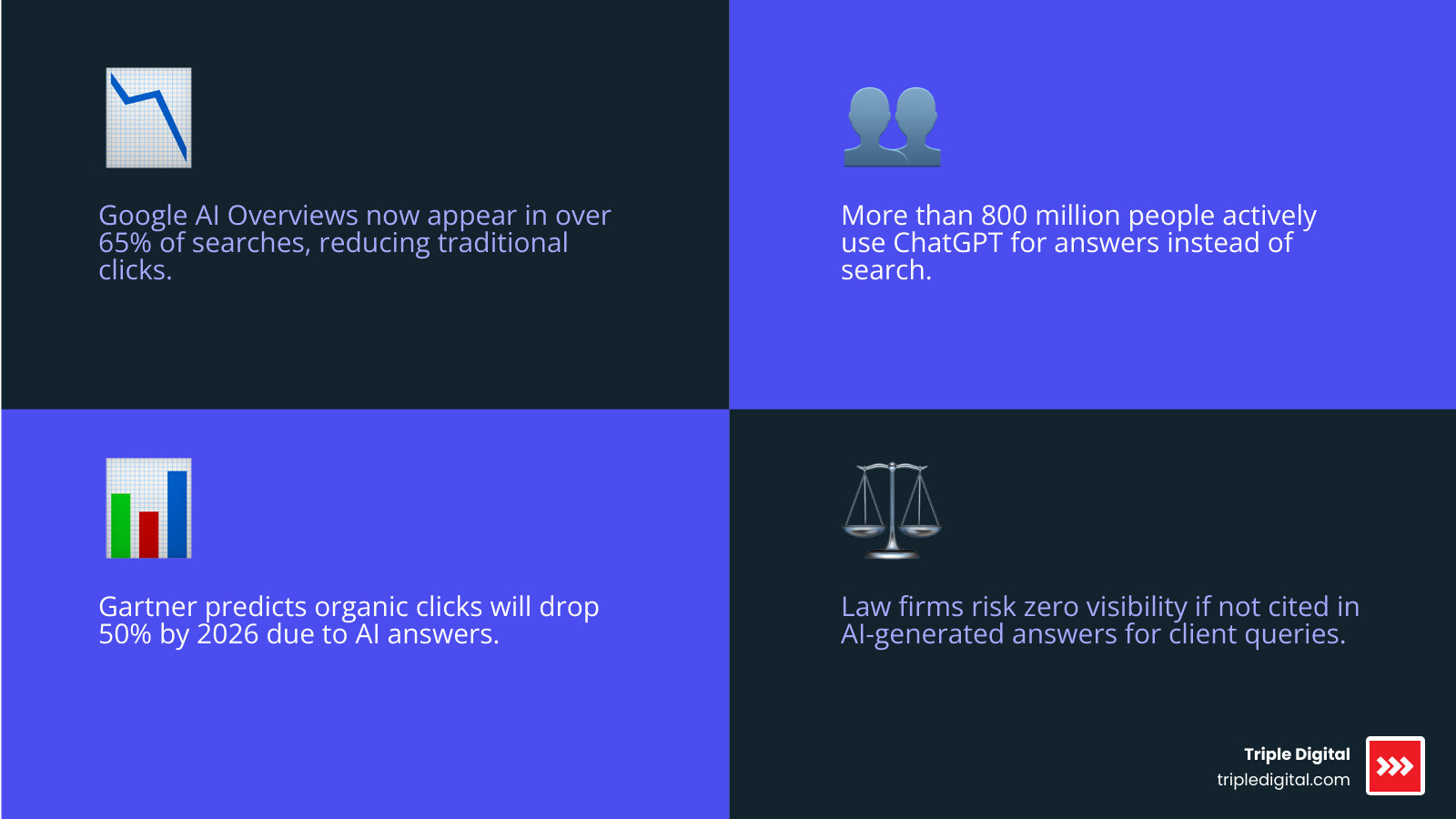
Search isn’t what it was two years ago. Google AI Overviews now appear in over 65% of searches. More than 800 million people use ChatGPT. Gartner predicts organic clicks will drop 50% by 2026.
For law firms, this matters more than most industries. When a potential client types “what should I do after a car accident” or “best personal injury lawyer in Houston” — they may never scroll past the AI-generated answer at the top of the page.
If your firm isn’t cited there, you don’t exist for that search.
Traditional SEO got your website ranked. AI SEO services get your firm mentioned, quoted, and recommended inside the answers AI tools generate — which is where attention is shifting fast.
This guide covers everything you need to know: what AI SEO is, how it works, what services are involved, how results are measured, and how to choose the right partner to help your firm stay visible as search continues to evolve.
The Evolution of Search: Why Your Business Needs AI SEO Services

The “Golden Age” of the ten blue links is officially over. For decades, SEO was a simple game: you rank #1, you get the click. But as of May 2026, the game has fundamentally changed. We are now living in the era of “Search Everywhere Optimization.”
Traditional SEO focuses on optimizing for search engine algorithms to rank a website on a Search Engine Results Page (SERP). AI SEO services, however, focus on Generative Engine Optimization (GEO). This is the practice of increasing a brand’s visibility within AI-generated responses. Instead of just trying to get a link on a page, we are now trying to get your firm’s expertise synthesized into the answer itself.
Why does this matter? Because search behavior has shifted from “searching” to “answering.” Users no longer want a list of websites to visit; they want a direct answer to their problem. If a Houston resident asks their phone, “How long do I have to file a medical malpractice claim in Texas?” they don’t want to read four different blogs. They want a direct answer and a recommendation for a firm that can assist them.
| Feature | Traditional SEO | AI SEO (GEO/AEO) |
|---|---|---|
| Primary Goal | Rank in top 3 organic links | Earn citations in AI-generated summaries |
| User Intent | Keyword matching | Conversational problem-solving |
| Output | List of relevant URLs | Synthesized, natural language answer |
| Success Metric | Click-Through Rate (CTR) | Citation Frequency & Share of Voice |
| Main Platform | Google Search | ChatGPT, Gemini, Perplexity, AI Overviews |
By leveraging AI Overviews, businesses can capture attention before a user even considers clicking a traditional link. This is the heart of Data-Driven Legal Marketing: using the way machines learn to ensure they learn about you.
How AI SEO Services Address Zero-Click Search
We’ve all done it. You search for a weather update or a quick fact, read the snippet at the top of Google, and close the tab. That is a “zero-click search.” In 2026, this isn’t just a trend; it’s the standard. Nearly 80% of consumers now rely on zero-click results in at least 40% of their searches.
This shift has created a massive challenge for traditional marketing. Gartner predicts a 25% drop in search engine volume and a staggering 50% drop in organic clicks by 2026. If your strategy relies solely on people clicking through to your blog to find your phone number, your lead flow is at risk.
AI SEO services solve this by ensuring your firm is the source of the information the AI is providing. When Google’s Gemini or OpenAI’s SearchGPT answers a legal question, it cites its sources. Our goal is to make sure your firm is that source. By appearing as a cited authority, you maintain brand visibility even when the “click” disappears. This is how we help Future-Proof Your Firm: The AI Advantage in Legal Marketing.
The Impact of ChatGPT, Gemini, and Perplexity on Search Behavior
Search has become a conversation. With over 800 million people using ChatGPT and millions more using Perplexity and Gemini, the way people phrase their needs has evolved. We’ve seen a 700% increase in queries that are 8 words or longer.
People aren’t just typing “Houston car accident lawyer” anymore. They are typing, “I was hit by a delivery truck in downtown Houston and the driver didn’t have insurance, what are my legal options?”
Traditional keyword-stuffing can’t handle that level of nuance. AI models, however, excel at it. Nearly 9 in 10 B2B buyers (89%) now use generative AI tools at some point during their purchase journey. They use these tools to build shortlists, compare services, and vet reputations. If you want to see how the landscape is shaking out, check out the Attorney Generative AI Rankings 2026.
Generative Engine Optimization (GEO) and the Rise of AI Overviews
If you’ve used Google lately, you’ve seen the “AI Overview” at the top—a colorful box that summarizes the answer to your query. These overviews now appear in more than 65% of Google searches. They are powered by Gemini, Google’s large language model (LLM), and they are the prime real estate of 2026.
GEO is the specialized wing of ai seo services that focuses on “Citation Probability Engineering.” Unlike Google’s traditional “web crawlers,” LLM crawlers are looking for something different. They aren’t just looking for keywords; they are looking for “entities” (concepts, people, places) and the relationships between them.
To get cited, your content must be more than just “good.” It must be structured in a way that an AI can easily parse, verify, and summarize. This is a key part of the Beyond the Bench: Key Trends Shaping the Legal Landscape.
Technical Components of Modern AI SEO Services
You can’t just write a blog post and hope for the best anymore. Technical AI SEO is the “under the hood” work that makes your site machine-readable.
- Structured Data & Schema Markup: This is code that tells the AI exactly what your content is. We use LegalService, FAQPage, Attorney, and LocalBusiness schema to remove any guesswork for the AI.
- Entity Mapping: We ensure your firm is recognized as a specific “entity.” This involves consistent naming, address, and phone number (NAP) data across the web, but also connecting your attorneys to their specific areas of expertise, publications, and awards.
- Semantic Structure: AI prefers a clear hierarchy. We use semantic header tags (H1, H2, H3) to create a logical map of the information.
- Crawl Efficiency: LLM crawlers are less sophisticated than the traditional Googlebot. They need clean architecture and fast load times to “digest” your site’s data.
We’ve seen the impact of these technical shifts firsthand. For example, Triple Digital LLC Unveils Groundbreaking AI Tool to Help Law Firms Outrank Competitors Online, which focuses specifically on these technical signals to boost visibility.
Content Strategies for AI Visibility
Content is still king, but the king has a new wardrobe. To win in AI search, we use three primary strategies:
- Topical Authority: AI tools don’t want to cite a “generalist.” They want to cite the expert. We build “content clusters”—a massive cornerstone page about a topic (like “Texas Personal Injury Law”) supported by dozens of smaller, highly specific pages (like “Houston personal injury court locations”).
- Definition-First Paragraphs: AI models love “featured snippets.” We structure our content so the most direct answer to a question appears in the very first two sentences of a section. This makes it incredibly easy for an LLM to “clip” your answer and use it in a summary.
- Fact-Rich Formatting: Use bullet points, numbered lists, and tables. AI models are programmed to find structured data more reliable than long, rambling blocks of text.
Understanding The Key to AI Written Content is about balancing human readability with machine parseability. For a deeper dive, our Guide to Law Firm AI Strategies breaks down how to execute this at scale.
Measuring Success: Beyond Traditional Rankings
If your current SEO agency is still just sending you a report of where you rank for “lawyer near me,” they are living in the past. In ai seo services, “Rank #1” is a vanity metric. Clicks are down 30% from AI-result answers, which means you could rank #1 and still see your traffic disappear.
So, how do we measure success? We look at:
- Citation Frequency: How often is your firm cited as a source in Google AI Overviews or Perplexity?
- Share of Voice (SoV): In a conversational search about your practice area, what percentage of the time does the AI mention your firm versus your competitors?
- Assisted Conversions: Since many users get their answer from AI and then search for your brand directly, we track “branded search lift” as a primary KPI.
- Brand Perception: We audit what the AI “thinks” of you. If you ask ChatGPT, “Who is the most reputable trial lawyer in Houston?” does your name come up?
This is the evolution of Data-Driven Legal Marketing. We focus on the bottom line—cases and revenue—rather than just traffic numbers that don’t convert.
Complementing Traditional SEO with AI Tactics
Don’t throw the baby out with the bathwater. AI SEO doesn’t replace traditional SEO; it sits on top of it. You still need a fast website, high-quality backlinks, and a solid Google Business Profile.
In fact, the fundamentals of E-E-A-T (Experience, Expertise, Authoritativeness, and Trustworthiness) are more important than ever. AI models use these signals to decide which sources to trust. If you have a high Domain Rating (DR) and a history of winning cases, the AI is much more likely to cite you.
We call this a “Hybrid Strategy.” We use traditional tactics to earn the attention of search engines and AI tactics to capture the attention of the users. Our AI Digital Marketing for Law Firms program is built on this exact synergy.
Frequently Asked Questions about AI SEO
How long does it take to see results from GEO efforts?
Typically, you can expect to see measurable results within 3 to 6 months. Technical “wins”—like improved crawl rates and faster indexation—often happen within the first few weeks. However, building the topical authority required for an AI to consistently cite you takes time. Content and internal linking signals usually start to compound in the 60-to-90-day range. Think of it like traditional SEO: it’s an investment, not a light switch.
Which industries benefit most from AI search optimization?
While almost every business is affected, industries where users seek fast, fact-based, or summarized answers see the biggest impact. This includes:
- Legal: Clients are often in high-stress situations looking for immediate procedural answers.
- Healthcare: Users searching for symptoms, treatments, and local providers.
- SaaS & Tech: B2B buyers researching complex software solutions.
- Finance: People looking for advice on loans, taxes, or investments.
For more on how this applies to the legal field specifically, see our guide on AI Digital Marketing for Law Firms.
What criteria should businesses use when choosing an AI SEO agency?
Don’t be fooled by agencies that just “sprinkle” the word AI onto their old service list. Look for:
- Strategic Thinking: Do they understand the difference between a keyword and an entity?
- Technical Capability: Can they implement advanced schema and audit your visibility across multiple LLMs like Claude and Perplexity?
- Revenue Focus: Are they talking about “citations” and “cases,” or just “traffic” and “rankings”?
- Transparency: Do they have a clear framework for measuring success in a zero-click world?
We discuss these requirements in depth in our article Future-Proof Your Firm: The AI Advantage in Legal Marketing.
Conclusion
The search landscape is moving faster than ever. By the time you finish reading this, Google has likely updated its AI Overview algorithm again. But the core mission remains the same: being the most helpful, most authoritative answer to your client’s problems.
At Triple Digital, we don’t do “fluff.” We are a Houston-based agency that lives and breathes lead generation and case acquisition. We understand that for law firms, an extra 1,000 visitors doesn’t matter if they don’t turn into signed cases. By leveraging ai seo services, data mining, and precise client targeting, we ensure your firm isn’t just part of the conversation—it is the conversation.
If you’re ready to stop losing traffic to AI and start winning the citations that drive high-value cases, let’s talk. We help firms move past the hype and into a strategy that actually works in 2026.
Explore our full suite of AI Digital Marketing for Law Firms to see how we can help you dominate the new era of search.