





How to Plan a Custom Website Design for Your Unique Law Practice
Your Law Firm’s Website Is Either Winning Clients or Losing Them
Custom lawyer web design is the practice of building a law firm website from the ground up — tailored to your specific practice, brand, and client acquisition goals — rather than using a pre-built template or DIY website builder.
Here’s a quick breakdown of what that means in practice:
| Feature | Custom Design | Template/DIY |
|---|---|---|
| Unique visual identity | Yes | Rarely |
| Built for your practice area | Yes | No |
| Ownership of your site | Full | Often none |
| SEO flexibility | Full control | Limited |
| Conversion optimization | Tailored | Generic |
| Scalability | High | Low |
When a potential client needs a lawyer, they search Google first. Your website is what they see. And in that moment, first impressions decide everything.
A generic template signals a generic firm. A custom site signals credibility, competence, and care — before a single word is read.
The numbers back this up. According to ABA data, 42% of law firms that hire outside marketing consultants do so specifically for website design. That’s not a coincidence. Legal professionals know their websites matter — many just aren’t sure how to get them right.
The challenge is real: most law school training doesn’t include a single lesson on digital marketing or web design. So firms end up with outdated sites, cookie-cutter templates, or expensive subscriptions they don’t own — and wonder why the phone isn’t ringing.
This guide walks you through how to plan a custom website that actually works for your practice.
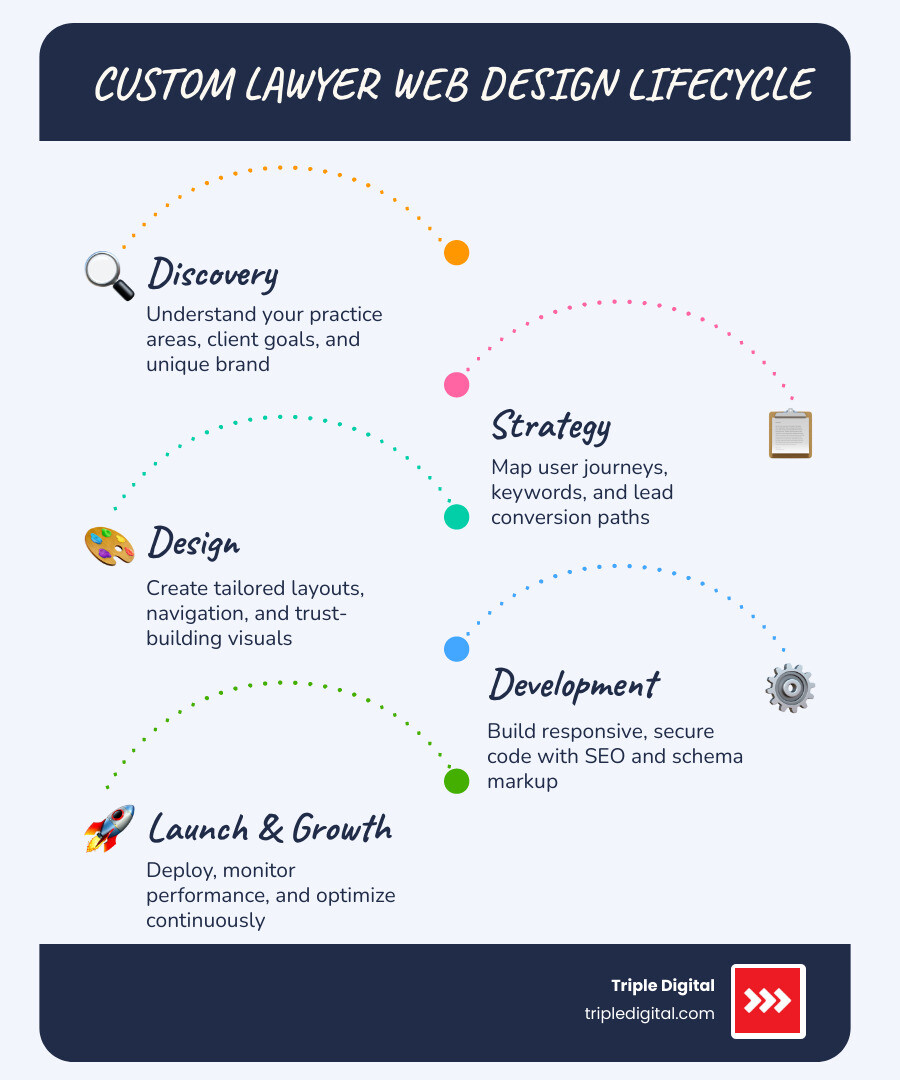
Quick custom lawyer web design terms:
Defining Custom Lawyer Web Design vs. Templates
In the digital landscape of 2026, the term “website” can mean anything from a $20-a-month drag-and-drop page to a sophisticated $50,000 lead-generation engine. For a law firm, the difference between these two isn’t just aesthetic; it’s about business growth and professional reputation. When we talk about custom lawyer web design, we are referring to a site that is architected specifically for your firm’s unique value proposition.
A custom site is built on a foundation of brand identity. It doesn’t just use a “legal theme”; it uses your firm’s colors, voice, and unique philosophy to create a digital handshake that feels authentic. Furthermore, custom builds typically utilize open-source Content Management Systems (CMS) like WordPress. This is vital because it ensures ownership and scalability. Unlike “website factories” that lock you into a proprietary platform, a custom WordPress site belongs to you. If you want to move to a different host or add complex new features three years from now, you have the freedom to do so. For a deeper dive into the technical side, check out our Lawyer Website Developer Guide.
What is custom lawyer web design?
At its core, custom lawyer web design is bespoke architecture. Every pixel is placed with intent. Instead of fitting your content into a pre-existing box, the box is built around your content. This involves:
- Unique Coding: Clean, lightweight code that isn’t bogged down by the “everything-and-the-kitchen-sink” features found in generic templates.
- Tailored User Experience (UX): A navigation path designed specifically for your clients. A personal injury client has different needs and a different state of mind than a corporate litigation client; your UX should reflect that.
- Practice-Specific Functionality: Whether it’s a secure document portal for estate planning or a sophisticated multi-step intake form for mass torts, custom design integrates the tools you actually need to run your practice.
The limitations of DIY and template sites
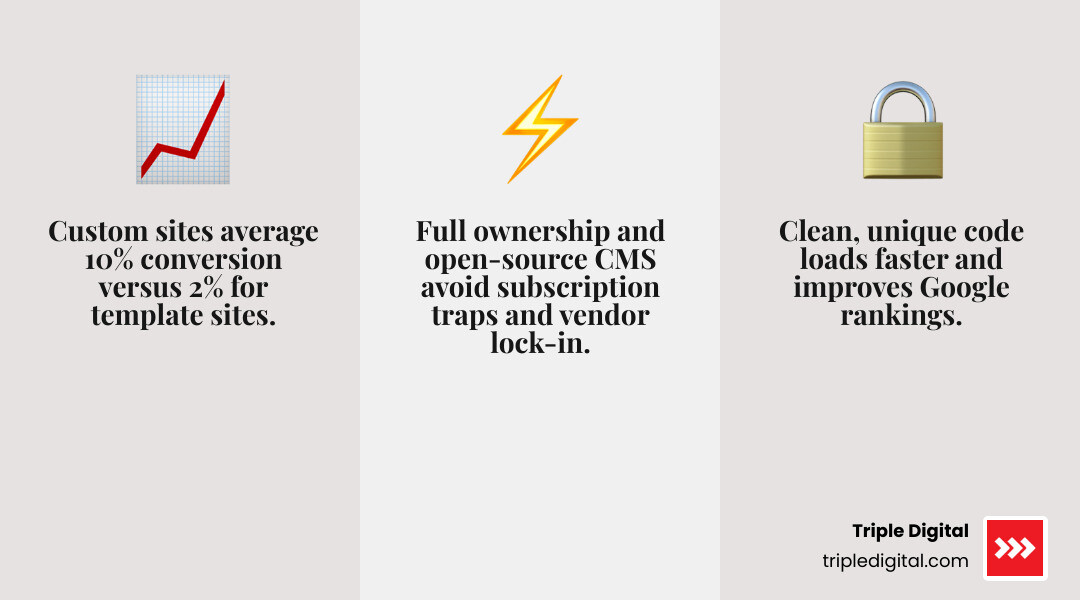
We’ve all seen them: the “legal website templates” that feature the same stock photo of a gavel and a generic marble courthouse. While DIY builders like Wix or Squarespace are tempting due to low upfront costs, they often become “subscription traps.” You pay a monthly fee forever, and if you stop paying, your website—and all the SEO authority you’ve built—disappears.
Template sites suffer from generic aesthetics that make your firm look like every other lawyer in town. Even worse, they often come with “bloated code”—excessive scripts and styling that slow down your site. In 2026, speed is a major ranking factor for Google, and a slow template can bury you on page five of the search results. Finally, these platforms offer limited SEO control. You can’t always tweak the technical metadata or schema markup necessary to truly dominate local search.
The Strategic Benefits of custom lawyer web design in 2026
The legal market in 2026 is more competitive than ever. To stand out, your website must do more than just look pretty; it must perform.
Investing in a custom site is a strategic move that pays dividends in credibility. In the legal world, your website often serves as a verification tool. Even if a client was referred to you, they will likely check your website before calling. A high-end, custom design signals financial stability and professional success. It builds trust through “E-E-A-T” signals (Experience, Expertise, Authoritativeness, and Trustworthiness), which are essential for both human visitors and search engine algorithms. To understand the financial impact, read about How Web Design Can Make Your Business More Profitable.
Improving lead generation and client conversion
The ultimate goal of your website is to turn a stranger into a consultation. Custom design allows for “conversion architecture.” While an average attorney website might convert at a measly 2%, the best-performing custom sites can hit 10% or higher. That is five times more clients from the same amount of traffic!
We achieve this through:
- Strategic CTAs: Placing “Call Now” or “Free Evaluation” buttons exactly where the user’s eye naturally falls.
- Intake Integration: Connecting your site directly to your CRM (like Clio or MyCase) to reduce manual data entry and ensure no lead falls through the cracks.
- Trust Signals: Highlighting case results, bar certifications, and client testimonials in high-visibility areas.
Enhancing search engine visibility
You can have the best law firm in Houston, but if no one can find you on Google, it doesn’t matter. Custom web design is the bedrock of a strong SEO strategy. Because custom sites are built with clean code and a logical site structure, search engines can easily “crawl” and index your pages.
Custom builds also allow for localized SEO optimization. We can build dedicated pages for every city and practice area you serve, ensuring you rank for specific terms like “personal injury attorney in Houston.” For more tips on expanding your reach, see Beyond the Homepage: Maximizing Your Legal Website’s Potential.
Essential Features for High-Performing Legal Sites
A modern law firm website needs more than just a “Contact Us” page. In 2026, certain features are non-negotiable if you want to compete at a high level. One of the most effective strategies we use is the “Practice Area Hub.” Instead of a single page listing your services, we create a comprehensive resource center for each area of law. This not only helps SEO but establishes you as the go-to authority. For more on the design phase, check out Website Development Design.
Technical requirements for 2026
The technical standards for law firm websites have evolved. To be successful today, your site must include:
- JSON-LD Schema: This is “hidden” code that tells search engines exactly what your firm does, where you are located, and what your reviews are. It’s what helps you show up in the “Map Pack.”
- ADA Compliance (WCAG 2.1 AA): Law firms are increasingly targets of accessibility lawsuits. Your site must be usable by people with disabilities, including screen reader compatibility and keyboard navigation.
- Mobile-First Design: With over 60% of legal traffic coming from mobile devices, your site shouldn’t just “work” on a phone—it should be designed for the phone first.
- Secure Hosting: Law firms handle sensitive data. We recommend dedicated hosting with SSL certificates and 24/7 uptime monitoring to ensure your site is always fast and safe.
Advanced functionality and integrations
Custom design allows you to move beyond the basic “digital brochure” and into a “client acquisition machine.” We can integrate:
- CRM Sync: Automatically push new leads into your practice management software.
- AI Chatbots: Provide 24/7 instant responses to potential clients, qualifying leads while you sleep.
- Secure Payments: Integrate LawPay or similar tools so clients can pay retainers or invoices directly on your site.
- Document Portals: Provide a secure area for clients to upload sensitive files.
Technical Excellence: Speed, Security, and AI Readiness
In 2026, “fast enough” isn’t good enough. Google’s Core Web Vitals are now a primary ranking factor. If your site takes longer than two seconds to load, you are likely losing 40% or more of your potential visitors. High-performance custom lawyer web design focuses on sub-2-second load times by optimizing images, using advanced caching, and minimizing scripts.
Furthermore, we are now designing for “AI Search Readiness.” With the rise of AI search platforms, your website needs to be GEO (Generative Engine Optimization) and AEO (Answer Engine Optimization) ready. This means structuring your content so AI models can easily find and cite your firm as the answer to legal questions.
Security and accessibility standards
Security is a matter of professional ethics for lawyers. A custom site allows for:
- Locked Core Files: Preventing hackers from injecting malicious code.
- Automatic Updates: Ensuring your CMS and plugins are always on the latest, most secure versions.
- Encryption: Using high-level SSL certificates to protect client communications.
Accessibility is equally critical. Beyond avoiding lawsuits, an ADA-compliant site ensures you aren’t turning away potential clients who rely on assistive technology. This includes proper heading hierarchy, color contrast ratios, and alt-text for all images.
Mobile responsiveness and performance
A “responsive” site is one that adjusts its layout based on the screen size. However, custom design goes a step further with “mobile-first” development. We prioritize touch-friendly UI—making buttons large enough to tap easily—and ensure that the most important information (like your phone number) is always visible, often through a “sticky” header that stays at the top as the user scrolls.
Budgeting and Partner Selection for Your Practice
One of the most common questions we hear is: “How much should this cost?” While you can find “cheap” options, a professional, custom lawyer web design project typically ranges from $10,000 to $20,000, and can go upwards of $50,000 for large, multi-office firms with extensive content needs.
Factors that influence the cost include:
- Number of unique page designs.
- Complexity of integrations (CRM, AI chat, payment portals).
- Amount of custom-written, SEO-optimized content.
- Advanced SEO features like schema markup and local optimization.
- Ongoing maintenance and support plans.
Maximizing ROI with custom lawyer web design
Think of your website not as an expense, but as a long-term asset. A custom site builds brand equity. Over time, the leads generated by a high-performing site far outweigh the initial investment. If a custom site brings in just two or three high-value cases that a template site would have missed, it has already paid for itself. It provides a competitive advantage that scales as your firm grows.
Choosing the right design partner
Not all web designers are created equal. When choosing a partner, look for:
- Legal Expertise: Do they understand state bar advertising rules? Do they know the difference between a “contingency fee” and a “retainer”?
- Portfolio Review: Look for sites that aren’t just pretty, but functional. Do they load fast? Are the CTAs clear?
- Technical Stack: Ensure they use open-source platforms like WordPress so you aren’t locked into a proprietary system.
- Communication: You need a partner who listens to your goals and provides regular updates. For more guidance, see our article on How to Choose the Best Lawyer Website Design Firm for Your Practice.
Frequently Asked Questions about Custom Legal Design
How much does a custom law firm website cost in 2026?
While basic “refresh” services might start around $4,000, a fully custom, high-performance site typically starts at $10,000. For firms looking for a comprehensive lead-generation engine with advanced SEO and custom content, budgets of $20,000 to $50,000 are common.
How long does the custom design and development process take?
A quality custom build shouldn’t be rushed, but it shouldn’t take forever either. Most professional projects take between 4 to 8 weeks. This includes discovery, design mockups, development, SEO optimization, and final testing.
Why is custom design better for SEO than a template?
Custom sites have cleaner code, faster load speeds, and a more logical structure—all of which Google loves. More importantly, custom sites allow for deep integration of schema markup and localized content strategies that template builders simply can’t handle.
Conclusion
Your website is the heart of your firm’s marketing. When 96% of people start their search for a lawyer online, you cannot afford to have a digital presence that looks “just okay.”
At Triple Digital, we specialize in custom lawyer web design that goes beyond aesthetics. Based in Houston, TX, we are a results-driven agency focused on one thing: getting you more cases. We take a “less fluff, more cases” approach, leveraging AI and data mining to ensure your firm targets the right clients with precision. We don’t just build websites; we build client acquisition machines.
Ready to transform your online presence? Explore our custom lawyer web design services and let’s start winning more cases together.