





How to Handle Negative Reviews for Law Firms in Legal Marketing
How Online Reputation Lawyers Help Law Firms Handle Negative Reviews
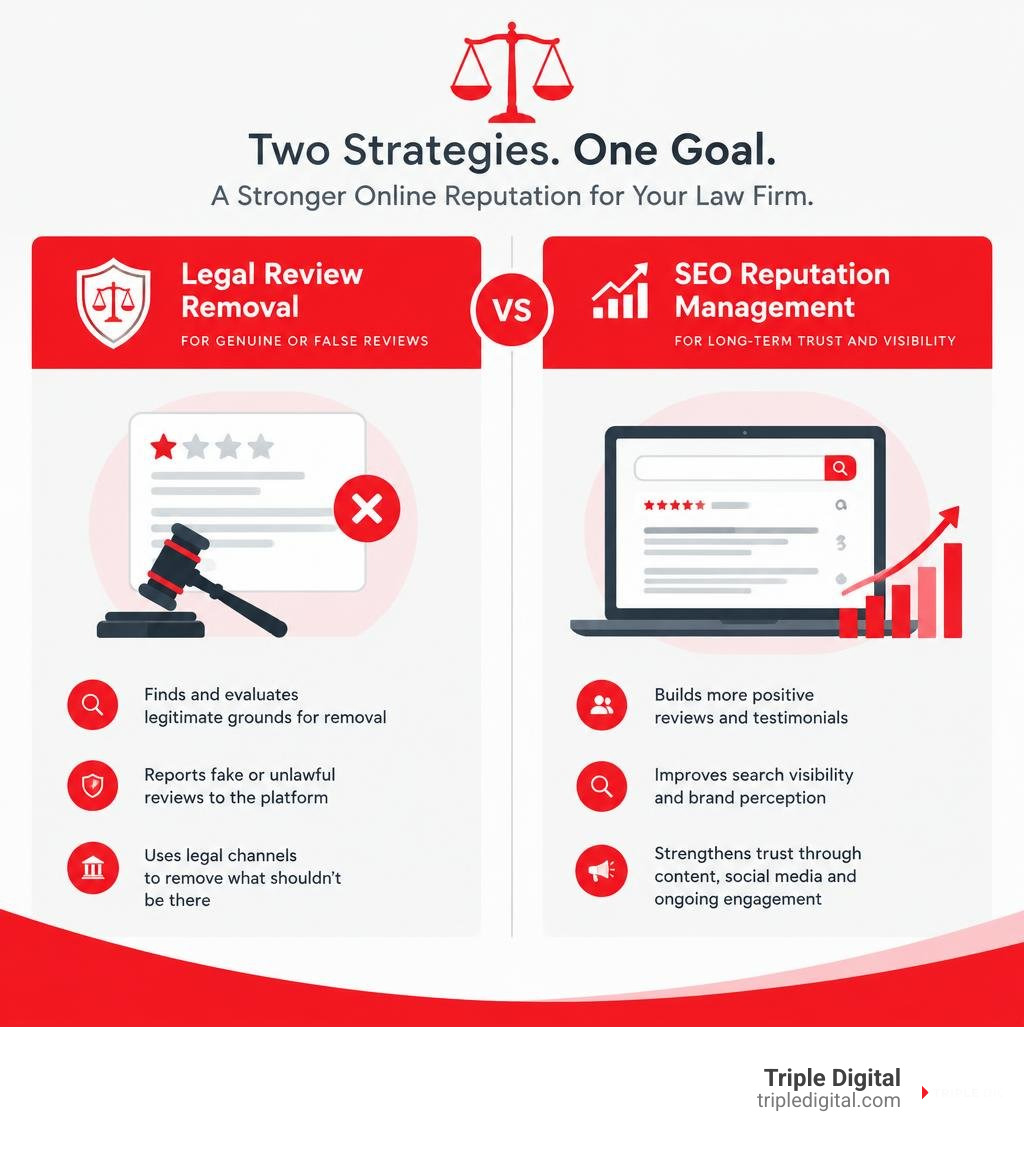
Start by saving the review, its URL, and the date you found it. If it makes a false claim of fact or appears to be fake, report it to the platform and ask an online reputation lawyer to assess your options. If it reflects a real client’s opinion, respond calmly without sharing confidential details. A digital marketing team can help you earn more genuine reviews and improve what prospective clients find in search.
The key is to match the response to the problem. A lawyer can pursue legal removal when there are grounds to do so. Marketing can build trust and visibility, but it cannot make a lawful review disappear.
Online reputation lawyers word list:
The Impact of Online Reviews and Defamation on Legal Practices

In today’s legal landscape, public perception is heavily dictated by search engine results. Almost 90% of people trust online reviews as much as personal recommendations from friends or family. For law practices, trust is the foundational currency of client acquisition. When a prospective client searches for counsel after an accident, during a commercial dispute, or amid a family crisis, a cluster of negative ratings can derail their decision within seconds.
Interestingly, consumer behavior is nuanced: 82% of consumers specifically seek out negative reviews because they perceive a mix of positive and critical feedback as more authentic than an improbable 5.0-star rating across hundreds of entries. However, there is a vast difference between a fair critique regarding response times and an unlawful, fabricated attack designed to destroy a practice.
When defamatory content or fraudulent 1-star review bombing occurs, the financial impact can be severe. Understanding why SEO is important for attorneys reveals that search engine algorithms factor user sentiment, local map pack rankings, and review velocities directly into your firm’s organic visibility. A sudden influx of bad ratings pushes your firm down the search rankings, cutting off inbound leads.
Law firms also face a unique operational hurdle: strict ethical guidelines. When a disgruntled client or an anonymous bad actor posts a scathing review, attorneys cannot simply publish rebuttal details that reveal case specifics, billing arrangements, or strategic confidences. The American Bar Association (ABA) Model Rules of Professional Conduct (particularly Rule 1.6 on Confidentiality of Information) strictly limit how lawyers may respond publicly. Breaching client confidentiality in an online retort can trigger state bar disciplinary investigations, compounding the reputational damage.
The most effective ethical response protocol involves:
- Acknowledging the comment with a neutral, professional tone.
- Refraining from confirming or denying that the reviewer was ever a formal client.
- Offering an offline avenue (such as a direct telephone number or compliance email) to discuss the matter privately.
- Engaging legal counsel to evaluate potential defamation if the statements cross into actionable falsehoods.
When to Retain Online Reputation Lawyers vs. Digital Marketing Agencies
Choosing between specialized legal representation and an agency depends entirely on whether the harmful content constitutes an actionable legal wrong or an organic branding challenge.

When false statements of fact are published, they can cross into tortious interference with prospective business relations or defamation (specifically libel when written). In these scenarios, digital marketing alone cannot compel a web host or publisher to take down the material. Online reputation defense attorneys focus on permanent legal content deletion, search engine de-indexing, and enforcing court orders against rogue platforms.
Conversely, partnering with an agency for legal marketing services is the right pathway when addressing lawful negative reviews, general brand visibility deficits, or low review volume. Marketing professionals handle positive asset creation, search governance, and systematic review generation campaigns—keeping in mind that 70% of consumers are more likely to leave a review when asked by a real person rather than through an impersonal automated system.
| Capability / Solution | Online Reputation Defense Lawyers | Digital Marketing & PR Agencies |
|---|---|---|
| Primary Objective | Permanent takedown, de-indexing, and legal liability enforcement | Search suppression, positive content generation, and brand building |
| Core Mechanisms | Cease-and-desist notices, subpoenas, DMCA notices, and court orders | Technical SEO, content marketing, review management, and PR outreach |
| Best Used For | Defamation, fabricated reviews, extortion, and cyber harassment | Authentic negative reviews, low star ratings, and poor search visibility |
| Speed of Resolution | Days (voluntary takedown) to months (court proceedings) | Ongoing (typically 60 to 180 days for visible search shift) |
| Target Entities | Anonymous posters, web hosts, search indexers, and bad actors | Search algorithms, prospective clients, and review platforms |
Tactical Strategies Used by Online Reputation Lawyers
Specialized attorneys employ a tiered strategy to neutralize digital threats without necessarily triggering protracted courtroom battles:
- Formal Cease-and-Desist Notices: A targeted, legally grounded letter sent to the poster or website administrator detailing the defamatory statements and setting strict compliance deadlines.
- Platform Terms of Service (ToS) Enforcement: Submitting comprehensive legal reports to hosting platforms demonstrating that the content violates specific guidelines regarding harassment, hate speech, or fraudulent business reviews.
- DMCA Copyright Claims: Utilizing Digital Millennium Copyright Act takedowns when defamatory posts unlawfully reproduce proprietary images, firm media, or copyrighted assets.
- Court-Ordered De-Indexing: Securing formal injunctions and court declarations that identify material as unlawful, which major search engines use to delist offending URLs from index pages.
Integrating these legal remedies alongside modern law firm SEO ensures that once unlawful assets are removed, your firm’s authoritative content occupies the top organic search results.
Understanding Anonymity and Digital Identification
A common challenge involves defamatory claims published behind pseudonyms, VPNs, or burner accounts.
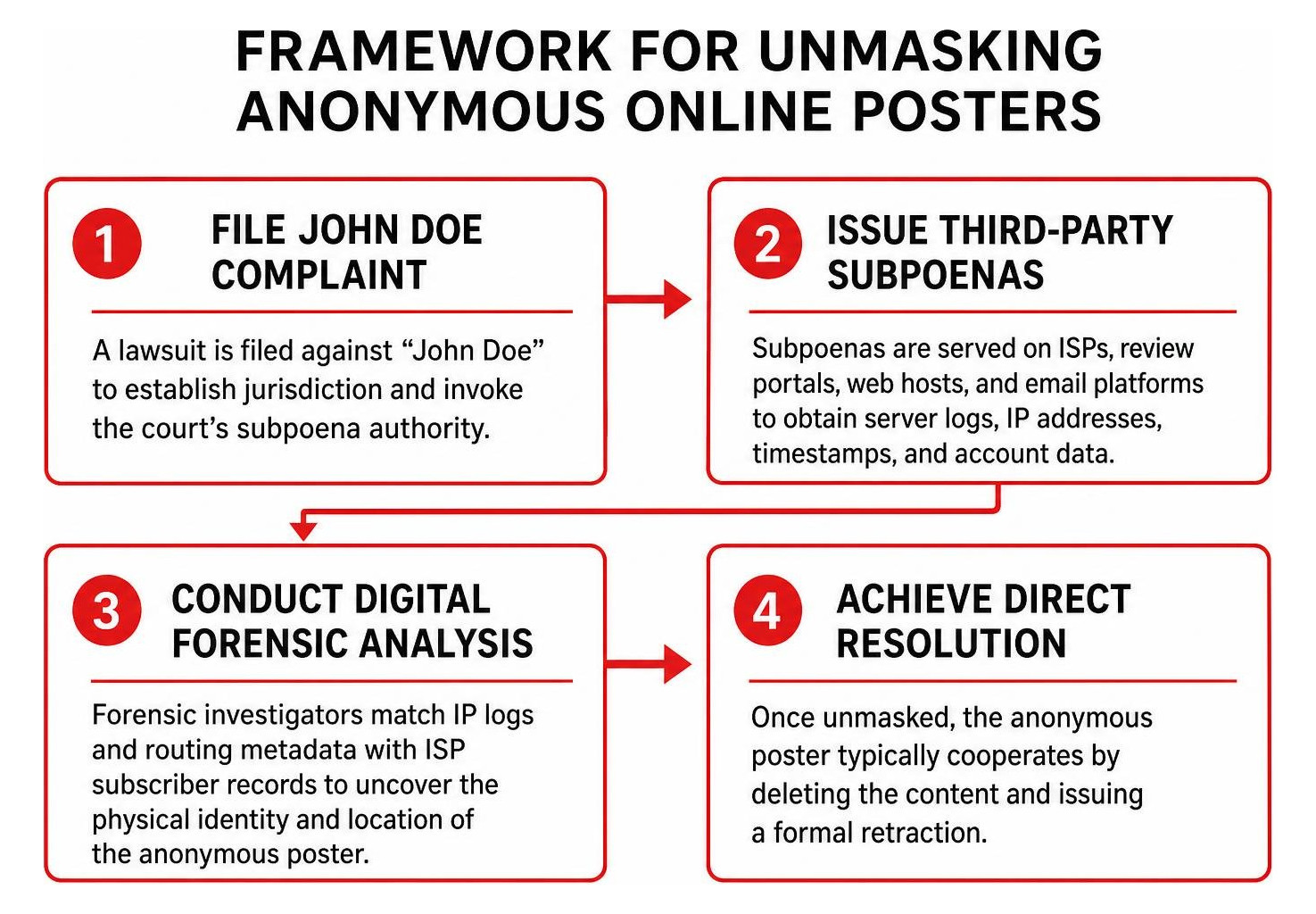
Attorneys and digital forensic professionals navigate these situations through specialized investigative frameworks:
- Third-Party Record Preservation: Formal legal notices and preservation requests can be directed to internet service providers (ISPs), review portals, web hosts, and email platforms to safeguard relevant server logs, IP records, access timestamps, and account data.
- Digital Forensics Analysis: Working alongside forensic investigators, counsel examines routing metadata and IP logs to trace unauthorized digital activity back to its source network.
- Voluntary and Out-of-Court Resolution: Once identifying evidence is established, the publishing party often cooperates directly by deleting the offending material and issuing a formal retraction, resolving the dispute without ongoing conflict.
Legal Standards, Defenses, and Regulatory Frameworks in Online Defamation

Navigating online reputation law requires an understanding of the legal requirements and statutory hurdles governing speech on the internet.
1. Elements of Online Defamation (Libel)
To establish a civil defamation claim, the affected party must generally demonstrate four core elements:
- A false statement purporting to be a matter of fact (not pure opinion).
- Publication or communication of that statement to a third party.
- Fault amounting to at least negligence (or actual malice for public figures).
- Actual harm or damage caused to the reputation, profession, or business of the subject.
2. Common Legal Defenses
Defendants facing defamation claims routinely invoke established legal privileges:
- Substantial Truth: Truth is an absolute defense. If the underlying assertion is provably accurate in its core substance, a defamation action cannot succeed.
- Pure Opinion Doctrine: Statements that cannot be objectively verified as true or false (e.g., “I found the lawyer’s courtroom style unimpressive”) are constitutionally protected speech.
- Judicial and Statutory Privilege: Statements made directly within judicial, legislative, or official proceedings enjoy absolute or qualified immunity from civil defamation claims.
3. Section 230 of the Communications Decency Act
Enacted in 1996, 47 U.S.C. § 230 provides broad immunity to interactive computer services (such as Google, Yelp, and social media networks) against being treated as the publisher or speaker of third-party content. Consequently, businesses cannot successfully sue review platforms simply because a third party posted a defamatory review. Legal actions must instead be directed toward the individual creator of the content or framed around platform-specific terms of service violations.
4. Public Figures vs. Private Individuals: The Actual Malice Standard
Established in the landmark U.S. Supreme Court decision New York Times Co. v. Sullivan, public officials and public figures must satisfy the rigorous actual malice standard. This requires proving by clear and convincing evidence that the publisher knew the statement was false or acted with reckless disregard for its truth. Private individuals and ordinary local businesses typically face a lower burden of proof, requiring only a showing of negligence.
5. Procedural Obstacles: Anti-SLAPP Laws and Statutes of Limitations
Many jurisdictions have enacted Anti-SLAPP (Strategic Lawsuits Against Public Participation) statutes designed to quickly dismiss meritless claims targeting protected speech. Filing a defective claim can result in an immediate motion to strike, potentially shifting the defendant’s attorney fees onto the plaintiff. Furthermore, defamation claims carry short statutes of limitations—often ranging between one and two years from the initial date of publication—making prompt evidence preservation critical.
Step-by-Step Action Plan: Handling Harmful and Defamatory Reviews
When a damaging review or defamatory article appears online, taking measured, systematic steps prevents unnecessary escalation while protecting your firm’s standing.
Step 1: Digital Evidence Preservation
Before taking any public action, create an unassailable digital record of the damaging material:
- Capture full-screen screenshots showing the review text, poster username, account avatar, and exact publication date.
- Record the full URL string and examine page source data if necessary.
- Document any corresponding dips in website inquiries, consultation bookings, or client cancellations to establish demonstrable economic harm.
Step 2: Legal Audit and Viability Assessment
Determine whether the content represents protected client feedback or an actionable legal wrong. A qualified attorney can evaluate whether the review contains verifiable falsehoods (e.g., claiming a lawyer was disbarred or charged unagreed fees when records prove otherwise) or if it constitutes protected hyperbole.
Step 3: Platform Reporting and Policy Enforcement
Submit a detailed takedown request through the platform’s official reporting channels. Reference specific violations of their published content guidelines—such as conflicts of interest (reviews left by direct competitors), harassment, hate speech, or lack of direct consumer experience.
Step 4: Controlled Professional Response
If the review remains visible while being assessed, draft a concise, ethical response that strictly adheres to professional confidentiality rules. Never argue, never confirm representation details, and always direct the reviewer to an offline resolution channel.
Step 5: Search Engine Optimization and Narrative Governance
Pair legal protections with proactive digital positioning. By partnering with our digital marketing specialists at Triple Digital, firms build robust search governance models. Deploying an online presence digital marketing agency strategy establishes authoritative content—such as legal guides, practice profiles, and verified directory listings—that consistently outranks negative noise.
Furthermore, as search behavior evolves, ensuring proper law firm digital marketing for ai visibility guarantees that generative search engines cite verified, accurate representations of your legal practice.
Frequently Asked Questions About Online Defamation and Reputation Management
Can negative Google reviews be legally removed by an attorney?
Yes, under specific circumstances. If a review contains provably false assertions of fact, constitutes harassment, violates platform policies, or originates from a competitor, an attorney can issue formal legal demands to the author or submit policy compliance requests to Google. If the content is proven unlawful in court, search engines will generally delist the specific URL upon receipt of a valid court order.
What is the actual malice standard in online defamation cases?
The actual malice standard requires a plaintiff to prove that the publisher of defamatory content knew the statement was false at the time of publication or acted with reckless disregard for whether it was true or false. This heightened standard applies primarily to public officials and public figures to safeguard robust public discourse under the First Amendment.
How does Section 230 of the Communications Decency Act impact review removal?
Section 230 protects internet platforms and web hosting services from legal liability for content posted by third-party users. As a result, businesses cannot hold platforms like Google, Yelp, or Facebook directly liable for hosting a defamatory review. Instead, legal remedies must be directed against the individual author of the review, or pursued through the platform’s voluntary terms of service enforcement mechanisms.
Build an Unshakeable Online Presence for Your Law Practice
Reputational defense is only half the battle. While legal avenues provide decisive tools for removing unlawful attacks, sustainable law firm growth requires building a digital footprint so commanding that isolated negative reviews cannot shake prospective client confidence.
At Triple Digital, our Houston-based team delivers a results-driven, “less fluff, more cases” approach to law firm growth. We combine AI-driven client targeting, data mining, and high-performance search governance to ensure your practice attracts high-value cases consistently.
Take full control of your firm’s digital narrative today. Schedule a private strategy consultation with our legal marketing experts to strengthen your brand and accelerate client acquisition.