





How to Design the Best Websites for Law Firms That Actually Convert
Why the Best Websites for Law Firms Win More Clients Before You Even Pick Up the Phone

The best websites for law firms do one thing above everything else: they turn strangers into clients.
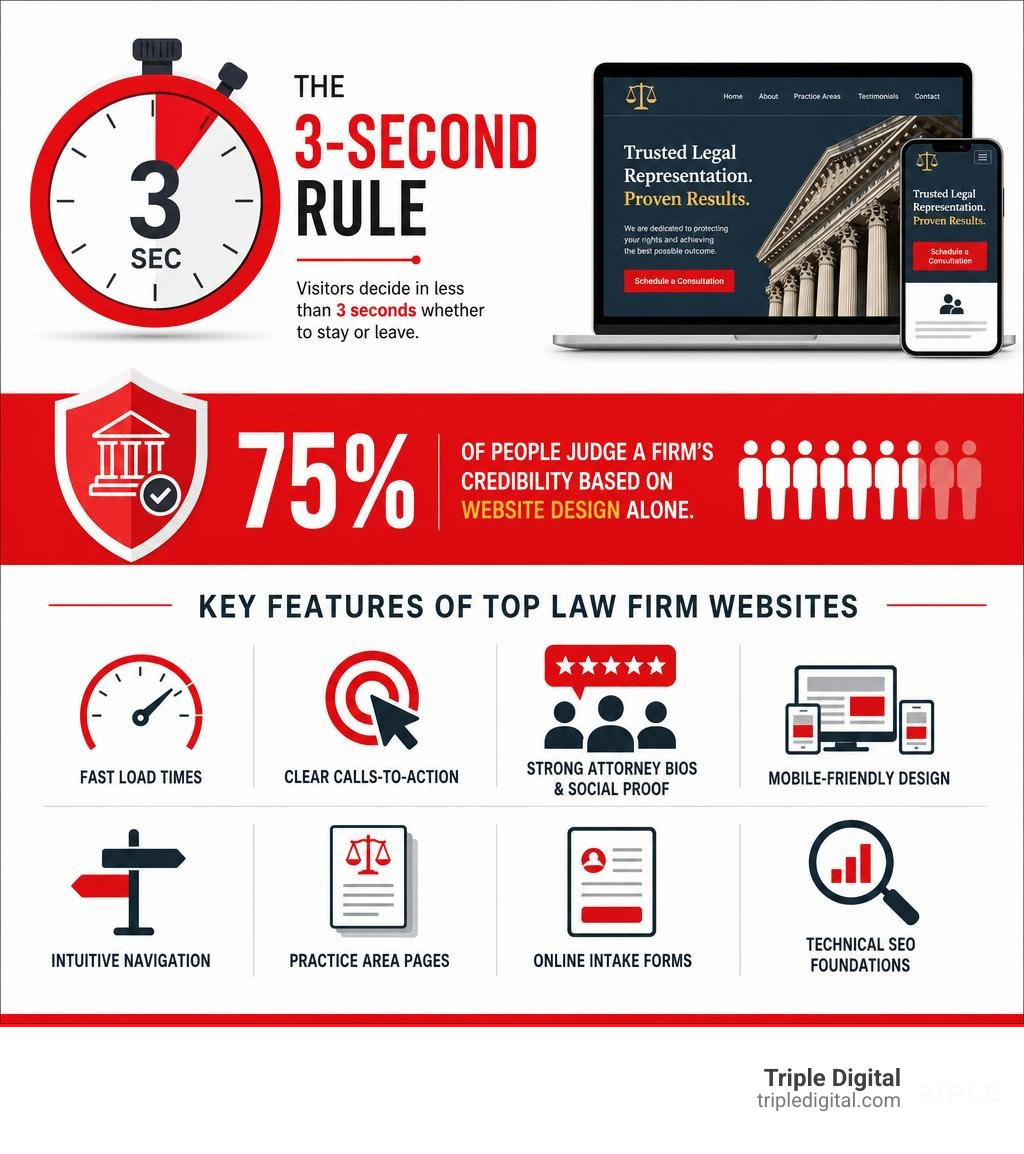
Here’s a quick look at the top qualities that separate high-performing law firm websites from the rest:
- Fast load times — pages load in under 2 seconds
- Clear calls-to-action — visitors know exactly what to do next
- Strong attorney bios and social proof — testimonials, case results, and real photos
- Mobile-friendly design — works seamlessly on any device
- Intuitive navigation — visitors find what they need without frustration
- Practice area pages — dedicated, focused content for each service
- Online intake forms — easy for prospects to reach out immediately
- Technical SEO foundations — schema markup, HTTPS, and Core Web Vitals
Your website is your firm’s digital front door. Before a prospective client calls, they’ve already judged your firm based on how your site looks and feels — often in less than three seconds.
Research backs this up: 75% of people judge a firm’s credibility based on website design alone. And if your page takes more than 2 seconds to load, roughly half of those visitors will leave before they even read a word.
That’s not a small problem. That’s lost revenue, every single day.
The good news? The gap between a website that quietly loses leads and one that consistently generates cases comes down to a handful of design and technical decisions — and they’re all fixable.
This guide walks through real examples and proven strategies from the best-performing law firm websites in 2026, so you can see exactly what works and why.
Quick best websites for law firms terms:
Core Pillars of the Best Websites for Law Firms
To build a website that consistently generates high-quality cases, we have to look past simple aesthetics. A beautiful website that doesn’t load quickly or guide a user to take action is just an expensive digital brochure. The best websites for law firms balance three critical pillars: client experience, distinct branding, and flawless technical performance.
When we approach Web Design for Law Firms, we focus on the intersection of these three disciplines. If any single pillar is weak, your conversion rate will suffer.
- Client Experience (CX): This is all about reducing friction. When a user lands on your site, they are often stressed, anxious, or in a hurry. They need to find answers to their questions and a way to contact you immediately.
- Branding and Positioning: Your website must visually and textually communicate who you are, who you serve, and why you are the right choice. It should establish your authority within milliseconds.
- Technical Performance: This is the invisible engine under the hood. It includes page load speed, mobile responsiveness, accessibility, and search engine optimization (SEO).
To help visualize what separates a high-performing legal website from an outdated one, let’s look at how key elements compare:
| Feature | High-Converting Law Firm Website | Low-Converting Law Firm Website |
|---|---|---|
| Page Load Speed | Under 2 seconds (retains over 90% of visitors) | 4+ seconds (loses over 50% of traffic) |
| Primary Visuals | High-quality, original team and office photos | Generic, cliché stock photos of gavels and scales |
| Call to Action (CTA) | Prominent, specific (e.g., “Schedule a Free Consultation”) | Vague or hidden (e.g., “Submit” or “Learn More”) |
| Mobile Experience | Fully responsive, thumb-friendly tap targets | Desktop layout shrunk down, hard to read or click |
| Tone & Copy | Empathetic, clear, and focused on client outcomes | Heavily academic, dense, and packed with legal jargon |
| Intake Options | Secure, multi-step online forms and instant chat | Standard, intimidating email links or clunky PDFs |
Establishing Trust and Credibility Instantly
In legal marketing, trust is the ultimate currency. If a visitor does not trust your firm within the first few seconds of landing on your page, they will click the back button and find a competitor.
To establish instant credibility, the best websites for law firms rely on robust social proof. This includes displaying prominent client testimonials, verifiable case results, and professional attorney biographies.
When showcasing testimonials, video is incredibly powerful. Seeing and hearing a real person discuss how your firm guided them through a difficult time creates an emotional connection that text alone cannot replicate. If you use written reviews, pull authentic quotes that highlight your communication, empathy, and professionalism.
Case results are another critical trust signal. However, they must be easy to read and contextually relevant. Instead of just listing dollar amounts, briefly explain the context of the case (while maintaining client confidentiality) to demonstrate your expertise in action.
Finally, do not underestimate the power of your attorney bios. The “About Us” or team profile page is consistently one of the most visited pages on any legal website. Clients want to know the human being behind the law degree. Avoid writing bios that read like a dry resume; instead, focus on why you practice law, your commitment to the community, and how you help your clients win. Investing in Custom Lawyer Web Design ensures these trust elements are woven naturally into your layout rather than tacked on as an afterthought.
Intuitive Navigation and Content Structure
A common mistake we see is organizing a website based on how the law firm is structured internally, rather than how a client actually searches for help. Your navigation should be incredibly simple and clean.
Your main menu should clearly point to your primary practice areas, about page, case results, blog, and contact page. If you practice multiple areas of law, group them logically. For example, if you practice family law, use a dropdown menu that cleanly separates divorce, child custody, and property division.
To maximize your site’s conversion potential, you must guide the user on a deliberate journey. When a prospective client lands on your homepage, they should immediately see:
- What you do (your core practice areas).
- Who you serve (your target audience).
- What their next step should be (your primary call-to-action).
Keep your copy free of dense legal jargon. Write at a level that is easy for a stressed layperson to understand. By structuring your content around client pain points rather than academic legal theories, you make your firm feel approachable and helpful. For a deeper look at optimizing your site beyond the main landing pages, explore our guide on Beyond the Homepage: Maximizing Your Legal Website’s Potential.
Key Design Elements That Drive Client Conversions
Conversion rate optimization (CRO) is the practice of turning more of your existing website visitors into signed cases. In our work, we find that small, intentional design choices yield massive improvements in lead generation.

A high-converting website uses a strong visual hierarchy to guide a visitor’s eyes to the most important elements on the page. This begins with your “Hero Section” — the very top part of your homepage that is visible without scrolling. This area must feature a compelling headline, an empathetic subheadline, and a clear, high-contrast call-to-action (CTA) button.
Color psychology also plays a major role in how prospects perceive your firm. Traditional legal websites often rely on dark blues, burgundies, and golds to project authority and seriousness. While these classic color palettes still work well, modern firms are increasingly using bold, high-contrast accents (like deep forest green, warm charcoal, or vibrant teal) to stand out and feel more accessible. The key is maintaining a clean, uncluttered layout with plenty of white space so the user’s mind can easily process the information.
Your online intake forms should be incredibly simple. Every extra field you add to a contact form reduces your conversion rate. Only ask for the absolute essentials: name, phone number, email address, and a brief description of their situation. You can collect deeper details during your initial intake call.
Inspiration from the Best Websites for Law Firms in 2026
The most successful legal websites in 2026 stand out because they embrace niche branding. Rather than trying to appeal to everyone, they align their visual identity and messaging with the exact emotional state of their target client.
- Personal Injury Law: The best personal injury sites avoid aggressive, loud designs. Instead, they focus on empathy, recovery, and clear paths to financial relief. They use soft, trustworthy color tones paired with bold headlines highlighting past results.
- Family Law: High-converting family law sites use calming colors (like warm neutrals, soft blues, or greens) to reduce anxiety. Their copy is highly supportive, often using headlines like “Breathe, Release, Reclaim” to focus on the future rather than the conflict.
- Corporate and Business Law: These sites prioritize clean, modern, minimalist aesthetics. They use sophisticated typography, high-end architectural or team photography, and structured layouts to project precision, efficiency, and commercial intelligence.
When planning a redesign, learning How to Choose the Best Lawyer Website Design Firm for Your Practice is a critical first step to ensure your agency understands how to translate your specific practice area into an effective visual brand.
Humanizing Your Firm with Visuals
Prospective clients do not hire logos; they hire people. Yet, many law firms hide behind generic stock photos of empty courtrooms, scales of justice, or models pretending to be lawyers.
To build real trust, you must invest in high-quality, original photography. Feature prominent photos of your founders and team on the homepage. Show your attorneys working together in your actual office, speaking with clients, or standing in front of local landmarks. This immediately grounds your firm in the real world and makes you feel familiar before the client even calls.
Video testimonials are another highly effective way to humanize your brand. Hearing a former client speak about how you protected their family or saved their business carries far more weight than any self-written marketing copy.
Technical Performance: Speed, Mobile, and AI Readiness
You can have the most beautiful website in the world, but if it takes five seconds to load on a smartphone, your prospective clients will click away before they ever see it. Technical performance is the backbone of successful digital marketing.

Mobile responsiveness is no longer optional. The vast majority of consumer legal searches begin on a mobile device. A truly mobile-friendly website isn’t just a desktop site that has been shrunk down; it is designed from the ground up to be easily navigated with a thumb. This means large, easy-to-click buttons, readable font sizes, and simplified menus.
Accessibility is another crucial element of technical performance. Ensuring your website complies with the Web Content Accessibility Guidelines (WCAG) is essential for making your site usable for all individuals, including those with visual, auditory, or motor impairments. Building an accessible site also helps protect your firm from potential legal issues and improves your overall search engine rankings. For a deep dive into these development standards, review our Lawyer Website Developer Guide.
Technical Standards of the Best Websites for Law Firms
To rank highly on search engines and convert traffic, your website must adhere to modern technical standards:
- SSL Security (HTTPS): Your website must be secure. A secure site protects user data and prevents browsers from displaying a “Not Secure” warning, which immediately destroys credibility.
- Core Web Vitals: Google uses these metrics to measure real-world user experience, focusing on loading performance, interactivity, and visual stability.
- Schema Markup: This is structured data added to your website’s code that helps search engines understand your content. For lawyers, implementing local business and attorney schema can help you show up in rich search results and local map packs.
Implementing these technical best practices is a core part of learning how to Rank Higher, Get More Clients: Essential Website SEO for Attorneys.
Optimizing for AI Search and Answer Engines
The search landscape is changing rapidly in 2026. Prospective clients are no longer just using traditional search engines; they are increasingly asking AI assistants like ChatGPT, Claude, Gemini, and Perplexity for legal recommendations.
To ensure your law firm gets cited by these AI answer engines, your website must be optimized for AI search. This means:
- Using Clean, Semantic HTML: AI crawlers read your site’s code to understand your content. Structured, clean code makes it easy for AI to parse your information.
- Writing in Natural Language: Frame your content as clear, direct answers to common questions. Instead of writing abstract legal articles, write helpful content that directly addresses user queries.
- Implementing Robust Schema Markup: Structured data provides search engines and AI models with explicit clues about your firm’s location, attorneys, practice areas, and credentials.
Frequently Asked Questions About Law Firm Web Design
How fast should a law firm website load in 2026?
Your website should load in under 2 seconds. About half of all web users will abandon a page that takes longer than two seconds to load. Fast load times improve your search engine rankings and directly increase your conversion rates by keeping users engaged.
What are the most common mistakes law firms make on their websites?
The most common mistakes include:
- Using generic stock photography instead of real team photos.
- Writing dense, academic content filled with complex legal jargon.
- Having weak or hard-to-find calls-to-action.
- Neglecting mobile optimization and page speed.
- Failing to implement secure, modern online intake forms.
How can smaller or solo law firms compete with larger firms online?
Smaller and solo firms can successfully compete by focusing on a specific niche and leveraging localized SEO. By building highly targeted practice area pages, showcasing deeply personalized client experiences, and maintaining an agile, fast-loading website, smaller firms can often rank higher for specific local searches than massive, general-practice firms.
Conclusion
Building one of the best websites for law firms isn’t about chasing design awards or writing complex legal treatises. It is about creating an intuitive, fast, and empathetic digital experience that guides a stressed user from a state of uncertainty to a state of relief.
At Triple Digital, we help law firms cut through the noise. Based in Houston, Texas, we are a results-driven digital marketing agency specializing in lead generation and case acquisition. Our approach is simple: “less fluff, more cases.” By leveraging advanced data mining, AI-driven targeting, and high-performance web design, we build websites that don’t just look great — they grow your practice.
Ready to transform your digital storefront into your firm’s most powerful client acquisition tool? Build a high-converting website with Triple Digital today.