





Beginner’s Guide to Paid Advertising Options
What Paid Advertising Actually Is (And Why It Matters for Law Firms)

Paid advertising is one of the fastest ways for a law firm to get in front of potential clients — right now, not months from now.
Here’s a quick breakdown before we dive in:
- What it is: You pay a platform (Google, Meta, LinkedIn, etc.) to show your ads to a specific audience
- How it works: Most platforms use an auction system — your bid, ad quality, and relevance determine when and where your ad appears
- What you pay for: Clicks (PPC), impressions (CPM), or conversions (CPA) — depending on your goal
- Who it’s for: Any law firm that wants predictable, scalable client acquisition
- Does it work? Yes — when done right, it delivers measurable results quickly
Many law firms still rely on referrals or outdated directory listings to bring in new cases. The problem? That pipeline is unpredictable. You can’t turn it up when you need more clients or slow it down when you’re at capacity.
Paid advertising changes that.
Unlike organic strategies that can take six to twelve months to gain traction, a well-structured paid campaign can start generating leads within days of launch. You set the budget. You choose the audience. You measure every dollar spent.
The catch? There are dozens of platforms, ad formats, bidding strategies, and targeting options to choose from. Without a clear roadmap, it’s easy to waste budget fast.
This guide breaks it all down — in plain language — so your firm can make smarter decisions about where to advertise, how to set it up, and what to track.
What is Paid Advertising and How Does It Work?
At its core, paid advertising is a digital marketing model where businesses pay to display their promotional messages to targeted audiences across search engines, social media networks, websites, and apps. Unlike organic marketing, which relies on building long-term visibility over time, paid ads buy you immediate placement right where your prospective clients are already looking.
But how does your ad actually get on the screen? It all happens behind the scenes in milliseconds through an ad auction.
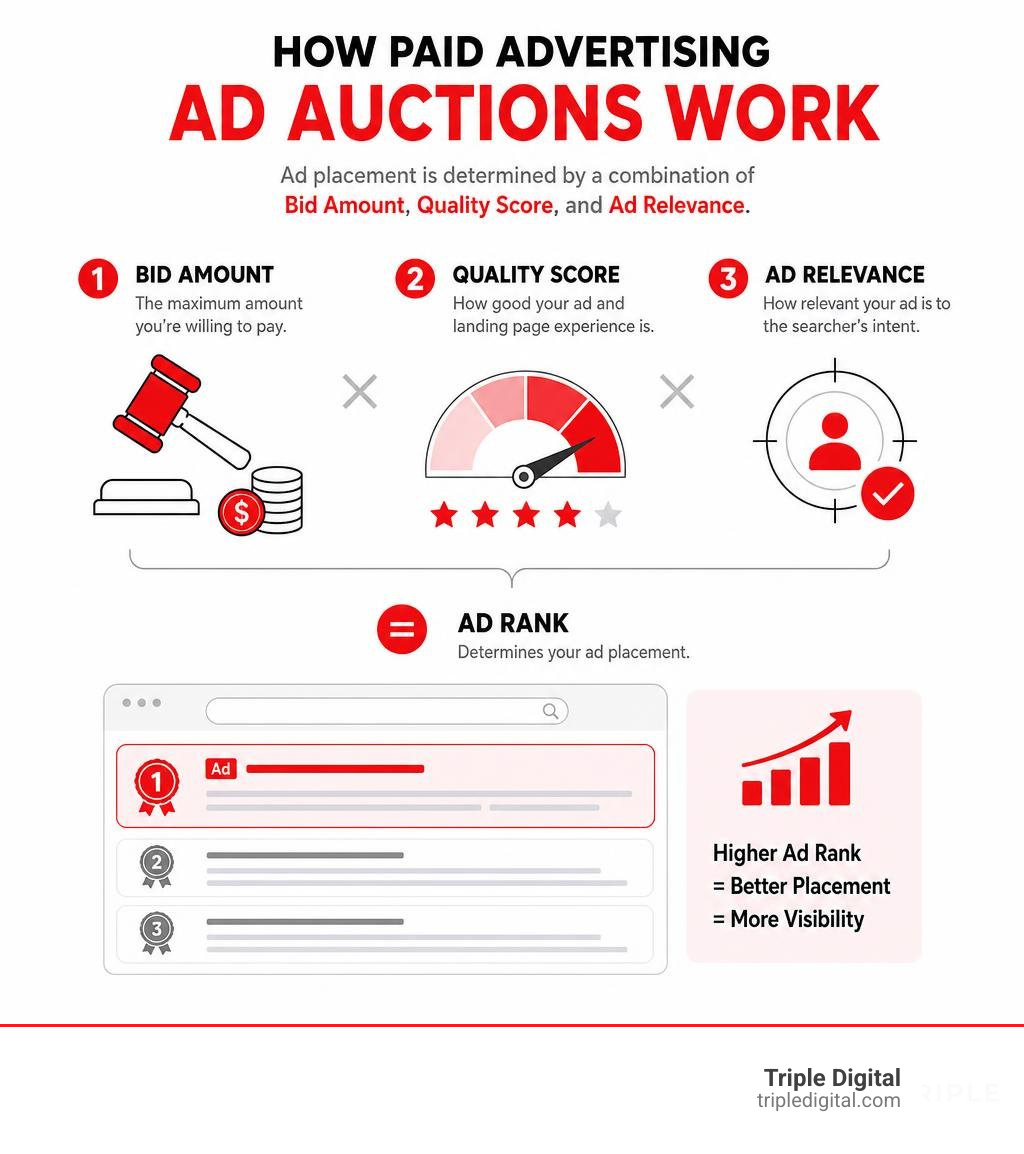
Whenever a user performs a search on Google or scrolls through their Facebook feed, the platform’s algorithm runs an instantaneous auction to decide which ads to display. The algorithm evaluates three primary factors:
- The Bid: The maximum amount you are willing to pay for a click, impression, or action.
- Ad Quality and Relevance: How helpful, engaging, and well-written your ad is for that specific user. On Google, this is represented by your Quality Score (rated on a 1-to-10 scale).
- The Expected Impact: How likely the user is to click or convert based on historical performance and ad extensions.
If two advertisers have equal budgets, the one with the more relevant, high-quality ad and landing page will win the auction and pay less per click. This is why throwing money at a campaign without optimizing your creative assets is a recipe for a drained budget.
Most online platforms operate on a pay-per-click (PPC) model, meaning you only pay when someone actually interacts with your ad. This makes it highly cost-effective because you aren’t paying just for people to look at your brand—you are paying for genuine interest. If you want to understand how this applies specifically to the legal sector, check out our comprehensive resource on Paid Advertising for Lawyers.
Core Types of Paid Advertising Options
Navigating the modern digital landscape in 2026 means understanding that there is no “one-size-fits-all” ad channel. To build a repeatable revenue engine, you need to know which channels align with your specific goals.

| Channel | Intent Level | Best For | Cost Structure |
|---|---|---|---|
| Search Ads | Extremely High | Capturing active searchers (e.g., personal injury, criminal defense) | Pay-Per-Click (PPC) |
| Social Ads | Medium to Low | Brand awareness, demographic targeting, and retargeting | Cost-Per-Mille (CPM) / CPC |
| Display Ads | Low | Keeping your firm top-of-mind (retargeting) | Cost-Per-Mille (CPM) |
Paid Search Engine Advertising and Paid Advertising
Paid search is the heavyweight champion of high-intent marketing. When someone searches for “car accident attorney near me” on Google or Bing, they aren’t browsing for fun—they have an immediate, pressing legal need.
By bidding on highly relevant keywords, your firm can appear at the very top of the search engine results page (SERP), even above organic listings. This is called intent targeting. Because you are meeting the user at the exact moment they need your services, search engine ads yield incredibly high conversion rates. To dive deeper into setting up keyword bids and choosing the right match types, read The Definitive Guide to Paid Advertising for Lawyers.
Paid Social Media Advertising and Paid Advertising
While search ads capture people who are actively looking, social media ads are brilliant at finding people based on who they are. Platforms like Meta (Facebook and Instagram), LinkedIn, and TikTok offer advanced demographic targeting, allowing you to show ads based on age, job title, interests, and location.
For example, on Facebook, you can target users who have shown interest in parenting pages if you run a family law practice, or target corporate executives on LinkedIn for business litigation. Social platforms also allow you to build lookalike audiences—leveraging platform data to find new users who share characteristics with your best existing clients. To see if this is the right move for your practice, read our analysis: The Verdict Is In: Are Facebook Ads a Win for Your Law Firm?.
Display, Video, and Native Placements
If you want to cast a wider net or keep your firm top-of-mind, display, video, and native placements are your best friend.
- Display Advertising: Static or animated banner ads that appear across millions of third-party websites (like news outlets or blogs) via networks like the Google Display Network. They are incredibly effective for retargeting users who visited your website but didn’t contact you.
- Video Marketing: Placed on platforms like YouTube (which has over 2.7 billion monthly active users) or streaming TV. Over 90% of marketers claim that video ads have helped them increase brand awareness, traffic, and sales.
- Native Ads: Sponsored content designed to match the form and function of the platform they appear on (like “Recommended Reading” sections on news sites). Because they don’t look like traditional ads, native ads can get 53% more consumer views than display ads.
For a detailed look at how to drive traffic using visual social placements, see How Facebook Advertising Can Bring Traffic to Your Website.
Paid Ads vs. Organic Marketing: Key Differences
We often hear business owners ask: “Should I do paid ads or SEO?”
The real answer? You should do both, but you must understand how they play different roles in your growth strategy.
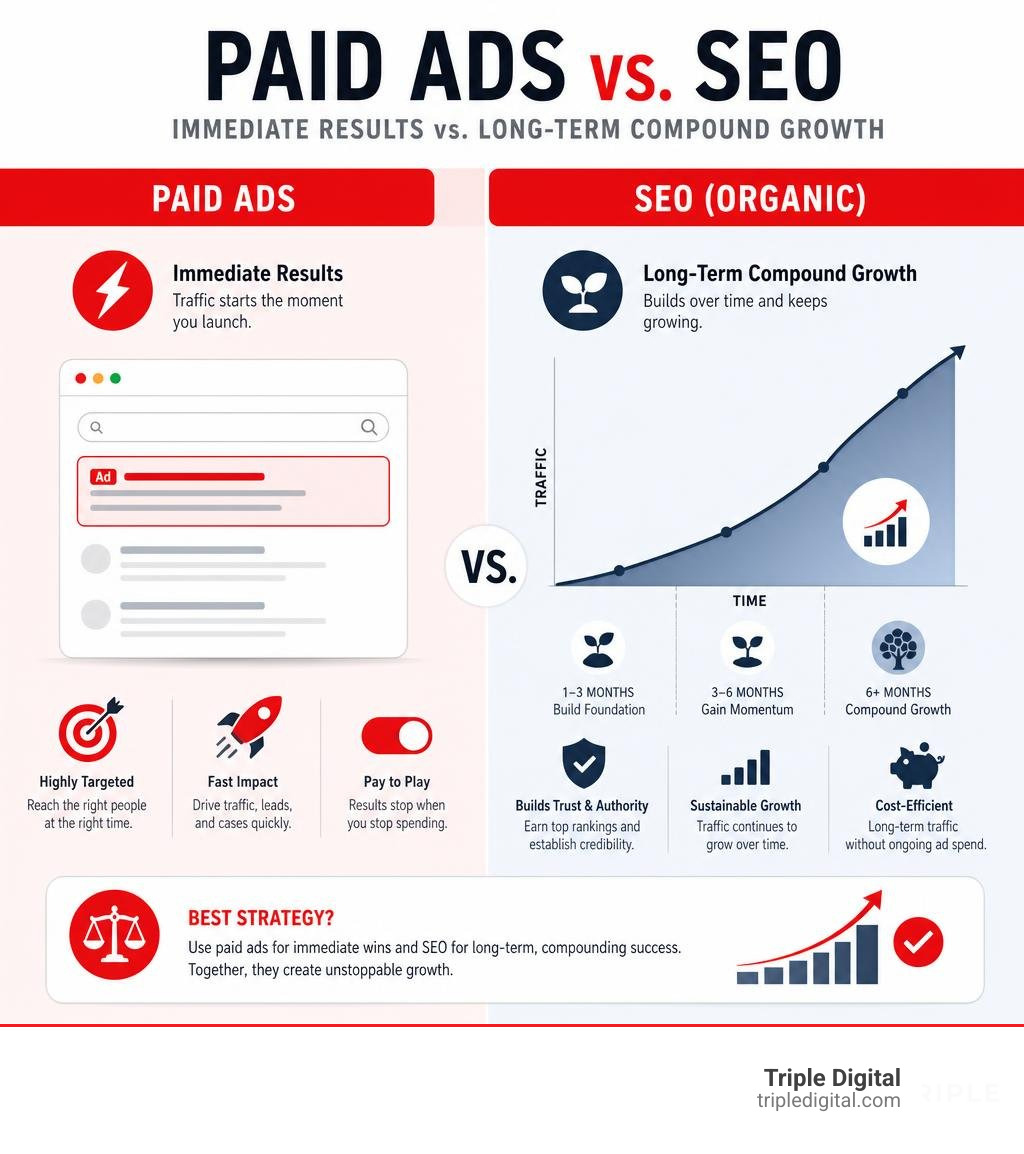
Organic marketing, like Search Engine Optimization (SEO) and content creation, is a long-term play. It builds authority, establishes trust, and provides compounding “free” traffic over time. However, it takes months of consistent effort to rank on the first page of Google.
Paid advertising provides instant gratification. The moment you launch a campaign, your ads go live, and highly targeted traffic begins flowing to your website. It is the perfect tool for testing new landing pages, launching new practice areas, or securing immediate cases while your organic SEO strategy matures.
The most successful firms use paid ads to fund their long-term organic growth, creating a highly efficient loop of short-term wins and long-term stability. To see how these two strategies fit into a larger growth blueprint, explore Law Firm Advertising Strategies: From Small Practice to Legal Empire.
Planning Your Campaign: Goals, Budgets, and Bidding Strategies
Before you spend a single dollar on paid advertising, you need a solid game plan.

1. Set SMART Goals
Are you looking for brand exposure, website clicks, or actual phone calls and form submissions? For law firms, the goal is almost always lead generation (phone calls and consultations). Make sure your goals are Specific, Measurable, Achievable, Relevant, and Time-bound.
2. Establish Your Budget
Don’t spread your budget too thin across five different platforms. If you are starting out, pick one channel (like Google Search) and fund it adequately. Most digital platforms allow you to set daily or lifetime budgets, giving you complete control over your spend.
3. Choose Your Bidding Strategy
Depending on your goals, platforms offer several bidding models:
- Cost-Per-Click (CPC): You pay only when someone clicks your ad. Perfect for driving traffic.
- Cost-Per-Mille (CPM): You pay per 1,000 impressions (views). Great for brand awareness.
- Cost-Per-Acquisition (CPA): You pay when a user completes a specific action, like submitting a contact form.
- Smart Bidding: Leveraging machine learning and AI to automatically adjust your bids in real-time to maximize conversions.
To master the art of setting up high-performing budgets without overspending, check out our guide, Ad-Vantage: Mastering Paid Advertising for Law Firms.
Creating High-Converting Ad Creatives and Targeting Strategies
An ad is only as good as its creative execution. If your copy is boring or your imagery looks like generic stock photography, users will scroll right past.
To build ads that convert:
- Write Compelling Copy: Speak directly to the prospect’s pain points. Use simple, empathetic, and professional language.
- Use High-Quality Visuals: If you are running social or display ads, use real photos of your team or high-production video. Avoid the cliché “gavel and scales of justice” stock photos.
- Include a Clear Call-to-Action (CTA): Tell the user exactly what to do next. “Call for a Free Consultation” or “Get Your Case Evaluation” performs significantly better than “Learn More.”
- Align Your Landing Pages: If your ad promises a free case evaluation, the page they land on must immediately offer that evaluation. Any friction or mismatch in messaging will cause users to leave instantly.
To make sure your ad creatives remain ethical and legally compliant, read Stay Clean, Stay Green: Your Guide to Ethical Legal Ads.
Navigating Compliance and Ethical Legal Ads
Lawyers face strict advertising regulations that other business owners do not. State bar associations have rigorous ethical guidelines regarding what you can say in your ads. For instance, you generally cannot make misleading promises, guarantee specific outcomes, or refer to yourself as a “certified specialist” unless you meet very specific state criteria.
Ensuring ad transparency and staying within these ethical boundaries is crucial to protecting your practice. To learn how to navigate these rules safely, read How to Run Social Media Ads Without Getting Disbarred.
Measuring Performance and Avoiding Common Mistakes
The beauty of paid advertising is that everything is measurable. If a campaign isn’t working, you don’t have to guess why—the data will tell you.
Here are the essential KPIs (Key Performance Indicators) you must track:
- Click-Through Rate (CTR): The percentage of people who clicked your ad after seeing it. Low CTR means your ad copy or creative isn’t engaging.
- Cost Per Click (CPC): How much you pay on average for each click. High CPC means high competition or a low Quality Score.
- Conversion Rate: The percentage of visitors who took the desired action (e.g., filled out a form or called). Low conversion rates point to an issue with your landing page.
- Cost Per Acquisition (CPA): The total cost to acquire one lead or client. This is the ultimate metric for measuring your actual ROI.
- Return on Ad Spend (ROAS): Your total revenue generated divided by your total ad spend.
To ensure your tracking is set up with complete integrity and accuracy, consult Integrity in Advertising: Your Guide to Ethical Legal Marketing.
Frequently Asked Questions
How much budget is needed to start in 2026?
There is no universal minimum, but for highly competitive industries like law, we recommend starting with at least $1,500 to $3,000 per month on a single platform like Google Ads. This ensures you get enough clicks and data to optimize your campaigns.
How do I choose the right platform?
Look at user intent and demographic data. If you are trying to reach people with immediate problems, start with Google Search. If you want to target specific professional demographics or build long-term brand equity, look at LinkedIn or Meta.
Should I hire an agency to manage my campaigns?
Managing paid ads requires daily monitoring, keyword optimization, creative testing, and technical tracking setups. If you want to scale your firm rather than spend hours inside ad managers, hiring an agency is highly recommended. To weigh your options, check out Should I Hire a Marketing Agency to Run My Law Firm?.
Conclusion
Paid advertising is a highly scalable, predictable engine for growing your law firm—but only if it’s executed with precision, data, and a deep understanding of the legal landscape.
At Triple Digital, we don’t believe in vanity metrics or empty promises. Based in Houston, Texas, we specialize in high-intent lead generation and case acquisition for law firms. Our approach is simple: “less fluff, more cases.” By leveraging cutting-edge AI and data mining, we pinpoint exact target audiences to deliver high-value cases directly to your firm.
Ready to stop guessing and start dominating your market? Let us build your custom growth engine.
Don’t Just Advertise, Dominate: Picking Your Perfect Legal Marketing Partner