


An Essential Guide to Copywriting for Law Firms
Copywriting for Law Practices vs. Legal Writing: Key Differences
Defining Strategic Copywriting for Law Practices
Strategic copywriting for law practices is persuasive writing crafted to prompt immediate action. While traditional legal drafting protects a client’s rights in court or contracts, marketing copy inspires prospective clients to take their very first step—picking up the phone, filling out a form, or scheduling a consultation.
At its core, strategic copy focuses on conversion. Every sentence serves a purpose: guiding a reader through their uncertainty and showing them why your firm is the right choice. When you refine your messaging using proven legal copywriting strategies, you stop simply presenting legal facts and start speaking directly to client needs.
Content Writing versus Direct-Response Copywriting
It is common to confuse content writing with direct-response copywriting, but they perform distinct roles in your firm’s growth:
- Content Writing: Educates readers, builds long-term authority, and improves organic search rankings over time. This includes educational blog posts, detailed guides, and resource articles.
- Direct-Response Copywriting: Focuses on immediate lead capture. It lives on homepages, practice area landing pages, ad campaigns, and intake forms, urging readers to take a specific, immediate action.
A well-balanced digital strategy relies on both. Educational articles draw readers into your ecosystem, while direct-response copy transforms those casual readers into active cases. To learn more about structuring these elements together, review our guide on law firm content strategies.
Distinguishing Legal Writing from Marketing Communication
Attorneys spend years mastering a formal, highly technical style of writing designed for judges, opposing counsel, and regulatory bodies. However, using that same style on prospective clients often creates friction and drives them away.
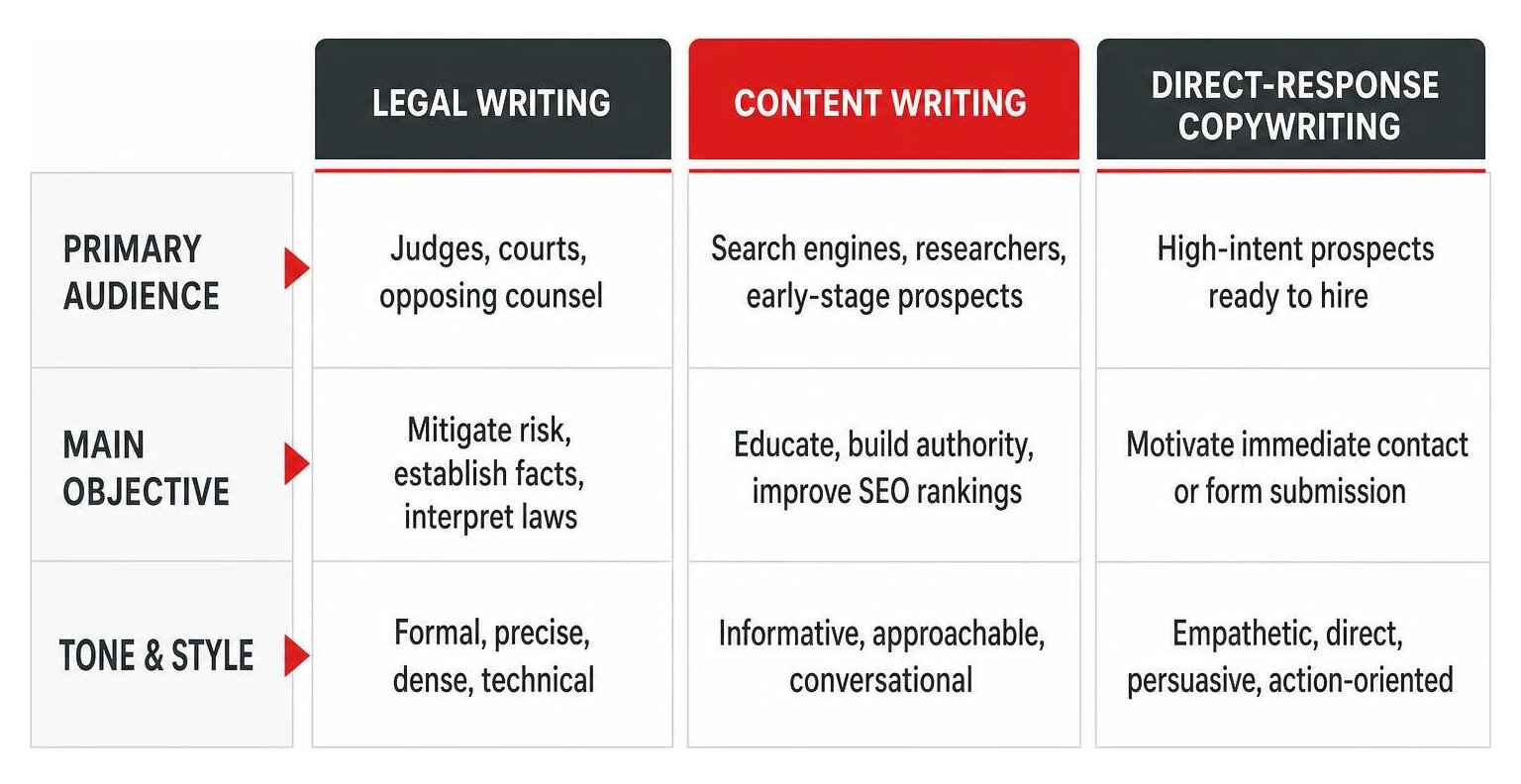
| Aspect | Legal Writing | Content Writing | Direct-Response Copywriting |
|---|---|---|---|
| Primary Audience | Judges, courts, opposing counsel | Search engines, researchers, early-stage prospects | High-intent prospects ready to hire |
| Main Objective | Mitigate risk, establish facts, interpret laws | Educate, build authority, improve SEO rankings | Motivate immediate contact or form submission |
| Tone & Style | Formal, precise, dense, technical | Informative, approachable, conversational | Empathetic, direct, persuasive, action-oriented |
| Primary Metric | Legal accuracy, court outcomes | Organic traffic, time on page, search positions | Conversion rate, phone calls, form fills |
Why Law Practices Struggle with Copy and the True Cost of Weak Messaging
Psychological and Educational Obstacles for Attorneys
Why do so many brilliant lawyers struggle to write effective website copy? The answer lies in their professional training and environment:
- Law School Habits: Legal education rewards formal phrasing, passive voice, and defensive hedging (such as repeating “it depends”). While essential in briefs, this style makes web copy dense and hard to read.
- The Expert Curse: When you know a topic inside and out, it is difficult to remember how a beginner views it. Words like “tortfeasor,” “indemnification,” or “dissolution” feel natural to attorneys but confuse distressed readers.
- Writing for Legal Peers: Subconsciously, many lawyers write copy to earn the respect of competing attorneys rather than to connect with prospective clients.
- Discomfort with Self-Promotion: Many attorneys feel uncomfortable writing persuasively about their own services, worrying it might sound unethical or overly aggressive.
The Financial Impact of Flawed Website Messaging

Weak messaging quietly harms your bottom line. When your website relies on dense legal jargon, visitors leave quickly—often landing straight on a competitor’s site.
Consider the real-world business impact of unoptimized copy:
- Lost Qualified Leads: Overly formal homepage copy can push away up to 25% of potential leads before they ever reach out.
- Wasted Ad Dollars: Sending paid advertising traffic to generic pages with weak calls-to-action burns your marketing budget without generating returns.
- Mismatched Client Expectations: Vague copy attracts wrong-fit prospects, wasting your intake team’s valuable time on cases you do not handle.
Crafting High-Converting Website Copy and Client-Focused Content
Homepage and Practice Area Page Optimization
Your homepage and practice area pages must answer three core questions within seconds of a visitor landing on the page:
- What problem do you solve?
- How do you solve it for someone in my situation?
- What should I do right now to get help?
High-converting pages lead with a benefit-focused hero headline rather than generic firm history. Instead of opening with “Experienced Trial Lawyers Established in 1998,” try a clear statement like: “Facing a Difficult Divorce? We Protect Your Rights, Your Assets, and Your Family’s Future.”
Support your main message with a strong proof stack: brief client testimonials, case results, and board certifications placed near key decision points. To explore these techniques further, read our article on effective legal content strategies.
Humanizing Attorney Bios and Managing Client Emotions
Attorney bio pages are frequently among the top three most-visited pages on a law firm website, yet most firms reduce them to dry lists of universities, clerkships, and bar memberships.
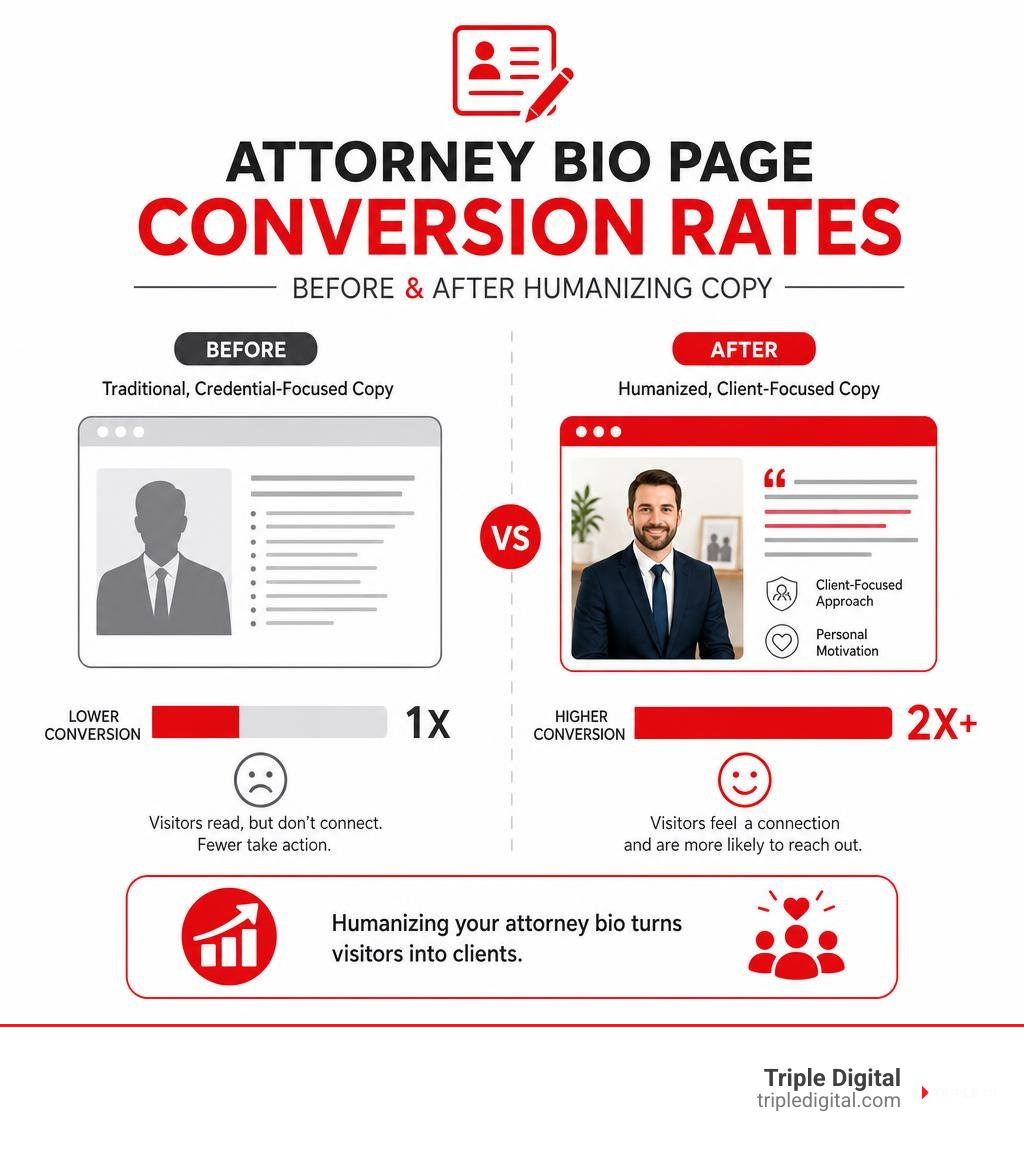
Potential clients want to know the person behind the law degree. One attorney added just two sentences to her bio explaining her personal motivation for practicing family law, and that page became the site’s highest-converting asset.
When writing attorney bios:
- Write in a natural, warm, professional tone.
- Explain why you practice law and how you guide clients through tough moments.
- Keep academic achievements and court admissions near the bottom, after establishing human connection.
Building Trust Through Educational Blog Articles
Educational blog articles allow you to meet prospective clients early in their search journey. The best topics come directly from the real questions clients ask during initial consultations.
Instead of writing vague articles loaded with legal disclaimers, provide clear, direct answers to practical questions like:
- What should I do immediately after a workplace injury?
- How is marital property split during a business owner’s divorce?
- What steps take place during an initial criminal arraignment?
Building an active publishing schedule establishes long-term market authority. For example, one firm expanded its publishing cadence to 16 targeted articles per month and saw quarterly incoming calls jump from 234 to 697—a nearly 200% increase—alongside a 258% rise in completed intake forms. Discover how to build a similar asset with our ultimate blog writing guide and see why your law firm needs a better blog strategy.
Optimizing Legal Copy for SEO, AI Search, and Client Intake
Human-Centric SEO and AI Overview Extraction
Modern search engine optimization (SEO) is no longer about repeating keywords every few sentences. Search engines—and AI-driven search overviews—prioritize clear, direct answers written in natural language.
To rank well and win featured snippets:
- Use clear subheadings structured as common client questions.
- Follow each heading immediately with a direct, 2-to-3 sentence answer in plain language.
- Use natural terms that everyday people type into search bars, such as “car accident lawyer near me” rather than “motor vehicle tort counsel.”
To learn more about optimizing content for modern search systems, read our analysis on leveraging AI-written content and implementing advanced SEO strategies.
High-Converting Calls-to-Action and Frictionless Intake Forms
A call-to-action (CTA) should feel like a helpful next step rather than a heavy commitment. High-friction terms like “Submit” or “Demand Consultation Now” often cause visitors to hesitate.
Small adjustments to CTA copy can deliver noticeable conversion improvements:
- Changing a generic “Request Appointment” link to “Book a 15-Minute Call” paired with “Same-day call back most weekdays” lifted one practice page’s conversion rate from 3.4% to 4.6% over 30 days with no extra traffic.
- Using low-commitment invitations like “Talk to Us Free” has been shown to double response rates compared to stiff, formal alternatives.
For client intake forms, keep friction as low as possible:
- Ask only for essential initial details: Name, Phone Number, Email, and a brief description of the issue.
- Studies show that paring form inputs down from 7 fields to 3 can boost submission rates by up to 86%.
- Use friendly, human confirmation messages that outline what will happen next and when the firm will reach out.
Multi-Channel Voice and Tone Consistency
Your firm’s brand voice should remain consistent across every client touchpoint, including your website, automated email replies, social channels, and intake follow-ups.
A family law firm tested this principle by simplifying their initial inquiry email response. They replaced a formal 380-word email with a clear, 160-word message detailing three simple steps and expected response times. Over six weeks, their booked consultation rate rose from 22% to 31%.
Maintaining a consistent, approachable tone builds trust from the very first click through to the signed retainer. Read our guide on law firm content marketing strategy to ensure your messaging stays aligned across all marketing channels.
Strategic Positioning and Partnering with Legal Copywriting Experts
Implementing Advanced Copywriting for Law Practices Through Positioning
Weak website copy is rarely just a writing issue—it is usually a positioning issue. If a law firm has not defined what makes it unique, copywriters can only produce generic text that sounds like every other firm in town.
Before drafting new copy, firms benefit from working through a strategic positioning process:
- Pinpoint your ideal client profile (the specific cases you handle best).
- Define clear differentiators that set you apart from local search competitors.
- Map out the primary anxieties and questions your target clients experience.
Establishing clear strategic positioning ensures that every landing page, ad, and article reinforces your firm’s distinct competitive strengths.
Evaluating In-House Writing versus Specialized Legal Agencies
While attorneys can write their own web content, doing so often pulls billable hours away from active casework. Partnering with a specialized legal marketing agency ensures high-quality copy that converts, built on deep industry expertise.
Working with an expert team gives you:
- Deep experience balancing conversion optimization with state bar advertising rules.
- Dedicated writers who know how to translate complex statutes into plain language.
- Ongoing data tracking, A/B testing, and campaign optimization to keep conversion rates growing.
At Triple Digital, we focus on lead generation and case acquisition for growth-oriented law firms, delivering clear, data-driven messaging without unnecessary fluff. Explore our insights on hiring legal ghostwriting services and content creation strategies for attorneys to learn more.
Frequently Asked Questions About Legal Copywriting
How does copywriting differ from traditional content writing for law firms?
Content writing focuses on educating readers, building long-term search authority, and answering broad legal questions over time through blog posts and guides. Copywriting is direct-response messaging designed to convert visitors into leads immediately by guiding them to call, complete an intake form, or schedule a consultation.
Why do potential legal clients abandon website contact forms before submitting?
Visitors usually leave forms due to unnecessary friction: too many required fields, invasive early questions, intimidating legal language, or a lack of clear privacy promises. Reducing inputs to essential contact details and adding clear response timelines significantly increases form completions.
How can a law practice maintain search engine rankings without sounding robotic?
Write for human readers first, then optimize for search engines. Focus on underlying search intent, structure pages with question-based subheadings, and give immediate, plain-language answers. Modern search engines and AI tools prioritize clear, helpful content over rigid keyword repetition.
Transform Your Firm’s Client Acquisition with Strategic Messaging
Effective legal copywriting is not about aggressive sales pitches or complex legalese—it is about meeting distressed people where they are, offering clear guidance, and showing them a simple path forward. By replacing dense legal jargon with empathetic, action-focused copy, your law firm can turn website visitors into signed cases.
If your website traffic is not generating the qualified caseload your firm deserves, our team is here to help. Discover how our specialized, results-focused marketing strategies can transform your firm’s conversion rates by reviewing our digital marketing services.