




Legal Marketing Lead Generation: From Clicks to Clients
Generate More Qualified Legal Leads in 2026
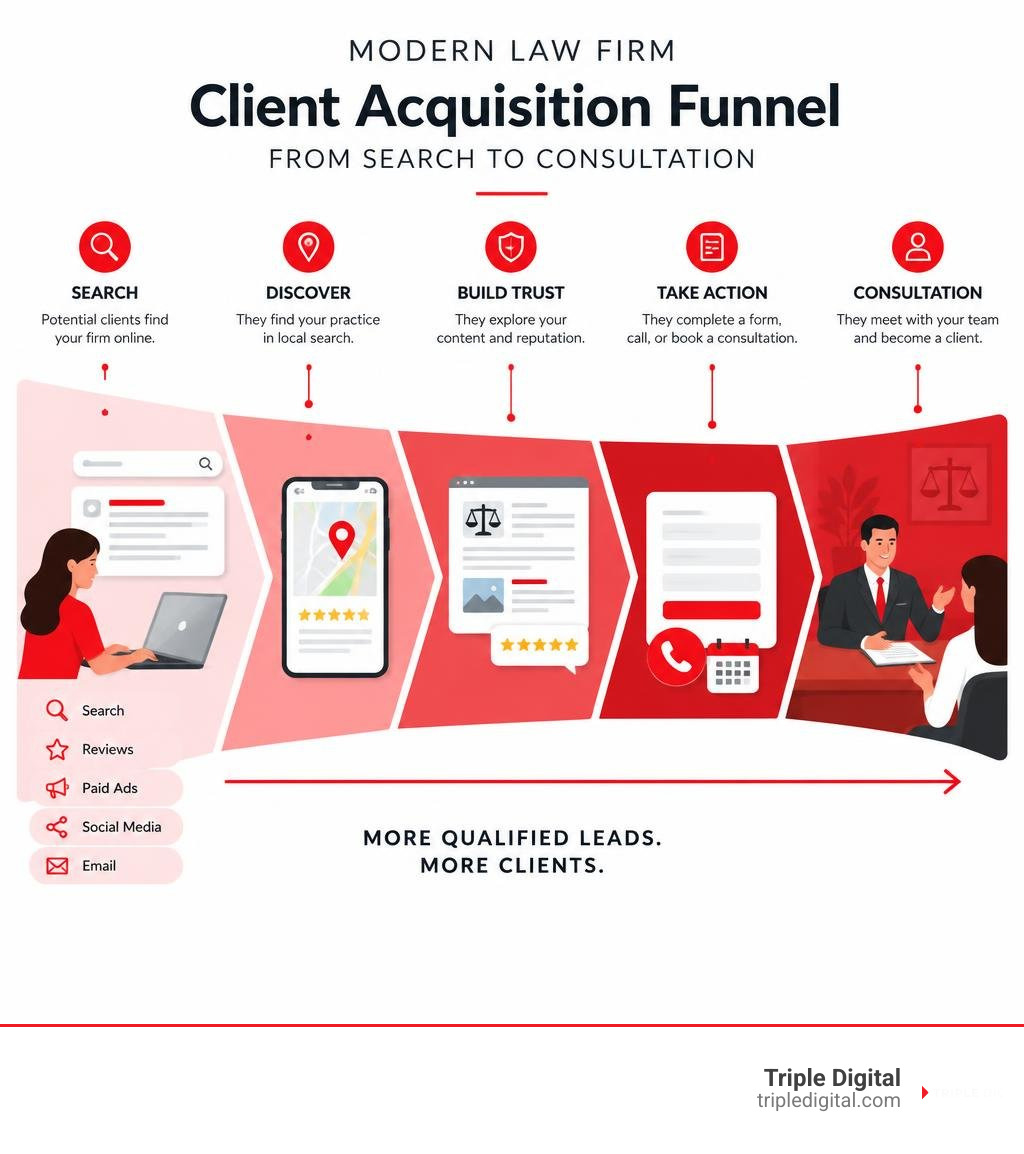
Legal marketing lead generation works when your firm makes it easy for the right potential clients to find you, trust you, and request help. Start with a fast, mobile-friendly website, clear consultation calls to action, local SEO for your practice areas, and a reliable system for responding to every inquiry.
Focus on these four actions first:
- Build dedicated practice-area pages that answer common client questions.
- Optimize your Google Business Profile and local search presence.
- Use clear intake forms, phone tracking, and appointment scheduling.
- Track where leads come from and follow up quickly through a CRM or intake workflow.
A lead is not automatically a client. It is a person who has shown interest in your services, such as calling the firm, completing a form, downloading a guide, or booking a consultation. The goal is to attract qualified prospects and guide them from first search to signed engagement.
In 2026, firms cannot rely only on referrals or a static website. Search, reviews, helpful content, paid ads, social media, and email follow-up can each support a different point in the client journey. The strongest approach connects these channels with responsive intake and measurement.
Terms related to legal marketing lead generation:
The Fundamentals of Legal Marketing Lead Generation
At its core, lead generation is the engine that keeps a practice healthy and growing. Without a steady stream of prospective clients raising their hands, even the most skilled attorneys end up riding an uncomfortable revenue rollercoaster. One month your calendar is packed to the brim, and the next you are wondering when the phone will ring.
Building an intentional acquisition system replaces that feast-or-famine cycle with predictable case volume. When you attract qualified prospects rather than unqualified calls, your firm saves countless hours on non-viable consultations, increases client retention rates, and establishes consistent revenue.
The Four Stages of the Law Firm Client Funnel
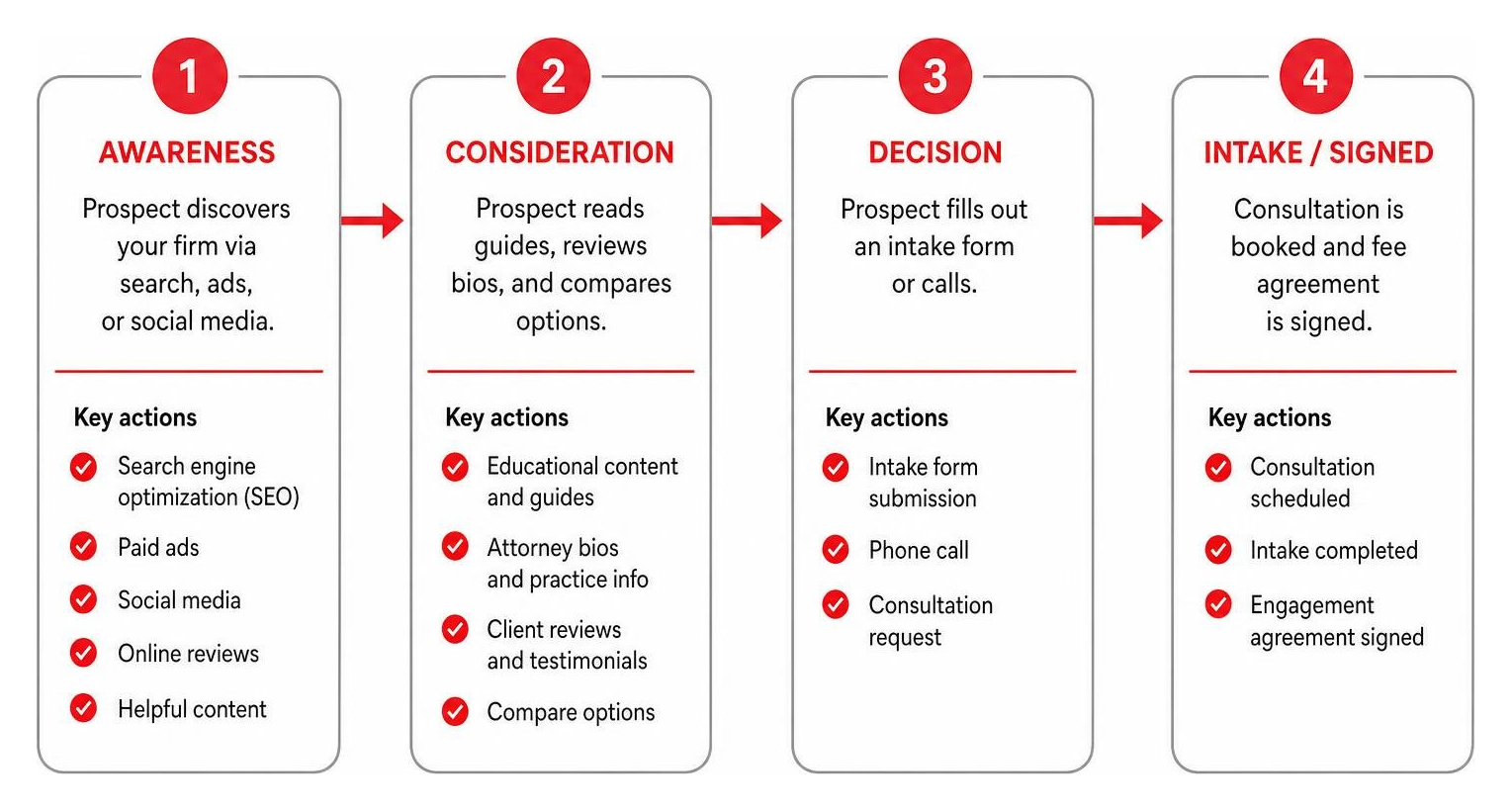
Prospective clients do not wake up and hire an attorney on a whim. They move through specific psychological phases before retaining legal counsel:
- Awareness Stage: The individual realizes they face a legal challenge, whether navigating estate planning questions or handling property issues. They start searching online for basic guidance and learn your practice exists.
- Consideration Phase: The prospect evaluates their options. They compare different firms, read educational blog posts, check online reviews, and review attorney credentials.
- Decision Making: Convinced they need professional assistance, they narrow down their list and prepare to reach out directly.
- Intake Conversion: The prospect contacts your office. A streamlined intake process turns this initial touchpoint into a scheduled consultation and a signed engagement.
Industry data confirms that intake workflows make a substantial difference. According to the 2024 Legal Industry Report, law firms using standardized, structured lead capture forms achieved an 18% lead conversion rate. Removing friction during the intake conversion step dramatically increases the return on your overall marketing investment.
Why Predictable Lead Generation Drives Firm Growth
Relying purely on traditional word-of-mouth creates operational bottlenecks. When you establish automated, multi-channel client acquisition, your firm unlocks several distinct competitive advantages:
- Caseload Consistency: Smooth out seasonality across the calendar year so your staff maintains a balanced workload.
- Overhead Optimization: Maximize the efficiency of your team by filtering out low-intent inquiries before they consume billable time.
- Market Authority: Dominating local search results and thought-leadership channels cements your firm as the go-to authority in your practice areas.
- High-Value Matters: When lead volume is high, you gain the luxury of selectivity, allowing you to prioritize the matters that best fit your firm’s strengths and financial goals.
- Scalable Revenue: Adding associates or expanding into adjacent geographic markets becomes low-risk because you possess a repeatable playbook for client acquisition.
Building a High-Converting Website and Inbound Strategy
Your website serves as your firm’s 24/7 digital intake coordinator. If your site is sluggish, difficult to navigate on mobile devices, or cluttered with dense legal jargon, prospective clients will bounce back to search results and call your competitor.
A high-converting legal website requires:
- Sub-two-second load times across all pages.
- Mobile-responsive design with click-to-call phone buttons.
- Prominent trust badges, professional associations, and peer recognitions.
- Verified client testimonials that highlight responsive communication and professionalism.
- Simple intake forms that capture essential details without overwhelming the visitor.

Conversion Rate Optimization and Intake Forms
Conversion Rate Optimization (CRO) is the art and science of turning passive website visitors into active inquiries. The key to legal CRO is reducing friction.
When people need legal counsel, they often feel stressed. Asking them to complete a 15-field intake questionnaire creates an unnecessary barrier. Instead, limit initial forms to basic contact details, practice area selection, and a brief description of their inquiry. Pair these simple forms with direct calendar scheduling tools so prospects can immediately secure an introductory phone call or office meeting.
Search Engine Optimization for Legal Marketing Lead Generation
Organic search engine optimization remains one of the highest-ROI acquisition channels for attorneys. When people face immediate legal questions, search engines are their primary starting point.
To capture these high-intent searches, your firm must execute a localized strategy:
- Google Business Profile (GBP): Optimize your listing with accurate practice categories, operational hours, updated contact info, and regular updates.
- Practice-Area Silos: Develop detailed, localized landing pages for each specific service you offer rather than lumping everything onto a single page.
- Local Citations & Backlinks: Earn mentions from local business directories, community organizations, and recognized legal publications.
At Triple Digital, our team helps law practices turn search visibility into actual retained cases through tailored legal marketing services that combine data analytics with proven local search techniques.
Content Marketing and Educational Authority
Content marketing builds trust before a prospect ever speaks with an attorney. By publishing practical, easy-to-understand educational resources, you address the exact questions your ideal clients are asking.
Effective legal content formats include:
- Client FAQ Guides: Step-by-step overviews explaining what to expect during probate, commercial lease negotiations, or corporate restructuring.
- Video Explainers: Short 60-to-90-second videos introducing your team, demystifying legal concepts, and answering common consultation questions.
- Downloadable Lead Magnets: Checklists and guides (e.g., “The Complete Estate Planning Checklist for Business Owners”) offered in exchange for a prospect’s email address.
This educational approach proves your expertise while establishing an ongoing connection with prospects who may need your services in the future.
Paid Advertising and Outbound Acquisition Strategies
While organic SEO builds sustainable long-term value, paid advertising delivers immediate visibility and qualified leads. A comprehensive legal marketing strategy blends organic authority with targeted direct-response advertising to capture demand across multiple channels.
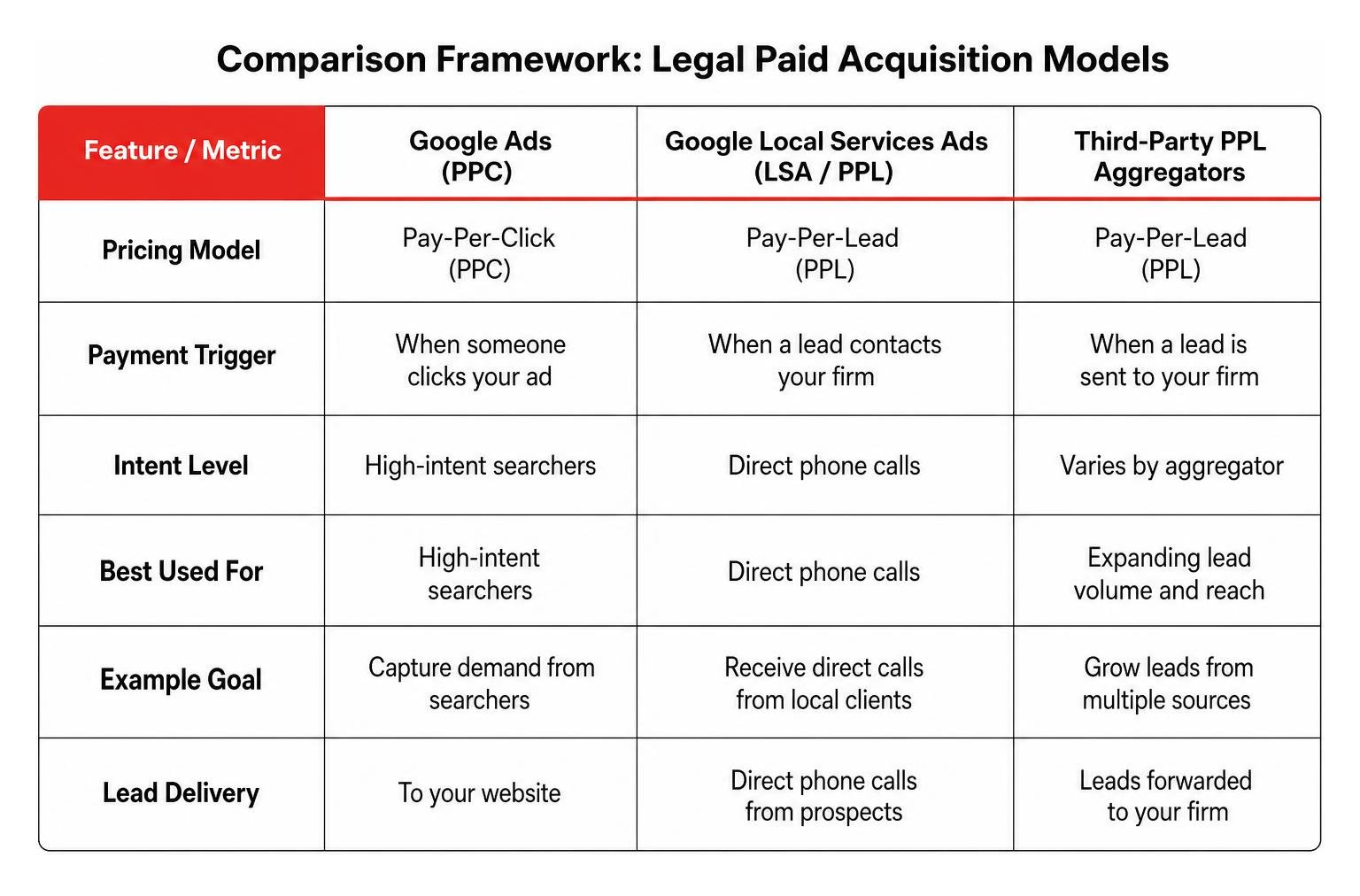
Comparing PPC vs. PPL and Local Services Ads
Law firms have several paid channels to consider, each with unique cost dynamics and intent levels:
| Feature / Metric | Google Ads (PPC) | Google Local Services Ads (LSA / PPL) | Third-Party PPL Aggregators |
|---|---|---|---|
| Billing Trigger | Every click to your website or landing page | Every legitimate direct phone call or message | Every lead contact submitted |
| Placement | Top of search results (sponsored text) | Absolute top of Google search (Google Screened badge) | Aggregator platform directory listings |
| Intent Level | High to Very High | Exceptionally High | Moderate to Low (often non-exclusive) |
| Lead Exclusivity | 100% exclusive to your firm | 100% exclusive direct inbound call | Often shared among 3–5 competing firms |
| Budget Control | Highly customizable bids and keywords | Set weekly lead budget targets | Fixed price per lead package |
Google Local Services Ads are especially attractive for local law firms because you only pay when an individual calls or messages your firm directly through the listing. When paired with high-intent Pay-Per-Click campaigns, your firm effectively dominates the top of the search engine results page.

Harnessing Social Media for Legal Marketing Lead Generation
Social media is not just for consumer lifestyle brands. When leveraged strategically, platforms like LinkedIn and Facebook provide exceptional targeting capabilities for lawyers.
- LinkedIn Thought Leadership: Ideal for commercial litigation, corporate governance, intellectual property, and employment law firms. Regularly publishing commentary on recent statutory updates or business regulations positions your partners as indispensable advisors to corporate decision-makers.
- Facebook & Instagram Retargeting: Use non-invasive retargeting ads to keep your firm top-of-mind for individuals who visited your website but did not submit an intake form on their first visit.
- Community Engagement: Share community involvement, firm milestones, and educational webinars to humanize your attorneys and build strong local brand affinity.
Email Marketing and Automated Lead Nurturing
Not every lead who contacts your firm is ready to retain counsel today. A prospect researching trust administration might spend three months gathering family records before scheduling a meeting. Without an automated email workflow, those warm leads will slip through the cracks.
Set up automated nurture sequences that:
- Deliver immediate confirmation emails with links to consultation preparation checklists.
- Send weekly educational newsletters discussing common legal mistakes and practical planning tips.
- Deploy automated SMS and email appointment reminders to eliminate consultation no-show rates.
How to Choose the Right Lead Generation Strategy for Your Budget
Selecting the ideal marketing mix depends on your practice area margins, growth timeline, and current operational bandwidth. There is no one-size-fits-all solution, but following a structured allocation framework prevents wasted marketing spend.
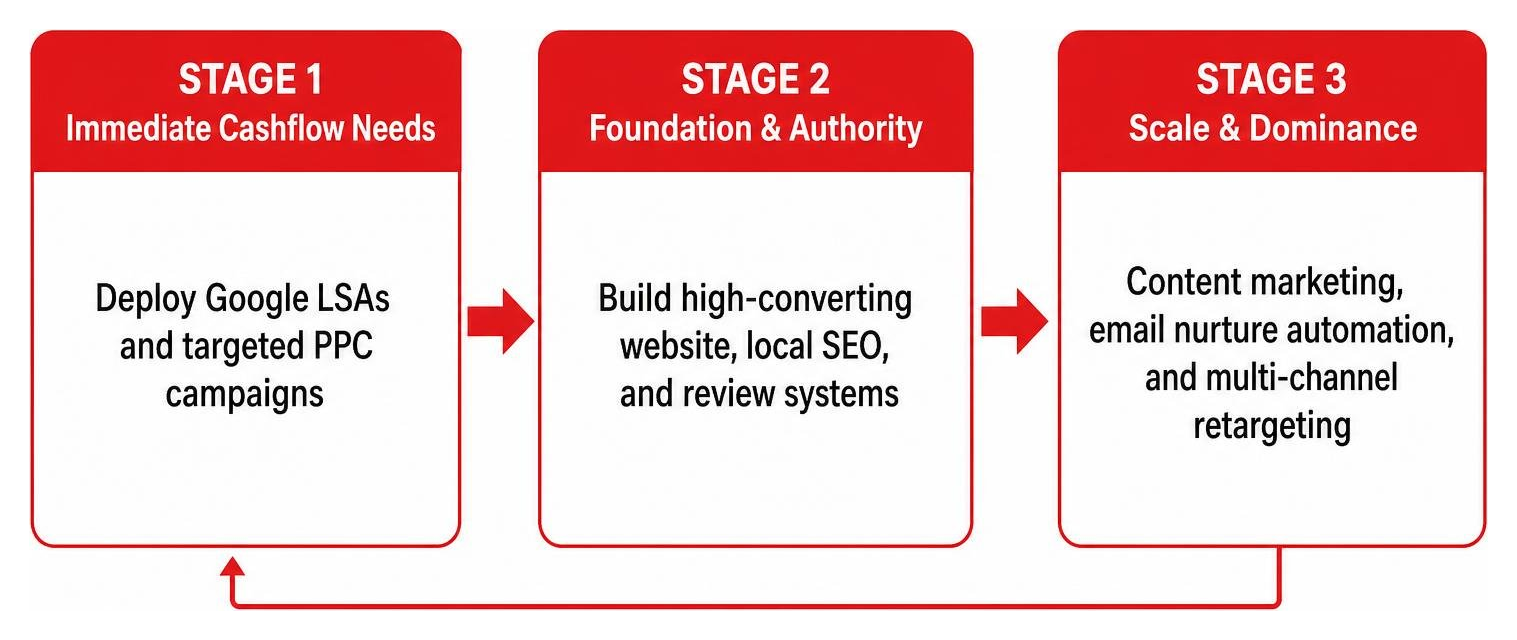
Allocating Marketing Spend Across Practice Areas
When planning your budget, balance short-term lead acquisition with long-term brand equity:
- High-Urgency Practice Areas (e.g., criminal defense, family law emergencies): Allocate a larger percentage of your initial budget (60–70%) toward direct-response paid search and Google Local Services Ads, where prospective clients need counsel immediately.
- Planned & Transactional Practice Areas (e.g., estate planning, corporate formation, real estate transactions): Invest heavily in content marketing, organic SEO, and email nurturing (50–60% of budget), as clients conduct substantial research before hiring an attorney.
- Competitive Urban Markets: In high-density metros like Houston, expect higher paid click costs. Counterbalance paid spend by building localized directory authority and gathering consistent client reviews to improve organic conversion rates.
Tracking Key Performance Indicators and Client Acquisition Cost
You cannot improve what you do not measure. High-growth firms continuously monitor core acquisition metrics through a centralized legal CRM:
- Cost Per Lead (CPL): Total marketing spend divided by the total number of inquiries received.
- Cost Per Acquisition (CAC): Total marketing spend divided by the number of signed, paying clients.
- Lead-to-Consultation Rate: The percentage of incoming leads that turn into scheduled consultations.
- Consultation-to-Retainer Rate: The percentage of completed consultations that result in a signed engagement.
If you are ready to remove the guesswork from your marketing and establish an acquisition system tailored to your practice goals, contact our team today to explore our proven client acquisition frameworks.
Frequently Asked Questions About Legal Lead Generation
What is the difference between PPC and PPL for law firms?
Pay-Per-Click (PPC) models, such as standard Google Search Ads, charge your firm whenever a user clicks your advertisement to visit your landing page, regardless of whether they complete a form. Pay-Per-Lead (PPL) models, such as Google Local Services Ads or specialized lead aggregators, only bill your firm when a prospect takes direct action, such as submitting their contact details or calling your office.
How long does it take for legal SEO to generate leads?
Organic SEO is a compounding long-term investment. Most law firms begin seeing initial keyword ranking improvements and local map visibility within 3 to 6 months. Substantial, predictable lead generation typically matures between 6 and 12 months as your domain authority grows and your practice-area content expands.
How can a small law firm generate legal leads on a limited budget?
Solo attorneys and boutique firms should prioritize high-leverage organic strategies:
- Claim and completely optimize your Google Business Profile.
- Request reviews from satisfied past clients systematically.
- Publish detailed answers to specific local legal questions on your blog.
- Network on LinkedIn with complementary professionals (accountants, financial planners, real estate brokers) who can refer relevant matters.
Elevate Your Practice With Data-Driven Acquisition
Generating high-quality legal leads requires more than isolated marketing tactics. Sustainable firm growth happens when search engine visibility, compelling educational content, high-converting website architecture, and responsive intake workflows operate in complete alignment.
At Triple Digital, we eliminate the fluff to deliver measurable case acquisition. By combining advanced audience targeting, search optimization, and automated conversion systems, we help ambitious law firms scale their caseloads efficiently.
Ready to transform your client acquisition pipeline? Discover how our specialized legal growth services can expand your practice, or schedule a growth strategy meeting with our team today.