




Master SEO Optimized Legal Posts to Outrank Competing Law Firms
Intent-Driven Keyword Strategy for Law Firm Blogs
To master SEO optimized legal posts, law firms should first identify high-intent, localized search queries, then organize content into topic clusters that connect detailed blog posts to comprehensive practice area pages. This approach helps search engines understand your firm’s authority while matching prospective clients with the specific legal guidance they need.
Every successful legal article starts with understanding why someone opened a search bar. Prospective clients rarely search for broad academic theories. Instead, they look for immediate clarity during stressful moments: understanding a contract dispute, navigating child custody guidelines, or reviewing post-accident steps.
To capture these high-value readers, your firm must match user intent with pinpoint topical relevance. We balance high-volume informational queries with localized commercial intent, ensuring every article attracts visitors who genuinely need professional guidance.
Identifying High-Converting Commercial and Local Search Queries
Search volume alone does not pay the bills. Ranking for a nationwide query with 50,000 monthly searches might stroke the ego, but if those visitors live across the country where you are not licensed to practice, that traffic rarely converts into retained clients.
Google Search dominates the landscape with an 89% market share, making it the primary battleground for client acquisition. In competitive markets like Houston, prospective clients frequently rely on localized phrasing. For example, generic terms like “law firm near me” drive roughly 3,000 monthly searches, while “personal injury law firms near me” sees around 2,800 monthly searches across national search patterns.
Conducting comprehensive keyword research for lawyers allows you to discover high-converting long-tail phrases that blend practice area topics with geographic identifiers:
- Informational Intent: “How does comparative negligence work in Texas?”
- Commercial Investigation: “Best business litigation attorney in Houston reviews”
- Transactional Intent: “Schedule consultation probate lawyer Houston TX”
Targeting specific, localized questions lowers competition while connecting your firm directly with people ready to retain legal counsel.
Topic Clustering and Practice Area Authority Mapping
Publishing disconnected, random articles leaves search engines confused about your core specializations. Instead, structure your website using a pillar-and-cluster model to establish undeniable topical authority.
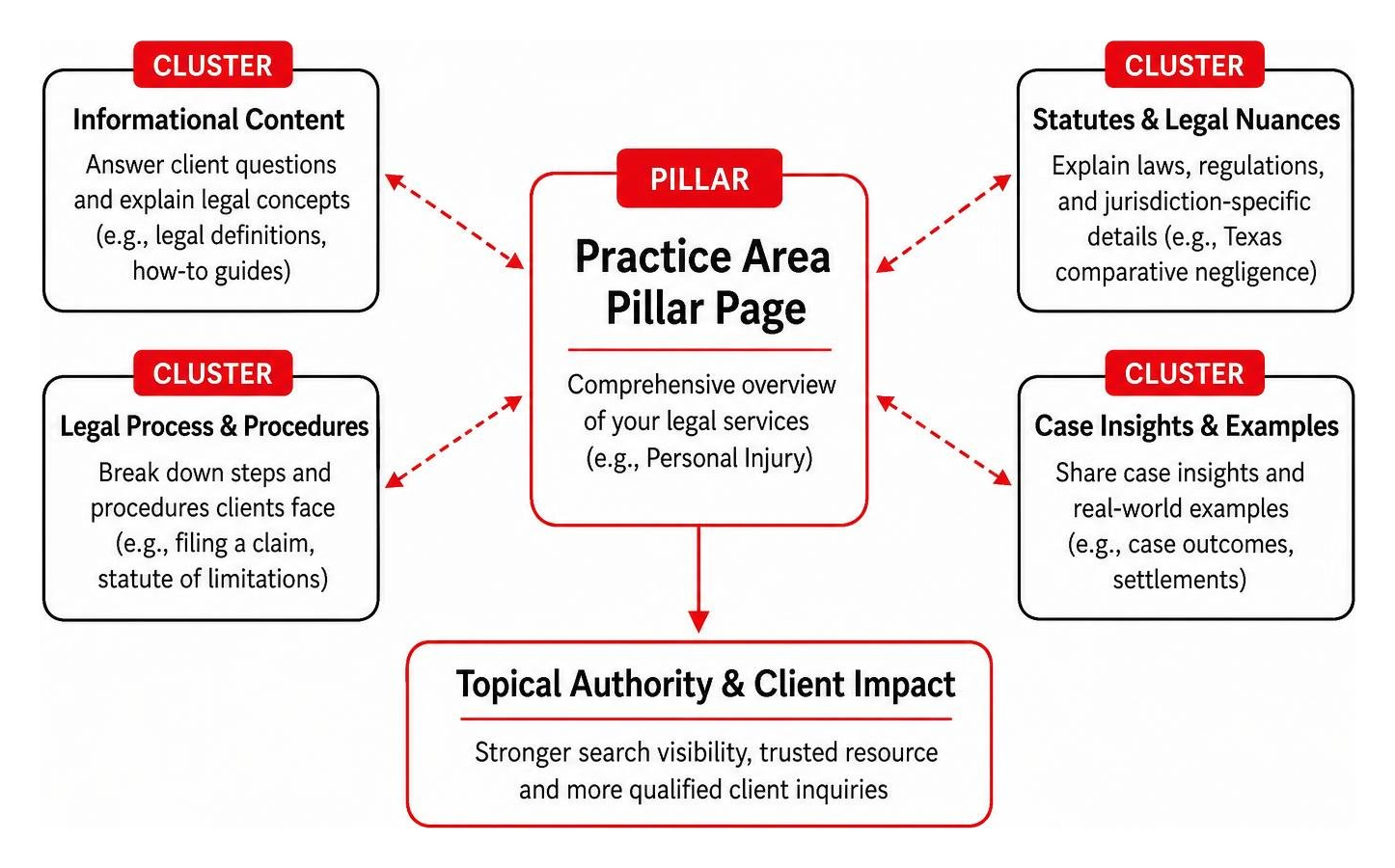
A comprehensive practice area page serves as the “pillar,” providing a broad overview of your legal services. Surrounding this core page are targeted blog posts (“clusters”) that address detailed client questions, legal definitions, statutory nuances, and common procedural hurdles.
By utilizing structured pillar content for legal websites, you link every supporting post back to your main service page. This architecture signals topical depth to search engine crawlers while guiding prospective clients smoothly down the inquiry funnel.
Step-by-Step Blueprint to Write SEO Optimized Legal Posts
High-ranking legal writing requires a balance between rigorous factual precision and accessible, human-centered communication. If an article reads like a dense appellate brief, readers bounce. If it reads like generic marketing fluff, readers leave without trusting your expertise.
Structuring SEO Optimized Legal Posts for AI Overviews and Snippets
Search engines and AI answer engines reward scannable, well-organized structures. Legal searches trigger Google AI Overviews roughly 78% of the time—the highest rate among all high-stakes search categories. Furthermore, studies show organic click-through rates can drop by up to 58% when an AI Overview dominates the top of the screen.
To capture featured snippets and secure citations in AI Overviews, design your articles with intentional formatting:
- Clear Header Hierarchy: Use logical H2 and H3 tags phrased as direct questions or topical milestones.
- Direct Answer Paragraphs: Place a concise 2-3 sentence answer directly beneath the heading before expanding into detailed analysis.
- Bulleted Summaries: Use lists to outline steps, requirements, or key considerations.
- Structured Breakouts: Highlight key takeaways or statutory definitions in distinct visual sections.
Crafting advanced SEO authoritative content ensures search engines easily parse and extract your content for prominent answer blocks.
Drafting E-E-A-T Compliant Copy That Converts Readers
Google evaluates legal content under its strict “Your Money or Your Life” (YMYL) standards. Because legal advice directly impacts personal finances, freedom, and well-being, demonstrating Experience, Expertise, Authoritativeness, and Trustworthiness (E-E-A-T) is mandatory.
- Author Transparency: Include clear bylines showcasing the reviewing attorney’s credentials, bar admissions, and practical experience.
- Jurisdictional Accuracy: Clearly state the jurisdiction, governing state statutes, and local court rules to prevent misleading out-of-state readers.
- Plain Language Explanations: Translate complicated legal jargon into approachable terms so readers understand their options without getting lost in Latin phrases.
- Mandatory Disclaimers: Maintain bar compliance by including clear statements that the article provides general educational information rather than formal legal advice.
Mastering legal copywriting for attorneys allows your firm to project authority while creating an empathetic connection with readers experiencing stressful legal situations.
On-Page Optimization and Legal Schema Markup Implementation
On-page technical elements help search engines index your content accurately. Pay close attention to these foundational elements:
- Title Tags: Keep titles between 55 and 65 characters, placing your primary keyword and local modifier near the front.
- Meta Descriptions: Write compelling summaries under 155 characters that address search intent and include an enticing call to action.
- Clean URL Slugs: Use short, descriptive URLs containing your core keyword phrase (e.g.,
/houston-probate-process-guide/). - Image Optimization: Compress all visual assets and use descriptive alt text under 125 characters to ensure accessibility.
Beyond standard metadata, implementing structured data is essential. Use LegalService, Attorney, and FAQPage schema markup to provide search engines with unambiguous context regarding your firm’s identity, physical location, and services. Reviewing essential legal SEO ranking factors will keep your on-page framework fully optimized.
Optimizing Legal Articles for AI Search Engines and Overviews
The rapid rise of generative engines has altered how potential clients discover legal information. Creating ranking content now requires optimizing for both traditional indexers and modern language models.
Generative Engine Optimization (GEO) for Practice Area Content
Generative Engine Optimization (GEO) involves formatting content so large language models (LLMs) cite your firm as a primary authority. In independent evaluations on US legal research questions, specialized models like OpenAI’s Astra for Law passed correctness checks on 54.0% of inquiries compared to just 38.7% for generic web search models—a 40% relative improvement driven by access to structured legal indexes.
To boost your firm’s visibility across AI responses:
- Cite specific state statutes, codes, and established legal precedents directly.
- Provide objective, factual definitions of legal terminology.
- Frame sections around direct question-and-answer pairs.
- Incorporate proprietary case insights and localized context that generic scrapers cannot replicate.
Following modern AI search optimization tips positions your articles to earn valuable citations within zero-click answer summaries.
Maintaining Editorial Integrity and Compliance in AI-Assisted Workflows
While generative AI tools can streamline research, drafting outlines, and brainstorming content ideas, they cannot replace licensed legal judgment. AI models frequently misunderstand local jurisdictional quirks or invent outdated precedents.

Every piece of content must pass through rigorous human review:
- Verify Primary Sources: Double-check every cited statute, court decision, and filing deadline against official government repositories.
- Audit for Ethical Compliance: Ensure all language complies with state bar rules regarding attorney advertising, specialty claims, and confidentiality.
- Refine the Firm’s Voice: Edit AI drafts to infuse genuine empathy, practical courtroom insights, and real-world perspective.
Maintaining strict editorial integrity protects your firm’s reputation and builds long-term authority.
Authority Building and Off-Page Promotion for Legal Content
Publishing great content is only half the battle. To outrank entrenched competitors, your website must earn trust from external platforms through authoritative backlinks and strong local signals.
High-Impact Legal Link Building and Outreach
Backlinks serve as digital votes of confidence. A legal blog backed by reputable industry references will consistently outrank an unlinked competitor.
- Legal Directories: Maintain verified profiles on established platforms like Avvo, Justia, and local chamber of commerce directories.
- Bar Associations and Law Journals: Contribute scholarly commentary, practice guides, or legal updates to local and state bar publications.
- Digital PR and Expert Commentary: Respond to journalist queries on platforms like Qwoted to earn high-authority media mentions.
- Community Engagement: Sponsor local civic events, educational scholarships, or pro bono clinics in your metropolitan area to earn authentic local news links.
Consistently executing effective blog writing for law firms naturally attracts citations from journalists, legal scholars, and industry peers.
Integrating Local SEO Signals and Practice Reviews
For location-bound legal practices, local search signals strongly influence case inquiries. Optimizing your Google Business Profile (GBP) alongside your blog strategy creates a unified digital presence.
At Triple Digital, we emphasize aligning your written content with local map pack optimization. Reinforce your localized content by ensuring your Name, Address, and Phone Number (NAP) details remain perfectly consistent across all web directories. Regularly encourage satisfied clients to leave detailed, authentic reviews highlighting specific practice areas.
Applying the principles in our complete guide to modern law firm SEO creates synergy between your informational blog posts and your local map listings, driving higher conversion rates across your service area.
Performance Tracking and Content Refresh Workflows
Legal SEO is not a “set-it-and-forget-it” investment. Ongoing measurement and systematic content updates are critical to sustaining top rankings.
Measuring the ROI and Performance of SEO Optimized Legal Posts
Track metrics that tie directly to firm revenue rather than obsessing over vanity traffic numbers.
| Metric Type | Vanity Metrics (Low Value) | Case Acquisition KPIs (High Value) |
|---|---|---|
| Search Visibility | Total raw impressions | Top 3 rankings for high-intent keywords |
| Traffic Quality | General nationwide site sessions | Localized, practice-specific visits |
| User Engagement | Low bounce rate on broad definitions | Average time on page & resource downloads |
| Conversion & Revenue | Newsletter signups | Direct consultation requests & signed retainers |
Monitor performance in Google Search Console and Google Analytics 4 (GA4). Track which specific articles generate incoming phone calls, completed consultation forms, and ultimately, retained clients.
Preventing Traffic Decay Through Content Refreshes
Legal statutes, case law, and filing thresholds change regularly. When an article contains outdated information, its search rankings decline as search algorithms prioritize fresh, accurate resources.
Implement a systematic content refresh cycle:
- Audit Decaying URLs: Identify high-performing posts that have lost impressions over the previous 6 to 12 months.
- Update Legal Standards: Revise references to state statutes, procedural rules, filing fees, or local court guidelines.
- Enhance Depth: Add new sections answering emerging client questions or addressing recent legal trends.
- Improve Interlinking: Connect older articles to newly published topic clusters.
Staying aligned with modern SEO for lawyers in 2026 keeps your historical content library producing qualified leads year after year.
Frequently Asked Questions About Legal Content SEO
How often should a law firm publish new blog posts?
Quality and strategic alignment matter far more than raw publishing volume. For most small to mid-sized firms, publishing 2 to 4 comprehensively researched, attorney-reviewed articles per month delivers stronger results than churning out low-quality weekly posts. Focus on building complete topic clusters that thoroughly answer real client questions.
Can attorneys safely use AI tools to produce legal posts?
Yes, provided there is strict human-in-the-loop oversight. AI tools can assist with keyword clustering, content outlines, and initial drafts. However, a licensed attorney must verify every legal citation, confirm jurisdictional accuracy, and ensure strict compliance with state bar advertising ethics.
How long does it take for legal posts to start generating client leads?
Typically, well-optimized legal content begins gaining traction within 3 to 6 months. Timelines depend on your website’s existing domain authority, technical health, backlink profile, and the competitive density of your local market. Once established, evergreen legal content continues to generate qualified inquiries for years.
Partner with Triple Digital to Scale Your Firm’s Case Acquisition
Outranking competing practices requires more than basic blogging—it demands a focused, data-driven strategy tailored to modern search engines and prospective client behavior.
At Triple Digital, our philosophy is simple: less fluff, more cases. We combine advanced SEO, AI-driven search optimization, and rigorous lead-generation frameworks to help law firms dominate local search results and acquire high-value cases.
Ready to transform your law firm’s organic reach into a consistent engine for signed clients? Schedule a strategy meeting with our legal growth team today.