





Keyword Research for Lawyers: Why Most Law Firms Leave Clients on the Table Without It
Keyword research for lawyers is the process of finding the exact words and phrases potential clients type into Google when they need legal help — then using those terms to make your firm show up first.
Here’s the quick version of how it works:
- Identify your practice areas and the case types you want to attract.
- Find the words real clients use — not legal jargon, but everyday language like “car accident lawyer near me.”
- Check search volume and competition to find terms worth targeting.
- Map keywords to the right pages — service pages, location pages, and blog posts.
- Track performance and refine over time as search trends shift.
That’s the core loop. The rest is execution.
Now here’s why it matters more for law firms than almost any other industry.
96% of people seeking legal advice start with a search engine. And yet most law firms either skip keyword research entirely, or they target the wrong terms and wonder why their site doesn’t bring in cases.
The stakes are unusually high in legal search. Legal keywords carry the highest average cost-per-click of any industry — competitive personal injury terms can exceed $300 per click in major markets. Getting your organic keyword strategy right doesn’t just improve your rankings. It can replace expensive paid ads with traffic that converts at more than double the rate.
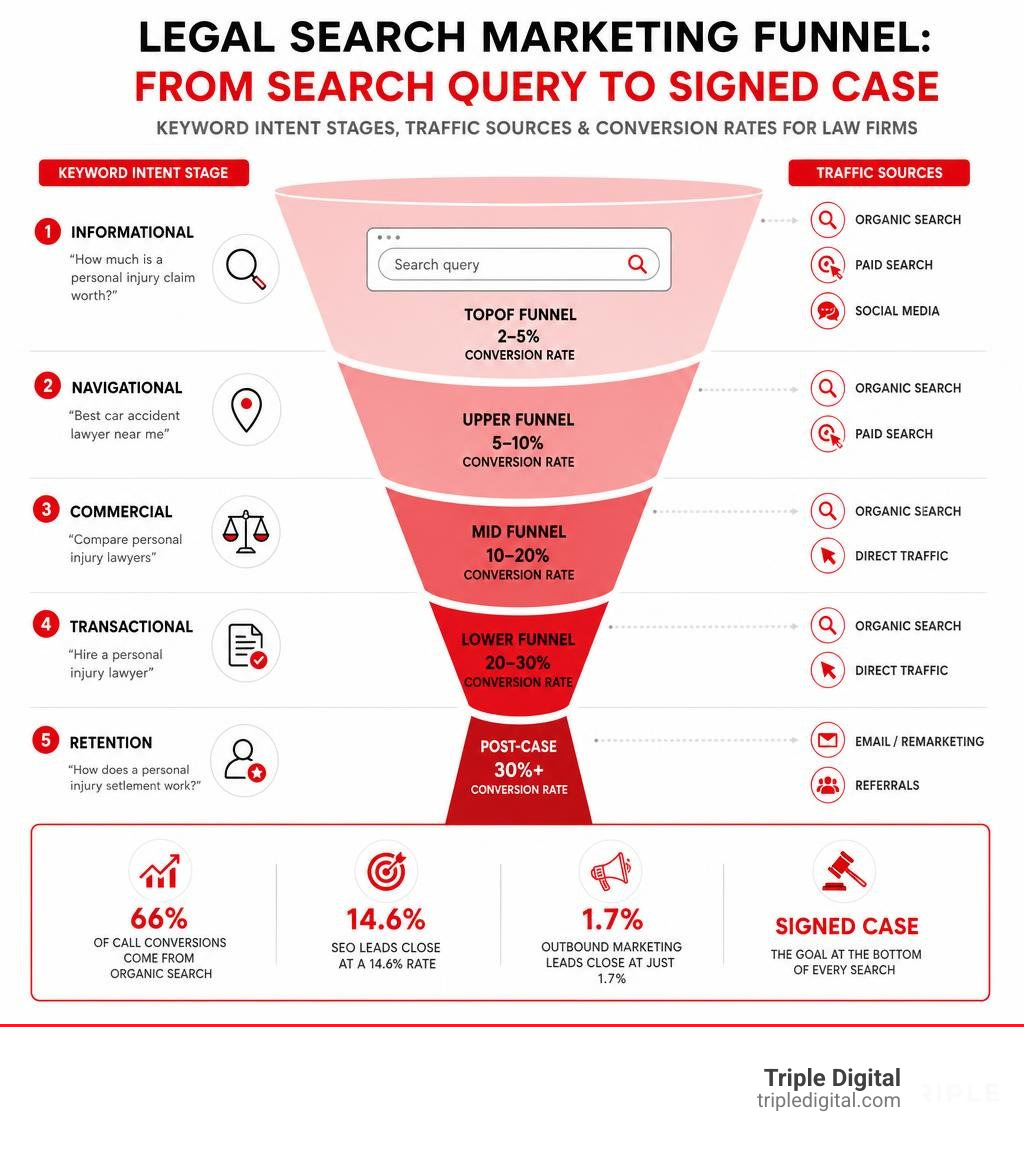
Organic search generates 66% of call conversions in the legal sector. And SEO leads close at a 14.6% rate — compared to just 1.7% for outbound marketing.
That’s not a small difference. That’s a fundamentally better way to grow a practice.
The problem is that most law firms either guess at keywords, copy competitors blindly, or rely on agencies that treat legal SEO like any other niche. This guide fixes that.
Keyword research for lawyers terms at a glance:
Why Keyword Research for Lawyers is Your Most Profitable SEO Asset
Many lawyers view SEO as a secondary marketing tactic, preferring to rely on traditional referrals. But relying solely on referrals is no longer a viable long-term growth plan. In July 2026, your prospective clients are online, and they are actively searching for answers to their legal crises.
If you don’t understand the exact search terms your prospective clients use, you are essentially building a website in the dark. Designing a beautiful law firm website without keyword research is like writing a brilliant legal brief without citing a single case. It might look impressive to you, but search engines won’t know how to evaluate its relevance.
When you align your website content with the vocabulary of your target audience, you tap into a highly profitable digital asset. Consider these industry-wide benchmarks:
- Higher Organic Traffic Share: Organic search accounts for 53% of all law firm website traffic, while paid search accounts for just 14%.
- Superior Conversion Rates: Organic search traffic converts at 4.2% in the legal sector compared to 1.8% for paid search. This is more than double the return for the same volume of traffic.
- Lower Client Acquisition Costs: While paid campaigns require continuous, expensive ad spend to maintain visibility, organic content built around the right keywords acts as a compounding asset. It continues to attract qualified cases long after it is published.
To understand why this works, you have to look at the financial mechanics of legal search. Because legal keywords carry the highest average cost-per-click (CPC) of any industry, bidding on broad terms can quickly deplete your marketing budget. For example, in competitive metro areas like Houston, paying $150 to $300 per click for paid search ads is common.
By executing a precise organic strategy, you bypass these exorbitant costs. Understanding why SEO is important for attorneys begins with recognizing that organic traffic is free. Once you rank on the first page for a high-value search term, every click you receive is a lead you didn’t have to buy. If you want to dive deeper into how these elements work together, check out our guide on Law Firm SEO: What Are the Most Important SEO Ranking Factors? to see how keywords influence search engine rankings.
How to Conduct Keyword Research for Lawyers in 5 Steps
Now that you understand the immense value of organic visibility, let’s look at how to build your keyword list. Effective keyword research isn’t about exporting a giant spreadsheet of thousands of random terms and hoping for the best. It’s about finding the specific queries that indicate a user is ready to hire an attorney.
To get the most out of your SEO investment, we recommend following a structured, five-step framework designed to identify high-value search opportunities. If you want a comprehensive look at how this fits into your broader marketing plan, review our guide on Mastering Law Firm SEO: Your Blueprint for Online Success.
Before we jump into the steps, make sure you have access to the essential tools of the trade. While there are dozens of SEO platforms available, you can build a powerful strategy using a combination of free and paid tools:
- Google Search Console (Free): Excellent for seeing what search terms your website already ranks for and identifying “near-miss” keywords ranking on pages 2 or 3.
- Google Keyword Planner (Free): A great starting point for checking search volume and estimating commercial intent based on paid advertising competition.
- Ahrefs or SEMrush (Paid): Invaluable for analyzing competitor websites, performing keyword gap analyses, and tracking your keyword rankings over time.
With these tools ready, let’s break down the step-by-step process.
Step 1: Build Seed Lists for Keyword Research for Lawyers
The biggest mistake most lawyers make when starting their SEO journey is relying solely on automated tools. Automated tools only show you what people have already searched for in large volumes; they often miss the highly specific, high-intent phrases that convert into actual clients.
The best keyword strategy starts with the language your clients actually use, not what search tools dictate. To build your initial seed list, start by looking at your own intake data:
- Talk to your intake team: What are the first words out of a caller’s mouth? They rarely say, “I require a personal injury litigator.” Instead, they say, “I was rear-ended by a commercial truck and my insurance company won’t pay.”
- Review your consultation notes: Look at the last 20 to 30 cases you signed. What specific legal problems did those clients describe?
- Analyze your online reviews: Read the reviews your clients have left for you and other local law firms. Pay attention to the specific nouns and verbs they use to describe their situations.
Once you gather these raw phrases, strip out the filler words and identify the core noun-verb combinations. For example, the intake phrase “I got hurt at work and my boss is threatening to fire me” translates into seed keywords like “workers compensation lawyer” or “injured at work attorney.” To learn how to convert these raw ideas into high-performing web pages, read our guide on Content Creation for Attorneys.
Step 2: Expand Your List with Search Volume and Intent Modifiers
Once you have your seed keywords, you need to expand them by adding modifiers that reflect how people search locally and how close they are to making a decision.
Modifiers fall into two main categories:
- Geographic Modifiers (Geo-modifiers): Because legal services are inherently local, prospective clients almost always add location-specific terms to their searches. If your firm is located in Houston, your modifiers should include “Houston,” “Harris County,” “Downtown Houston,” and surrounding suburbs like “The Woodlands” or “Sugar Land.”
- Intent Modifiers: These are words that indicate where the searcher is in their decision-making process. Words like “best,” “top-rated,” “reviews,” “cost,” and “near me” indicate that a user is actively looking to hire someone.
By combining your seed keywords with these modifiers, you can build highly targeted long-tail keywords.
That long-tail keywords (phrases containing four or more words) are incredibly valuable. They may have lower search volumes than broad terms, but they convert at up to 11 times the rate of single-word head terms. A highly specific six-word query like “best Houston car accident lawyer reviews” has an average conversion rate of 1.94%, compared to just 0.17% for a generic term like “lawyer.”
Step 3: Analyze Competitor Gaps to Find High-Value Opportunities
You don’t have to reinvent the wheel to find profitable keywords. Your competitors have already done a portion of the work for you. By performing a keyword gap analysis, you can identify the exact search terms your competitors are ranking for that your website completely misses.
To perform a gap analysis:
- Identify your top three to five organic competitors (the law firms that consistently rank in the top spots for your primary practice areas).
- Run their website URLs through a tool like SEMrush or Ahrefs.
- Filter the results to show keywords where your competitors rank on page one, but your website does not rank at all.
- Prioritize terms that have clear commercial intent and manageable keyword difficulty scores.
This process helps you identify overlooked practice area subtopics, local suburb pages, and question-based queries that can quickly drive fresh traffic to your site. For more advice on outperforming your local competition, read our playbook on how to Rank Higher, Get More Clients: Your SEO Playbook for Law Firms.
Mapping Search Intent: High-Intent vs. Research-Stage Keywords
One of the most critical aspects of keyword research is understanding user intent. If you target keywords without considering what the searcher actually wants, you will end up with a high-bounce website that fails to generate leads.
Search intent in the legal industry generally falls into three distinct phases along the client journey:
- Informational (Research-Stage): The user is experiencing a legal problem but isn’t sure if they need a lawyer yet. They are looking for answers, rules, and general guidance.
- Commercial Investigation (Comparison-Stage): The user knows they need a lawyer and is actively researching their options, comparing firms, and looking at reviews.
- Transactional (High-Intent / Hire-Ready): The user is ready to speak with an attorney immediately. They are searching for direct contact options in their local area.
To help you visualize how to balance your content strategy, here is a comparison of how these intent stages translate into real-world search queries:
| Keyword Type | Search Intent | Example Query | Best Page Type | Conversion Potential |
|---|---|---|---|---|
| Transactional | Hire-Ready / Urgent | “Houston car accident lawyer near me” | Practice Area Page | Extremely High |
| Commercial | Comparison / Evaluation | “best personal injury attorney reviews Houston” | Homepage / About Page | High |
| Informational | Research / Education | “what to do after a minor car accident in Texas” | Blog Post / FAQ Page | Medium to Low |
Building a balanced content strategy means targeting both ends of the funnel. Informational keywords build your website’s overall topical authority, while transactional keywords drive immediate signed cases. To learn how to structure your informational content effectively, explore The Ultimate Guide to Blog Writing for Law Firms.
Targeting High-Intent Keyword Research for Lawyers to Drive Signed Cases
While informational blog posts are great for building brand awareness, your primary practice area pages must be optimized for transactional, high-intent terms. These are the pages that turn searchers into signed clients.
When optimizing your practice area pages, make sure you avoid legal jargon. Clients in crisis do not search for “tort litigation specialist.” They search for “car accident lawyer” or “medical malpractice lawyer.”
Ensure that your high-intent keywords are strategically placed in your page’s most important SEO fields:
- The Meta Title Tag: This is the blue link that appears in Google search results. It should always lead with your primary keyword and location (e.g., Houston Car Accident Lawyer | [Firm Name]).
- The H1 Heading: The main title on your webpage should clearly state your service and location.
- The URL Structure: Keep it clean and keyword-focused (e.g.,
tripledigital.com/houston-car-accident-lawyer).
For a detailed walkthrough on on-page optimization, read our guide on Rank Higher, Get More Clients: Essential Website SEO for Attorneys.
Local SEO and Geo-Specific Targeting for Law Firms
Because legal services are highly localized, approximately 70% of legal searches have local intent. This means that Google’s map pack—the box of three local business listings that appears at the top of local search results—is the single most valuable piece of digital real estate for your firm.
To win in local search, you must treat your organic website keywords and your Google Business Profile (GBP) keywords as two parts of a unified local SEO strategy.
To optimize your firm for local search queries:
- Claim and Optimize Your Google Business Profile: Ensure your firm’s name, address, and phone number (NAP) are 100% consistent across the web.
- Select the Correct Categories: Your primary category on GBP should match your main practice area (e.g., “Personal Injury Attorney” or “Divorce Lawyer”).
- Add Specific Services: Use the exact long-tail keywords you uncovered during your research as named services in your GBP dashboard. If your research shows people search for “motorcycle accident attorney,” add that as a specific service under your primary category.
- Build Local Citations: Get listed in reputable local directories and legal-specific platforms like Avvo, Justia, and Lawyers.com.
If you are a personal injury attorney looking to dominate your local market, read our specialized guide on SEO for Personal Injury Attorneys to learn how to capture high-value local cases.
Frequently Asked Questions About Law Firm Keywords
How long does it take to rank for legal keywords?
For highly competitive local terms like “personal injury lawyer Houston,” a new website typically takes 6 to 12 months of consistent SEO effort to reach page one. However, for long-tail informational keywords or specific niche services, you can often start ranking on the first page within 4 to 8 weeks by publishing high-quality, well-optimized content.
Is keyword research still important in the AI search era?
Yes, absolutely. While ChatGPT usage for attorney research tripled from 9% in 2023 to 28% in 2025, 94% of ChatGPT users still verify their findings on Google. Furthermore, AI engines like Google’s AI Overviews rely on the same semantic keyword and authority signals to pull sources as traditional search results. To learn how to optimize your content for both traditional search and AI models, check out our guide on Top SEO Tips for Criminal Defense Lawyers in the AI Search Era.
What is the difference between short-tail and long-tail legal keywords?
Short-tail keywords are broad, highly competitive terms like “lawyer” or “attorney” that have massive search volumes but very low conversion rates. Long-tail keywords are highly specific phrases like “emergency child custody rules in Harris County.” Long-tail terms have lower search volumes, but they carry much higher conversion intent and are significantly easier to rank for.
Scale Your Practice with Data-Driven Search Strategy
Effective keyword research for lawyers is not a one-time task; it is an ongoing, compounding engine for your firm’s growth. By aligning your digital presence with the exact terms your prospective clients use during their most challenging moments, you build a sustainable source of high-value cases that scales over time.
At Triple Digital, we help ambitious law firms cut through the noise. We don’t believe in vanity metrics or empty traffic. Our results-driven, “less fluff, more cases” approach leverages advanced data mining and AI to target the exact keywords that translate into signed clients and real revenue.
Ready to dominate your local market and stop leaving valuable cases on the table? Explore our digital marketing services today, or get in touch to schedule a strategy session.