




7 Proven Tactics for Employment Based Immigration Marketing
Strategic Foundations of Employment Based Immigration Marketing
Effective employment based immigration marketing combines B2B content that addresses corporate compliance pain points, targeted outreach to HR and in-house legal stakeholders, and clear guidance on nonimmigrant-to-immigrant pathways such as H-1B, L-1, and PERM. By positioning your firm as an enterprise risk advisor rather than a document filer, you can capture high-value corporate retainers and build predictable case pipelines.
The economic reality of the American workforce looks drastically different today than it did decades ago. Between 1990 and 2020, foreign-born individuals accounted for 30% of total population growth and an astonishing 57% of civilian labor force growth. Looking ahead, immigration is projected to be the sole driver of net U.S. population increases over the next two decades.
Yet, the legal architecture governing corporate sponsorship remains tethered to statutory limits enacted under the Immigration Act of 1990—a time when dial-up modems were luxury items and modern cloud engineering did not exist.
While the baseline statutory allocation sits at roughly 140,000 permanent resident visas annually (distributed across employment preferences EB-1 through EB-5), real-world demand regularly outstrips supply. In FY2023 alone, employment-based immigrants and their derivative family members totaled 196,760, representing 16.8% of all lawful permanent resident admissions.
When your law firm produces strategic content, leaning into these structural imbalances allows you to position your practice not merely as document filers, but as enterprise risk advisors. Utilizing our comprehensive SEO guide for immigration lawyers enables practices to capture search volume around corporate labor shortages, while mastering attorney-client targeting to win high-value cases helps separate routine consumer queries from lucrative multi-petition enterprise accounts.
Target Audience Segmentation for Employment Based Immigration Marketing
Corporate immigration marketing requires a distinct B2B approach. Unlike consumer immigration, where the foreign national pays and directs the representation, employment-based representation involves multiple corporate stakeholders:
- Chief Human Resources Officers (CHROs) & Heads of People: Focused on employer branding, retention rates, corporate liability, and compliance with Department of Labor mandates.
- In-House Legal Counsel: Concerned with regulatory exposure, audit risks, Form I-9 verification, and prevailing wage adherence.
- Talent Acquisition Directors: Needing quick turnaround times, predictable start dates for specialized hires, and smooth onboarding workflows.
- Foreign National Employees: Highly educated, anxious about status maintenance, and seeking clear communication regarding their pending petitions.
Connecting with these enterprise buyers requires thoughtful outreach. Publishing case summaries and regulatory breakdowns via LinkedIn for legal professionals creates direct touchpoints with enterprise mobility managers who are actively looking to outsource their caseloads to agile boutique practices.
Nonimmigrant to Immigrant Pipeline Positioning
The corporate immigration journey rarely starts with a direct green card petition. In FY2023, 75% of all employment-based permanent residents adjusted status from within the United States, having already spent years working on temporary visas. Marketing campaigns must capture corporate decision-makers at the entry stage of this talent pipeline.
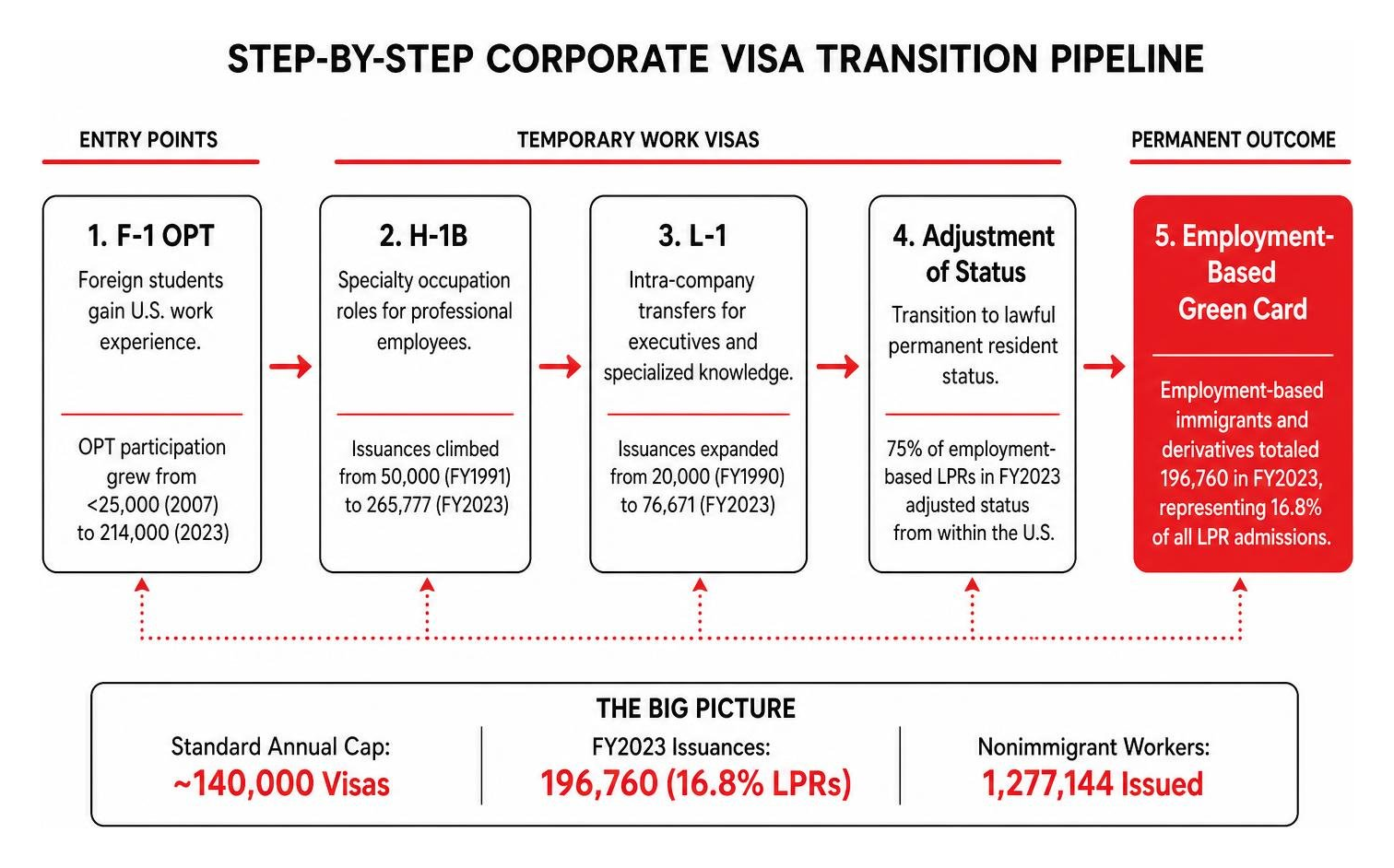
The volume of temporary worker visas surged from 159,778 in FY1989 to over 1.27 million in FY2023. Key entry points include:
- H-1B Specialty Occupations: Issuances climbed from 50,000 in FY1991 to 265,777 in FY2023. Cap season every spring is an opportune moment to run targeted paid advertising for lawyers focusing on lottery filings, cap-exempt institutional strategies, and Request for Evidence (RFE) mitigation.
- L-1 Intra-Company Transfers: Expanding nearly fourfold from 20,000 in FY1990 to 76,671 in FY2023, L-1A executives and L-1B specialized knowledge workers represent high-margin corporate accounts.
- F-1 Optional Practical Training (OPT): With foreign student OPT participation jumping from under 25,000 in 2007 to over 214,000 in 2023, companies hiring STEM graduates (who receive 44% of all U.S. STEM graduate degrees) need clear roadmaps to transition these entry-level professionals onto long-term corporate visas before their 24-month STEM extensions lapse.
Positioning High-Friction Legal Workflows to Attract Enterprise Employers
The most lucrative corporate immigration accounts often originate from a single acute pain point: the Program Electronic Review Management (PERM) labor certification process.
Navigating the Department of Labor’s strict recruitment guidelines is notoriously difficult. Securing a certified PERM takes between two to three years, with total employer costs ranging from $2,500 to upwards of $20,000 when accounting for mandatory advertising, prevailing wage determinations, and legal fees. Under federal law, the sponsoring employer must bear all costs related to the DOL labor market test.
By applying modern law firm SEO techniques, law firms can capture intent-rich search traffic from HR managers looking for guidance on PERM recruitment windows. Content should explain critical compliance phases clearly:
- Prevailing Wage Determinations (PWD): Setting expectations on processing backlogs at the National Prevailing Wage Center.
- Mandatory Labor Market Testing: Structuring the strict 180-day recruitment window, including newspaper placements, state workforce agency job orders, and internal postings.
- Audit File Preparation: Maintaining audit-proof documentation to protect the employer from substantial civil penalties.
Addressing Per-Country Caps and Visa Retrogression Roadblocks
One of the largest hurdles in corporate immigration is the statutory 7% per-country ceiling. Five countries—India, China, the Philippines, Brazil, and South Korea—accounted for 48% of all employment-based permanent residents in FY2023.
Because demand from high-population countries heavily outstrips the statutory per-country allocation, retrogression creates multi-year queues. For instance, the Visa Bulletin has shown EB-2 final action dates for Indian nationals spanning back more than a decade, meaning an Indian tech professional could easily face a 12-year wait before filing Form I-485 to adjust status.
Educating clients on these realities through dedicated law firm content creation builds immense credibility. Corporate clients appreciate attorneys who offer practical solutions to maintain valid nonimmigrant status (such as AC21 H-1B extensions beyond the six-year limit) while waiting for priority dates to become current.
Promoting Alternative Merit-Based Avenues: EB-1 and EB-2 NIW
To bypass multi-year PERM delays and labor market testing, progressive employers and high-skill professionals frequently seek alternative pathways.
Firms can attract top-tier individual clients and specialized corporate sponsors by publishing authoritative guides on:
- EB-1 Priority Workers: Catering to multinational executives (EB-1C), outstanding professors and researchers (EB-1B), and individuals of extraordinary ability (EB-1A).
- EB-2 National Interest Waivers (NIW): Under the Matter of Dhanasar precedent, applicants who show their proposed endeavor holds substantial merit and national importance can waive both the job offer and PERM certification. This strategy has gained substantial traction among AI researchers, data science innovators, and advanced business leaders.

Multi-Channel Inbound Strategies for Corporate Client Acquisition
Attracting high-value corporate retainers requires an omnichannel marketing presence that addresses both active searchers and passive corporate decision-makers. At Triple Digital, our team helps law practices implement a cohesive inbound marketing mix tailored to commercial legal representation.
| Acquisition Channel | Target Audience | Primary Value Proposition | Typical Conversion Timeline |
|---|---|---|---|
| Organic Search (SEO) | HR Directors, Talent Leads, In-House Counsel | Educational compliance guides, PERM steps, visa comparisons | 30–90 Days |
| Paid Search (PPC) | Urgent Hirers, Employers with RFEs | Fast issue resolution, immediate consultation availability | 1–7 Days |
| B2B Social (LinkedIn) | Corporate Mobility Teams, Executives | Thought leadership, regulatory shifts, Visa Bulletin alerts | 60–180 Days |
Deploying unified law firm digital marketing strategies ensures that when an enterprise talent director faces an urgent immigration issue, your practice is the visible authority across search engines and industry networks.
Optimizing B2B Legal Intake and Lead Qualification
Corporate leads must be managed with speed and precision. Enterprise HR representatives will not wait three days for an initial email reply; first-contact responsiveness is a decisive factor in converting prospective corporate accounts.
Streamlining your firm’s workflows through modern legal intake management ensures that enterprise leads are automatically categorized by case type (e.g., blanket L-1 petitions, batch PERM filings, or single H-1B transfers), assigned priority scoring based on company size, and routed immediately to senior attorneys for prompt onboarding.
Measuring ROI in Employment Based Immigration Marketing Campaigns
Tracking marketing performance in employment-based immigration differs from standard transactional consumer practices. A single corporate client may begin with one H-1B transfer, but evolve into an ongoing account generating dozens of PERM applications, I-140 petitions, and corporate compliance audits over several years.
By implementing forward-thinking law firm AI analytics and growth strategies, firms can monitor Customer Acquisition Cost (CAC) against the lifetime value (LTV) of corporate retainers, ensuring every marketing dollar produces predictable firm growth.
Frequently Asked Questions About Employment-Based Immigration Outreach
How do visa bulletin retrogression updates impact law firm content strategies?
Visa Bulletin movements drive massive spikes in organic search traffic. When priority dates advance or retrogress, foreign professionals and corporate HR staff actively search for clear interpretations of how the changes impact filing windows for Form I-485. Releasing prompt monthly breakdowns and video analyses establishes your firm as an active, dependable authority.
Why should corporate immigration firms target STEM employers specifically?
Foreign nationals earn approximately 44% of all STEM graduate degrees awarded by U.S. universities. Companies hiring in technology, life sciences, engineering, and artificial intelligence routinely require visa sponsorships (starting with 36-month OPT/STEM OPT extensions and transitioning to H-1B and PERM). Focusing content on technical roles creates natural entry points for ongoing corporate representation.
How does marketing for employer-sponsored PERM differ from self-petition NIW services?
Employer-sponsored PERM marketing is strictly B2B, focusing on statutory employer compliance, Department of Labor wage regulations, recruitment documentation, and corporate risk mitigation. Conversely, EB-2 NIW outreach targets the individual professional, highlighting personal qualifications, career achievements, publication and citation records, and self-petitioning advantages.
Scale Your Corporate Immigration Practice with Triple Digital
Navigating the complexities of employment-based immigration marketing requires deep industry familiarity, strategic precision, and data-driven execution. At Triple Digital, our Houston-based team delivers a “less fluff, more cases” approach to law firm growth. We build data-backed acquisition systems that turn complex corporate immigration processes into predictable, high-value enterprise retainers.
Ready to attract leading corporate accounts and scale your practice? Schedule a consultation for law firm growth with our digital marketing specialists today.