





How to Master Attorney Client Targeting and Win High-Value Cases
Why Attorney Client Targeting Decides Which Law Firms Grow — and Which Get Left Behind
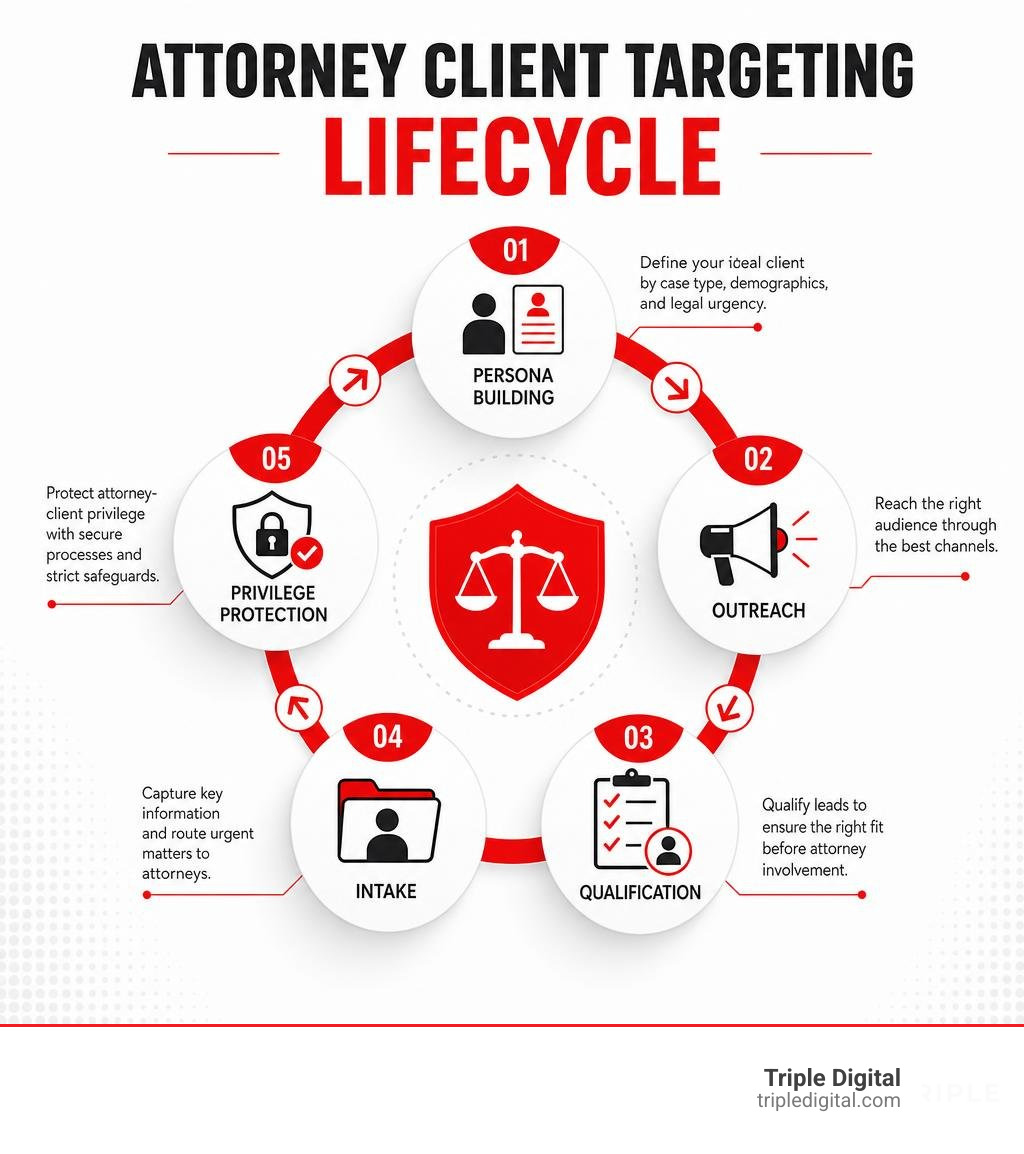
Attorney-client targeting is the practice of identifying, reaching, and converting the specific types of clients a law firm most wants to serve — using data, digital channels, and structured outreach to do it systematically rather than by chance.
Here’s a quick breakdown of what it involves:
- Define your ideal client — build personas around case type, demographics, and legal urgency
- Choose the right channels — LinkedIn for B2B practices, Google and social ads for consumer-facing ones
- Build a compliant lead-gen stack — data providers, CRM, outreach tools, and intake routing
- Separate marketing leads from legally sensitive prospects — route urgent cases to attorneys immediately
- Protect attorney-client privilege — use proper email practices, privilege logs, and contractual safeguards
- Stay within ethical boundaries — follow ABA Model Rule 7.3 and applicable state bar solicitation rules
Most law firms still rely on referrals and word of mouth. Those channels still matter — but they’re not enough to scale predictably in 2026.
The firms winning high-value cases today are building systems. They know exactly who they’re targeting, how to reach them, and how to qualify them before a single attorney spends time on a call.
But there’s a catch. Legal marketing isn’t like selling software. The rules are different. Aggressive outreach can cross into improper solicitation. Careless email practices can waive attorney-client privilege. And the wrong lead-gen setup can create compliance exposure that far outweighs the revenue it generates.
This guide covers all of it — the strategy, the tools, the ethics, and the safeguards — so your firm can grow without the risk.
Defining Attorney Client Targeting in Modern Legal Marketing

In the past, law firms cast a wide, expensive net. They bought billboards along major highways, took out full-page Yellow Pages ads, or ran late-night television commercials hoping that someone with a legal issue would see them. While those methods can still build broad brand awareness, they lack precision. They are the marketing equivalent of a megaphone when what you really need is a laser pointer.
Modern attorney client targeting flips this traditional model on its head. Instead of asking, “How many people can we get our name in front of?” we ask, “How do we position our firm directly in front of the exact person who needs our specific legal expertise at the precise moment they need it?”
By leveraging data-driven strategies, law firms can now pinpoint prospects based on their industry, corporate role, geographic location, and even real-time behavioral signals that indicate a pressing legal need. For example, a business facing an impending regulatory shift or an individual actively researching a complex legal problem online represents a highly qualified opportunity. When you align your firm’s expertise with these specific audiences, you stop wasting money on low-value traffic and start generating cases that move the needle.
To explore the fundamental mechanics of paid channels, read our comprehensive guide on Paid Advertising for Lawyers.
Developing Client Personas for Precision Attorney Client Targeting
To target the right clients, we must first understand exactly who they are. This is where client personas come in. A client persona is a detailed, semi-fictional representation of your ideal client based on real data, past case histories, and market research.
When we build personas for law firms, we look far beyond simple demographics like age or location. We dive deep into:
- The Core Legal Problem: What specific crisis or opportunity is driving them to seek counsel? (e.g., an IRS audit, a complex partnership dispute, or a catastrophic personal injury).
- The Emotional Trigger: Are they feeling anxious, angry, protective, or highly pressured by a strict legal deadline?
- Information-Seeking Behavior: Where do they go to research their problem? Do they search Google for immediate answers, or do they look for authoritative thought leadership on professional networks?
- Decision-Making Obstacles: What is keeping them from hiring an attorney? Is it fear of high hourly rates, confusion about the legal process, or previous bad experiences with law firms?
For example, a boutique corporate litigation firm might build a persona named “General Counsel Gary”—a legal executive at a mid-sized technology company who is overwhelmed by patent disputes and values rapid, clear communication over generic prestige. Conversely, a personal injury practice might build a persona named “Injured Irene”—a working mother seeking clear answers on how to pay medical bills and obtain fair compensation without getting bogged down in legal jargon.
Once these personas are clearly defined, every piece of content, every ad copy, and every landing page should be custom-tailored to address their specific pain points. For a deeper look at how to reach these audiences through highly targeted social campaigns, check out our insights on Social Media Pinpoint Targeting.
B2B vs. B2C Targeting Strategies on Professional Networks
The distinction between Business-to-Business (B2B) and Business-to-Consumer (B2C) marketing is incredibly sharp in the legal industry. Treating them the same is one of the fastest ways to exhaust a marketing budget with zero return.
For B2B legal practices—such as corporate transactions, employment defense, intellectual property licensing, commercial litigation, and M&A advisory—professional networks like LinkedIn are goldmines. In fact, research shows that 87% of law firms are already on LinkedIn, and 34% of lawyers rank it as the single most effective channel for driving new leads.
The growth of this channel is highly tied to the massive expansion of the in-house counsel market. The U.S. in-house counsel population reached approximately 145,000 by 2024, representing an 87% increase from 78,000 in 2008. To reach these decision-makers, B2B firms should combine two strategies:
- Authority Content: Consistently publishing highly specific, educational posts that demonstrate deep expertise on complex regulatory updates, corporate governance, or industry-specific disputes.
- Direct Outreach: Utilizing tools like LinkedIn Sales Navigator to filter prospects by company size (such as 50 to 500 employees), seniority level (e.g., General Counsel, VP of Legal, or Chief People Officer), and geographic location.
For B2C practices, such as personal injury, family law, criminal defense, or consumer bankruptcy, direct cold outreach on professional networks is virtually ineffective. Instead, B2C firms must focus on high-intent search channels (like Google Search Ads) and broad-reach social platforms where they can capture prospects at the exact moment a personal legal need arises.
To master these distinct methodologies across different channels, read The Definitive Guide to Paid Advertising for Lawyers.
The Ethical Boundaries of Attorney Client Targeting and Solicitation

While modern data tools allow us to identify and reach prospective clients with incredible precision, attorneys cannot market their services like traditional software companies or retail brands. The legal profession is bound by strict ethical rules designed to protect the public from overreaching, deception, and undue pressure.
Every marketing campaign must be designed with compliance at its core. Under the ABA Model Rules of Professional Conduct (particularly Rules 7.1, 7.2, and 7.3), attorneys must ensure that all communications regarding their services are completely truthful, non-deceptive, and free from misleading statements. Additionally, the rules strictly limit how and when an attorney can directly initiate contact with a prospective client.
To ensure your campaigns remain completely compliant without sacrificing performance, read our guide on How to Run Social Media Ads Without Getting Disbarred.
Understanding Barratry and Improper Solicitation Risks
At common law, barratry was defined as the offense of frequently exciting and stirring up suits and quarrels. Today, state bar associations and criminal statutes actively prohibit barratry, improper solicitation, and the use of “runners” or “cappers”—agents paid to recruit clients for attorneys. Crossing the line from legitimate marketing into improper solicitation can carry devastating consequences, including state bar disciplinary action, loss of your law license, and even criminal prosecution.
The landmark California Supreme Court case Rubin v. Green (1993) highlights the delicate balance between protecting access to courts and regulating attorney solicitation. In that case, a mobile home park owner attempted to sue an opposing law firm for allegedly soliciting park residents. The court ultimately held that the litigation privilege (under Civil Code section 47(b)) protected the attorneys’ pre-litigation communications with residents, blocking the park owner’s retaliatory lawsuit.
The court reasoned that allowing defendants to launch derivative tort suits against opposing counsel for solicitation would trigger an endless cycle of retaliatory litigation, severely harming citizens’ access to the courts. Instead, the court emphasized that the proper remedies for improper solicitation lie in:
- Sanctions within the underlying lawsuit (such as recovery of attorney fees or procedural penalties).
- State Bar disciplinary proceedings for violations of professional conduct rules.
- Criminal prosecution under state statutes that outlaw runner-and-capper schemes.
The lesson for modern firms is clear: while the litigation privilege may protect certain pre-litigation communications from derivative lawsuits by third parties, it does not shield attorneys from the severe wrath of state bar regulators or criminal prosecutors if they engage in improper, direct, or coercive solicitation. To learn more about maintaining this crucial balance, read Ad-Vantage: Mastering Paid Advertising for Law Firms.
Algorithmic Matching and Compliant Lead Generation
As technology evolves, many law firms have turned to online lead-generation platforms to connect with prospective clients. But how do these platforms stay compliant with rules against paying for referrals?
A key piece of guidance comes from the New York State Bar Association (NYSBA) Committee on Professional Ethics in Opinion 1294. The opinion evaluated a digital platform where users logged workplace experiences, and the platform shared this information in anonymized form with employment attorneys. Attorneys could then purchase credits to request the user’s identifying contact information, which would only be disclosed if the user explicitly consented.
The NYSBA concluded that this model does not constitute prohibited solicitation or improper referral fees, provided that specific, strict conditions are met:
- User-Initiated Contact: The communication is initiated entirely by the user seeking legal help, rather than the lawyer targeting an unsuspecting individual.
- Neutral, Mechanical Criteria: The platform must match users and lawyers using objective, mechanical criteria (such as practice area and geographic location) rather than endorsing or recommending specific attorneys.
- Fixed, Non-Variable Fees: The fees paid by the attorney to the lead generator must be flat, fixed costs for the lead itself, completely independent of whether the client ultimately retains the attorney or the amount of legal fees generated.
- Clear Disclosures: The platform must clearly state to users that it does not recommend or endorse any particular lawyer, and it must obtain informed consent before sharing any information.
By ensuring your lead-generation partners adhere to these strict standards, you can safely scale your client acquisition without running afoul of ethical guidelines. For an overview of compliant advertising frameworks, see our Beginner’s Guide to Paid Advertising Options.
Protecting Attorney-Client Privilege During Outreach and Business Transactions
Attorney-client privilege is the bedrock of the legal profession, ensuring that clients can communicate openly and honestly with their counsel. However, in our highly digital, marketing environment, this privilege can easily be compromised if firms are not incredibly diligent.
When executing an attorney client targeting campaign, firms must maintain a strict wall between general marketing communications and actual legal consultations. If prospective clients share sensitive, confidential case details too early in the marketing funnel—before a formal attorney-client relationship is established—that information may not be protected by privilege, leaving it highly vulnerable to discovery by opposing parties.
For a deeper dive into how cutting-edge technology and data-driven campaigns interact with these protections, read about Everything You Need to Know About Attorney AI Ad Targeting.
Lessons from Muro v. Target Corp on Email Confidentiality
The transition from paper-based communications to corporate email has fundamentally changed how courts view the preservation of attorney-client privilege. A powerful cautionary tale is found in the federal case Muro v. Target Corporation (2007).
In this case, the court ordered Target to produce numerous internal email communications that the company claimed were protected by attorney-client privilege. The court found that Target had failed to meet its burden under Federal Rule of Civil Procedure 26(b)(5) to establish that the emails were truly confidential legal communications.
Several critical errors led to Target losing its privilege claims:
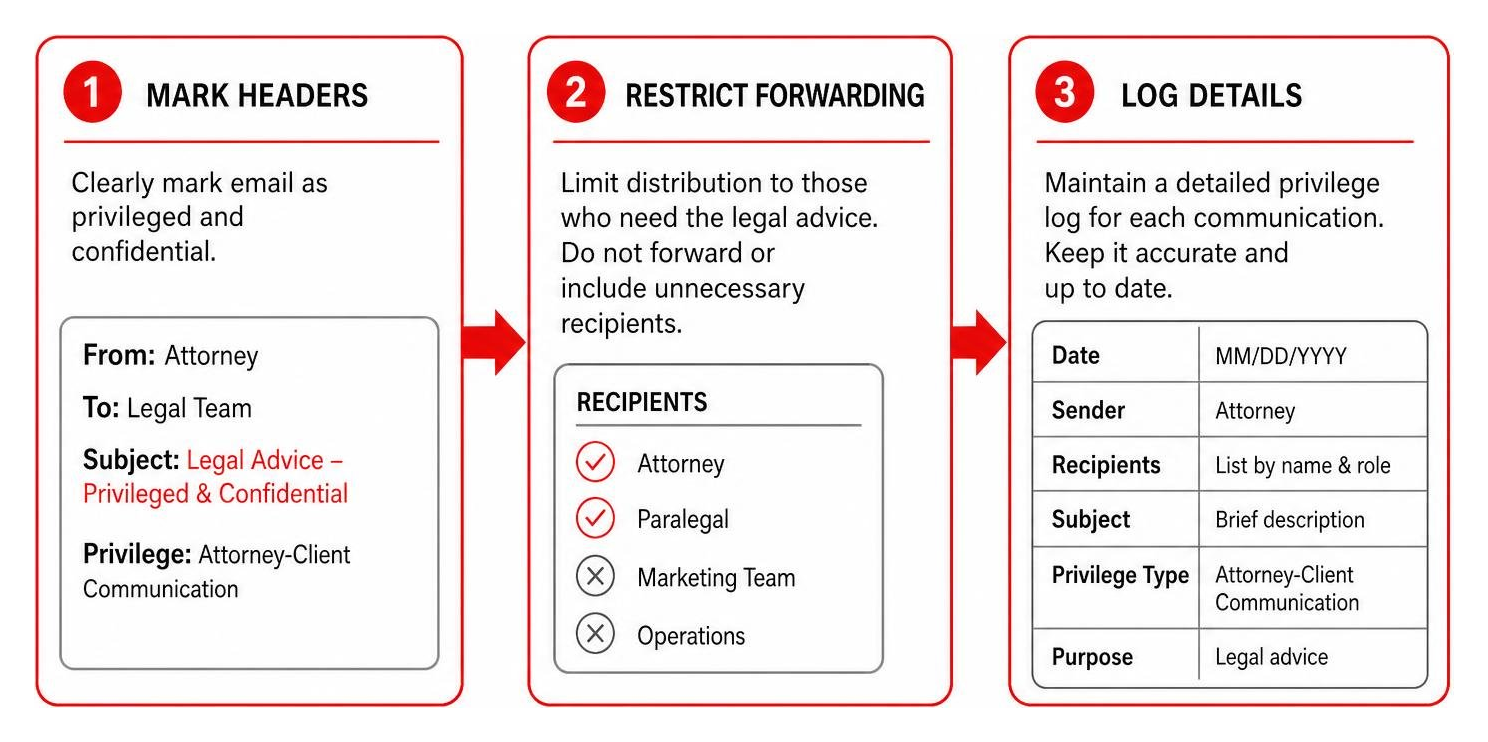
- Over-Distribution: Privileged emails were forwarded to ten or more corporate employees, including broad, unidentified distribution lists. The court held that distributing these communications to employees who did not strictly need to know the legal advice destroyed the expectation of confidentiality and effectively waived the privilege.
- Inadequate Privilege Logs: Target’s privilege logs merely repeated email subject lines and generic job titles, failing to provide the detailed factual information required to prove that the recipients fell within the scope of the privilege.
- Mixing Business and Law: The emails frequently mingled general business discussions with legal advice. Because the primary purpose of many of these communications was business-related rather than legal, they were deemed discoverable.
To protect your firm and your clients from these devastating waivers, we recommend executing the following process:
Preserving Privilege in Mergers and Business Sales
Another critical risk area for attorney-client privilege occurs when a business is sold or merged. Many business owners assume that their pre-closing communications with their corporate attorneys will always remain private. However, corporate transactions can completely upend this protection if the deal documents are not drafted with extreme care.
Under corporate law in many jurisdictions, including Delaware, all assets, rights, and privileges of a constituent corporation automatically transfer to the surviving corporate entity upon a merger. In the landmark case Great Hill Equity Partners IV, LP v. SIG Growth Equity Fund I, LLLP (Del. Ch. 2013), the court held that because the merger agreement did not contain an express carve-out, the attorney-client privilege over all pre-closing communications transferred entirely to the buyer. As a result, when a post-closing dispute arose, the buyer was legally permitted to access and use the seller’s private communications with their deal counsel against them in court.
Fortunately, the court also provided a clear roadmap for how sellers can protect themselves. In Shareholder Representative Services, LLC v. RSI Holdco, LLC (Del. Ch. 2018), the court upheld the seller’s assertion of privilege because the parties had included explicit contractual language in the merger agreement. This language stated that the attorney-client privilege over pre-merger communications remained exclusively with the seller’s representative and did not transfer to the buyer.
To protect privilege during business sales:
- Include Express Carve-Outs: Always write clear, explicit language into the purchase or merger agreement stating that all pre-closing attorney-client communications remain the exclusive property of the seller and do not transfer to the buyer.
- Segregate Communications: Prior to closing, ensure that all sensitive communications regarding the sale are conducted on private, non-company email servers (such as secure, personal accounts) rather than the corporate email servers that will be handed over to the buyer.
Building a Compliant Lead-Generation Stack for Law Firms
To scale predictably, a law firm needs a modern, automated lead-generation stack. However, you cannot simply copy a standard sales stack used by a B2B SaaS company. A legal lead-gen stack must be built to handle data with extreme security, maintain strict compliance with professional responsibility rules, and protect prospective client confidentiality.
To see how we are building next-generation, data-driven tools specifically for law firms, read about how Triple Digital Revolutionizing Legal Tech: Pinpoint Unveils Industry-First Data Mining Software to Precisely Target Prospective Clients.
Separating Marketing-Qualified Leads from Legally Sensitive Prospects in Attorney Client Targeting
One of the most common compliance mistakes law firms make is routing all incoming leads into the exact same automated marketing sequence. This creates massive ethical risks. If a prospect shares sensitive, highly urgent case facts, putting them on a generic, slow-moving newsletter sequence can lead to missed deadlines, conflict-of-interest violations, or a failure to properly handle prospective client data.
To protect your firm, we recommend implementing a two-track intake model:
- Marketing-Qualified Leads (MQLs): These are individuals or businesses showing general, educational interest. They might download a free eBook, read a blog post, or subscribe to your newsletter. They have not shared specific case facts or requested an immediate consultation. These leads can safely be placed into automated nurture sequences that share helpful, high-level legal resources.
- Legally Sensitive Prospects (LSPs): These are individuals who actively reach out with urgent, specific legal issues (e.g., they just received an IRS audit notice, were injured in an accident, or are facing an active lawsuit). These leads must bypass automated marketing entirely. They must be routed immediately to an secure, human intake specialist or attorney to perform conflict-of-interest checks and evaluate the case.
To automate this separation, use smart form logic on your landing pages. If a prospect checks a box indicating an active lawsuit or an upcoming court deadline, the system should immediately trigger an alert, pause all automated marketing, and route the lead to your urgent intake queue.
Selecting the Right Tools for Your Legal Lead-Gen Stack
Building a high-performing, compliant lead-gen stack requires pairing the right tools with strict data hygiene. Below is a comparison of the industry-standard tools used by modern law firms to balance aggressive growth with absolute compliance.
| Tool Category | Recommended Software | Primary Function | Legal Compliance Risks & Best Practices |
|---|---|---|---|
| Data Providers | ZoomInfo, RocketReach | Top-of-funnel prospecting, finding verified contact info for B2B targets. | Risk: High bounce rates can damage domain reputation. Best Practice: Always run list validation before launching campaigns. |
| CRM Systems | HubSpot, Pipedrive | Central source of truth for managing leads, pipelines, and communication history. | Risk: Storing sensitive case details before conflict checks are complete. Best Practice: Keep marketing CRM separate from formal case management software. |
| Outreach Platforms | Salesloft, Outreach | Executing multi-touch outbound sequences (email, phone, LinkedIn). | Risk: Accidental automated spamming or direct solicitation violations. Best Practice: Use highly personalized templates; enable strict suppression lists. |
| Conversion Tools | Typeform, ActiveCampaign | Building smart landing pages, intake forms, and automated lead segmentation. | Risk: Capturing sensitive legal admissions on insecure forms. Best Practice: Use secure, encrypted forms; include clear disclaimers. |
To evaluate whether Facebook and other social ad platforms are a smart fit for your lead-generation stack, read The Verdict Is In: Are Facebook Ads a Win for Your Law Firm?.
Frequently Asked Questions About Attorney Client Targeting
What is the difference between a marketing-qualified lead and a legally sensitive prospect?
A marketing-qualified lead (MQL) is a prospect who has shown general interest in your firm’s educational content (like downloading a guide or subscribing to a newsletter) but has not shared specific case details.
A legally sensitive prospect (LSP) has reached out with an active, urgent legal issue. LSPs require immediate human intervention, a formal conflict-of-interest check, and direct attorney review, whereas MQLs can be nurtured over time through automated marketing.
Can a lawyer cold-message a prospect on LinkedIn without violating solicitation rules?
In most jurisdictions, yes—especially when targeting B2B audiences like General Counsel or business owners. Under ABA Model Rule 7.3, the strict ban on live, real-time solicitation generally applies to in-person, telephone, or real-time electronic communications (like video calls). It typically does not apply to written communications (like emails or LinkedIn direct messages) that the recipient can easily ignore.
Additionally, Rule 7.3 contains an explicit carve-out permitting outreach to individuals who routinely use the type of legal services being offered. However, state-level rules vary significantly, so you should always verify your local state bar guidelines before launching an outbound campaign.
How did the Target case change how law firms handle email communications?
The Muro v. Target Corp. decision served as a major wake-up call regarding digital confidentiality. It established that simply marking an email as “Confidential” or “Attorney-Client Privileged” is not enough to protect it in court.
Firms and corporations must actively limit the distribution of privileged communications to only those individuals who strictly need to know the legal advice. Forwarding a privileged email to broad internal distribution lists or employees outside the core decision-making group can completely waive the privilege, making those communications discoverable by opposing counsel.
To explore how social media fits into this broader digital landscape, read How Facebook Advertising Can Bring Traffic to Your Website.
Scale Your Firm with Precision Case Acquisition
Building a highly targeted, ethically compliant client acquisition system is the single most powerful way to secure high-value cases and grow your firm predictably. But you don’t have to navigate this complex digital landscape alone.
At Triple Digital, we are a Houston-based digital marketing agency built on a simple promise: less fluff, more cases. We specialize in helping law firms nationwide leverage advanced data mining, precise AI-driven targeting, and compliant lead-generation systems to win the exact cases they want.
We understand the unique ethical, legal, and operational boundaries that attorneys operate within, and we build custom marketing engines that respect those limits while driving massive, measurable growth.
Ready to take control of your firm’s pipeline? Schedule a consultation with our team today, and let’s design a high-performing client acquisition system for your firm.