




How a Lead Management System Workflow Turns Inquiries Into Cases
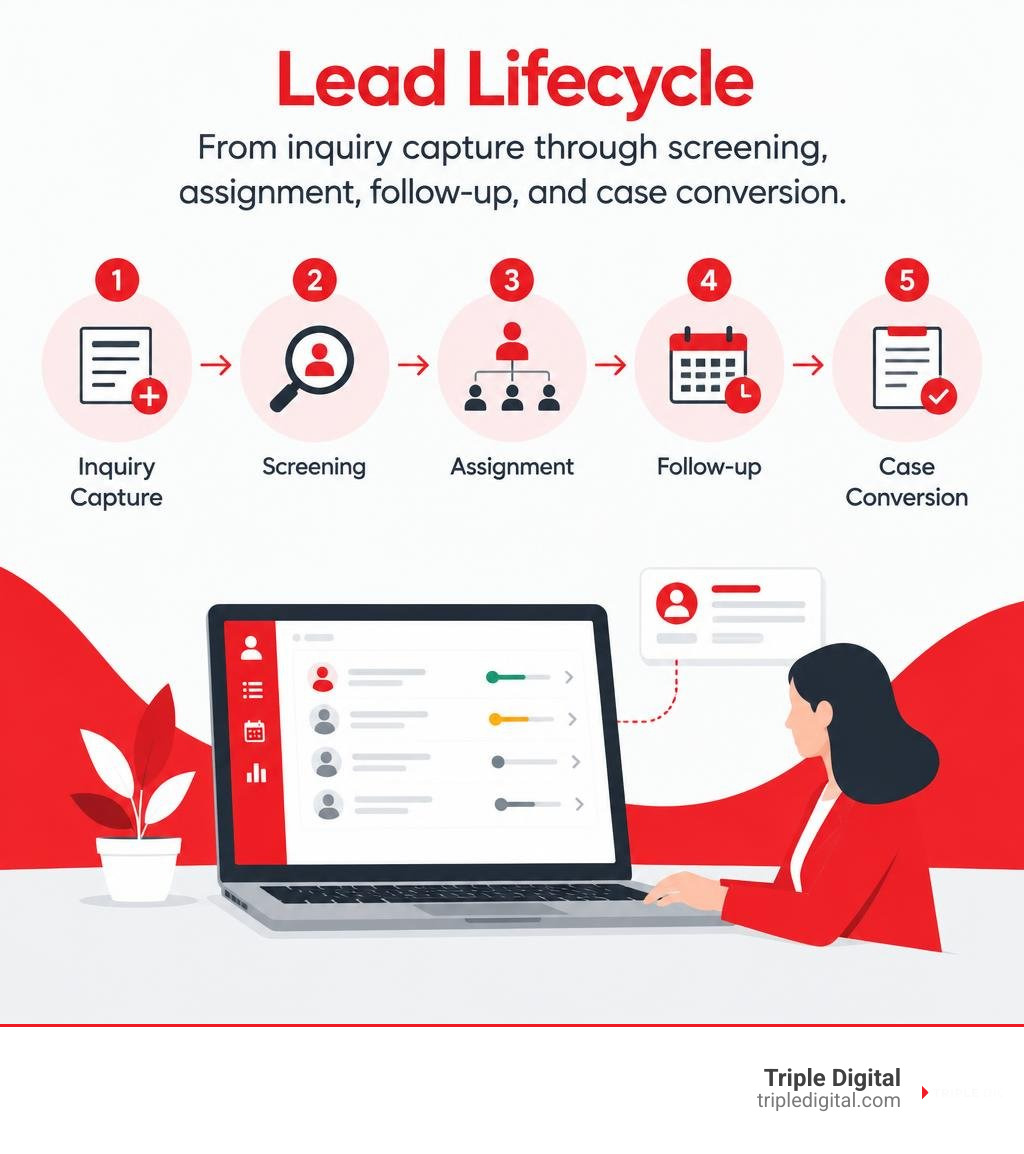
A lead management system workflow gives every new inquiry a clear path. Capture it in one place, check the contact details, screen for fit, and assign it to the right intake team member. Set a time for follow-up. If the person is not ready to move forward, keep their history and plan the next contact instead of letting the inquiry disappear.
For a law firm, the first step is to map what happens today, from the first call or form submission to a signed client. Look for delays, missed handoffs, and duplicate records. Then set clear rules for ownership and track how quickly inquiries get a response and become cases.
Lead management system workflow terms you need:
Core Architecture of a Lead Management System Workflow
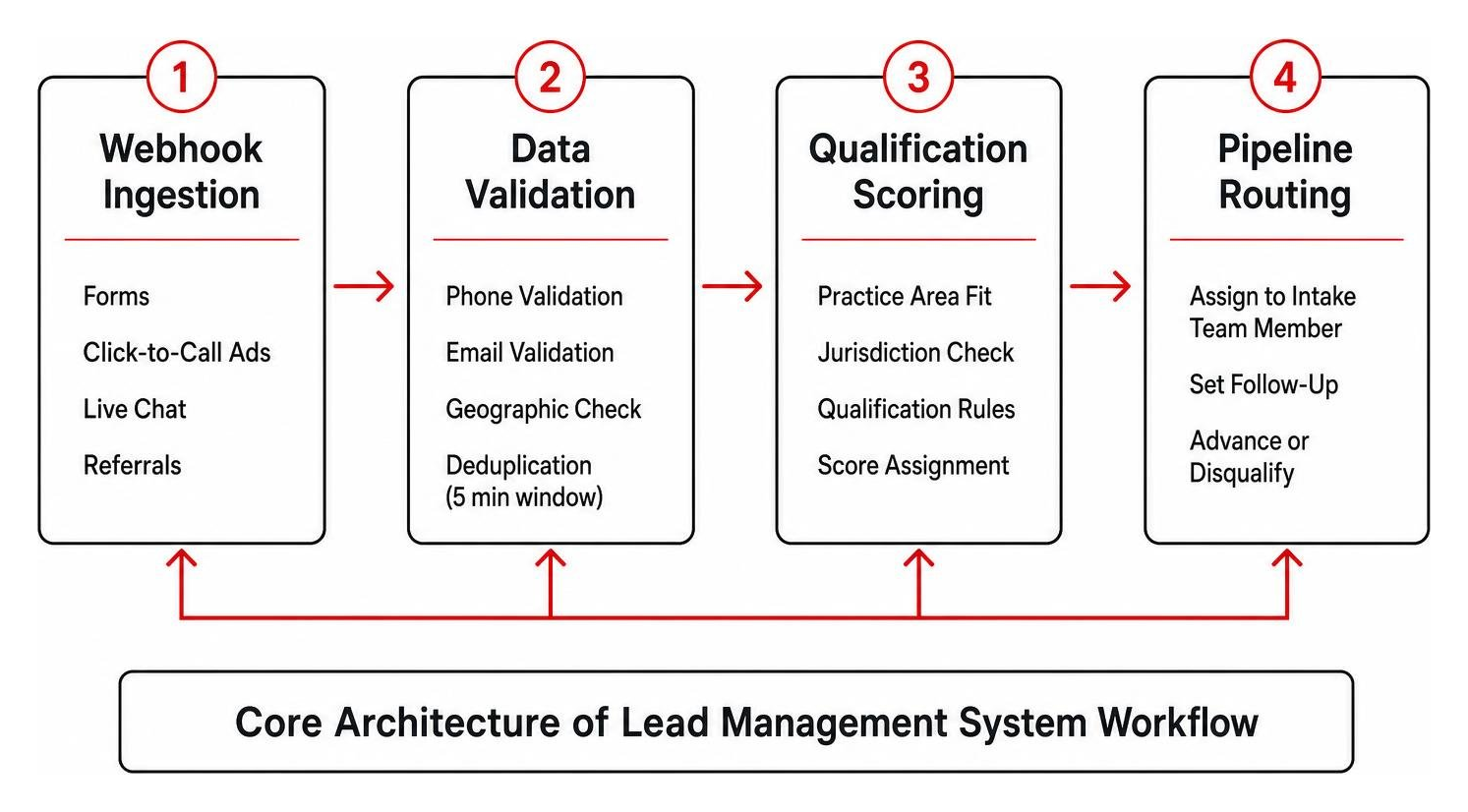
An effective revenue engine requires a dependable architectural backbone. Without standardized rules and structured data pipelines, even high-budget advertising campaigns can result in lost opportunities and operational friction. When we design robust intake management solutions, we structure the entire system around reliable data ingestion, objective qualification, and seamless workflow automations.
At Triple Digital, we know that modern intake relies heavily on webhook-driven event triggers rather than manual data entry. Webhooks instantly ingest data from landing page forms, click-to-call ads, live chat sessions, and referral networks. Dynamic field mapping automatically flattens incoming payloads into core record attributes and custom variables while preserving original tracking tags.
To prevent systemic errors, deduplication safety locks should be established with a dedicated time window (such as 5 minutes). This prevents rapid multiple form submissions from creating duplicate records or triggering overlapping automation cadences.
Ingestion, Verification, and Stage-Gating Rules
Once data enters the system, stage-gating rules ensure that only verified prospects consume valuable team hours. During initial qualification, the platform automatically validates phone numbers, email structures, and geographic criteria. If a record contains invalid contact details or falls entirely outside your practice areas, the workflow flags it and applies an explicit disqualification code (such as “Incorrect Data” or “Out of Jurisdiction”).
Records that meet initial verification standards advance through clearly defined lifecycle stages:
- New / Ingestion: Raw lead captured via webhook or manual entry.
- Verification: Data completeness and contact validity checked.
- Screening & Scoring: Evaluation against qualification thresholds.
- Handoff: Assignment to dedicated team members or intake specialists.
- Opportunity Conversion: Formal consultation scheduled and retainer agreement dispatched.
Multi-Dimensional Scoring and Qualification Criteria
Lead scoring prevents teams from treating urgent, high-value inquiries with the same priority as casual website visitors. An optimized intake management process uses multi-dimensional scoring models incorporating:
- Firmographics and Demographics: Industry alignment, geographic location, and specific case type.
- Engagement Signals: High-intent behaviors such as demo or consultation requests (+50 points), visits to specific service or pricing pages (+20 points), or resource downloads (+15 points).
- BANT Fit: Budget availability, Authority (is the contact the decision-maker or authorized representative?), Need urgency, and Timeline expectations.
By establishing weighted scoring tiers—Hot (80+ points), Warm (50–79 points), and Cold (under 50 points)—the system automatically prioritizes immediate direct outreach for high-intent prospects while routing lower-scoring inquiries to educational nurture tracks.
Step-by-Step Guide to Mapping and Optimizing Lead Routing
Process mapping provides a visual depiction of operational components, simplifying actual work processes so systemic bottlenecks and improvement alternatives can be identified. Adapting industrial frameworks like the Supply Chain Operations Reference (SCOR) model allows organizations to examine operational processes, minimize waste, and achieve near-six-sigma operational quality.
Applying process mapping to intake begins with evaluating your existing operational pathways. By utilizing modern lead tracking tools, teams can pinpoint precisely where prospects stall between their initial inquiry and the initial consultation. Systematically optimizing your intake process ensures that administrative friction never compromises client acquisition.
Designing the Lead Management System Workflow for Maximum Speed
Lead management is an operational function where manual delays carry immediate, compounding costs. Every hour an inquiry sits without a response, conversion probability drops substantially. Transitioning from fragmented manual reviews to an automated workflow reduces response times from hours to minutes, unlocking up to a 40% increase in overall conversion rates.

Fast routing depends on clear logic:
- Round-Robin Assignment: Distributing leads evenly across available team members.
- Specialty and Territory Routing: Directing inquiries based on legal subject matter or geographic jurisdiction.
- Service Level Agreements (SLAs): Establishing automated alerts if an intake specialist has not engaged an assigned lead within 5 to 15 minutes.
Adapting JIT and VMI Principles for Inquiry Distribution
Supply chain principles offer practical insights for intake routing. Traditional intake systems frequently overload specialists by pushing every inquiry into their queue simultaneously, creating bottlenecks. Adapting Just-In-Time (JIT) principles transforms this into a pull-based routing model: inquiries are dispatched to intake personnel only when they have verified active capacity.
Similarly, Vendor-Managed Inventory (VMI) frameworks can be adapted into a centralized lead pool model. Instead of individual departments managing disconnected lead lists, a centralized orchestration system monitors the flow of inquiries, smoothing out workload spikes and balancing capacity across team members during peak advertising periods.
Mitigating Operational Uncertainty and Silos Across Departments
Uncertainty regarding inquiry volume and lead quality is a primary operational challenge. In supply chain theory, the “bullwhip effect” demonstrates how distorted demand signals create magnified operational delays across connected stages. The same phenomenon occurs when marketing and intake teams operate in informational silos: marketing scales lead generation campaigns without real-time intake visibility, causing capacity bottlenecks and delayed response times.
Sharing centralized demand and pipeline data directly smooths forecasts, mitigates the bullwhip effect, and dramatically reduces inquiry-to-consultation lead times. Following structured legal intake process steps gives both marketing and intake teams complete visibility into lead progression.
Centralized Data Sharing to Eliminate Pipeline Bottlenecks
Integrating CRM platforms with operational databases ensures full bidirectional communication. When an intake specialist logs consultation notes or adjusts an inquiry’s status, that data immediately updates marketing performance dashboards.
Shared activity feeds ensure that essential context—such as case specifics, preferred communication channels, and timeline constraints—transfers smoothly between intake staff and legal professionals without requiring the client to repeat their story.
Managing Fluctuations in Lead Quality and Volume
Inquiry volume inevitably fluctuates due to seasonality, advertising scale, and market shifts. Managing this uncertainty requires dynamic buffer allocation. When inquiry volume exceeds immediate team capacity, intelligent workflow engines dynamically direct lower-priority leads into high-touch automated nurture tracks, preserving direct agent capacity for high-scoring inquiries.
Furthermore, prospects who express genuine interest but cannot proceed immediately should not be marked as permanently lost. The workflow engine should support bidirectional status updates, allowing postponed leads to be assigned a “Discovered” maturity status and routed back to structured nurturing campaigns until their timeline aligns.
Advanced Optimization: Simulation, AI, and Automation
Modern intake workflows benefit significantly from intelligent automation and mathematical modeling. Implementing comprehensive law firm process automation eliminates repetitive administrative burdens, letting your team focus on meaningful client consultations.
Testing Your Lead Management System Workflow with Simulation Models
Simulation methods, including Single-Objective and Multi-Objective Genetic Algorithms (SOGA and MOGA), can model complex operational variables before changes are implemented. These algorithms simulate thousands of operational scenarios under varying lead time and volume uncertainties to balance operational costs against client service levels.
By running simulation models, organizations can identify optimal safety buffers, determine ideal team capacity thresholds, and fine-tune automated routing rules without disrupting live operations.
Automated Waterfall Sequences and Multi-Channel Fallbacks
Waterfall automation workflows execute structured outreach across multiple communication channels while monitoring delivery events (Sent, Delivered, Read, or Failed). If a primary channel encounters a delivery error—such as an SMS delivery failure—the workflow instantly triggers a dynamic fallback to an alternative channel like email.
| Operational Dimension | Fragmented Manual Workflow | Automated Optimization Workflow |
|---|---|---|
| Initial Response Time | 2 to 24 hours | Under 5 minutes |
| Data Ingestion | Manual manual entry across spreadsheets | Webhooks with automatic JSON payload flattening |
| Deduplication | Manual spot-checks; frequent duplicate outreach | Automated 5-minute safety lock deduplication |
| Follow-Up Consistency | Sporadic; dependent on agent schedule | Structured timed cadences (Immediate, Day 2, Day 5, Day 7) |
| Pipeline Visibility | Siloed and backward-looking | 100% real-time transparency across all stages |
| Conversion Efficiency | Baseline conversion rates | Up to 40% higher conversion rates |
Performance Metrics and SME Implementation Strategies
Measuring system performance enables continuous improvement by identifying operational constraints, lowering cost per acquisition, and improving client service quality. Implementing rigorous law firm lead tracking provides the objective data required to systematically optimize conversion pipelines.
Evaluating Workflow Performance and Service Level Quality
Performance measurement systems must balance operational expenditure against service delivery quality. Core metrics to monitor include:
- Response Latency (Velocity): Average minutes elapsed between initial inquiry submission and first response touchpoint.
- Conversion Rate by Pipeline Stage: Tracking percentage movement across each phase (Captured to Qualified, Qualified to Consultation, Consultation to Retained).
- Service Reliability and the “Perfect Order” Equivalent: The percentage of inquiries processed completely without data errors, missed SLAs, or duplicate entries.
- Customer Satisfaction and Service Levels: Evaluating responsiveness and communication clarity from the prospect’s perspective.
- Cost of Acquisition per Retained Case: Total marketing and intake labor expenditures divided by total retained cases.
Overcoming SME Implementation Barriers and Data Fragmentation
Small and medium-sized enterprises (SMEs) often encounter challenges when adopting advanced workflows, including limited technical resources, employee resistance to new processes, and fragmented data across disparate tools.
Overcoming these barriers requires establishing clear standard operating procedures (SOPs) and selecting modular software solutions that integrate cleanly with existing infrastructure. Selecting intake software tailored to firm needs ensures high team adoption, clear pipeline transparency, and reliable execution without overwhelming staff with unnecessary technical complexity.
Frequently Asked Questions About Lead Management Workflows
What are the core stages of an effective lead management workflow?
An effective lead management workflow consists of five core stages:
- Multi-Channel Ingestion: Capturing inquiry data in real time via webhooks and forms.
- Verification and Qualification: Checking data accuracy and scoring prospects against firmographic and behavioral criteria.
- Automated Distribution: Routing qualified leads to team members based on capacity and specialty.
- Structured Follow-Up: Executing multi-touch email, call, and SMS sequences.
- Opportunity Conversion: Scheduling consultations, conducting conflict checks, and completing formal onboarding agreements.
How does cross-departmental information sharing improve conversion rates?
Information sharing eliminates operational silos between marketing and intake teams. By establishing centralized dashboards and bidirectional CRM integrations, marketing teams gain real-time insight into which campaigns produce qualified cases rather than raw inquiry volume. This alignment reduces the bullwhip effect, smooths operational capacity, and preserves client context throughout the entire onboarding process.
How can simulation and genetic algorithms optimize lead strategies?
Mathematical simulations and genetic algorithms allow organizations to test operational parameters under varying levels of demand and timing uncertainty. These models evaluate trade-offs between operational costs and client response times, identifying optimal staffing schedules, routing rules, and queue thresholds before implementing them in active environments.
Transforming Your Intake Pipeline into a Predictable Growth Engine
Optimizing an inquiry pipeline requires moving beyond disjointed manual processes to establish a unified, automated operational framework. By incorporating automated webhook ingestion, objective qualification scoring, pull-based routing, and centralized data sharing, your organization can eliminate pipeline bottlenecks and deliver prompt, professional communication to every prospect.
Continuous workflow improvement ensures that your team maintains high client service levels while driving sustainable revenue growth. If you are ready to eliminate manual intake friction and scale your case acquisition with data-driven workflows, schedule a strategy meeting with the intake and growth specialists at Triple Digital today.