




How Personal Injury Law Firms Can Rank in Google AI Overviews
Why Are Google AI Overviews Dominating Legal Search in 2026?
The legal search landscape has transformed dramatically. In 2026, potential clients searching for answers after an accident rarely scroll through a list of ten blue links. Instead, Google synthesizes the answer at the very top of the page using generative models.
To appear in AI Overviews, personal injury law firms must structure their digital assets into concise, easily extractable answer blocks backed by authoritative legal proof. AI answer engines prioritize clarity, structured data, and verifiable expertise over legacy tactics like keyword repetition.
Industry data shows that approximately 78% of legal search queries now trigger an AI Overview. At the same time, traditional organic click share has contracted significantly as Gartner’s projection of a 25% drop in traditional search volume becomes reality. When an injured person searches for guidance on accident documentation, insurance discussions, or state-specific recovery timelines, Google’s AI evaluates millions of data points to generate an instant synthesis.
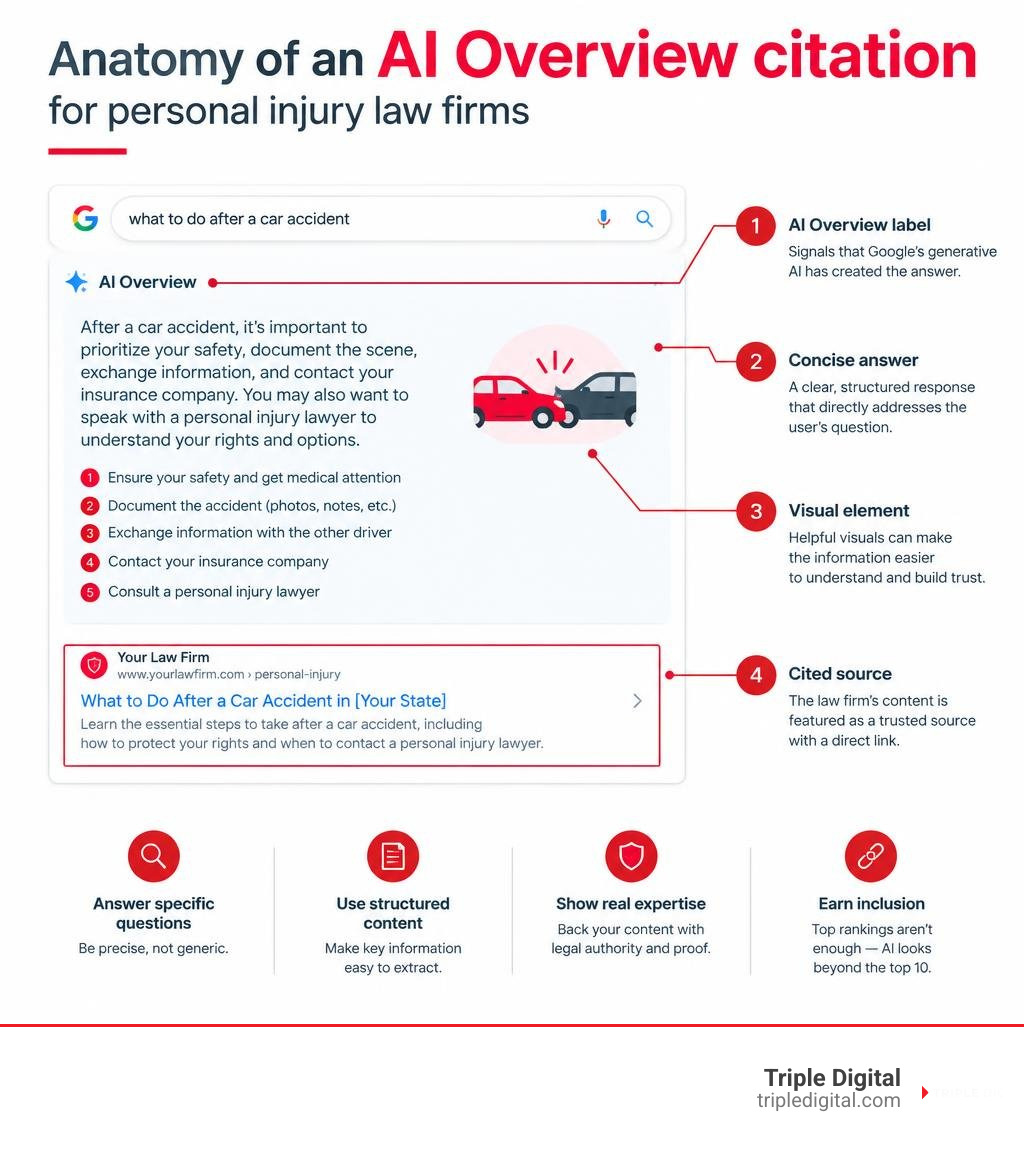
This evolution fundamentally reshapes modern SEO for personal injury attorneys. In traditional search, law firms with massive marketing budgets could dominate high-cost keywords like “Houston car accident lawyer” through sheer link volume and broad practice pages. Generative search operates differently:
- Semantic precision beats backlink volume: AI models select sources that answer specific user questions directly and objectively.
- Top 10 rankings do not guarantee inclusion: Only about 12% of URLs cited in AI answer panels rank in Google’s traditional top 10 organic results.
- Budget-conscious firms can compete: By focusing on comprehensive answers and structured content, smaller firms can outrank legacy competitors without paying tens of thousands of dollars for link campaigns.
When we examine how answer engines process content, their goal is simple: deliver the most accurate, easily readable legal explanation to the searcher. Firms that adapt to this shift capture high-intent inquiries right at the moment an injured party seeks guidance.
What Are the Most Cost-Effective Strategies to Get Cited in AI Overviews?
Capturing AI citations does not require an expensive website redesign or enterprise software subscriptions. The most cost-effective path involves reorganizing your existing content to match how large language models extract information.
The most effective technique is answer-first content structuring. When drafting practice pages or guides, provide a plain-language answer within the opening 40 to 60 words of each section immediately beneath a question-based heading. AI systems look for immediate definitions and direct guidance before parsing supporting paragraphs.
By applying the practical principles in our guide to AI Overview optimization for lawyers, your firm can systematically upgrade its content library.
Here are low-budget, high-impact content optimization techniques for personal injury firms:
- Adopt question-based H2s and H3s: Replace generic headers like “Overview of Fault” with conversational queries such as “How is fault evaluated in a multi-vehicle accident?”
- Implement self-contained content blocks: Ensure each sub-section stands on its own so an AI crawler can extract the entire concept without needing surrounding context.
- Incorporate clear legal disclaimers: Reassure search engines of your ethical compliance by noting that content provides general educational information rather than individualized legal representation.
- Publish direct statistical ranges and statutory time limits: Cite exact legislative codes and verifiable timelines rather than vague generalities.
- Use clean formatting: Replace dense walls of text with bulleted lists, summary tables, and definition callouts that crawlers can easily parse.
Mapping Case Intake Questions to Citation-Ready Pages
Most personal injury websites focus heavily on broad practice area terms. However, real accident victims use search engines to solve urgent, immediate problems. Building pages mapped directly to common intake questions drives significantly higher AI extraction rates than traditional keyword-stuffed copy.
When someone experiences an accident, their search queries follow a predictable trust and urgency timeline:
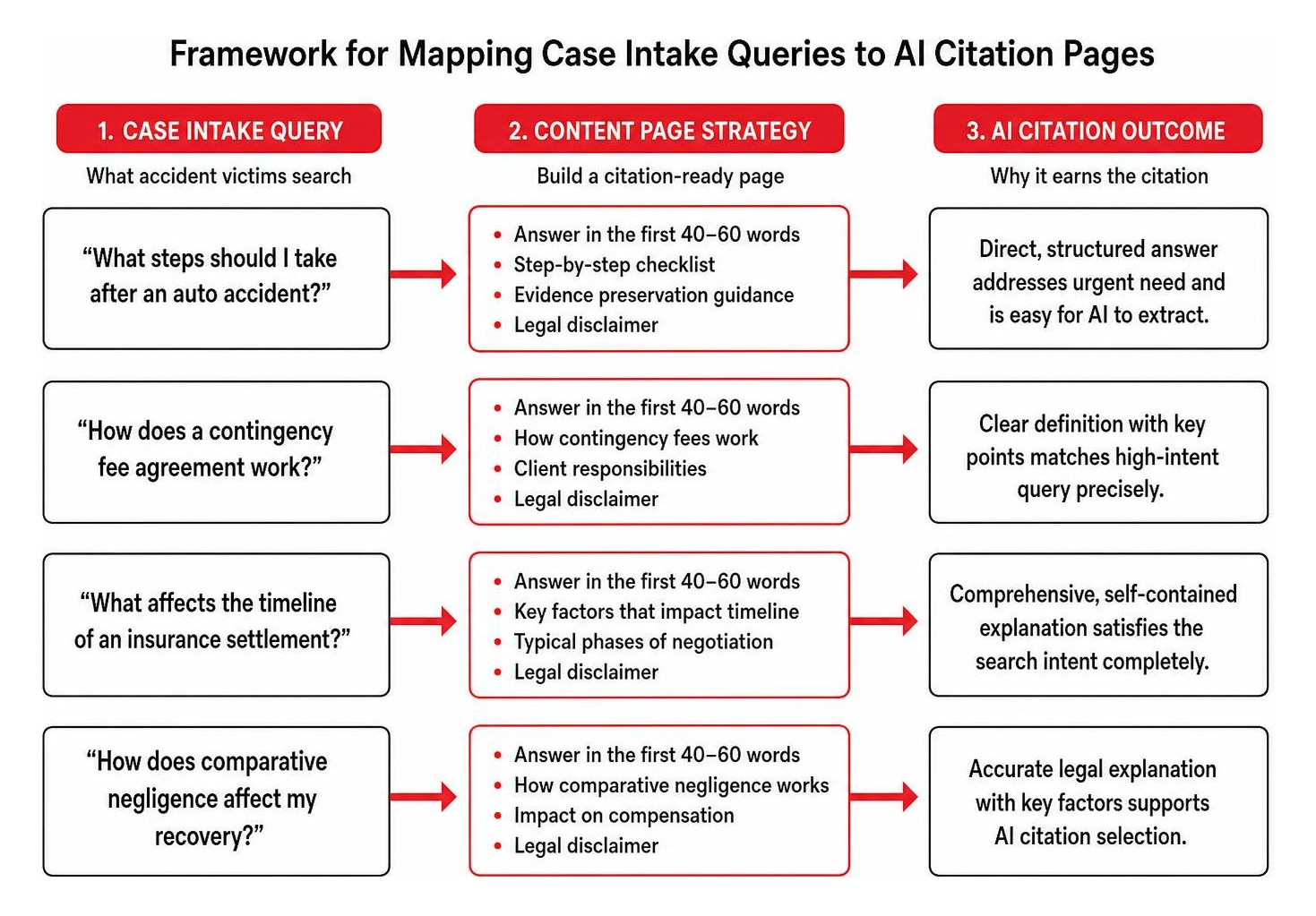
When addressing foundational topics in personal injury law, structure individual pages or sections around specific questions:
- What immediate steps should someone take after an auto collision to preserve physical evidence?
- How does a contingency fee agreement work when working with personal injury counsel?
- What factors influence the timeline of an insurance settlement negotiation?
- How do comparative negligence laws affect recovery if multiple parties share responsibility?
Answering these intake-focused questions directly satisfies the user’s intent while providing AI engines with clear, citation-ready text blocks.
Implementing Free Structured Data and Legal Schemas
Structured data acts as a translator between your website and search engine algorithms. Adding schema markup allows AI crawlers to instantly identify who you are, what legal services you offer, and which jurisdictions you serve.
You do not need expensive software tools to deploy schema. Free JSON-LD markup generators allow you to add essential schemas directly to your site:
LegalServiceSchema: Identifies your organization as an accredited legal practice, specifying your physical address, service radius, and practice areas.AttorneySchema: Connects individual attorney profiles with their state bar admissions, credentials, education, and professional affiliations to establish strict E-E-A-T trust signals.FAQPageSchema: Highlights question-and-answer pairs across your guides, making it simple for Google’s AI Overview to pull answers into its summary interface.
By nesting your attorney credentials within practice page markup, you provide the explicit verification signals required for Your Money or Your Life (YMYL) topics.
How Does Generative Engine Optimization Differ from Traditional Legal SEO?

For over two decades, legal marketing centered entirely on traditional search engine optimization: optimizing title tags, earning external backlinks, and securing a top-five spot on the search engine results page (SERP). Generative Engine Optimization (GEO) requires a different mindset.
While traditional SEO seeks to drive a user to click a blue link, GEO aims to make your content the foundational source cited inside the AI’s generated response. Understanding everything you need to know about Generative Engine Optimization helps bridge the gap between traditional ranking mechanics and conversational answer engines.
The following comparison illustrates the operational differences between both models:
| Strategic Dimension | Traditional Law Firm SEO | Generative Engine Optimization (GEO) |
|---|---|---|
| Primary Goal | Rank on Google Page 1 for broad target keywords | Become the cited informational source inside AI-generated answers |
| Keyword Strategy | High-volume, short-tail terms (e.g., “accident lawyer”) | Natural conversational queries, long-tail questions, and intake scenarios |
| Content Formatting | Long-form content designed to maximize dwell time and keyword density | Modular, answer-first content blocks, tables, and scannable summaries |
| Algorithmic Focus | PageRank, backlink quantity, anchor text, domain age | Semantic relevance, content freshness, structured schema, and verifiable E-E-A-T |
| Search Channels | Google and Bing traditional desktop/mobile search | Google AI Overviews, Perplexity, ChatGPT Search, and Copilot |
| User Experience | Browsing multiple websites to compile answers | Reading a single synthesized overview with embedded citation links |
Optimizing for Multi-Platform AI Search Engines
Modern legal search behavior is no longer limited to Google. Prospective clients increasingly use conversational search tools like Perplexity and ChatGPT Search to research legal processes, understand insurance communication, and evaluate their options.
To establish broad authority, firms must optimize across all major AI search engines:
- ChatGPT Search Optimization: Applying actionable ChatGPT SEO optimization tips involves creating comprehensive, authoritative explainers that define complex legal terms in clear, everyday language.
- Perplexity AI Citations: Learning how to optimize content for Perplexity requires adding empirical data, citing local statutes, and structuring content with distinct headings that answer direct prompts.
- Cross-Platform Measurement: Using AI digital marketing for law firms allows you to monitor how conversational assistants present your brand. Configure Google Analytics 4 (GA4) custom referral channels to track traffic originating from
chatgpt.com,perplexity.ai, and Google AI Overviews.
What Content Formats and E-E-A-T Signals Maximize Law Firm AI Citations?

Because legal topics directly affect a person’s financial and physical well-being, Google enforces strict Experience, Expertise, Authoritativeness, and Trustworthiness (E-E-A-T) standards for personal injury content. AI Overviews will not cite unverified opinions or ambiguous claims.
Recent algorithmic studies reveal that AI-cited legal content is on average 25.7% fresher than standard organic search results. Stale legal pages published years ago without recent statutory updates are routinely passed over in favor of recently revised materials.
Firms incorporating practical guidance from our complete guide to modern law firm SEO should focus on two core content elements:
- Prominent “Last Updated” Timestamps: Display visible update dates on every practice area page and guide, reflecting current 2026 legal statutes and court procedures.
- Named Attorney Authorship & Peer Review: Every article should include a clear author byline linked to an attorney bio that lists state bar license numbers, trial experience, and verified practice credentials.
Applying advanced SEO authoritative content methodologies guarantees that your legal answers satisfy both search engine crawlers and human readers seeking reliable information.
Structuring Bulleted Checklists, Stat Tables, and Case FAQs
AI models rely on structured patterns to extract clear, accurate answers. When your website provides structured visual formats, the AI can summarize the information without misinterpreting complex legal concepts.
Here are three high-performing content formats to implement:
- Post-Incident Checklists: Create step-by-step guides detailing evidence collection, medical documentation, and official report requests following an accident.
- Statutory Summary Tables: Build concise comparison tables detailing statutory filing deadlines, reporting requirements, and comparative fault thresholds across local jurisdictions.
- Practical Settlement Factor Breakdowns: Present the various elements that adjust insurance evaluation metrics—such as medical expenses, lost wages, and property damage documentation—in organized bullet points.
In addition to traditional accident guides, addressing tangential recovery and wellness topics—such as managing physical therapy documentation, navigating post-concussion recovery, or finding therapeutic support—demonstrates comprehensive topical authority that search engines reward.
How Do Local Signals and Google Business Profile Impact AI Recommendations?
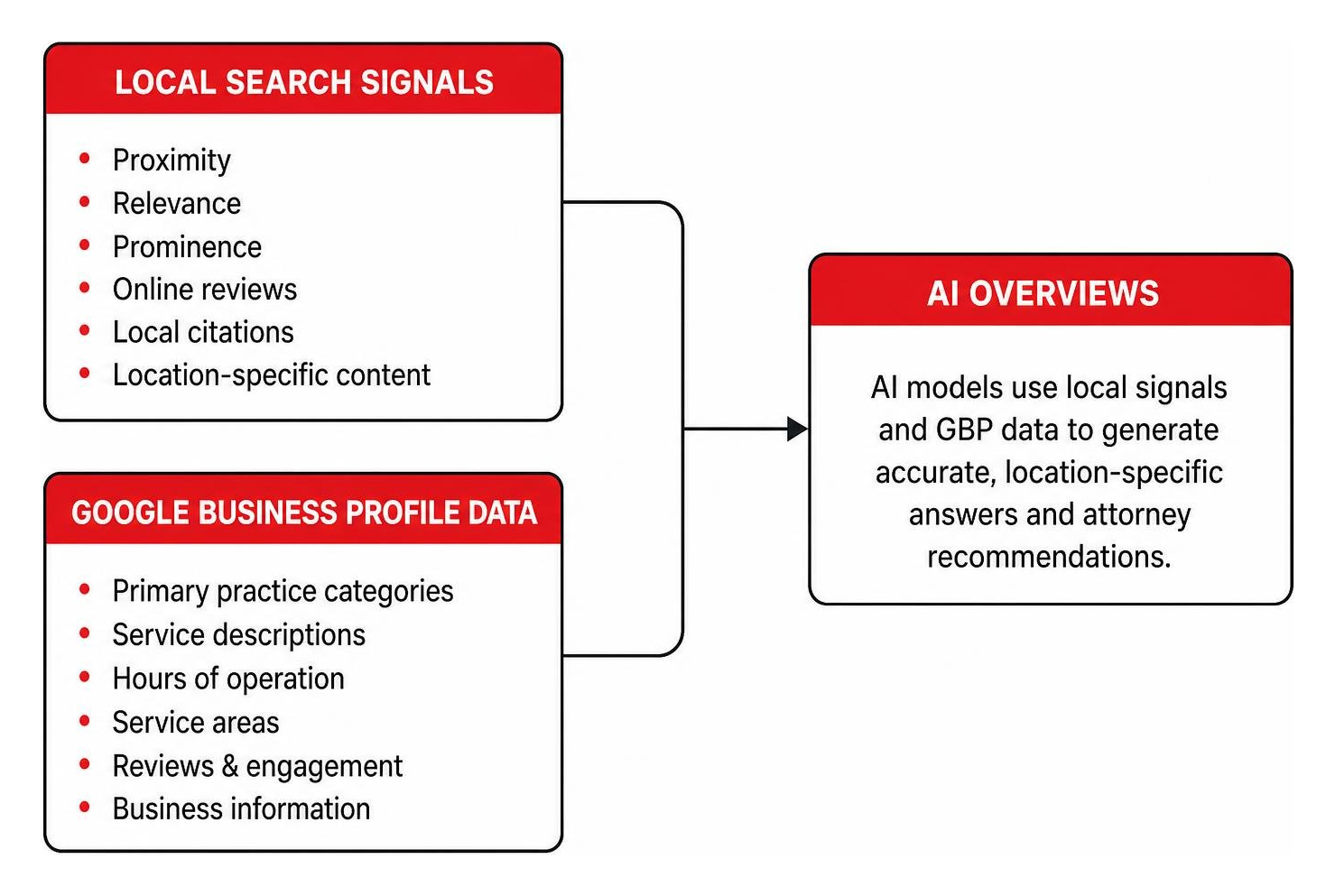
AI Overviews do not operate in a geographic vacuum. When a user asks a location-specific question (e.g., “What should I do after a car crash in Houston?”), generative algorithms rely heavily on local data to supply geographically accurate answers and attorney recommendations.
Local visibility in AI Overviews depends on several core components:
- Google Business Profile (GBP) Completeness: Your primary practice categories, service descriptions, hours of operation, and localized service areas must be fully completed and updated.
- NAP Consistency: Ensure your firm’s Name, Address, and Phone number (NAP) are identical across Google, Apple Maps, Bing Places, Yelp, and legal directories like Avvo and Justia.
- Localized Client Reviews: High-quality client reviews that mention specific practice areas and geographic locations provide natural language confirmation of your firm’s real-world expertise.
Aligning your local strategy with evolving standards in SEO for lawyers in 2026 ensures your firm remains visible across both the local map pack and AI-generated answer summaries.
At Triple Digital, our Houston-based team applies a data-driven approach to help personal injury attorneys generate qualified case leads by pairing technical answer engine optimization with robust local search visibility.
Frequently Asked Questions About Ranking Personal Injury Law Firms in AI Overviews
Why is my personal injury law firm ranking on Google Page 1 but not appearing in AI Overviews?
Traditional top rankings do not guarantee AI citations because AI search engines prioritize concise, direct answer blocks, high content freshness, and structured data over standard keyword density. AI algorithms extract text from pages that directly answer specific queries, regardless of whether that page holds position one or position eight in traditional organic results.
How quickly can a law firm see results from AI Overview optimization?
Personal injury law firms that update core practice pages with answer-first paragraphs, updated 2026 state statutes, and FAQ schema can often see citations appear in AI Overviews within 30 to 60 days following re-indexing. Because AI models value fresh content, updated pages are frequently re-evaluated ahead of static, older URLs.
Do personal injury law firms need large advertising budgets to rank in AI Overviews?
No, AI Overviews reward semantic clarity, factual accuracy, structured schema markup, and verifiable legal E-E-A-T rather than high ad spend or massive backlink profiles. Small to mid-sized law firms can out-optimize larger competitors simply by answering case intake questions more clearly and structuring their data properly.
How Can Your Law Firm Build an Actionable 30-Day AI Overview Strategy?
Ranking in AI Overviews does not require an enterprise marketing budget. By executing a focused 30-day plan, your firm can systematically optimize its web presence for generative search:
- Days 1–7 (Content Audit): Review your top 10 practice pages. Identify existing walls of text and rewrite section openers into 40–60 word answer-first definitions.
- Days 8–14 (Intake Query Mapping): Interview your intake team. Identify the 15 most common procedural questions prospective clients ask and build dedicated FAQ sections for them.
- Days 15–21 (Schema & E-E-A-T Integration): Implement
LegalService,Attorney, andFAQPageJSON-LD schema markup. Add bar admission numbers and visible “Last Updated” timestamps to every guide. - Days 22–30 (Local Alignment & Monitoring): Audit your Google Business Profile, synchronize local directory citations, and establish custom AI referral tracking in Google Analytics 4.
Review our comprehensive GEO strategy for attorneys and explore our tailored digital marketing services to see how we help firms capture high-value case opportunities.
Ready to position your firm at the top of generative search? Take the next step to schedule a strategy meeting or contact Triple Digital today to build a sustainable, future-proof AI search strategy.