





Why Intake Management Solutions Are Reshaping How Organizations Work
The Definitive Guide to Intake Management Solutions
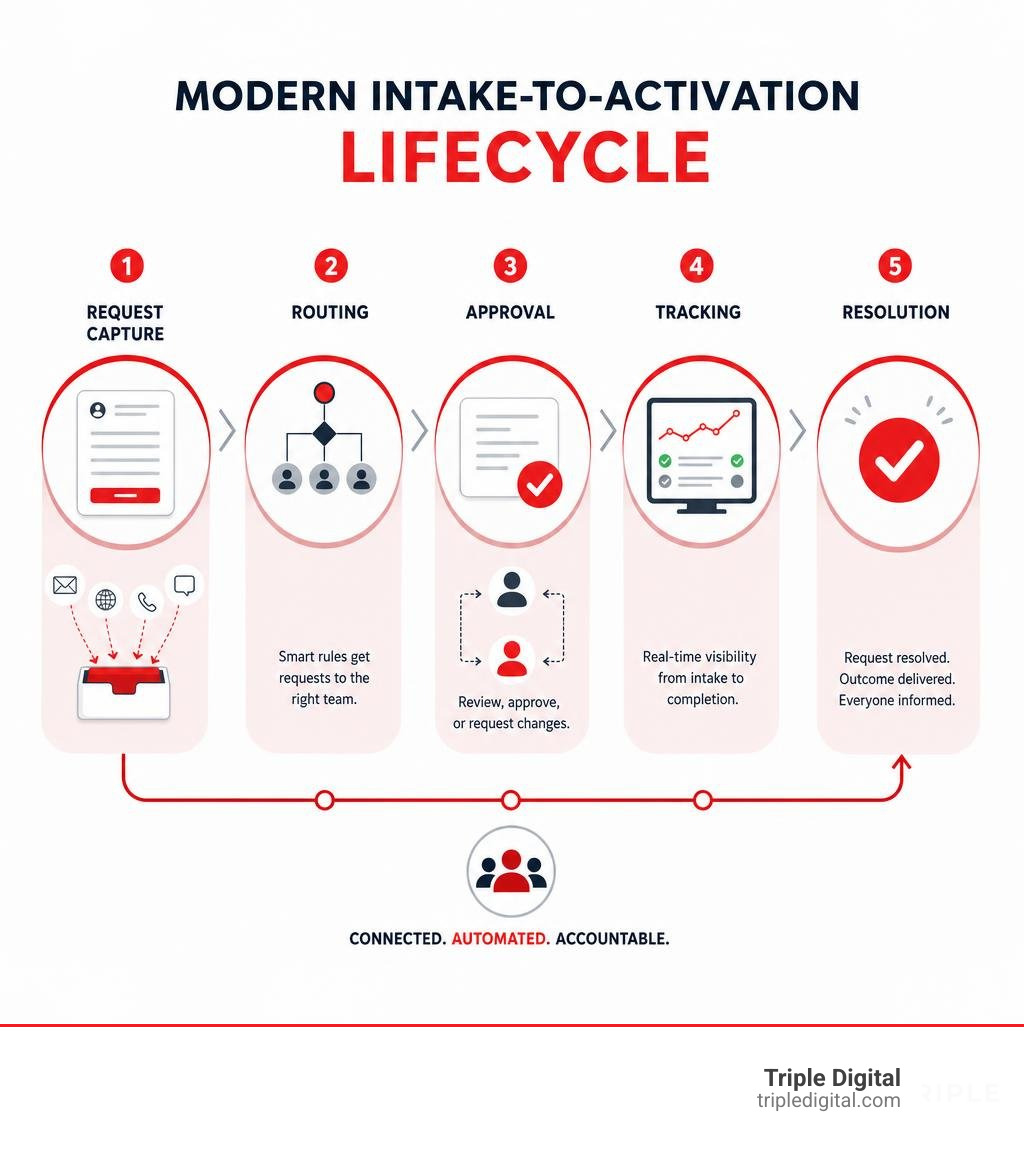
Intake management solutions are software platforms that capture, route, and track incoming requests — whether those are purchase orders, patient referrals, or new client leads — through a single, structured digital process.
If you’re trying to understand what these tools do and whether you need one, here’s the short answer:
What intake management solutions do:
- Replace email chains, spreadsheets, and paper forms with automated digital workflows
- Route requests to the right person or team instantly, based on predefined rules
- Capture complete, accurate data upfront — so nothing gets lost or delayed
- Give everyone involved real-time visibility into request status
- Reduce compliance risks by enforcing policies at the point of submission
Who uses them: Law firms, hospitals, procurement teams, professional services firms, and any organization that receives high volumes of requests requiring review and approval.
Now, here’s why this matters right now.
The intake management software market was worth $1.71 billion in 2024. It’s projected to hit $5.66 billion by 2033. That’s not a niche trend — it’s a signal that organizations across every industry are finally fixing the part of their process that was quietly costing them the most.
For law firms especially, the stakes are high. Most failed attempts to grow a practice aren’t a marketing problem — they’re an intake problem. Leads come in through emails, phone calls, web forms, and referrals. Without a structured system to capture and follow up on every single one, potential clients slip through the cracks every day.
This guide covers everything you need to know: what intake management solutions are, what they cost you when they’re broken, how to choose the right one, and what the best platforms look like in 2026.
What Are Intake Management Solutions?
At its core, an intake management solution serves as the centralized digital “front door” for any request entering an organization. Think of it as a highly intelligent, automated traffic controller. Instead of allowing requests to flood in through disjointed channels like personal emails, Slack messages, paper forms, and voicemail transcripts, these solutions funnel everything into a single, standardized entry point.
Once a request enters this centralized hub, the software automatically validates the information, categorizes it, and routes it to the appropriate team or workflow for action. Whether it is a corporate purchase request, a patient referral, or a prospective legal client, the intake solution ensures that no request is ignored, delayed, or processed without proper authorization.
Defining Modern Intake Management Solutions
Historically, “intake” was treated as a passive, administrative task. Someone filled out a form, and a staff member manually typed that data into another system.
In 2026, modern intake management solutions have completely redefined this process. Today’s systems use dynamic, user-friendly digital forms that adapt in real-time based on the answers provided. If a prospective client selects “personal injury” on a law firm’s intake form, the system instantly adjusts to ask relevant follow-up questions about the incident date and medical treatment, completely skipping irrelevant questions about corporate contracts.
This intelligent, structured entry point ensures that complete, accurate data is captured on the very first attempt. To understand how this works in a professional context, you can explore the critical phases of a structured system in our breakdown of the Legal Intake Process Steps. By replacing static questionnaires with conversational, guided workflows, organizations drastically improve the user experience while ensuring compliance from the absolute beginning of the process.
How Intake Differs from Downstream Workflows
A common point of confusion is how intake software differs from downstream systems like Enterprise Resource Planning (ERP), Electronic Health Records (EHR), Client Relationship Management (CRM), or Case Management Systems.
Simply put, intake is the “front door,” while downstream systems are the “rooms” inside the house.
| Capability / Phase | Intake Management Solutions | Downstream Workflows (CRM, ERP, Case Management) |
|---|---|---|
| Primary Focus | Capture, triage, validate, and route incoming requests. | Execution, long-term management, and record-keeping. |
| User Experience | Simple, intuitive, and designed for non-technical users or external clients. | Complex, feature-rich interfaces designed for internal specialists. |
| Process Stage | The absolute beginning (Intake-to-Activation). | The execution phase (e.g., Procure-to-Pay, Case Litigation). |
| System Interaction | Orchestrates tasks across multiple disconnected systems. | Acts as the single system of record for a specific department. |
Without a dedicated intake layer, organizations are forced to let untrained users directly access complex downstream systems, leading to incomplete records, security vulnerabilities, and widespread user frustration. An intake solution acts as an orchestration layer, cleaning and organizing data before pushing it seamlessly into your primary databases.
The Cost of Broken Intake: Common Operational Pain Points

When an organization relies on manual, fragmented intake processes, the operational friction is felt across every department. Emails sit unread in crowded inboxes, spreadsheets become outdated the moment they are saved, and critical details are lost in transition. The consequences aren’t just annoying—they directly damage your bottom line.
Manual Data Entry and Human Error
Relying on manual data entry is an operational hazard. When administrative staff must manually copy and paste information from email attachments, faxes, or handwritten notes into downstream databases, errors are inevitable. Names are misspelled, phone numbers are transposed, and critical documents are overlooked.
In the healthcare sector, this administrative burden is particularly severe: 75% of healthcare workers report that excess documentation makes it harder to deliver exemplary patient care.
For professional service providers and law firms, these manual bottlenecks directly erode client trust and delay onboarding times. When clients have to repeat their stories multiple times because of disjointed internal systems, satisfaction plummet. You can read more about resolving these operational bottlenecks in our guide on Enhancing Client Satisfaction and Firm Profitability: Optimizing the Intake Process.
Lack of Visibility and Tracking Bottlenecks
Without a centralized intake platform, requests exist in functional silos. An employee has no easy way to check the status of their software purchase request, and a prospective client has no idea if a law firm is actively reviewing their case. This lack of transparency leads to constant, manual follow-up emails and phone calls, which waste hours of administrative time.
For businesses trying to scale, this lack of visibility makes accurate reporting impossible. If you don’t know where your leads are coming from or how long they sit in each stage of your pipeline, you cannot optimize your operations.
Implementing structured Law Firm Lead Tracking is essential to identify these exact bottlenecks, allowing your team to see exactly which marketing channels are converting and where prospective clients are getting stuck in your onboarding funnel.
Core Capabilities of Modern Software
To move away from manual chaos, organizations need an enterprise-grade platform capable of handling complex, real-time workflows. The best intake management solutions in 2026 are built on dynamic routing, automated validation, and robust cloud security.
Key Features of Modern Intake Management Solutions
A strong intake platform does far more than host digital forms. It serves as an active orchestrator of your business logic. Key capabilities to look for include:
- Conditional Logic & Dynamic Forms: Forms that automatically adapt based on user input, ensuring only relevant questions are asked.
- Automated Routing & Approvals: Predefined rules that instantly send requests to the correct department, manager, or compliance officer based on category, value, or risk level.
- Out-of-the-Box Templates: Prebuilt workflows for common scenarios (e.g., vendor onboarding, client intake, IT requests) to accelerate implementation.
- Real-Time Dashboards: A single pane of glass showing the live status of every active request, eliminating follow-up emails.
Choosing the right platform can feel overwhelming given the sheer number of options. To cut through the noise, review our practical guide on How to Choose the Best Law Firm Intake Software Without Losing Your Mind to learn how to align software features with your actual operational workflows.
Conversational AI and Guided Forms
One of the most significant technological leaps in 2026 is the shift from static questionnaires to conversational AI interfaces. Rather than forcing clients or employees to fill out intimidating, multi-page forms, modern systems engage them in natural, interactive dialogues.
AI-powered conversational agents can ask clarifying questions, extract key details from uploaded documents (such as insurance cards, driver’s licenses, or vendor invoices), and automatically pre-fill form fields.
The impact of this shift is dramatic: conversational intake platforms achieve an average completion rate of 87%, compared to just 20% for traditional, static forms. Furthermore, the average session time is reduced to just five minutes, providing a frictionless, consumer-grade experience that keeps users engaged.
Seamless Enterprise System Integration
An intake solution cannot exist on an island. To be truly effective, it must integrate bidirectionally with your existing enterprise technology stack.
Whether your organization relies on complex ERPs for financial management, EHR platforms for clinical data, or specialized CRMs for client relationships, your intake software must push and pull data smoothly across these platforms. Bidirectional synchronization ensures that when a request is approved or a new client is signed, records are updated across all systems in real time—eliminating duplicate data entry and keeping your databases clean.
Measurable Benefits of Automating Your Intake Process
Implementing an automated intake solution is not just an administrative upgrade; it is a strategic business decision that delivers rapid, measurable return on investment (ROI).
Drastic Reductions in Cycle Times
By replacing manual review processes with automated triage and instant routing, organizations can compress their cycle times from days to minutes. In specialized supply chains and healthcare environments, automated document processing tools can reduce order and referral processing times from an average of six minutes to under one minute per request—an 85% increase in operational speed.
For service-oriented businesses, speed is the ultimate competitive advantage. In lead generation, the first provider to respond to an inquiry almost always wins the business.
Using dedicated tracking systems and numbers allows firms to measure this response time with precision. To see why this matters, read our analysis on Why Tracking Numbers Are So Important to Track Leads.
Enhanced Compliance and Risk Mitigation
Operating without standardized intake workflows exposes an organization to massive compliance and financial risks. Whether it is unmanaged corporate spend bypassing procurement policies or a law firm taking on a client without running a proper conflict check, the consequences can be devastating.
Modern intake management solutions solve this by embedding policy guardrails directly into the submission process. The system can automatically cross-reference requests against corporate policies, regulatory standards, or existing databases to flag potential issues before they ever reach an approver.
Indeed, advanced intake systems can reduce compliance-related issues by up to 80%, protecting your organization from costly litigation and regulatory fines.
Improved Conversion Rates and Profitability
For law firms and professional services, a streamlined intake process is a direct driver of revenue growth. When you make it incredibly easy for a prospective client to submit their information, sign a retainer agreement digitally, and onboard, your conversion rates skyrocket.
By eliminating administrative friction, your team can focus on nurturing high-value leads rather than chasing down missing paperwork. To master this transition, explore From Prospects to Partners: The Lawyer’s Playbook for Lead Gen and discover how to build proactive growth pipelines in our guide on why you shouldn’t Don’t Just Wait for Cases: Strategies for Proactive Legal Lead Generation.
Consider the tangible financial impacts across different corporate applications:
- Procurement Savings: Organizations unlock an estimated $0.5 million to $2.5 million in cost savings for every $100 million of unmanaged spend brought under structured procurement oversight.
- Productivity Gains: Businesses gain an estimated $100,000 in productivity for every 1,000 employees simply by removing complexity from internal request processes.
- Onboarding Efficiency: Professional services firms leveraging dedicated compliance and intake systems report 50% productivity gains and get paid 20% faster by drastically reducing billing disputes and manual administrative delays.
How to Evaluate and Choose the Right Intake Software
Selecting the right software requires a clear understanding of your organization’s unique operational needs, regulatory environment, and existing technology stack.
Assessing Your Industry-Specific Needs
There is no such thing as a one-size-fits-all intake solution. A procurement team needs a system optimized for spend compliance, vendor risk evaluation, and ERP integration. A healthcare facility requires a platform built to handle clinical documents, insurance verification, and EHR syncing. A law firm needs robust conflict-of-interest checks, lead tracking, and CRM connectivity.
Before evaluating vendors, clearly document your current intake workflows, identify your primary operational bottlenecks, and define what success looks like. To learn how to use data to guide this evaluation, read our resource on Measure Up: How Analytics Can Transform Your Legal Marketing.
Security, Compliance, and Scalability
Because intake systems handle highly sensitive data—including proprietary corporate financial plans, confidential legal intake narratives, and protected health information (PHI)—security is non-negotiable.
Any solution you evaluate must meet strict enterprise security standards:
- Data Encryption: End-to-end encryption for data both in transit and at rest.
- Regulatory Compliance: Full adherence to industry-specific regulations, such as HIPAA for healthcare or SOC 2 Type II for general enterprise cloud security.
- Role-Based Access Control: Detailed permission settings to ensure employees only see the data required for their specific roles.
- Scalable Architecture: A cloud-native platform that can easily handle growing volumes of requests as your organization expands.
Frequently Asked Questions About Intake Management
What is the difference between intake and CRM?
While both systems handle incoming information, they serve different purposes. An intake solution is focused on the initial capture, validation, and routing of a request or lead. A CRM is designed for long-term relationship management, communication tracking, and sales pipeline execution. The intake system acts as the gatekeeper, cleaning and organizing data before passing a qualified record into the CRM.
How does AI improve the intake process?
AI transforms intake from a passive data-collection form into an active, intelligent assistant. It powers conversational interfaces that achieve higher completion rates, automatically extracts and structures data from uploaded documents (like PDFs and images), and uses predictive routing to send requests to the correct teams instantly while flagging policy or compliance risks in real-time.
Can intake software integrate with legacy systems?
Yes. Modern intake platforms are designed to act as an orchestration layer over your existing IT infrastructure. Through robust APIs and prebuilt connectors, they can integrate bidirectionally with legacy ERPs, EHRs, and database systems, allowing you to modernize your user experience without undergoing expensive and disruptive system replacements.
Maximize Your Firm’s Growth with Data-Driven Intake
In 2026, operational efficiency is no longer just about cutting costs—it is the foundation of business growth. Relying on manual email threads, disjointed spreadsheets, and disconnected systems to handle your organization’s incoming requests is a recipe for administrative bottlenecks, lost leads, and compliance risks.
By implementing a modern, automated intake management solution, you create a seamless, professional “front door” for your business. You empower your staff with automated workflows, protect your organization with built-in compliance guardrails, and unlock the operational speed required to outpace the competition.
At Triple Digital, we help law firms and professional organizations eliminate administrative fluff, optimize their digital pipelines, and convert more high-value leads into signed cases through sophisticated, data-driven strategies. Ready to transform your intake process and scale your business? Schedule a consultation with our team today.