



How Law Firms Can Show Up in Google AI Overviews
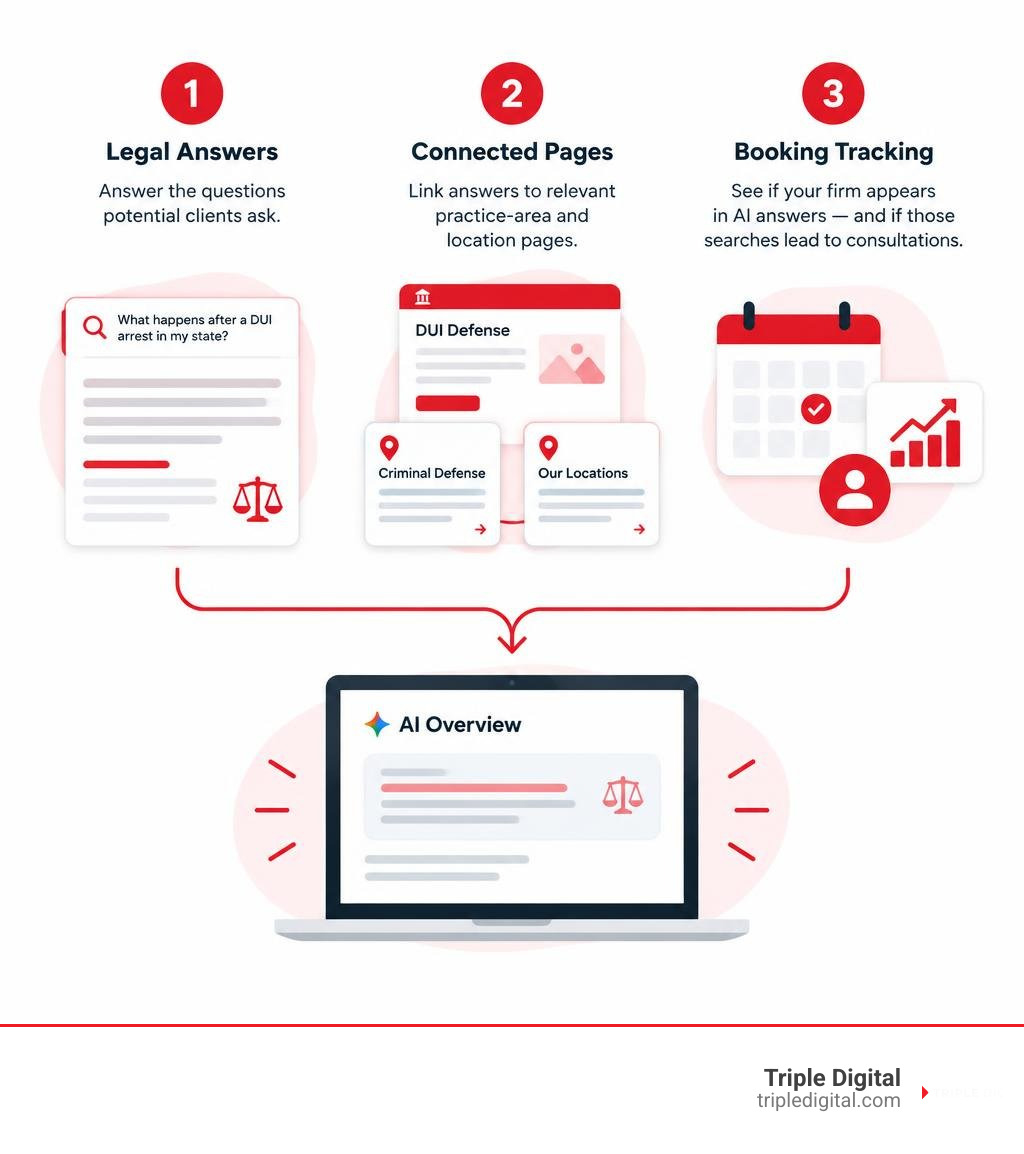
To improve your law firm’s visibility in Google AI Overviews, start with the questions potential clients ask before they call. Publish clear, accurate answers about charges, deadlines, and next steps. Connect those answers to relevant practice-area and location pages. Then track whether your firm appears in AI answers and whether those searches lead to booked consultations.
A DUI search, for example, may be answered before someone clicks a website. Your content needs to be useful enough to appear in that answer and clear enough to help the reader take the next step. This guide shows how to build that content, strengthen its credibility, and measure results beyond traffic.
Relevant articles related to Google AIO law firms:
- AI overview optimization for lawyers
- google ai overview optimization for lawyers
- Modern law firm SEO
The Strategic Shift: How Google AIO Law Firms Tactics Outperform Traditional SEO
Legal search has permanently transformed. In October 2026, prospective clients dealing with urgent legal crises no longer scroll through ten blue links to compare firm biographies. Instead, Google’s AI Overviews synthesize multi-source legal information right at the top of the search engine results page (SERP).
When someone searches for statutory definitions, bail procedures, or court timelines, Google generates a direct, natural-language summary. If your firm’s content is not part of that synthesis, you are invisible to high-intent searchers. Modern practices must shift from conventional keyword stuffing to generative engine optimization strategies that defend against zero-click drop-offs by earning explicit citations and brand recommendations inside the AI snapshot.
| Strategic Dimension | Traditional Legal SEO | Legal Answer Engine Optimization (AEO) |
|---|---|---|
| Primary Goal | Blue link rankings on Page 1 | AI citation & top recommendation inclusion |
| Content Structure | Keyword-dense, lengthy prose | Answer-first, modular, structured question blocks |
| Target Query Type | Broad head terms (e.g., “defense lawyer”) | Conversational, high-intent, multi-part questions |
| Authority Engine | Backlink volume and anchor text | Semantic knowledge graphs & verifiable entity citations |
| Success Metric | Raw organic traffic impressions | AI Share of Voice & qualified consultation bookings |
Understanding AI Share of Voice for Practice Areas
Traditional SEO tracks rank positions for individual keywords. In contrast, AI Share of Voice (SoV) measures the percentage of AI-generated responses in your target geographic market that actively cite or recommend your firm.
When a user asks complex legal questions across various conversational prompts, algorithms evaluate multiple authoritative resources. If your practice consistently earns citation real estate across these queries, you dominate the market conversation. Gaining high recommendation share through optimizing legal services for AI search ensures that when urgent decisions are made, your firm is presented as the primary authority.
Why Local SEO Alone Falls Short in 2026
For years, optimizing your Google Business Profile and building basic local citations was enough to capture nearby clients. However, local SEO limitations for legal AI search have become glaringly apparent.
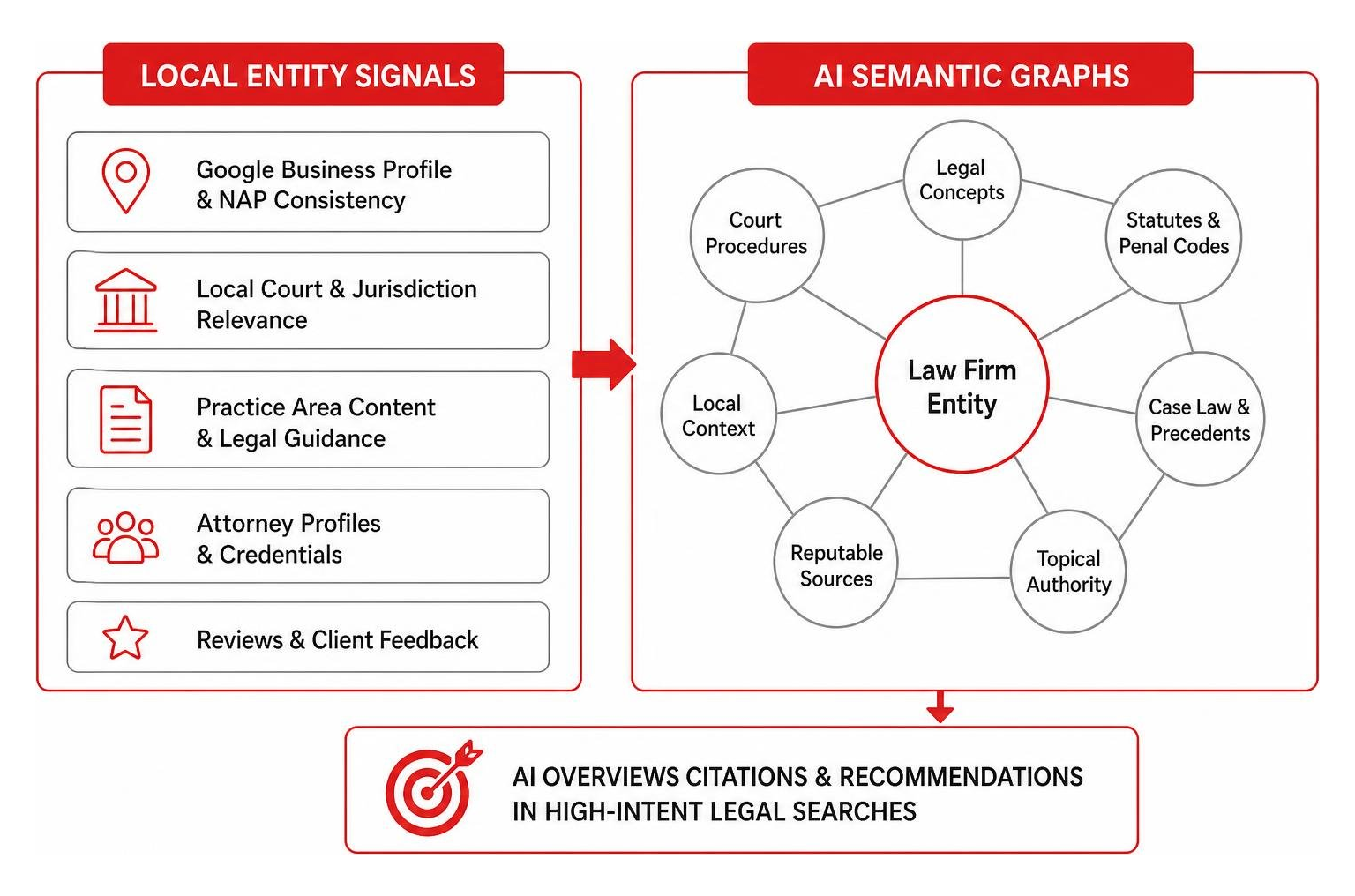
While proximity still matters for map packs, generative AI answers rely heavily on semantic relevance, entity validation, and topical authority across your digital footprint. AI models do not just check your physical address; they parse your site’s content to determine if you provide accurate, clear guidance on specific penal codes, local court customs, and legal procedures before featuring your firm in a synthesized overview.
Proven Case Study: How AEO Drove a 217% Traffic Surge and 9x Client Bookings
To see how generative search optimization works in practice, consider the results achieved by a criminal defense practice that restructured its digital presence for AI answer engines.
Facing intense competition, the firm transitioned away from generic legal blog posts toward an intent-driven answer engine optimization model. Over a six-month period, the firm achieved:
- A 217% increase in organic search traffic.
- A 9x surge in monthly client consultations, scaling from 6 to 54 retained client bookings per month.
- A commanding 51% AI Share of Voice across its highest-value local criminal defense queries.
- Consistent #1 AI recommendations for major practice areas including DUI, domestic violence, drug charges, and felony offenses.

High-Trigger Legal Queries: DUI, Domestic Violence, and Felonies
Urgent, high-stakes legal situations generate the exact query types most likely to trigger AI Overviews. When an individual or family member searches phrases like “What happens in the first 24 hours after a DUI arrest?” or “What is the difference between misdemeanor and felony vandalism under state law?”, Google serves an immediate breakdown.
By publishing comprehensive statutory threshold breakdowns and step-by-step guides, the firm positioned itself as the definitive source for AI extraction. Utilizing proven strategies for lawyers to win cases from AI Overviews enabled these informational overviews to convert into urgent consultation calls.
Core Blueprint for Google AIO Law Firms Success
The framework behind this success relies on a repeatable three-pillar architecture:
- Answer-First Content Design: Structuring every practice page with immediate, direct summaries before expanding into detailed legal nuances.
- Entity-Level Content Hierarchy: Linking localized practice pages directly to related penal code explanations, court procedure FAQs, and attorney credential data.
- Data-Driven Feedback Loops: Continuously auditing prompt responses to spot visibility gaps and update existing resources.
Adopting this comprehensive guide to AI Overview optimization for lawyers ensures your website satisfies the precise data extraction requirements of modern search models.
Step-by-Step Implementation: Structuring Law Firm Content for AI Extraction
Implementing an effective strategy for Google AIO law firms requires re-architecting your content so large language models can parse your authority effortlessly.
At Triple Digital, our Houston-based team executes this process by replacing generic copy with modular, question-led frameworks that directly address legal concerns. Applying these AI visibility strategies for legal marketing helps search crawlers identify your answers as the most reliable synthesis source.

Technical Schema Markup and Topical Authority Clusters for Google AIO Law Firms
To make your content easily digestible for machine extraction, wrap your legal insights in clean, structured data:
LegalServiceSchema: Define specific practice areas, attorney bar admissions, office coordinates, and accepted consultation methods.FAQPageSchema: Tag your direct-answer question blocks to help search algorithms identify definitive question-and-answer pairs.- Breadcrumb & Author Entities: Validate the credentials of the reviewing attorney to satisfy Google’s Experience, Expertise, Authoritativeness, and Trustworthiness (E-E-A-T) criteria.
- Internal Entity Linking: Connect core practice pages to relevant statutory guides and municipal court overviews, reinforcing your firm’s topical depth across the region.
Off-Page Citations and Digital PR for AI Recommendations
AI models do not evaluate your website in isolation. They validate your expertise against third-party digital ecosystems, including prominent legal directories, local bar associations, and state court resources.
Maintaining consistent NAP (Name, Address, Phone) data, securing verified client reviews, and earning editorial mentions across authoritative legal publications reinforce your firm’s entity status. Investing in comprehensive AI SEO services bridges the gap between on-site technical content and the off-site credibility required for top-tier AI recommendations.
Scaling AEO Across Practice Areas and Measuring Actual Case Conversions
A common misconception is that AI visibility only benefits criminal defense practices. In reality, the same principles drive significant consultation growth across family law, estate planning, and personal injury litigation.
Whether an injured individual is researching statutory timelines or a parent is reviewing custody factors, the underlying need for direct, authoritative answers remains identical. Reviewing our guide on ranking personal injury law firms in AI Overviews illustrates how these modular content structures adapt across various litigation fields.
Tracking the bottom-line value of these campaigns requires connecting AI visibility directly to intake performance:
- Dynamic Call Tracking: Assign unique tracking numbers across AI referral pathways and organic landing pages.
- CRM Lead Source Attribution: Log the initial search prompt and entry page within your practice management software.
- AI Share of Voice Auditing: Regularly run prompt suites across major generative engines to monitor your citation share over time.
By aligning your intake data with our 2026 legal AI search visibility roadmap, you ensure every content update directly supports case acquisition.
Frequently Asked Questions About Google AIO Law Firms
How do Google AI Overviews decide which law firms to cite?
Google selects citation sources based on semantic relevance, factual precision, structural clarity, and entity authority. Pages that provide concise, direct answers at the beginning of sections—supported by schema markup and verified attorney credentials—have a significantly higher chance of being featured in AI-generated answers.
Can personal injury and family law firms achieve similar 9x booking results?
Yes. High-intent legal queries span every consumer-facing practice area. By structuring content around urgent questions—such as what to do immediately following an accident or how temporary custody orders function—firms across diverse specialties can capture searchers at the exact moment they need legal counsel.
How can legal practices track AI Share of Voice accurately?
Tracking AI Share of Voice involves running automated, localized prompt tests across common legal queries in your target jurisdiction. By measuring the frequency with which your firm appears as a cited link or recommended authority compared to competitors, you can quantify your overall market visibility in AI search.
Dominating Legal Search: Turn AI Answers into Signed Cases
The legal search landscape has entered a new era. Law firms that cling to outdated SEO tactics will continue to watch their organic inquiries decline as zero-click AI summaries dominate search results. Conversely, firms that adapt by publishing clear, structured answers, building robust topical authority, and measuring AI Share of Voice will capture the highest-value cases in their markets.
At Triple Digital, our Houston-based team delivers a data-driven, “less fluff, more cases” approach designed specifically for forward-thinking law practices. We help you cut through the noise, dominate AI Overviews, and turn complex search algorithms into a reliable case acquisition pipeline. Ready to elevate your practice’s visibility? Take the next step and schedule a consultation for AI Overview optimization with our team today.