





Winning the AI Search Trial with Generative Engine Optimization
How Search Changed Overnight — and What Law Firms Must Do Now
Google AI Overview optimization for lawyers is the practice of structuring your firm’s content, authority signals, and technical setup so Google’s AI engine cites your firm in the generated summaries that now appear above every paid ad, map pack, and organic result on legal searches.
Here’s what that looks like in practice:
- Build topic clusters — Create a pillar page for each practice area, supported by FAQs, sub-topic articles, and jurisdiction-specific content
- Format for direct answers — Open every section with a 1-2 sentence answer to the user’s question, in plain English
- Add structured data — Implement FAQPage, LegalService, and LocalBusiness schema so Google can extract your content reliably
- Demonstrate E-E-A-T — Publish attorney-authored content with verified credentials, bar admissions, and named source citations
- Maintain entity consistency — Keep your firm name, address, phone, and practice areas identical across Google, Bing, Avvo, Justia, and every legal directory
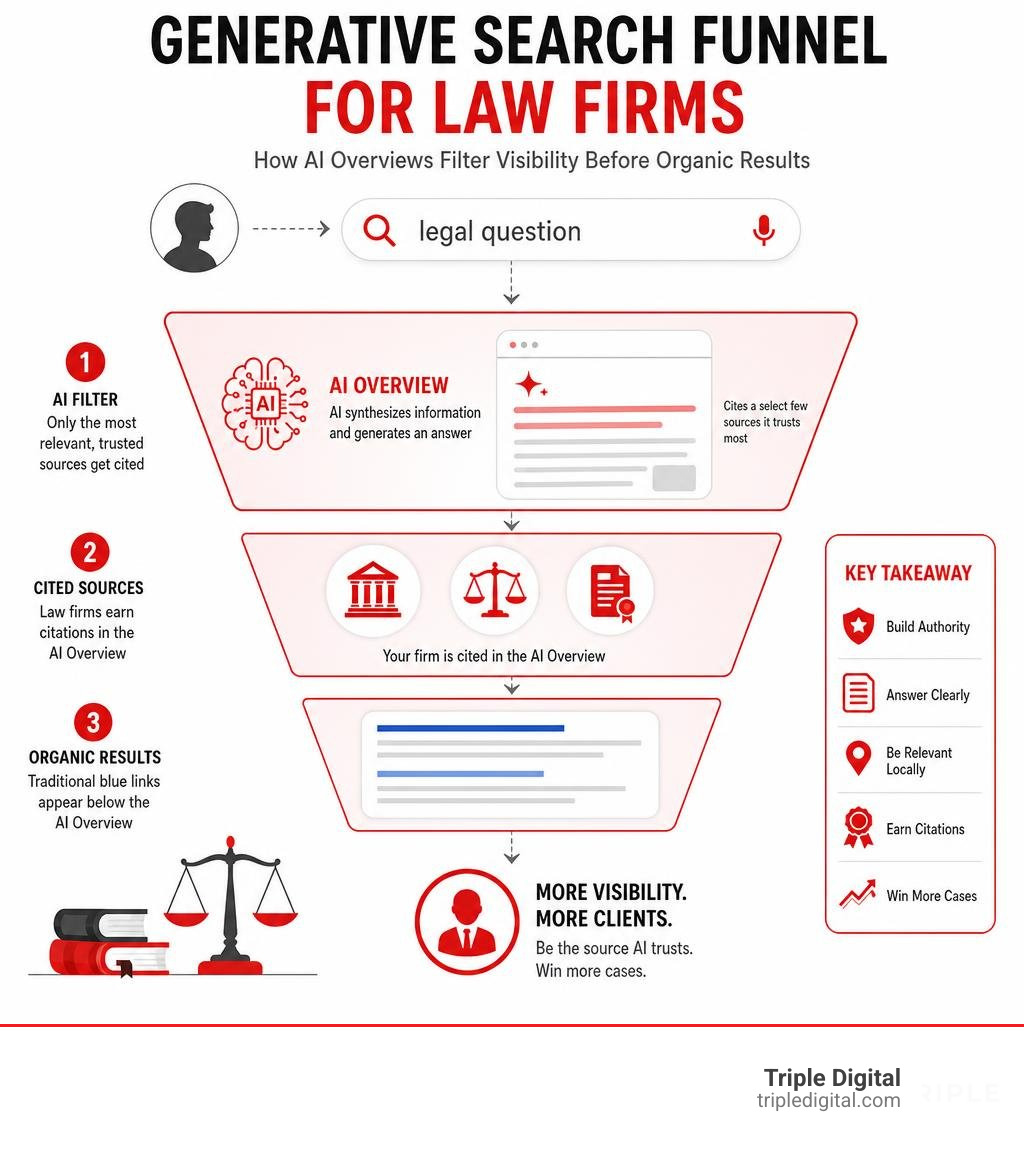
Open Google right now and search for a personal injury attorney in any major city. Before you see a single ad — before the map pack, before any blue link — there is a block of AI-generated text that attempts to answer the user’s question in full. That block is the new front door to legal services.
The numbers tell a stark story. As of March 2026, AI Overviews appear in roughly 48% of all Google queries, up from 34.5% just three months earlier. For the informational questions that drive legal research — “how long do I have to file after a car accident?” or “what happens at an arraignment?” — that figure climbs to 70-85% of searches.
Meanwhile, the overlap between the top-10 organic results and the firms actually cited inside AI Overviews has collapsed to somewhere between 17% and 38%, depending on the query. Ranking #1 no longer guarantees you’re the answer a potential client sees first.
For law firms still relying on traditional SEO alone, that gap is where leads quietly disappear.
Explore more about google ai overview optimization for lawyers:
The Shift from Traditional SEO to Google AI Overview Optimization for Lawyers
For decades, the search engine optimization playbook for law firms was simple: write content packed with high-volume keywords, build backlinks, and optimize your local map pack listings. The goal was to rank in the “top ten blue links.”
Today, that playbook is undergoing its most radical evolution. With the emergence of Google’s Search Generative Experience (SGE), now known as AI Overviews, searchers no longer have to click through multiple websites to find answers. Google synthesizes the information directly on the search results page.
This has led to a massive shift in user behavior. Instead of clicking on the first organic result, users read the AI-generated summary. If they get their answer immediately, they may never visit a website at all—a phenomenon known as a “zero-click search.” Traditional organic click-through rates (CTR) have dropped significantly for queries where an AI Overview is present.
However, this is not the death of search traffic; it is a redistribution of it. Google’s AI Overviews cite their sources. When your law firm is featured as a cited source, you occupy “Position 0″—the ultimate real estate on the screen. Cited sources actually receive a significant lift in high-intent clicks because users already trust the firm the AI recommended. Transitioning from traditional SEO to AI Overview Optimization (AIO) and Generative Engine Optimization (GEO) is the only way to ensure your firm remains visible.
Understanding AIO, GEO, and Traditional SEO
To win cases in this new environment, we must understand the distinct differences between traditional SEO, AI Overview Optimization (AIO), and Generative Engine Optimization (GEO).
Traditional SEO focuses on optimizing your website for search engine crawlers to rank your pages in standard organic search results. It is highly dependent on keywords, metadata, and standard backlink profiles.
AIO is a specialized subset of optimization focused specifically on Google’s AI Overviews. It targets the algorithms (like Gemini) that extract and summarize web content at the very top of Google’s search results.
GEO is a broader, multi-platform framework. It involves optimizing your firm’s digital footprint so that large language models (LLMs) across all major platforms—including ChatGPT, Claude, Perplexity, and Gemini—consistently cite and recommend your firm when users ask conversational questions.
| Feature | Traditional SEO | AI Overview Optimization (AIO) | Generative Engine Optimization (GEO) |
|---|---|---|---|
| Primary Goal | Rank in the top 10 blue links | Earn citations in Google’s AI summaries | Earn recommendations across LLMs (ChatGPT, Perplexity, etc.) |
| User Query Type | Short-tail & long-tail keywords | Conversational questions & multi-step queries | Highly conversational, intent-driven prompts |
| Key Ranking Factor | Backlinks, keyword density, technical site health | Direct answers, structured data, topical clusters | Entity authority, brand mentions, third-party validation |
| Primary Metric | Keyword rankings, organic traffic | Citation share, brand search volume | Referral traffic, conversational brand mentions |
Why Law Firms Must Prioritize Google AI Overview Optimization for Lawyers
If your firm is not actively optimizing for AI search, you are voluntarily handing cases to your competitors. Over 60% of users now report using AI tools instead of traditional search engines for informational queries. When those users do use Google, they face an interface dominated by AI-generated answers.
Consider the reality of the legal market: legal queries are highly informational. Before a client hires a lawyer, they ask questions. They want to know their rights, the timeline of a case, or what to expect in court. Because these queries are complex and searchers are looking for syntheses of information, they trigger AI Overviews at an incredibly high rate—often exceeding 75% of the time.
If your website is structured only to rank for “car accident lawyer near me,” you miss the entire top of the funnel. By the time a client is ready to hire, their opinions have already been shaped by the firms cited in the AI answers they read during their research. Prioritizing google ai overview optimization for lawyers allows you to capture prospects at the exact moment they seek clarity. To dive deeper into this shift, read our comprehensive Guide to AI Overview Optimization for Lawyers.
Core Strategies for Earning Citations in AI-Generated Legal Answers
AI engines do not search the web the way traditional search engines do. They do not simply look for matching keywords; they analyze the relationships between concepts, evaluate the credibility of sources, and extract structured answers. To get cited, your content must be structured in a way that makes this extraction seamless.
Building Topic Clusters and Content Ecosystems
AI models value comprehensive, interconnected content ecosystems over isolated, one-off blog posts. If you want Google to trust your firm as an authority on a subject, you must build robust topic clusters.
A topic cluster consists of a highly authoritative “pillar page” that provides a broad overview of a major topic (e.g., “Texas Car Accident Law”) and multiple supporting “cluster pages” that dive deep into specific sub-topics (e.g., “Who is at fault in a multi-car pileup?”, “How to obtain a Houston police accident report”, or “Understanding Texas comparative negligence laws”).
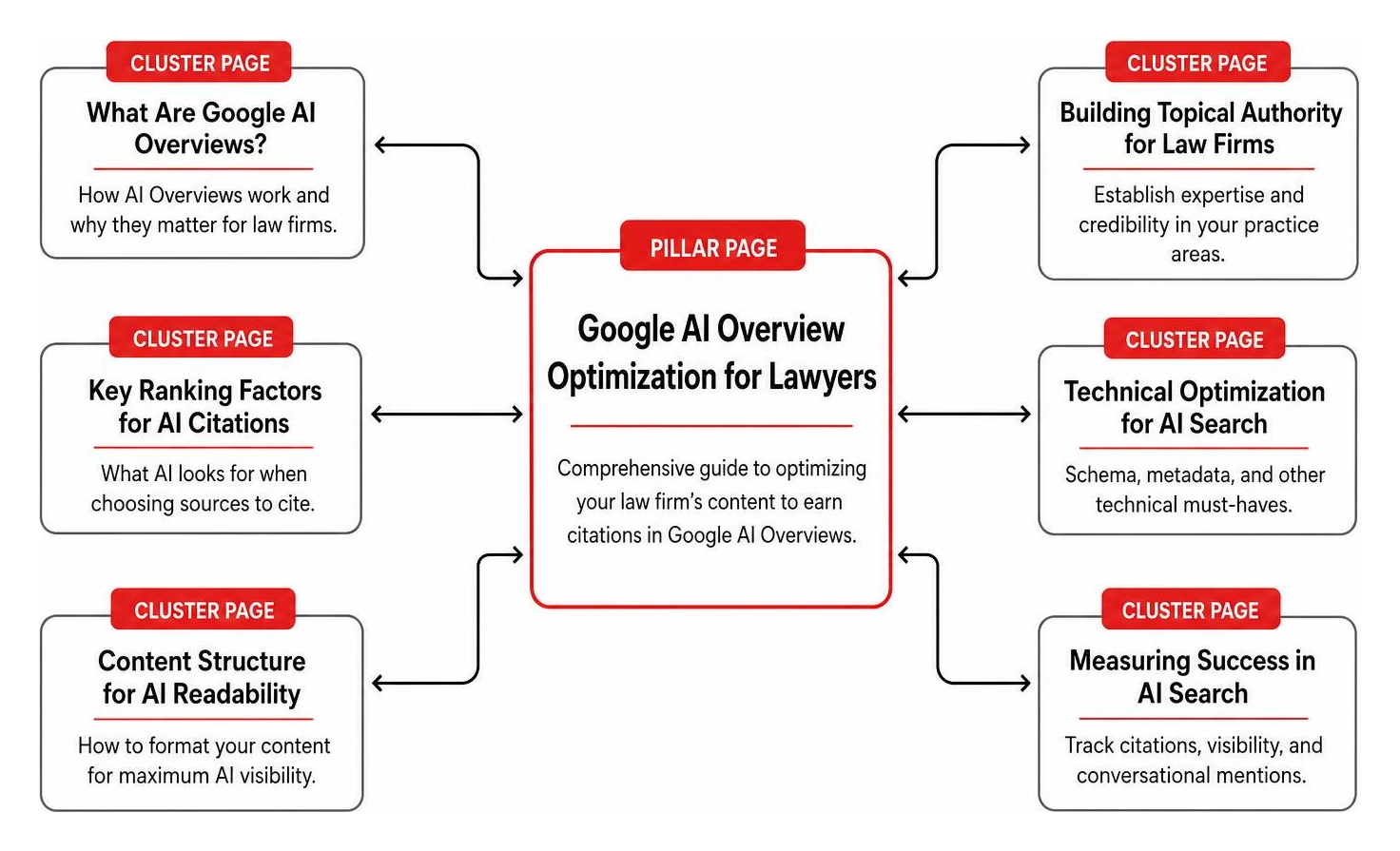
These pages must be tightly interlinked. The pillar page links out to all supporting sub-pages, and every sub-page links back to the main pillar. This internal linking structure signals to Google’s AI that you have covered the entire client journey and possess deep topical authority. To learn how to write cluster content that stands out, refer to The Ultimate Guide to Blog Writing for Law Firms.
Structuring Content for Google AI Overview Optimization for Lawyers
Writing for AI search requires a fundamental shift in how you structure your web pages. AI engines prefer content that follows a clear, logical hierarchy. If your answers are buried deep within long, winding paragraphs of legalese, the AI will bypass your site in favor of a competitor who gets straight to the point.
We recommend using the Question-Answer-Elaboration pattern.
- The Question (Heading): Write your subheadings (H2 or H3) as natural, conversational questions that clients actually ask.
- The Answer (Direct block): Immediately following the heading, provide a direct, clear, and concise answer. This direct answer should be between 40 and 60 words, written in plain English, and completely free of jargon.
- The Elaboration: Below the direct answer, provide the necessary legal nuance, statutory citations, and detailed explanations for readers who want to dive deeper.
By formatting your content this way, you create perfect “answer blocks” that Google’s Gemini or OpenAI’s models can easily extract and copy directly into their summaries, complete with a link back to your page.
Demonstrating E-E-A-T and Author Credentials
Because legal advice falls under Google’s strict “Your Money or Your Life” (YMYL) guidelines, search engines and AI models hold legal content to the highest standards of accuracy and trust. You cannot rely on generic, anonymous content. AI engines actively look for signals of Experience, Expertise, Authoritativeness, and Trustworthiness (E-E-A-T).
To build undeniable E-E-A-T signals:
- Use Named Authors: Every article must have a clear, named author attribution. Content with named author attribution earns an average 41% GEO visibility lift.
- Build Robust Attorney Bios: Link the author’s name to a detailed attorney profile page that highlights their JD degree, year of bar admission, court admissions, professional awards, and case results.
- Cite Authoritative Sources: Back up your claims by citing official statutes, local court rules, and government sources. Use inline citations and hyperlinked sources, which provide an average 30% lift in AI engine visibility.
- Keep Content Fresh: Include a “last updated” timestamp on your pages to prove to AI crawlers that your legal information is current.
For a deeper dive into establishing legal authority online, check out our guide on Advanced SEO: Authoritative Content.
Technical Optimization and Schema Markup for AI Visibility
While content quality is paramount, technical optimization ensures that AI crawlers can easily read, parse, and understand your website’s data. If an AI engine cannot clearly identify who you are, what services you offer, and where you practice, it will not recommend you.
Implementing Structured Data for Legal Entities
Schema markup is a form of structured data that you add to your website’s HTML. It acts as a translator, telling AI engines exactly what your content represents in a standardized, machine-readable format. For law firms, implementing advanced schema is one of the highest-leverage actions you can take.
The essential schema markup types for law firms include:
- LegalService Schema: Identifies your business as a law firm, specifying your official business name, logo, physical address, phone number, and accepted payment methods.
- Attorney / Person Schema: Defines individual attorneys, linking their profiles to their specific credentials, education, and bar associations.
- FAQPage Schema: Explicitly highlights the questions and answers on your pages, making it incredibly easy for Google’s AI to pull your direct answers into search results.
- LocalBusiness Schema: Solidifies your local presence and coordinates with your Google Business Profile.
Using structured data removes all ambiguity for search crawlers, dramatically increasing the likelihood of your content appearing in AI answer boxes. To ensure your local technical foundation is solid, explore our resource: Stop Wasting Money: The Ultimate Guide to Local SEO for Your Law Firm.
Local Signals and Multi-Platform Entity Consistency
AI engines do not just scrape your website; they look at your entire digital footprint to build a profile of your firm as an “entity.” If your information is inconsistent across the web, AI models will lose confidence in your business data and exclude you from local recommendations.
To build strong entity authority, we must maintain absolute consistency in your Name, Address, and Phone Number (NAP) across all major directories.
Furthermore, you must optimize for non-Google platforms. For example, ChatGPT and Microsoft Copilot heavily rely on Bing Maps and Bing Places data to generate local business recommendations. If you have ignored your Bing listings, you are completely invisible to millions of users searching for legal help on those platforms. Ensure your Google Business Profile, Bing Places, Apple Maps, Yelp, Avvo, and Justia profiles are fully claimed, detailed, and completely identical down to the formatting of your suite number.
Practice Area Variations and Common Optimization Pitfalls
AI Overview Optimization is not a one-size-fits-all strategy. The search intent, language, and regulatory guidelines vary dramatically depending on the type of law you practice.
Tailoring AIO Across Personal Injury, Family Law, and Criminal Defense
Let’s look at how AIO strategies must be adapted for different practice areas:
Personal Injury Law
Personal injury clients are often searching during stressful, high-stakes moments. They frequently ask informational questions about timelines, insurance, and medical bills.
- Focus on: Clear, step-by-step guides, transparent pricing or settlement details, and interactive tools like settlement calculators.
- AI Trigger: Queries like “what is the average settlement for a rear-end collision?” or “how long do I have to file a claim?” trigger AI Overviews at massive rates. Ensure your answers lead with direct, state-specific statutory timelines.
Family Law
Family law clients search with high emotional intent. They want clear, compassionate, and easy-to-understand explanations of complex court processes.
- Focus on: Clear FAQs addressing child custody, asset division, and mediation procedures. Avoid cold, overly clinical legal jargon. Use conversational phrasing like “how is child custody decided?” rather than strictly referencing legal codes.
Criminal Defense Law
Criminal defense queries are highly urgent and procedural. People want to know what is going to happen to them or their loved ones immediately after an arrest.
- Focus on: Direct, reassuring answers explaining court procedures, arraignments, and rights under local laws.
- AI Trigger: Queries like “what happens at a first court appearance?” or “do I need a lawyer for a misdemeanor?” demand precise, authoritative answer blocks. To protect your firm’s visibility in this highly competitive niche, review our Top SEO Tips for Criminal Defense Lawyers in the AI Search Era.
Common Mistakes and Realistic Timelines for AI Citations
As law firms rush to adapt to AI search, we see many falling into the same critical traps.
The biggest mistake is mass-producing low-quality, AI-generated content to “scale” their website. AI engines are incredibly sophisticated at detecting generic, synthesized text. If your content looks like a rehashed version of what is already on the web, Google’s Helpful Content system will penalize your site, rendering you invisible to both traditional and AI search. Real attorney insights and unique case perspectives are non-negotiable. To understand the balance of using AI safely, read The Key to AI Written Content.
Another common error is using the nosnippet meta tag in an attempt to block AI engines from training on your content. While this prevents AI models from scraping your site, it also completely removes your firm from eligibility for AI Overview citations, destroying your digital visibility.
Realistic Timelines for AIO Success
Optimizing for AI search is a medium-to-long-term investment. While traditional SEO changes can take months to show results, well-structured GEO content can sometimes earn citations faster due to the real-time nature of AI search updates.
- 30 to 60 Days: Initial AI citation improvements typically appear for low-competition, highly specific long-tail queries.
- 3 to 6 Months: Consistent AI Overview citations across major practice areas generally begin to take hold.
- 6 to 12 Months: Dominating highly competitive, high-intent local queries in major metropolitan markets requires sustained, authoritative content and link acquisition efforts.
Frequently Asked Questions About AI Search for Law Firms
How can law firms measure success in AI Overview Optimization?
Because AI search leads to more zero-click searches, traditional metrics like organic sessions and page views are no longer the sole indicators of success. To measure your AI visibility, we track:
- Brand Search Volume: When clients see your firm recommended in ChatGPT or a Google AI Overview, they often open a new tab and search for your firm by name. A rise in branded search is a direct indicator of AI citation success.
- AI Referral Traffic: Monitor your Google Analytics (GA4) for referral traffic coming directly from platforms like
chat.openai.com,perplexity.ai, or Google’s AI referral paths. - Manual and Tool Audits: Regularly query your top practice area questions in Google, ChatGPT, and Perplexity to track whether your firm is cited in the generated summaries. Learn more about tracking these shifts at AI Overviews.
Do AI Overviews replace traditional organic rankings?
No, AI Overviews do not replace traditional rankings—they build on top of them. Data shows that 76% of AI Overview citations come from pages that already rank in the top 10 organic results. Traditional SEO remains the critical foundation. However, once you rank on page one, you must implement structural and schema optimizations to convince Google’s AI to pull your content into the AI Overview block. Earning both a traditional ranking and an AI citation maximizes your real estate and trust on the page.
Which AI platforms should lawyers prioritize for optimization?
Law firms should focus their optimization efforts on the platforms that command the highest market share and user intent:
- Google AI Overviews & Gemini: Because Google remains the starting point for the vast majority of searchers, optimizing for Google’s AI ecosystem is the highest priority.
- ChatGPT (OpenAI): With billions of monthly visits, ChatGPT is the dominant conversational tool. It relies heavily on web browsing capabilities and authoritative brand mentions to recommend local businesses.
- Perplexity AI: Highly favored by research-oriented users, Perplexity provides direct citations for every claim, making it a valuable source of highly qualified referral traffic.
- Claude (Anthropic) & Bing Copilot: Crucial platforms that round out the multi-engine landscape, utilizing Bing’s index and structured web data.
Securing Your Firm’s Digital Future in the Agentic Era
The transition from standard search queries to conversational, AI-driven answers is the most significant shift in legal marketing in a generation. As search engines evolve into active “information agents” that scan the web and make decisions on behalf of users, the firms that build the strongest, most structured digital footprints will capture the lion’s share of new cases.
At Triple Digital, we help law firms cut through the noise. As a Houston-based digital marketing agency specializing in lead generation and case acquisition, our approach is built on “less fluff, more cases.” We leverage cutting-edge AI and advanced data mining to target precise client demographics and optimize your firm’s online footprint for maximum visibility across Google AI Overviews, ChatGPT, and traditional search.
Do not let your competitors claim Position 0. If you are ready to secure more cases and future-proof your firm’s marketing, Schedule a meeting with our team or connect with our Houston office at Triple Digital today.