





Detailed Guide to Automated Law Firm Growth
Why Automated Law Firm Growth Is Changing Legal Practice Forever
Automated law firm growth is the process of using technology and AI to systematically acquire clients, reduce overhead, and scale revenue — without proportionally increasing headcount or hours worked.
If you’re short on time, here’s the core idea:
| What It Means | Why It Matters |
|---|---|
| Automate intake, follow-up, billing, and document drafting | Frees attorneys for high-value work |
| Use AI to capture and qualify leads 24/7 | Never miss a potential client again |
| Track revenue attribution by marketing source | Stop wasting budget on campaigns that don’t convert |
| Reduce administrative overhead | Protect margins as compensation costs rise |
| Systematize client acquisition | Create predictable, repeatable growth |
Most law firms grow the same way they always have: hire more staff, bill more hours, and hope referrals keep coming in. It works — until it doesn’t.
Expenses at law firms rose 10.4% last year, with compensation alone jumping 16.3%. At the same time, 59% of legal employees plan to ask for a raise in 2026, and nearly a third are ready to walk if they don’t get one.
The math is getting harder to ignore.
Meanwhile, research from McKinsey estimated that 23% of a lawyer’s work could be automated — and that figure is almost certainly higher today. Gartner expects legal departments to automate over half of their work on key business transactions. The global AI legal technology market is projected to hit $37.8 billion by 2026.
This isn’t a future trend. It’s happening now.
The firms pulling ahead aren’t necessarily the biggest or the most well-funded. They’re the ones replacing manual, repetitive processes with smart systems — and using the time saved to focus on what actually moves the needle: client relationships, strategic work, and case outcomes.
This guide breaks down exactly how to do that.
What is Automated Law Firm Growth?
To put it simply, automated law firm growth is the transition from a business that relies entirely on manual labor to one that scales using smart systems.
In a traditional law firm, growth is linear. If you want to take on twice as many cases, you generally need to hire twice as many paralegals, associates, and intake specialists. This model creates massive operational bottlenecks. Your team gets bogged down in administrative tasks, overhead costs skyrocket, and your best people eventually burn out.
Automated growth breaks this cycle. By leveraging modern technology, a firm can handle a significantly higher caseload while keeping administrative overhead flat. Instead of forcing attorneys to spend hours copying data from intake forms, drafting basic contracts from scratch, or chasing down unpaid invoices, automation handles these tasks in the background.
This shift does more than just cut costs; it prevents the chronic burnout that plagues the legal industry. When you free your team from routine administrative tasks, they can focus on what they actually went to law school for: practicing law, advocating for clients, and thinking strategically. To understand the strategic mindset shift required, you can explore our Guide to Law Firm AI Strategies.
Traditional vs. Automated Law Firm Growth
The differences between traditional and automated growth models become obvious when you look at how they handle daily operations:
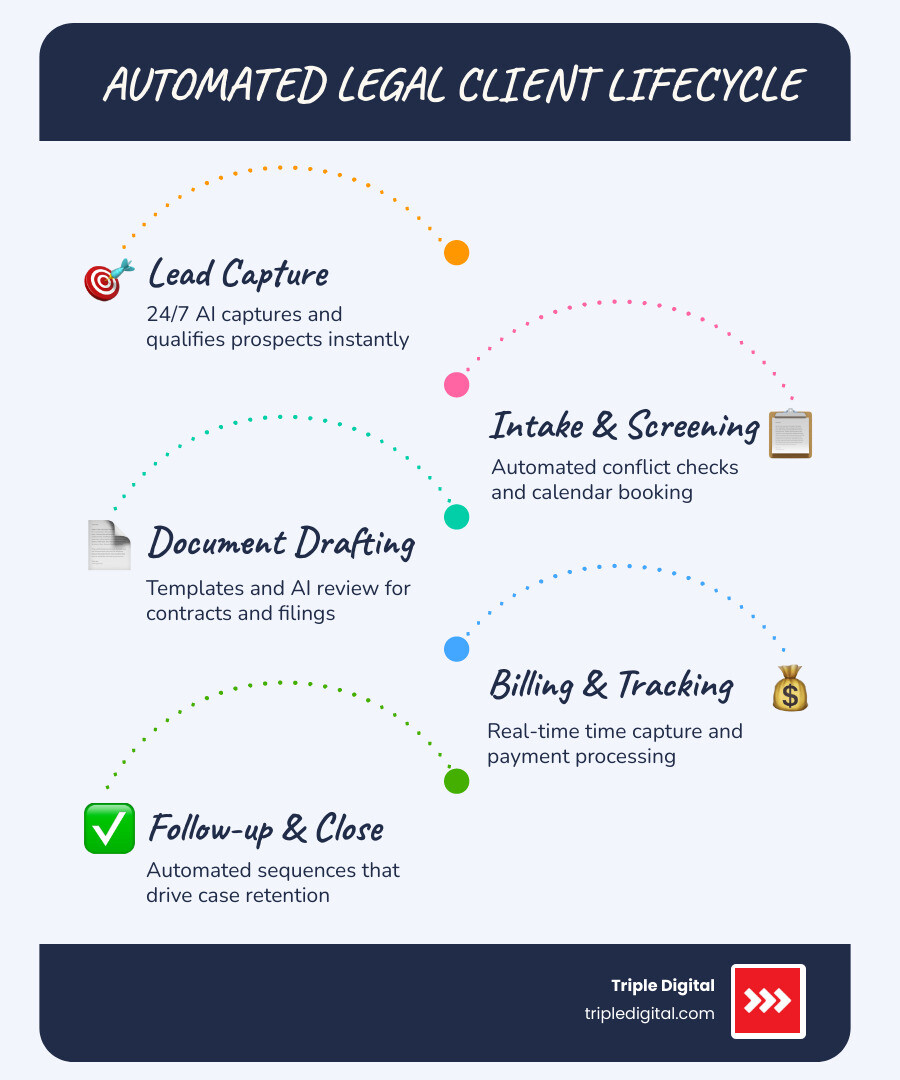
- Lead Intake: Traditional firms rely on a receptionist or an attorney to manually answer calls during business hours. If a lead calls at 8:00 PM, they leave a voicemail—and usually call a competitor next. Automated firms use AI-driven, 24/7 conversational agents that capture, qualify, and book consultations instantly, day or night.
- Scalability Limits: A traditional firm hits a hard ceiling when its staff is working at maximum capacity. An automated firm can handle a 50% spike in lead volume without adding a single dollar to its payroll.
- Margin Protection: With compensation costs rising rapidly, traditional firms are watching their profit margins shrink. Automated firms protect their margins by using technology to absorb the administrative workload, keeping operations highly profitable even in a competitive market.
How Automation Eliminates Administrative Burnout
Lawyer burnout isn’t caused by doing legal work; it’s caused by the endless administrative friction surrounding it.
Attorneys use up to 100,000 sheets of paper per year in traditional office environments, highlighting the massive amount of physical and digital administrative clutter that still exists. When an attorney’s day is fragmented by manual time entry, chasing down signatures, and searching through disorganized folders, their billable potential drops.
Workflow automation cleans up this mess. By setting up automated triggers—such as automatically generating a retainer agreement when a lead is marked “won” in your CRM—you eliminate the tedious micro-tasks that drain your team’s energy.
Key Systems to Automate for Scalable Practice Growth
You don’t have to automate your entire firm overnight. The secret to predictable, scalable growth is targeting the specific systems that consume the most non-billable hours.

By prioritizing key workflows, you can see immediate improvements in speed and accuracy. For a deeper look at the tools available, read our Guide AI Automation for Lawyers.
Streamlining Client Intake and Lead Qualification
Client intake is the most critical pipeline in your firm, yet it is often the most neglected.
Did you know that 46% of potential client calls come outside of normal business hours? If your firm doesn’t have a reliable way to capture these leads instantly, you are losing revenue. To make matters worse, the first firm to respond and qualify a lead wins the retainer 78% of the time. If you take more than a few minutes to respond, your chances of signing that client drop off a cliff.
AI-driven intake systems solve this problem by providing 24/7 lead capture. When a prospect visits your site or calls after hours, an AI agent can:
- Conduct a structured intake interview to gather incident details, injuries, timelines, and jurisdiction.
- Screen the lead against your firm’s specific criteria (e.g., checking the statute of limitations).
- Perform an automated conflict check against your existing database.
- Book a consultation directly onto your calendar if the lead is a good fit.
This process ensures that your team only spends time talking to highly qualified prospects. For actionable tips on optimizing this process, see our article From Prospects to Partners: The Lawyer’s Playbook for Lead Gen.
Document Assembly and Automated Law Firm Growth
Drafting routine legal documents is another area ripe for automation. Instead of copy-pasting client information from a CRM into a Word document—which is slow and highly prone to human error—document assembly software can generate contracts, pleadings, and motions instantly using pre-built templates.
AI-powered contract review tools can also scan incoming documents, highlight potential issues, and summarize key clauses in seconds. In eDiscovery, AI systems can search through thousands of pages of transcripts and documents instantly, turning what used to be weeks of manual paralegal work into a task that takes minutes.
Automated Billing and Time Tracking
Manual time tracking is a major leak in law firm revenue. Many attorneys wait until the end of the day—or even the end of the week—to recreate their billable hours from memory, phone logs, and calendar invites. This guessing game leads to missed billable hours and lower realization rates.
Automated billing systems solve this by automatically logging calls, emails, and meetings directly into your practice management software. When it’s time to send invoices, the system can generate, review, and email them automatically. Providing secure, online payment options and automated payment reminders helps keep your cash flow healthy and dramatically reduces outstanding accounts receivable.
The Financial Impact: ROI, Productivity, and the Billable Hour
How does automating these systems impact your bottom line? The data shows that the financial return on legal automation is both immediate and substantial.
| Billing & Tracking Method | Daily Time Spent | Realization Rate | Revenue Leakage |
|---|---|---|---|
| Traditional Manual Entry | 30–45 mins (end-of-day guessing) | ~75% – 80% | High (missed calls, short emails) |
| Automated Time Capture | < 2 mins (real-time background logging) | ~95%+ | Minimal (every interaction is tracked) |
Redefining the Billable Hour with AI
For decades, the billable hour has been the foundation of law firm revenue. However, as AI and automation make tasks incredibly fast, some firms worry that their revenues will decline if they bill purely by the hour.
The reality is quite different. Rather than destroying profitability, AI is allowing firms to shift toward more profitable business models, such as flat-fee arrangements or value-based pricing. Because you can deliver high-quality work in a fraction of the time, your profit margin per case actually increases.
Even for firms sticking to the billable hour, AI improves profitability. Ninety percent of AmLaw 100 firms expect AI to improve their quality of service rather than just cut costs. Instead of billing for routine administrative tasks, attorneys can spend their billable hours on high-level strategic analysis, which clients are much more willing to pay for. To learn more about how AI is reshaping legal marketing and pricing, read our guide on Future-Proof Your Firm: The AI Advantage in Legal Marketing.
Measuring ROI and Productivity Gains in Automated Law Firm Growth
The productivity gains from AI are hard to overstate. In high-volume litigation, firms using AI-powered complaint response systems have seen associate preparation time drop from 16 hours down to just 3 to 4 minutes—a massive productivity gain.
On the marketing side, the return on investment is equally clear. Firms using advanced lead qualification and automated follow-up systems report average ROIs as high as 12:1, with response times dropping to under 5 seconds.
Without proper tracking, the average law firm wastes roughly $3,200 per month on marketing campaigns that do not convert into signed cases. By implementing automated revenue attribution systems, firms can track exactly which marketing campaigns produce signed retainers, allowing them to cut waste and scale what actually works. Some firms have recovered over $36,000 in untracked revenue within just 90 days simply by fixing their attribution.
Overcoming Challenges in Legal Automation Adoption
While the benefits of automated law firm growth are clear, implementing these tools does come with challenges. Understanding how to navigate these hurdles is key to a successful transition.

Navigating Change Management and Integration Costs
The biggest obstacle to automation is rarely the technology itself; it is human resistance. Legal teams are traditionally risk-averse, and staff members may worry that automation is a threat to their job security.
To overcome this, you must frame automation as a tool that empowers your staff, not one that replaces them. Show your team how these systems will eliminate the boring, repetitive parts of their jobs so they can focus on more rewarding work.
Additionally, avoid the temptation to buy dozens of disconnected software tools. Look for comprehensive practice management software or platforms that offer drag-and-drop workflow builders and integrate seamlessly with your existing tech stack.
Balancing Automation with the Human Touch
Legal services are deeply personal. When clients hire an attorney, they are often going through some of the most stressful moments of their lives. If your firm feels entirely cold and automated, you will struggle to build trust.
The goal of automation is not to remove the human element, but to enhance it. By automating the administrative steps, you free up your attorneys to have deeper, more meaningful conversations with their clients.
Furthermore, you must maintain strict ethical oversight. AI is an incredible assistant, but it should never be the final decision-maker. Always maintain a “human-in-the-loop” approach, ensuring that an attorney reviews every AI-generated document, legal citation, and intake decision before it is finalized. For strategies on maintaining strong client trust while scaling, see The Client Whisperer: Proven Strategies to Grow Your Legal Practice.
A Step-by-Step Framework for Implementing Automated Growth
Ready to build a highly efficient, automated law firm? Here is a simple, three-step framework to help you implement automation for predictable, scalable growth. For a broader look at scaling your practice, read our guide From Small Firm to Legal Empire: A Guide to Practice Growth.
Step 1: Audit Workflows and Identify Bottlenecks
Before buying any new software, you need to understand where your time is actually going. Conduct a simple time audit with your team for one to two weeks. Have everyone track their daily tasks and flag anything that is repetitive, manual, or administrative.
Look for tasks like:
- Manually typing client details from emails into your CRM.
- Chasing clients for signed retainer agreements or intake documents.
- Sending manual follow-up emails to leads who haven’t scheduled a consultation.
These are your primary targets for automation.
Step 2: Select and Integrate the Right Tech Stack
Once you have identified your bottlenecks, select tools that solve those specific problems. Ensure that whatever tools you choose can integrate directly with your core Legal Practice Management Software (LPMS) or CRM.
For marketing and client acquisition, look for tools that leverage data mining and AI to find and qualify leads. You can read more about these technologies in our articles on AI Tools for Law Firm Marketing and Triple Digital Revolutionizing Legal Tech: Pinpoint Unveils Industry-First Data Mining Software to Precisely Target Prospective Clients.
Additionally, staying ahead of online search trends is critical for organic growth. To see how we help firms dominate search results, check out Triple Digital LLC Unveils Groundbreaking AI Tool to Help Law Firms Outrank Competitors Online.
Step 3: Track Performance and Scale What Converts
With your automated systems in place, you can begin tracking key performance metrics with absolute precision. Use your dashboard to monitor metrics like:
- Cost Per Acquisition (CPA): How much you spend to sign a single client.
- Lead-to-Consultation Conversion Rate: The percentage of leads that book a meeting.
- Response Time: How quickly your system engages with a new lead.
By analyzing this data, you can stop guessing which marketing campaigns work. Double down on the channels that generate high-value, signed cases, and cut the ones that only drive empty clicks. For advanced lead generation strategies, read Don’t Just Wait for Cases: Strategies for Proactive Legal Lead Generation.
Frequently Asked Questions about Automated Law Firm Growth
How does automation improve client acquisition without losing personalization?
Automation handles the speed and consistency of your communication, while you control the message. For example, an automated system can instantly send a personalized text message or email using the prospect’s name and specific case details the moment they submit a form. This rapid response makes the client feel heard immediately, while freeing you up to speak with them personally during their scheduled consultation.
What is the typical ROI for law firms adopting AI automation?
While results vary depending on the firm’s practice area and market, many firms experience an average ROI of 12:1 on automated lead generation and qualification systems. Furthermore, by automating time tracking and marketing attribution, firms regularly recover thousands of dollars in lost revenue within the first 90 days of implementation.
Is AI-driven document drafting ethically compliant for lawyers?
Yes, as long as there is strict attorney oversight. AI tools are designed to draft templates, organize research, and find key clauses, but they do not replace the professional judgment of a licensed attorney. To remain ethically compliant, an attorney must review and verify every document, citation, and legal argument generated by an AI tool before it is signed or filed.
Boost your Law firm with Triple Digital
The legal landscape is shifting rapidly. With rising overhead, increasing compensation demands, and clients expecting instant responses, traditional law firms are facing unprecedented pressure.
Automated law firm growth is no longer a luxury reserved for massive national firms. It is a highly accessible, incredibly powerful strategy that allows boutique and mid-sized firms to compete at the highest level. By automating your intake, document drafting, billing, and marketing attribution, you can build a highly profitable practice that scales predictably.
At Triple Digital, we are a Houston-based digital marketing agency specializing in lead generation and case acquisition for law firms. Our approach is simple: “less fluff, more cases.” We leverage cutting-edge AI and data mining to help law firms target prospective clients with absolute precision, ensuring you spend your budget on campaigns that convert.
Ready to stop guessing and start scaling?
Read the full article now to discover how we can help you build an automated system that drives consistent, high-value cases to your firm.