





Ultimate Checklist for AI Lead Gen Tools for Personal Injury
Why AI Lead Acquisition Matters for Personal Injury Firms
AI lead acquisition personal injury tools help law firms attract, respond to, qualify, and follow up with prospective clients faster – while measuring success by signed cases, not just form fills or phone calls.
For a quick tool-evaluation answer, prioritize platforms that can support these five jobs:
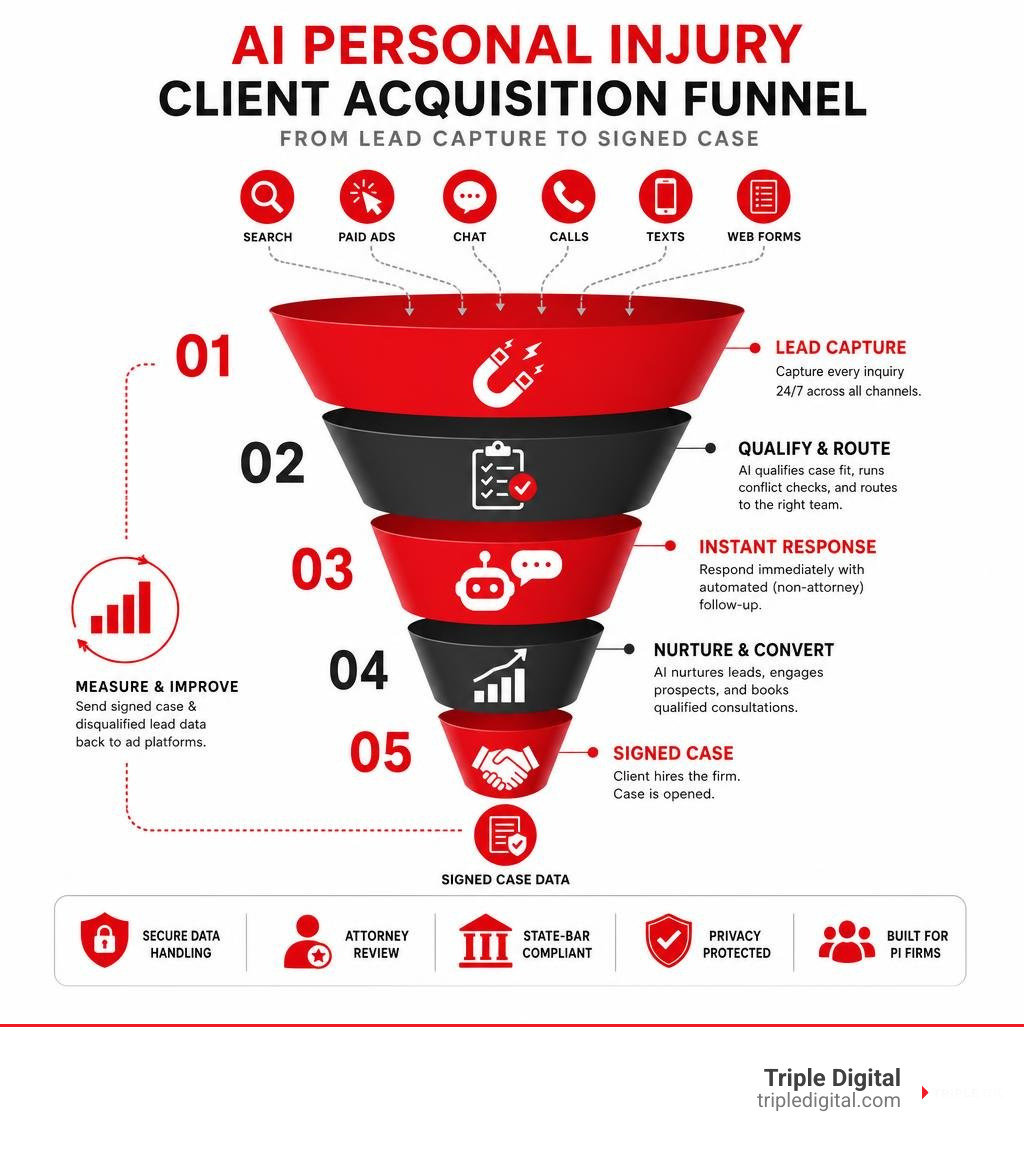
- Capture every inquiry through 24/7 chat, phone, text, and web forms.
- Qualify case fit using firm-approved questions, conflict checks, and routing rules.
- Respond immediately with automated but clearly identified non-attorney follow-up.
- Improve marketing spend by sending signed-case and disqualified-lead data back to ad platforms.
- Protect clients and the firm with secure data handling, attorney review, and state-bar-compliant messaging.
Personal injury marketing is expensive and fast-moving. In major markets, search ads for high-intent terms can cost more than $150 per click. Yet the average PI firm turns only 2.3% of paid-search clicks into signed retainers. The gap is rarely just traffic. It is often response time, intake quality, and follow-up.
Prospects contact an average of 3.2 firms before choosing counsel. When a caller reaches voicemail, 80% move on without leaving a message. That makes AI useful not as a replacement for experienced intake staff, but as a way to ensure the right human gets the right opportunity quickly.
The best systems connect the full path: local search visibility, paid ads, intake, case-fit scoring, follow-up, and signed-case reporting. This checklist will help your firm judge which tools solve its real bottleneck – and which are simply adding more software.
Core Funnel Stages for AI Lead Acquisition Personal Injury
To successfully implement AI lead acquisition personal injury systems, you must stop viewing legal marketing as a series of disconnected campaigns. Acquiring a client is an interconnected journey. If your ad campaigns drive high volumes of traffic but your intake team takes two hours to call back, your acquisition cost spikes. Conversely, if your intake team responds in seconds but lacks pre-qualification data, they spend all day speaking with individuals who do not have viable claims.
By taking a full-funnel approach, personal injury law firms optimize every touchpoint from initial discovery to the moment a digital retainer agreement is signed. Explore our comprehensive Guide To Ai Lawyer Growth Strategy to see how full-funnel architecture transforms law firm scaling.
Evaluating AI Tools Across the Full Acquisition Lifecycle
When evaluating software, assess how well a tool supports each specific stage of your prospective clients’ acquisition journey:
- Top-of-Funnel (Awareness & Search): Tools at this stage leverage machine learning to optimize ad targeting, programmatic keyword expansion, and local search presence.
- Middle-of-Funnel (Capture & Screening): Conversational AI chatbots and voice screening tools engage visitors instantly, collecting incident dates, injury details, liability facts, and insurance status.
- Bottom-of-Funnel (Nurture & Conversion): Automated multi-channel sequences engage prospects who didn’t sign immediately, delivering persistent follow-ups across SMS, email, and ringless voicemail.
- Closed-Loop Feedback: Advanced platforms feed real-time case status (signed cases vs. disqualified inquiries) back into your ad networks to continually refine user targeting.
Focusing on these stages yields substantial financial gains. Mid-size personal injury firms deploying end-to-end AI demand generation workflows have reduced their average cost-per-signed-case by 41% within six months while increasing qualified lead volume by 67%. To learn more about structuring these acquisition funnels, read our guide on Injury Insights Mastering Lead Generation For Personal Injury Lawyers.
How Mid-Size PI Practices Pick the Right Starting Point
With around 30 percent of law firms already leveraging some form of AI, standing out requires identifying your firm’s primary operational bottleneck before purchasing software.
- If your issue is low conversion on existing web traffic: Start by deploying a 24/7 legal conversational intake chatbot to capture off-hours inquiries.
- If your issue is high ad spend with low signed-case yields: Start by connecting your CRM case data back to your Google Ads and Meta platforms to enable value-based bidding.
- If your issue is slow response times: Start with automated SMS and multi-channel follow-up sequences that trigger within seconds of form submissions.
The table below highlights the performance shift when moving from legacy, manual processes to an AI-driven acquisition structure:
| Metric / Operational Stage | Legacy Manual Approach | Integrated AI-Driven Workflow | Impact on Growth & Efficiency |
|---|---|---|---|
| Initial Contact Time | 2 to 4 hours (or next business day) | Under 90 seconds (24/7/365) | Eliminates client drop-off to competitors |
| Case-Fit Qualification Accuracy | 61% accuracy via manual intake notes | 89% accuracy via automated scoring | Prevents wasted time on non-viable claims |
| Intake Specialist Productivity | 100% time spent handling raw inquiries | 74% time spent on pre-qualified leads | Focuses human talent on high-value retainers |
| Paid Media Efficiency | High ad spend waste on unqualified clicks | 29% reduction in wasted media spend | Lowers overall cost-per-signed-case |
| Lead-to-Retainer Conversion Rate | 2.3% paid search click conversion average | 52% improvement in conversion rates | Maximizes return on overall ad spend |
AI Tools Checklist for Intake Automation and Speed-to-Lead

In personal injury law, speed-to-lead dictates client acquisition success. An injured individual seeking legal counsel rarely calls just one office; they want immediate answers and reassurance. Industry metrics show that 78% of law firms lose winnable cases simply by failing to follow up within the first four hours of an inquiry.
Implementing intelligent intake automation eliminates human delay, capturing client interest at the exact moment intent is highest. For detailed frameworks on capturing pre-qualified cases, review our Guide To Qualified Pi Case Leads.
AI Lead Acquisition Personal Injury Qualification and Case-Fit Scoring
Not every inbound call represents a viable personal injury claim. Manual screening often leads to inconsistent qualification, letting valuable motor vehicle or premises liability cases slip through while spending hours on non-viable calls.
Modern AI lead acquisition personal injury intake tools use voice-to-text processing and natural language algorithms to evaluate incoming phone calls in real time. These platforms check key parameters:
- Statute of Limitations: Verifies incident dates immediately to confirm claims are legally actionable.
- Liability Determination: Analyzes caller descriptions to evaluate who was at fault in the collision or incident.
- Injury Severity & Medical Treatment: Identifies whether emergency care, hospitalization, or ongoing therapy occurred.
- Insurance Coverage & Fee Predictors: Estimates potential fee recovery by evaluating coverage limits and liability details.
This real-time evaluation reduces average intake call times by 34% while increasing case-fit accuracy from 61% with manual screening to 89%. Consequently, human intake specialists spend 74% of their work hours speaking directly with prospects already pre-qualified to at least a 70% case-fit score. To understand how pre-screened leads transform firm efficiency, consult our breakdown on Beyond The Referral How Exclusive Leads Can Transform Your Practice.
AI Chatbots and Multi-Channel Instant Follow-Up Sequences
When an injured prospect reaches voicemail, 80% hang up and immediately call another law firm. A well-configured legal AI chatbot installed on your website addresses this vulnerability by operating 24/7/365. These conversational tools do far more than collect basic contact details—they conduct initial case screening based on your practice area criteria, driving web lead capture rates up by 38% and filtering out unqualified leads by up to 45%.
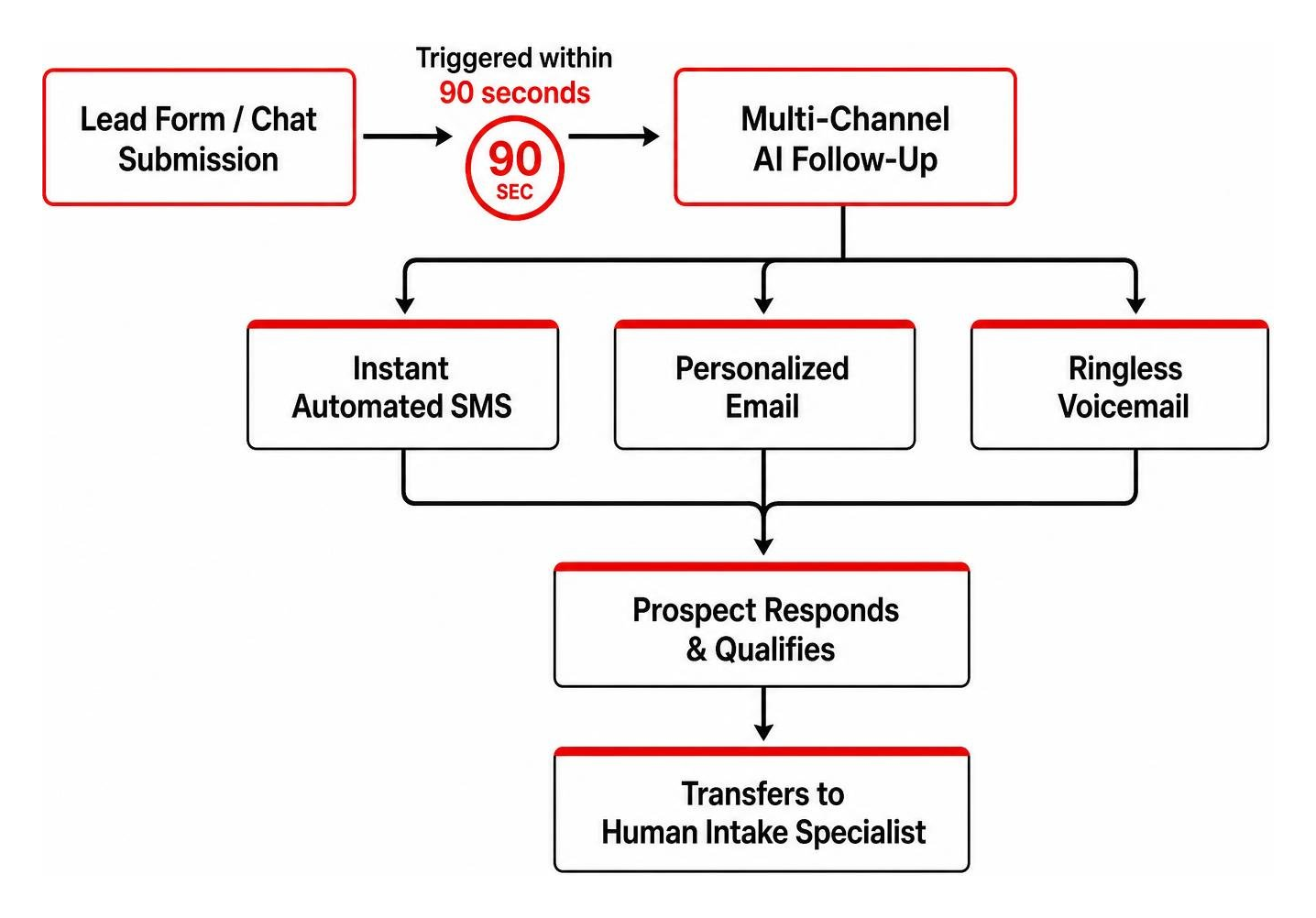
When a form is submitted, timing is everything. Deploying automated multi-channel follow-up sequences across SMS, email, and ringless voicemail increases prospect contact rates from an industry average of 42% to 81%—provided the first automated touchpoint launches within 90 seconds.
Persisting with a 12-touch follow-up sequence over a 21-day period yields a 52% boost in overall lead-to-retainer conversions compared to standard manual outreach. For actionable strategies on turning cold prospects into signed clients, read From Prospects To Partners The Lawyers Playbook For Lead Gen.
Evaluating AI Marketing Tools for SEO, Paid Media, and Market Intelligence

Capturing inquiries at intake is only half the equation; your firm must also generate a steady, scalable stream of high-intent prospects. Marketing for personal injury requires continuous refinement across search engines and paid channels.
At Triple Digital, our Houston-based team uses a data-mining approach to target high-value legal cases. Discover how machine learning scales legal acquisition in our detailed guide to Ai Driven Law Marketing.
Programmatic SEO and Local Content Scaling
Organic search engine leads are exceptionally valuable in personal injury marketing, carrying a 38% higher average case value than paid media leads. However, maintaining top rankings across multiple sub-practice areas (such as commercial truck accidents, rideshare collisions, or wrongful death) in broad geographic territories requires extensive content creation.
Personal injury firms leveraging AI-assisted content production publish 4.7 times more targeted local SEO content than traditional competitors. Modern programmatic SEO systems monitor local news feeds and incident reports, drafting hyper-local, educational blog posts and landing pages tailored to specific jurisdictions.
This hyper-targeted content strategy enables law firms to rank for 63% more long-tail keywords within 90 days of launch. To learn how to execute this strategy effectively, review our expert resource on Seo For Personal Injury Attorneys.
AI Lead Acquisition Personal Injury Paid Media Optimization
Pay-per-click (PPC) advertising on platforms like Google Ads and Meta offers immediate visibility, but inefficient management can burn through marketing budgets quickly. AI-driven ad management tools use machine learning to automate bidding, test dynamic ad copy combinations, and refine audience targeting based on user intent signals.

Connecting your firm’s CRM data directly to your paid advertising platforms establishes a powerful closed-loop feedback mechanism. Rather than optimizing ads for generic form fills or phone calls, AI bidding tools analyze which campaigns generate signed retainer agreements and which yield disqualified inquiries.
Feeding first-party outcome data back into platforms like Google Performance Max or Meta Advantage Plus improves cost-per-qualified-lead by 44% within 60 days while reducing wasted ad spend by an average of 29%. To optimize your ad campaigns and attract higher-value claims, read Generate Leads Unlocking A Flood Of New Legal Cases.
AI-Powered Competitive Intelligence and Market Positioning
Standing out in saturated personal injury markets requires clear visibility into your competitors’ strategies. AI-driven market intelligence tools continually analyze competitor activity across digital landscapes by tracking:
- Ad Spend and Bidding Shifts: Uncovers when competing firms increase or decrease budgets on primary keyword categories.
- Ad Copy and Creative Variations: Analyzes message positioning, highlighting whether competitors focus on settlement speeds, past verdict totals, or client service promises.
- Content Gaps: Scans regional search engine result pages (SERPs) to uncover underserved long-tail search queries.
- Local Map Pack Rankings: Tracks real-time changes in competitor Google Business Profile rankings across micro-neighborhood grids.
Armed with these insights, your firm can deploy counter-strategies, fill content gaps, and capture untapped search volume before competitors adapt. To build proactive acquisition campaigns, check out Dont Just Wait For Cases Strategies For Proactive Legal Lead Generation.
Key Pitfalls, Compliance Rules, and Expected ROI Timelines
While the growth opportunities of AI lead acquisition personal injury technology are significant, law firms must navigate implementation carefully. Deploying automation without clear oversight, ethical boundaries, or structured management can create compliance risks, damage firm reputation, or waste financial resources.
To learn how to select safe, legal-specific technology platforms, consult our comprehensive guide on Finding Your Next Client A Guide To Lead Generation Services.
Ethical Pitfalls, Confidentiality, and Bar Compliance
Legal advertising is strictly regulated by state bar association guidelines, requiring law firms to maintain high standards of transparency, confidentiality, and accuracy when deploying AI tools:
- Maintain Human-in-the-Loop Oversight: AI tools should draft communications, summarize documents, and pre-screen prospects, but licensed attorneys must review all published legal content, ad copy, and formal retainer agreements.
- Clear Non-Attorney Disclosures: Automated chatbots and text sequences must clearly disclose to prospects that they are communicating with an automated assistant, not an attorney, avoiding any implication of formal legal representation before a signed retainer exists.
- Protect Client Confidentiality: Avoid entering unredacted, personally identifiable information (PII) or confidential incident records into public, non-secure language models. Ensure software vendors provide enterprise-grade encryption, SOC 2 certification, or HIPAA compliance, with explicit written guarantees that firm data will not be used to train external public AI models.
- Avoid Outcome Guarantees: AI systems must never promise specific financial recoveries or guarantee legal outcomes during automated intake interactions.
Measuring ROI and Conversion Timelines
Adopting AI tools yields measurable returns, but different technologies deliver results on distinct schedules. Expecting immediate organic search rankings on day seven leads to premature pivots, while waiting six months to assess chat performance hides preventable drop-offs.
Here is what realistic ROI timelines look like for well-executed legal AI implementations:
- 30 to 60 Days (Intake & Follow-Up): Automated chatbots, instant SMS follow-up, and call evaluation software show immediate results. Firms typically see an instant bump in contact rates (moving toward 80%+) and a drop in off-hours lead abandonment within the first month.
- 45 to 75 Days (Paid Media Optimization): Integrating CRM signed-case data into ad networks requires 45 to 75 days to train machine learning algorithms effectively. Expect a noticeable reduction in cost-per-qualified-lead and wasted ad spend around the two-month mark.
- 60 to 120 Days (Programmatic SEO & Content): Scaling hyper-local SEO content takes time for search engine bots to index, evaluate, and rank. Significant increases in organic keyword visibility, long-tail search traffic, and non-paid lead volume typically materialize between month two and month four.
Frequently Asked Questions About Legal AI Lead Acquisition
What is the average ROI timeline for AI-driven lead generation?
Measurable gains depend on the funnel stage targeted. Intake automation, instant chatbot engagement, and multi-channel SMS follow-up deliver improvements in lead contact rates and call conversions within 30 to 60 days. Paid media bidding adjustments optimized via CRM data feedback show significant cost-per-qualified-lead reductions in 45 to 75 days. Comprehensive AI-driven programmatic SEO strategies require 60 to 120 days to achieve top local search engine rankings and generate sustained organic inquiries. Overall, mid-size personal injury practices adopting integrated AI acquisition workflows generally achieve a full return on investment and a 41% average reduction in cost-per-signed-case within six months.
How do AI tools protect client confidentiality and comply with bar rules?
To maintain client confidentiality and comply with legal ethics rules, firms must utilize enterprise AI software built specifically for the legal or medical sector. These platforms incorporate end-to-end data encryption, SOC 2 Type II compliance, and strict data privacy agreements ensuring firm inputs are never utilized to train third-party public AI models.
To satisfy state bar advertising rules, firms must enforce a strict “human-in-the-loop” policy where licensed attorneys review published marketing content and legal intake frameworks. Furthermore, automated chatbots and SMS sequences must state that the prospect is communicating with an automated assistant rather than a licensed attorney.
Can AI tools replace human intake teams in personal injury law?
No, AI tools are designed to augment and empower human intake specialists, not replace them entirely. While AI platforms excel at 24/7 lead capture, instant response initiation, conflict checking, and initial case-fit scoring, prospective clients facing traumatic injuries require empathy, active listening, and personal connection.
By automating initial call screening and filtering out unqualified inquiries, AI tools allow human intake teams to focus 74% of their working hours on high-value, pre-qualified prospects. This human-AI partnership accelerates speed-to-lead while maintaining the personal touch necessary to convert high-value personal injury claims.
Accelerate Your Practice Growth with Data-Driven AI Workflows
Successfully scaling a personal injury law firm requires balancing high marketing visibility with rapid, effective intake execution. Generating high traffic volumes yields little benefit if slow response times, missed after-hours calls, or manual intake bottlenecks allow winnable cases to slip through to competing firms.
At Triple Digital, we help law firms replace guesswork with a streamlined, “less fluff, more cases” approach. By combining data mining, AI-driven paid media optimization, programmatic SEO, and fast intake workflows, we help legal practices reduce client acquisition costs while building predictable signed-case volume.
Ready to audit your acquisition strategy and capture high-value cases in your market? Schedule a Strategy Session with our digital marketing specialists today.