





The Definitive Guide to AI Lawyer Growth Strategy
Why an AI Lawyer Growth Strategy Is Now a Competitive Necessity
An AI lawyer growth strategy is no longer optional for firms that want to stay competitive — it’s the defining factor separating high-growth practices from those losing ground fast.
Here’s what a strong AI lawyer growth strategy looks like in 2026:
- Use AI to win more clients — predictive analytics, personalized outreach, and AI chatbots reduce cost per lead by up to 50-60%
- Cut operational overhead — AI tools reduce attorney marketing workload by 40-60% and content production time by 75%
- Deliver faster, better legal work — document review, research, and drafting are the top AI use cases, with some firms reporting 100x productivity gains in high-volume matters
- Build specialized AI service lines — IP protection, model governance, regulatory compliance, and AI litigation are the fastest-growing revenue areas
- Govern AI responsibly — ethics frameworks, attorney supervision, and confidentiality protocols are non-negotiable under ABA rules
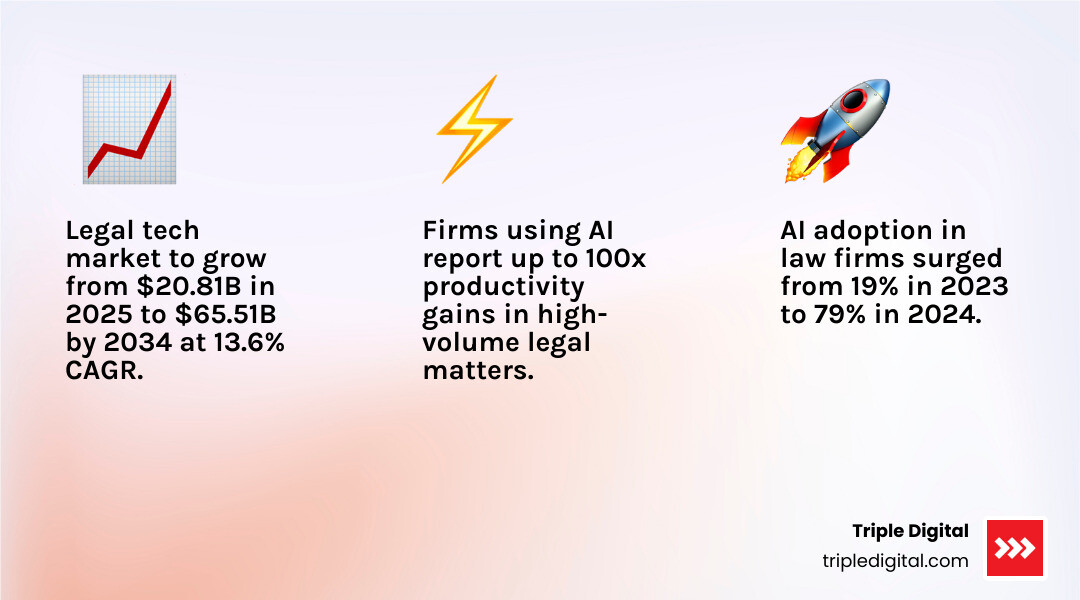
The numbers tell a clear story. The global legal tech market was valued at $20.81 billion in 2025 and is projected to reach $65.51 billion by 2034. AI adoption inside law firms jumped from just 19% in 2023 to 79% in 2024 — one of the fastest technology adoption curves any professional services industry has ever seen.
Firms that move now build compounding advantages. Those that wait are already behind.
But speed alone isn’t enough. Deploying AI without a clear strategy creates real risks — ethics violations, confidentiality breaches, and wasted spend. This guide covers everything you need to grow your firm with AI the right way.
Structuring Your AI Lawyer Growth Strategy for Market Dominance
To dominate the legal market in 2026, we have to look beyond simple automation. Leading firms are restructuring their entire practice to capture the massive influx of AI-related legal work. This isn’t just about using tools; it’s about becoming the “lawyers to the innovators.”
A winning AI lawyer growth strategy involves a multidisciplinary approach. You aren’t just providing legal advice; you are helping clients navigate the “wild west” of model governance, data scraping litigation, and authorship rights. For instance, the fair use doctrine is currently being redefined by cases involving large language models. Firms that position themselves as experts in these first-of-their-kind issues—like copyright bias and agentic AI—are seeing the highest revenue growth.
We’ve found that a successful Guide to Law Firm AI Strategies must include a robust governance framework. This ensures that while you are chasing market share, you aren’t sacrificing model transparency or client trust.
Capturing Market Share through Specialized AI Legal Services
The fastest-growing revenue streams in 2026 are found in specialized AI services. We are seeing a massive surge in:
- AI Litigation Support: Handling precedent-setting cases involving DMCA claims and allegations of model misuse.
- Regulatory Compliance: Navigating complex state, federal, and global investigations into data use.
- Healthcare AI: Advising on clinical decision support systems and the specific FDA regulatory pathways required for AI-based medical devices.
- Predictive Analytics: Using advanced tools to forecast case outcomes. To understand how this changes the game, check out our insights on Beyond the Gavel: Using AI for Predictive Analytics in Legal Proceedings.
By mitigating bias in AI models and ensuring compliance with emerging biometric privacy laws, firms can charge premium rates for high-stakes advisory work that traditional generalists simply cannot handle.
Scaling with an AI Lawyer Growth Strategy in Mid-Sized Firms
You don’t need an AmLaw 100 budget to win. In fact, mid-sized firms often have an “entrepreneurial agility” that allows them to deploy custom tools faster than their massive competitors.
By building in-house agents and bespoke models tailored to specific workflows, smaller firms can achieve competitive parity. This involves replacing expensive, old-school reporting infrastructure with AI-driven data aggregation. Instead of spending $400,000 a year on manual data visualization, we’ve seen firms use AI to do the same work for a fraction of the cost—sometimes reducing reporting expenses by 99%.
Leveraging AI Tools for Law Firm Marketing allows mid-sized firms to scale their case acquisition without a massive increase in headcount. The key is to focus on the “relationship layer” while letting AI handle the heavy lifting of data mining and lead qualification.
Revolutionizing Law Firm Business Models and Pricing
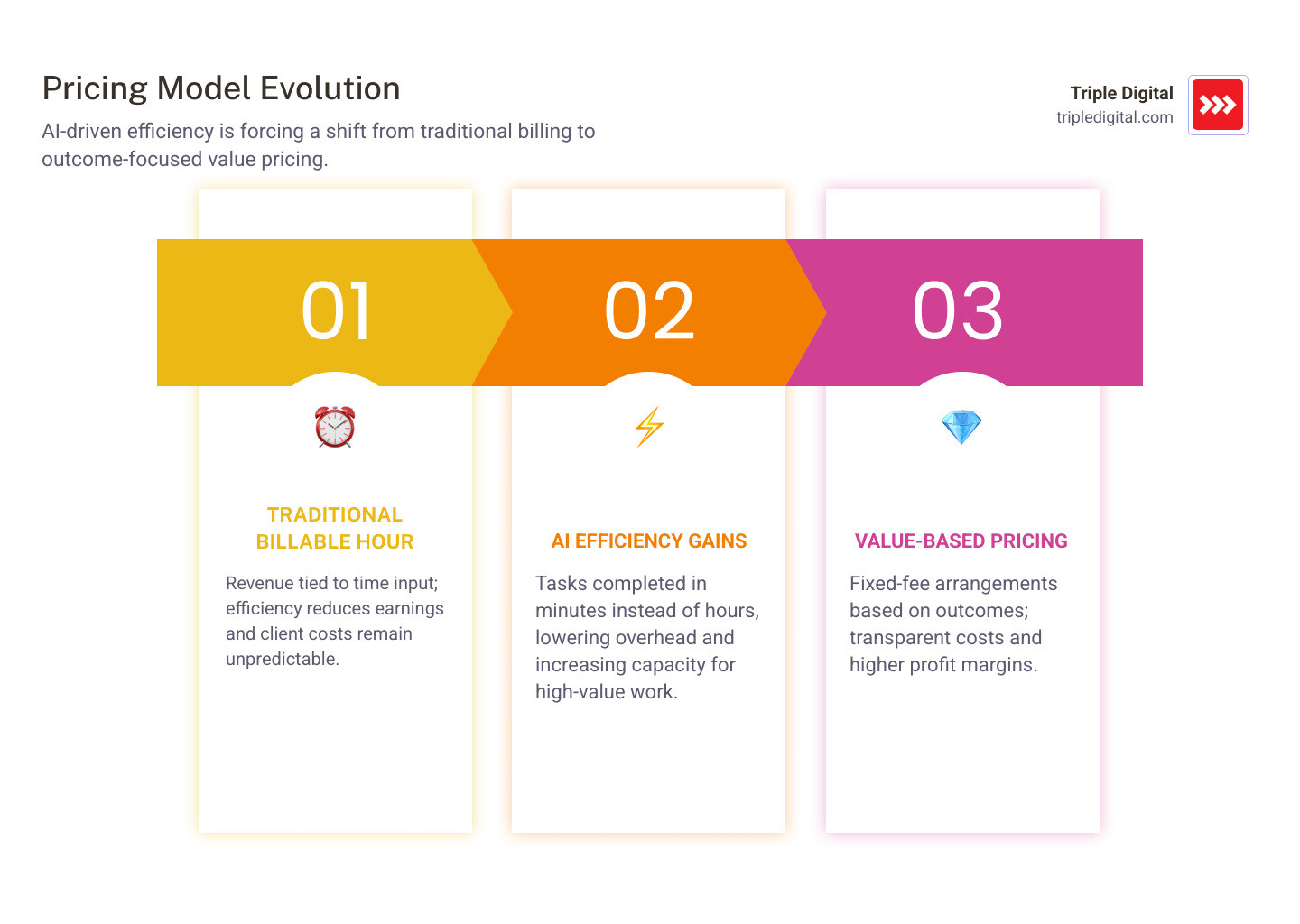
The “billable hour” has been the bedrock of law for decades, but an AI lawyer growth strategy is forcing a radical evolution. When a task that used to take 16 hours now takes 4 minutes, the old model breaks.
| Feature | Traditional Billable Hour | AI-Driven Value Pricing |
|---|---|---|
| Primary Metric | Time spent (Input) | Results/Outcome (Output) |
| Efficiency Incentive | Low (More hours = more revenue) | High (Faster work = higher margin) |
| Client Transparency | Often unpredictable | Clear, upfront costs |
| Scalability | Limited by human hours | Exponentially scalable |
We are seeing a shift toward alternative pricing and value-based billing. Clients in 2026 expect transparency and are increasingly resistant to paying “learning curve” rates for junior associates. By using fixed-fee arrangements for document-heavy matters, firms can actually expand their profit margins through AI efficiency while keeping clients happy.
Productivity Gains and Staffing Evolution in the AI Era
The legal workforce is changing. We aren’t seeing a reduction in practicing attorneys, but we are seeing the rise of the “Legal Engineer” and the “Lawyer-Data Scientist.”
AmLaw 100 firms are reporting productivity gains of over 100x in high-volume litigation matters. This doesn’t mean firms are firing people; it means they are adding more value. Associates are being trained to use AI for document summary and contract analysis, allowing them to focus on high-level strategy rather than clerical drudgery.
To stay ahead, you must understand Future-Proof Your Firm: The AI Advantage in Legal Marketing. Skill valuation is shifting toward those who can effectively prompt and supervise AI systems to produce high-quality, error-free work at scale.
Navigating Ethical, Regulatory, and Confidentiality Risks
Growth is great, but safety is paramount. The legal industry has zero tolerance for error, and AI “hallucinations” have already led to judicial sanctions.
Under ABA Model Rule 7.1 and various state bar rules, attorneys must maintain “human-in-the-loop” review for all AI-generated content. We’ve seen a 340% increase in DOJ investigations regarding AI-driven advertising discrimination. If your targeting algorithm accidentally excludes a protected class, you are liable.
Confidentiality is the biggest hurdle. Using free, consumer-grade AI tools can lead to a waiver of attorney-client privilege. Every AI lawyer growth strategy must include strict confidentiality protocols and the use of enterprise-grade, closed AI systems. For a deeper dive into how to handle AI-generated text without losing your firm’s soul (or license), read The Key to AI Written Content.
Implementing Governance Frameworks for an AI Lawyer Growth Strategy
A defensible posture requires more than just a policy; it requires an audit trail. Modern firms are appointing “AI Ethics Officers” to oversee:
- Algorithmic Bias Testing: Ensuring marketing and intake tools aren’t discriminatory.
- HIPAA and Biometric Privacy: Protecting sensitive health and personal data.
- Data Ownership: Clarifying who owns the prompts and the outputs.
- Attorney Generative AI Rankings: Staying updated on which models are actually performing. You can find the latest data in the Attorney Generative AI Rankings 2026.
By creating structured case methodologies, you ensure that every AI-assisted matter meets the same high standard of quality control.
Maximizing ROI through AI-Driven Marketing and Lead Generation
This is where we at Triple Digital excel. We’ve seen that firms using AI-driven analytics report a 38% improvement in marketing ROI within just 6-12 months.
An effective AI Digital Marketing for Law Firms strategy uses predictive analytics to score leads. Instead of chasing every phone call, AI identifies the leads with a 50-60% higher chance of becoming a high-value case.
Furthermore, AI-powered personalization increases client engagement by 45%. Whether it’s a personalized email sequence or a chatbot that can answer specific legal FAQs in real-time, AI makes the client feel heard instantly. And because AI can reduce content production time by 75%, you can dominate search results with high-authority content that uses “semantic variety” to capture zero-click searches.
Evaluating AI Tools for Practice Area Specific Growth
Not all AI is created equal. A tool that is great for contract analysis might be useless for personal injury lead generation.
- Perplexity AI: Excellent for real-time web access and citation verification.
- Lexis+ AI & CoCounsel: The gold standard for legal research and document review.
- Harvey: A powerful, enterprise-first platform used by elite global firms for complex workflows.
- Triple Digital’s AI Tool: We’ve developed specialized tech to help you win. Triple Digital Unveils Groundbreaking AI Tool to Help Law Firms Outrank Competitors Online.
When evaluating tools, look for multimodal capabilities (the ability to process text, audio, and video) and “Pro Search” modes that allow for deep, iterative research.
Frequently Asked Questions about AI Lawyer Growth
How do law firms measure the ROI of AI infrastructure and talent?
We look at several key metrics. Beyond just “cost savings,” we track Cost Per Signed Case and Consultation Conversion Rates. If your AI tool reduces attorney marketing workload by 60%, that’s hundreds of hours redirected to billable work. We also see a significant boost in client retention rates when AI is used to provide faster, more accurate updates on case progress.
What are the biggest ethical risks when using AI for client marketing?
The biggest risks are confidentiality breaches (inputting client data into public LLMs) and advertising rule violations. Some state bars have issued over 100 ethics complaints in a single year regarding AI-generated ads. There is also the risk of the “unauthorized practice of law” if a chatbot provides specific legal advice rather than general information. Always ensure a human attorney supervises every AI output.
Can smaller firms compete with AmLaw 100 resources using AI?
Absolutely. In fact, we believe AI is a “technology leveler.” While the biggest firms have deep pockets, they also have massive, slow-moving bureaucracies. A smaller, entrepreneurial firm can build custom, bespoke models and niche specializations much faster. By focusing on the “relationship layer” and using AI for operational efficiency, a solo or mid-sized firm can deliver a “big firm” experience at a much lower overhead.
Conclusion
The legal landscape has shifted. An AI lawyer growth strategy is no longer a futuristic concept—it is the engine of the modern law firm. At Triple Digital, we help firms navigate this transition with a “less fluff, more cases” approach. Based in Houston, TX, we specialize in high-precision lead generation and case acquisition through advanced data mining and AI targeting.
If you are ready to outrank your competitors and future-proof your practice, explore our AI Overview to see how we can help you dominate your market in 2026 and beyond.