





Why Attorney AI Ad Targeting Is Changing How Law Firms Win Clients
Attorney AI ad targeting is transforming legal marketing — and if your firm is still relying on traditional advertising methods, you’re likely paying more and getting less.
Here’s a quick breakdown of what it is and why it matters:
What is attorney AI ad targeting?
- It’s the use of machine learning and predictive algorithms to show your ads to the people most likely to need your legal services — at the right time, on the right platform
- Platforms like Google Ads and Meta Ads already embed AI into bidding, audience selection, and ad assembly — whether firms realize it or not
- AI targeting goes beyond basic demographics, using behavioral signals, search intent, and lookalike modeling to find high-value prospects
Why it matters right now:
- Over 70% of law firms now use AI-driven tools for client acquisition and engagement
- Law firms using AI-driven analytics have seen up to a 40% increase in marketing ROI compared to traditional strategies
- AI-driven PPC campaigns have helped firms boost lead generation by up to 50%
- Legal advertising is one of the most expensive ad categories — with cost-per-click exceeding $100 in major markets like Los Angeles, Houston, and New York
The stakes are high. Legal consumers are also changing how they search — moving from Google queries to conversational AI tools like ChatGPT. Firms that adapt now build a compounding advantage. Those that don’t keep paying premium CPCs for shrinking returns.
This guide covers everything: how AI targeting actually works, which platforms do it best, how to stay compliant with ABA rules, and how firms of any size can put it to work.
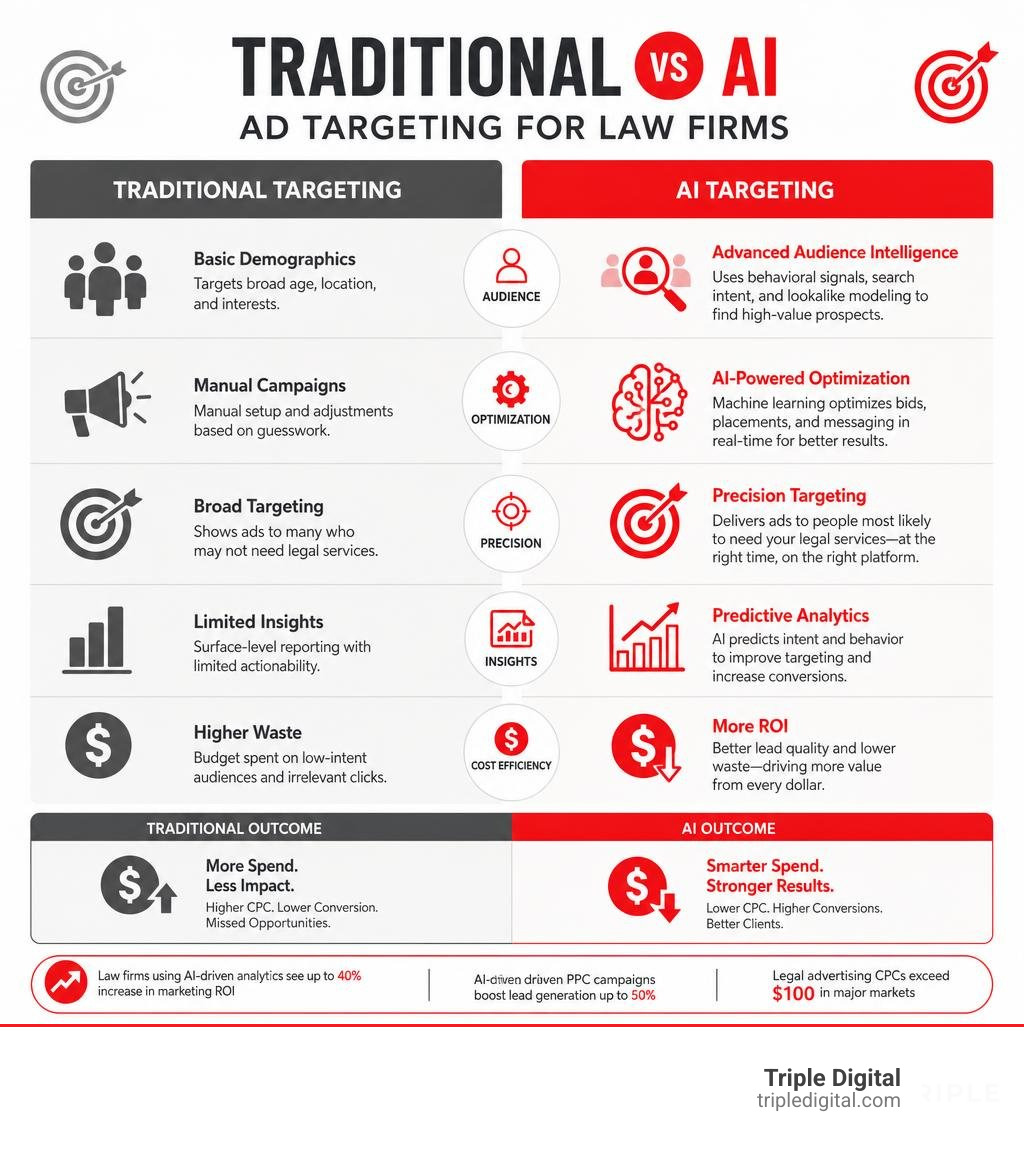
Terms related to Attorney AI ad targeting:
What Is Attorney AI Ad Targeting and How Does It Work?
To understand how Attorney AI ad targeting works, we must first look at how traditional legal advertising has historically operated. For decades, law firms relied on broad-brush marketing: billboards along the highway, television spots during evening news broadcasts, or basic Google PPC campaigns targeting wide keyword matches like “personal injury lawyer.”
While these methods can build general brand awareness, they are incredibly inefficient. You end up paying to display your message to thousands of people who have absolutely no need for legal representation.
AI-powered ad targeting flips this model on its head. Instead of casting a wide net and hoping for the best, artificial intelligence relies on predictive modeling, advanced audience segmentation, and deep data mining to place your ads in front of high-intent prospects at the exact moment they need assistance.
| Feature | Traditional Legal Advertising | AI-Powered Legal Ad Targeting |
|---|---|---|
| Targeting Method | Broad demographics, geographic location, basic keywords | Behavioral signals, predictive modeling, search intent, lookalikes |
| Bidding Strategy | Manual bidding on static keywords | Real-time smart bidding optimized for case conversions |
| Ad Delivery | Static creatives shown to all users | Dynamic ad creatives assembled in real time based on user profile |
| Data Utilization | Historical, delayed performance metrics | Real-time data mining and continuous algorithm learning |
| Cost Efficiency | High wasted spend on low-intent clicks | Low cost-per-lead due to continuous optimization and negative auditing |
At its core, AI targeting works by analyzing massive datasets to identify patterns in user behavior. For example, before a user explicitly searches for a divorce attorney, their online behavior may change in subtle ways—such as researching asset division, reading articles on co-parenting, or visiting financial planning websites.
AI algorithms recognize these behavioral clusters and flag the user as a high-intent prospect. By utilizing proprietary data mining techniques, modern platforms can identify these prospective clients before your competitors even know they exist. To see how we are leveraging these advanced data techniques to revolutionize case acquisition, read about how Triple Digital Revolutionizing Legal Tech: Pinpoint Unveils Industry-First Data Mining Software to Precisely Target Prospective Clients.
By combining search intent with historical data, AI-driven systems build highly accurate predictive models. Instead of guessing which ad copy will resonate, the AI tests hundreds of micro-variations of headlines and images, serving the optimal combination to each unique user. This ensures your marketing budget is spent only on the most qualified prospects, transforming your digital presence into a highly efficient AI-Driven Law Marketing engine.
How Machine Learning Powers Attorney AI Ad Targeting on Major Platforms
The major advertising platforms—Google, Meta, and LinkedIn—have all transitioned to “AI-first” ecosystems. When you run campaigns on these channels, you are already using machine learning, but maximizing your ROI requires understanding how each platform’s algorithms function in a legal context.
Google Ads: Smart Bidding and Quality Score Optimization
Google Ads is the battlefield for high-intent legal searches. In highly competitive metro areas like Houston, TX, paying over $100 per click is common. To survive, your campaigns must leverage Google’s Smart Bidding.
Smart Bidding uses machine learning to optimize for conversions or conversion value in every single auction—a process known as “auction-time bidding.” The algorithm analyzes contextual signals such as the user’s exact device, location, time of day, browser, and search history to calculate the exact likelihood of that click turning into a signed case.
Furthermore, Google’s AI rewards ad relevance. By maintaining a high Quality Score—which the AI calculates by matching your ad copy tightly to the search query and the landing page content—you can dramatically lower your cost-per-click (CPC).
Meta Ads: Advantage+ and Lookalike Audiences
Meta (Facebook and Instagram) specializes in behavioral targeting. Because users rarely search for a lawyer on social media, Meta’s AI relies on its Advantage+ system to find prospects. Advantage+ automates audience targeting and creative testing, dynamically serving different ad variations to users based on their interests and past interactions.
Additionally, we can feed offline conversion data—like your signed retainer agreements—back into Meta’s AI. The machine learning model analyzes the digital profiles of your actual signed clients and builds highly accurate “lookalike audiences.” The system then targets Facebook and Instagram users in your local market who share those exact behavioral characteristics, finding new clients who match your best historical cases.
LinkedIn Ads: Account-Based Targeting for B2B and Corporate Law
For corporate law, business litigation, or employment defense firms, LinkedIn Ads provides unmatched professional targeting. LinkedIn’s machine learning algorithms allow us to target decision-makers, general counsel, and executive stakeholders. By using buying-committee logic, the AI can deliver tailored messages to different stakeholders within the same target corporation, ensuring your firm remains top-of-mind when corporate legal needs arise.
To learn how to structure your campaigns across these platforms for maximum impact, check out The Definitive Guide to Paid Advertising for Lawyers.
The Shift to Conversational Search and AI Overviews
The way consumers find legal help is undergoing the most significant shift since the birth of search engines. In 2026, search behavior is no longer limited to typing short, fragmented keywords into a search bar. Instead, millions of legal consumers are having natural, conversational interactions with AI engines like ChatGPT, Google Gemini, and Perplexity.
This shift has introduced two major challenges and opportunities for law firms:
- The Rise of Zero-Click Searches: Traditional search engines display a list of links, forcing the user to click through to a law firm’s website. AI search engines, however, provide direct, summarized answers directly on the search page. This means traditional organic traffic may decrease, but the users who do click through possess much higher intent.
- Conversational, Intent-Rich Queries: Instead of searching “Houston car accident lawyer,” a user might ask ChatGPT: “I was rear-ended by a commercial truck on I-45 in Houston, the driver was speeding, and my insurance is refusing to cover my medical bills. What are my options under Texas law?”
These conversational queries are incredibly specific and reveal exact pain points. To capture this traffic, forward-thinking law firms are running educational ad campaigns within conversational AI platforms. Because platforms like OpenAI have strict rules against direct solicitation or advertising legal representation, the key is to advertise highly valuable, educational resources—such as a free Texas truck accident informational guide—hosted on an unbranded, informational subdomain.
By positioning your firm as the trusted educational resource inside the AI’s conversation, you build incredible credibility before the prospect even speaks to an attorney. To ensure your website and content are optimized to be summarized and cited by these conversational search engines, explore our Guide to AI Overview Optimization for Lawyers.
Key Benefits of AI-Driven Advertising for Law Firms
Implementing Attorney AI ad targeting is not just about keeping up with technology; it is about protecting your firm’s bottom line. In highly competitive legal markets, traditional agencies that log into your ad accounts once a month to make manual adjustments simply cannot compete with algorithms that optimize your campaigns every 24 hours.
When you transition to an AI-driven marketing strategy, your firm unlocks several massive advantages:
- Significantly Lower Cost Per Lead (CPL): By automating search term audits and instantly pausing underperforming keywords, AI minimizes wasted ad spend. Many firms experience up to a 68% reduction in CPL compared to traditional agency-managed campaigns with the same ad spend.
- Improved Lead Quality: AI doesn’t just look for clicks; it looks for cases. By feeding signed case data back into the machine learning models, the system continuously refines its targeting to focus on high-value catastrophic injuries, complex business disputes, or highly qualified family law matters.
- Improved Marketing ROI: Firms leveraging AI-driven analytics have seen an average 40% increase in marketing ROI compared to traditional strategies. This is driven by smarter budget allocation, higher conversion rates, and better overall campaign efficiency.
- Rapid Market Deployment: Traditional campaign setup across multiple ad networks can take weeks of manual copywriting, design, and technical configuration. With specialized AI tools, you can launch highly targeted, cross-channel campaigns across Google, Meta, and LinkedIn in under two minutes.
To understand how to position your firm to capture these compounding benefits, read our guide on how to Future-Proof Your Firm: The AI Advantage in Legal Marketing.
To measure the success of your AI campaigns, you must track the metrics that actually impact your firm’s revenue, rather than relying on vanity metrics like impressions or clicks. We recommend focusing on the following key performance indicators (KPIs):
- Cost Per Signed Case (CPSC): The total ad spend divided by the number of actual signed retainer agreements. This is the ultimate metric of marketing efficiency.
- Lead-to-Opportunity Conversion Rate: The percentage of incoming leads that meet your firm’s case criteria and are marked as qualified opportunities.
- Cost Per Lead (CPL): The average cost to generate a phone call, form submission, or chat inquiry.
- Average Quality Score: Google’s rating of the relevance and quality of your keywords, ads, and landing pages. Higher Quality Scores directly cut your cost-per-click.
- Return on Ad Spend (ROAS): The total fee value generated from cases acquired through paid ads divided by your total ad spend. Across our legal clients, we see an average of 4.8x ROAS.
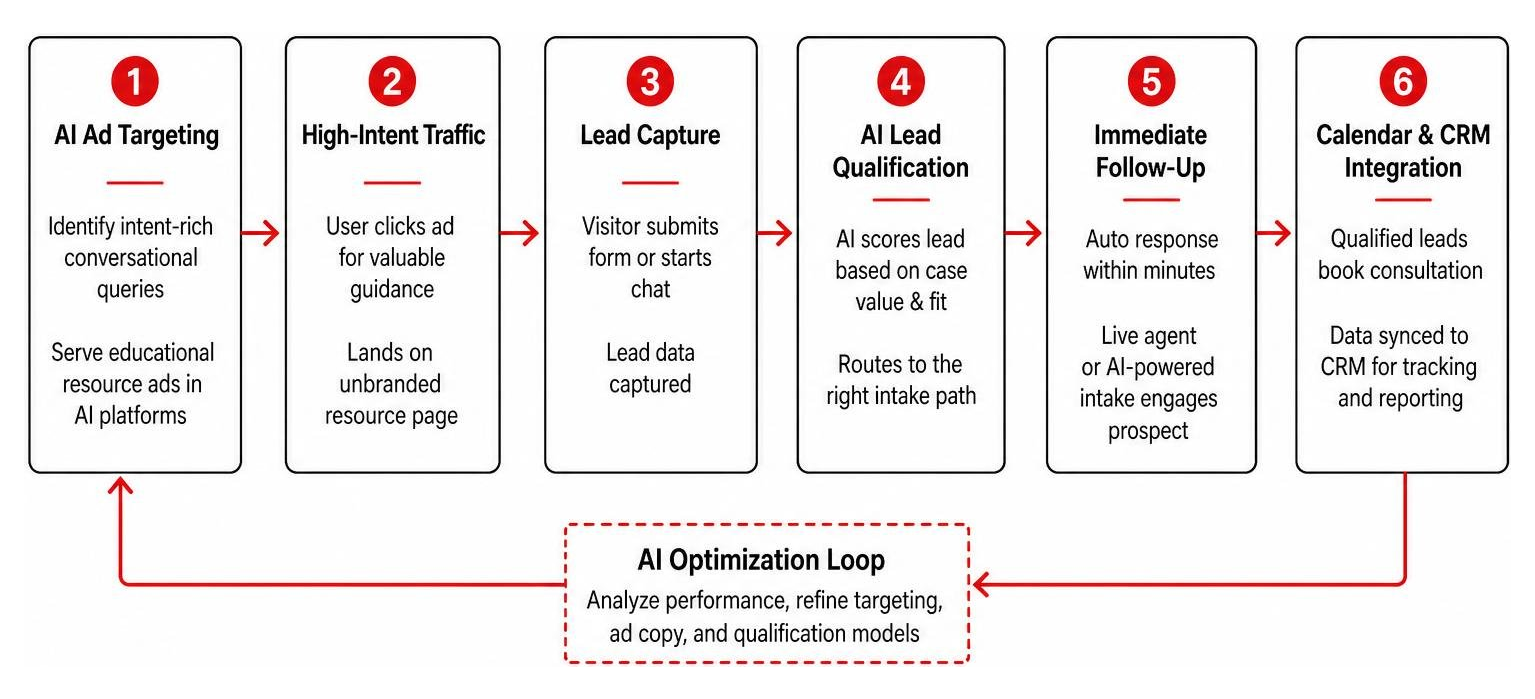
Automated Lead Qualification and Intake Integration
Generating a lead is only half the battle. In the legal industry, “speed-to-lead” is everything. If a car accident victim or a business owner facing an urgent lawsuit contacts your firm and doesn’t receive a response within five minutes, they will call your competitor.
AI-driven lead qualification and intake automation bridge the gap between ad clicks and signed retainers. When a lead is captured via your AI-targeted ads, the data is instantly processed through an automated CRM system.
Here is how AI transforms the intake process:
- 24/7 Virtual Intake Assistants: AI-powered chatbots and virtual assistants can engage with prospects instantly, answering common questions and collecting essential case details at any hour of the night. This has been shown to improve client response times by up to 60%.
- Intelligent Lead Scoring: The AI analyzes the intake conversation or form submission to instantly score the lead. If the system detects high-value indicators—such as a catastrophic commercial vehicle accident or a clear statute-of-limitations deadline—it flags the case and alerts your intake team for immediate human follow-up.
- Bilingual Call Routing: Advanced AI call analytics can automatically detect whether a caller prefers English or Spanish, routing them to the appropriate bilingual intake specialist and ensuring you don’t lose valuable cases due to language barriers.
- Automated Follow-Up Sequences: If a lead doesn’t sign a retainer immediately, AI-personalized email and SMS campaigns maintain engagement, improving overall client conversion rates by 30%.
While AI handles the speed and data processing, human empathy remains irreplaceable during sensitive intake conversations. The ideal system combines machine precision with human conversion. To learn how to implement these automated workflows in your practice, check out our Guide AI Automation for Lawyers.
Cost Optimization and Budget Reallocation
One of the biggest frustrations lawyers have with traditional marketing agencies is the lack of agility. If a major news story breaks or a high-value mass tort opportunity arises, waiting days for an account manager to reallocate your budget can mean missing the market entirely.
AI ad management systems solve this by conducting real-time budget optimization and negative keyword auditing. Every morning, the AI logs into your accounts to analyze search terms, identify wasted spend, and automatically shift budget to the top-performing ad groups.
For example, if your Houston criminal defense campaigns are seeing an influx of low-intent searches like “free legal aid,” the AI instantly adds those terms as negative keywords. This prevents your budget from being drained by clicks that will never turn into paying cases.
By continuously improving your Quality Score and removing low-performing assets, AI-driven platforms can cut your average CPC by up to 50%, allowing you to dominate local search results without increasing your monthly ad spend. To explore the power of data-driven budget management, read more about Data-Driven Legal Marketing.
Compliance, Ethics, and ABA Rules in AI Legal Marketing
While the technological advantages of Attorney AI ad targeting are clear, law firms operate under a strict regulatory framework. You cannot simply hand your marketing over to an autonomous AI agent and hope for the best. As attorneys, we are ultimately responsible for ensuring that every piece of ad copy, every targeting method, and every landing page complies with our state bar association rules.

When using AI for legal marketing, several American Bar Association (ABA) Model Rules must be kept at the forefront of your strategy:
- ABA Model Rule 7.1 (Communications Concerning a Lawyer’s Services): This rule strictly prohibits making false or misleading claims. AI models are prone to “hallucinations”—meaning they can confidently generate incorrect legal information, non-existent statutes, or misleading success rate claims. Every single ad headline and landing page draft generated by AI must undergo a line-by-line attorney review before going live.
- ABA Model Rule 5.3 (Responsibilities Regarding Nonlawyer Assistance): This rule dictates that lawyers must properly supervise non-lawyer assistants—which includes AI software. You cannot use “the AI wrote it” as a defense if a state bar committee flags an ad as non-compliant.
- ABA Model Rule 1.6 (Confidentiality of Information): When utilizing AI tools for audience targeting or content generation, you must never upload confidential client data, full case files, or sensitive medical records into public AI models. Doing so can violate client confidentiality and expose your firm to severe liability.
To explore the specific AI tools that are built with legal compliance in mind, read our breakdown of AI Tools for Law Firm Marketing.
Best Practices for Implementing Attorney AI Ad Targeting Safely
To leverage the incredible efficiency of AI while maintaining absolute compliance with state bar regulations, your firm should adopt a “human-in-the-loop” approach.
Here are the best practices we recommend to our clients:
- Mandatory Attorney Sign-Off: Establish a strict internal policy that no AI-generated ad copy, social media post, or landing page is published without final approval from a licensed attorney.
- Localize and Fact-Check AI Drafts: AI is excellent at creating initial drafts, outlines, and campaign structures. However, it lacks an understanding of jurisdiction-specific nuances. Ensure your legal team localizes every piece of content to reflect Texas statutes and local court procedures.
- Maintain Direct Data Ownership: Avoid using marketing agencies that restrict access to your ad accounts or keep your campaign data in proprietary silos. Ensure your firm retains direct ownership of your Google Ads, Meta, and LinkedIn accounts.
- Use Clear Disclaimers: Ensure all AI-targeted landing pages contain clear, conspicuous disclaimers stating that the information provided is for educational purposes only and does not constitute legal advice or establish an attorney-client relationship.
By combining AI efficiency with strict human oversight, you can scale your firm safely and ethically. For a comprehensive roadmap on scaling your practice, read our Guide to AI Lawyer Growth Strategy.
Mitigating Hallucinations and Platform-Specific Risks
In addition to state bar rules, law firms must navigate platform-specific advertising policies. Social media and search networks rely heavily on automated AI systems to review and approve ads. Because these platform algorithms are highly sensitive, they frequently flag legitimate legal ads as policy violations.
For example, Meta’s automated ad review system often flags basic legal ads containing words like “court,” “civil lawsuit,” “county,” or “arrest” as political or social issue content. This can lead to immediate ad disapproval and, in severe cases, account suspension.
To mitigate these platform-specific risks:
- Avoid Trigger Words: Structure your ad copy to avoid overly aggressive, dramatic, or politically adjacent terminology that might trigger automated flagging.
- Leverage Human Appeals: When a compliant ad is mistakenly disapproved by an platform’s automated system, immediately submit a request for manual human review to resolve the issue.
- Stay Up-to-Date on Platform Policies: Large language models and ad networks update their advertising guidelines constantly. For instance, OpenAI’s ad policy explicitly prohibits direct ads for legal representation but permits general legal education. Navigating these nuances requires working with partners who understand the latest platform capabilities. To see how different legal AI systems rank in terms of performance and safety, consult our Attorney Generative AI Rankings 2026.
Frequently Asked Questions About AI Legal Ads
How does AI ad targeting improve lead quality for law firms?
AI ad targeting improves lead quality by shifting the focus from broad keywords to real-time search intent and user behavior. Instead of showing your ads to anyone searching for a lawyer, the algorithms analyze contextual signals—such as specific long-tail questions, local geographic data, and online research patterns—to identify prospects who are actively seeking representation. By importing signed case data back into the ad networks, the AI continuously refines its audience targeting, focusing your budget on the specific demographics and behaviors that result in signed retainers rather than empty phone calls.
Is AI-driven legal advertising compliant with state bar rules?
Yes, AI-driven legal advertising is fully compliant, provided that your firm maintains strict human oversight. Under ABA Model Rules 7.1 and 5.3, attorneys are responsible for ensuring that all public communications are truthful and non-misleading. AI should be used as a powerful tool to draft copy, identify target audiences, and optimize bidding, but a licensed attorney must review and approve all final ad creatives and landing page content before they go live to ensure compliance with local state bar guidelines.
How can smaller law firms leverage AI without a massive budget?
Smaller law firms can easily leverage AI without building expensive in-house tech infrastructure. By partnering with specialized digital marketing agencies that already possess advanced AI tools and proprietary data mining software, boutique and mid-sized firms can access enterprise-level targeting capabilities. Many of these partnerships operate on scalable models, allowing smaller firms to compete directly with large, high-budget practices in local markets like Houston by targeting niche practice areas with incredible precision.
Accelerate Your Case Acquisition with Smarter Legal Marketing
The digital landscape for law firms is changing faster than ever. As we navigate 2026, relying on outdated, manual advertising strategies is a recipe for high marketing costs and missed opportunities. Implementing Attorney AI ad targeting is the most effective way to eliminate wasted ad spend, lower your cost per signed case, and consistently attract high-value clients.
At Triple Digital, we don’t believe in vanity metrics or empty promises. Based in Houston, TX, we are a results-driven digital marketing agency specializing in high-performance lead generation and case acquisition for law firms. Our approach is simple: “less fluff, more cases.” By leveraging cutting-edge machine learning and our industry-first data mining software, we help law firms precisely target prospective clients and dominate their local markets.
If you are ready to stop overpaying for clicks and start signing more high-quality cases, we are here to help. Contact us today or schedule a meeting with our team of legal marketing experts to get a personalized audit of your current ad campaigns and discover how AI can revolutionize your firm’s growth.