



Why AI in Legal Marketing Matters Now
AI in legal marketing is reshaping how law firms attract and convert clients in 2025. Here’s what you need to know:
Quick Answer: What is AI in Legal Marketing?
- Content Creation – AI drafts blog posts, emails, and social media content faster
- Lead Generation – Predictive analytics identify high-intent prospects
- Client Communication – Chatbots provide 24/7 responses and qualify leads
- Search Optimization – AI helps firms rank in Google AI Overviews and voice search
- Data Analysis – AI tracks campaign performance and competitor strategies
- Personalization – AI segments audiences and tailors messaging at scale
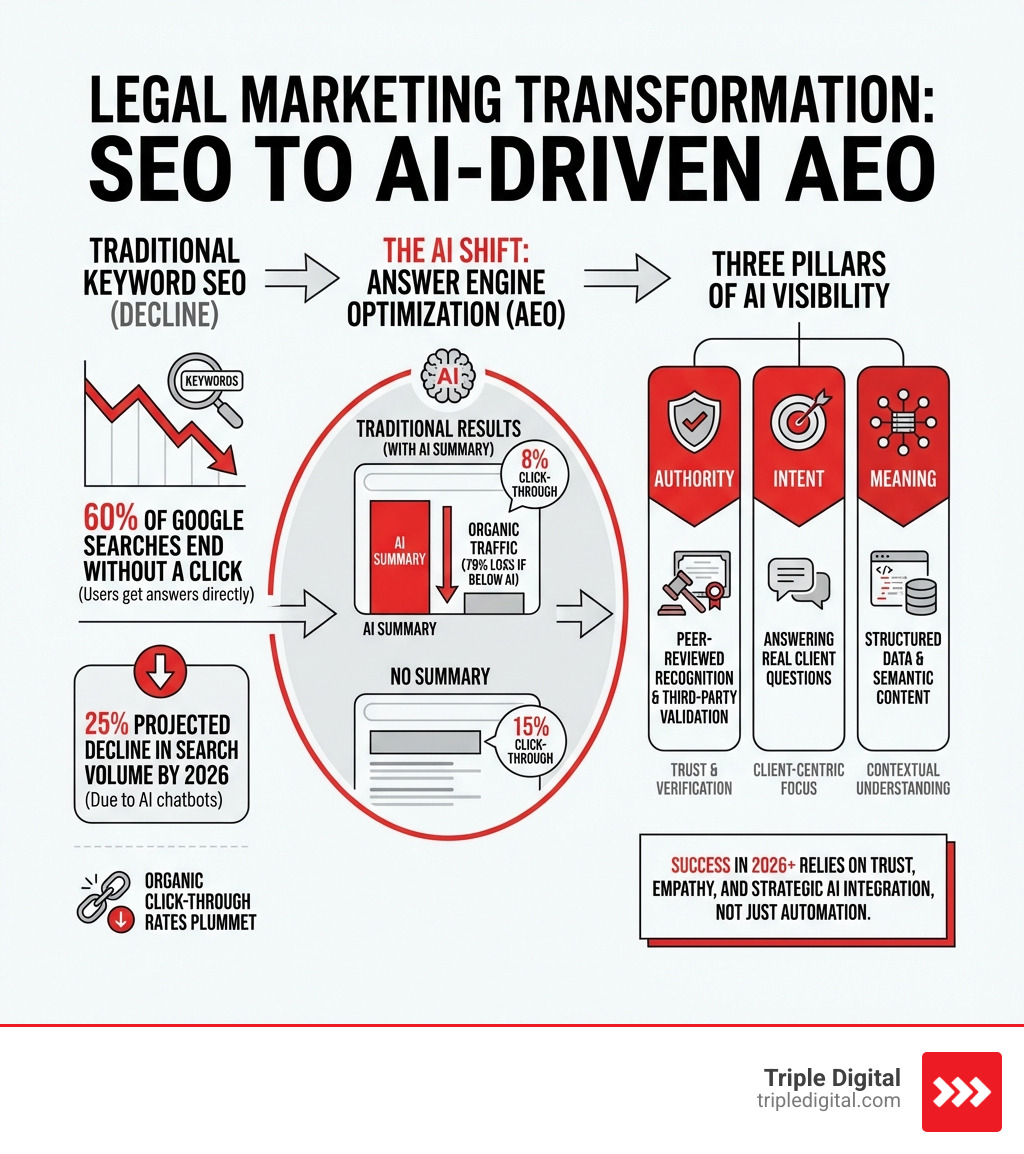
The legal industry is facing a defining moment. About 60% of Google searches now end without a click, as users get answers directly from AI platforms like ChatGPT, Perplexity, and Google AI Overviews. Gartner predicts search engine volume could decline 25% by 2026 due to AI chatbots and virtual agents.
This isn’t about fewer people needing lawyers. It’s about people finding lawyers differently.
Traditional keyword-based SEO is giving way to Answer Engine Optimization (AEO), where trust and verification matter more than keyword density. When AI summaries appear in Google results, users click traditional results only 8% of the time, compared with 15% when no summary is shown. A site previously ranked first could lose about 79% of its traffic if results appear below an AI overview.
Meanwhile, 51% of marketing leaders are already using AI, yet only 9% have measured ROI and just 5% report clear positive returns. The gap between adoption and results reveals a critical truth: AI is a tool, not a silver bullet.
Law firms that succeed will be those who integrate AI strategically—not just to automate tasks, but to enhance what makes their practice human: expertise, empathy, and trust.
Handy AI in legal marketing terms:
The Evolution of AI in Legal Marketing
The shift we are seeing today is the most significant change since the birth of the search engine itself. In the early days, legal marketing was simple: buy a Yellow Pages ad or a billboard. Then came the era of “traditional SEO,” where we focused on keywords like “Houston personal injury lawyer.”
Today, we have entered the era of Generative Search. Large Language Models (LLMs) like ChatGPT and AI Overviews don’t just provide a list of blue links; they provide a coherent answer. If a potential client asks, “What should I do after a car accident in Houston?”, the AI summarizes the steps and suggests specific firms based on authority and data, not just keyword density.
This “zero-click” trend means firms must adapt or become invisible. When users get their answers directly on the search results page, they don’t need to visit your website to get the information they need. However, they do need to see your firm cited as the authoritative source for that information.
How AI in Legal Marketing is Transforming Client Discovery
Search behavior is becoming increasingly fragmented. While Google still dominates, prospective clients are moving toward an “ask and receive” model.
- Voice and Visual Search: Voice search now powers 40% of online queries. Clients are asking Siri or Alexa, “Find a divorce attorney near me,” which requires content optimized for natural, conversational language.
- Answer Engine Optimization (AEO): Unlike traditional SEO, AEO focuses on providing the best direct answer to a query. To win here, your firm needs structured data (Schema markup) that tells AI exactly who you are, what you do, and why you are an expert.
- Third-Party Validation: AI models prioritize “sources of truth.” They look at peer reviews, legal directories, and independent recognitions to decide which lawyers to recommend.
At Triple Digital, we recognize that staying ahead requires more than just standard tactics. That’s why Triple Digital LLC Unveils Groundbreaking AI Tool to Help Law Firms Outrank Competitors Online, focusing on these new signals that AI platforms crave.
Balancing AI in Legal Marketing with Human Expertise
While the efficiency of AI in legal marketing is undeniable, we must remember that the law is a “human-to-human” business. A chatbot can answer a question about a statute, but it cannot offer the empathy a grieving family needs after a wrongful death.
Firms leaning too heavily on unedited AI output risk losing their brand authenticity. Clients can often sense generic, “robotic” communication. The goal is to use AI to handle the “heavy lifting”—data analysis, initial drafts, and scheduling—so that your attorneys have more time for high-value human interaction.
Every piece of AI-generated content must be reviewed by a human hand to ensure it aligns with your firm’s unique voice and values. To understand how to get this right, check out our guide on The Key to AI-Written Content.
High-Impact Use Cases for Case Acquisition
If you want to move beyond “experimenting” and start seeing more cases, you need to apply AI in legal marketing to the areas that drive the most ROI. Here are the most effective tactics we use:
- Lead Generation & Data Mining: Instead of waiting for the phone to ring, we use AI to identify high-intent prospects. For example, Revolutionizing Legal Tech: Pinpoint Unveils Industry-First Data Mining Software to Precisely Target Prospective Clients allows us to find the exact people who need your services right now.
- AI Chatbots (Virtual Receptionists): Tools like Smith.ai use natural language processing to qualify leads 24/7. They can route calls, schedule consultations, and answer basic questions, ensuring you never miss a lead because it’s 2:00 AM.
- Predictive Analytics: We can now use data to predict which marketing channels will yield the highest-value cases. This is similar to how lawyers are Using AI for Predictive Analytics in Legal Proceedings to forecast judge behaviors or case outcomes.
- Content Repurposing: AI can take one high-quality webinar or long-form article and “remix” it into ten social media posts, three emails, and a video script, maximizing your reach with minimal effort.
- Competitive Intelligence: AI tools can monitor your competitors’ reviews and ad spend, highlighting gaps in their service (like slow response times) that your firm can exploit in its own messaging.
Navigating Ethics and Data Security
As a law firm, your duty to protect client confidentiality is paramount. You cannot simply plug sensitive client data into a public version of ChatGPT.
The American Bar Association (ABA) has issued clear guidance: attorneys must maintain “technological competence” and ensure that any AI tool they use does not compromise privilege.
| Feature | Public Generative AI (e.g., Free ChatGPT) | Secure Legal AI (e.g., CoCounsel, Harvey) |
|---|---|---|
| Data Privacy | Data may be used to train future models. | Data is siloed and never used for training. |
| Confidentiality | High risk of data leakage. | Built with enterprise-grade security. |
| Accuracy | Prone to “hallucinations” (fake cases). | Grounded in verified legal databases. |
| Ethics Compliance | Requires extreme caution. | Designed for legal professional standards. |
To mitigate risks, we recommend:
- Human Oversight: Never publish or file anything without a thorough attorney review.
- Bias Audits: AI can reflect biases present in its training data. Regularly check your marketing outputs to ensure they are fair and inclusive.
- Transparency: If a client is talking to a chatbot, they should know it’s a chatbot.
A Step-by-Step Guide to AI Integration
Integrating AI in legal marketing doesn’t have to happen overnight. In fact, a “slow and steady” approach is usually more sustainable.
- Needs Assessment: Identify your biggest bottleneck. Is it answering the phone? Is it writing blog posts? Is it finding new leads? Start there.
- Pilot Programs: Don’t roll out a new tool to the whole firm at once. Let one or two associates or your marketing team test it for 30 days.
- Staff Training: AI is only as good as the person prompting it. Invest in training your team on “prompt engineering” and the ethical use of these tools.
- Workflow Automation: Use tools like Microsoft Copilot to automate administrative tasks within your existing Microsoft 365 environment.
- ROI Measurement: Track your metrics religiously. Are you getting more leads? Is your cost-per-case going down? Are you spending less time on admin?
Frequently Asked Questions about AI in Legal Marketing
How can small law firms compete with larger firms using AI?
AI is the great equalizer. It allows a solo practitioner or a small firm in Houston to produce the same volume of content and handle the same level of client intake as a firm with 100 lawyers. By automating the “busy work,” small firms can focus their limited resources on winning cases and providing superior client service.
What are the biggest ethical risks of using AI in marketing?
The biggest risks are confidentiality (leaking client data into a public model), accuracy (AI “hallucinating” legal facts or case citations), and algorithmic bias. Additionally, firms must be careful not to engage in the unauthorized practice of law by allowing a chatbot to give specific legal advice instead of just general information and intake.
How do you measure the ROI of AI-driven marketing campaigns?
We look at three main buckets:
- Conversion Rates: Are more website visitors turning into qualified leads?
- Cost Per Case: Has the efficiency of AI reduced your overall client acquisition cost?
- Time Savings: How many hours of “billable-equivalent” time did your team save by using AI for drafting or research?
Conclusion
The “AI revolution” isn’t a future concept—it’s happening right now in the Houston legal market. Firms that embrace AI in legal marketing will find themselves at the top of the new “Answer Engines,” while those that resist will likely see their organic traffic continue to dwindle.
At Triple Digital, we help you navigate this transition with a “less fluff, more cases” approach. Whether it’s through our advanced data mining or our specialized SEO strategies, our goal is to ensure your firm remains the authoritative choice for clients.
Ready to see how AI can transform your practice? Maximize your firm’s growth with a strategy built for the future.