





The Complete Guide to AI-Driven Law Marketing
How AI-Driven Law Marketing Is Changing the Way Firms Win Clients
AI-driven law marketing uses artificial intelligence to help law firms attract more clients, generate more leads, and grow their caseload — faster and more efficiently than traditional marketing methods.
Here’s a quick breakdown of what it involves:
| What It Does | How It Helps Law Firms |
|---|---|
| Automates content creation | Publishes SEO-optimized blog posts and social content at scale |
| Optimizes for AI search engines | Gets your firm cited in ChatGPT, Gemini, and Google AI Overviews |
| Runs smarter ad campaigns | Uses machine learning to lower cost-per-case and prioritize high-value leads |
| Monitors competitors 24/7 | Identifies content gaps and untapped marketing opportunities |
| Integrates with your CRM | Feeds signed case data back into ad targeting for continuous improvement |
For most law firms, the old playbook — referrals, Yellow Pages, generic Google Ads — isn’t cutting it anymore. Competition is fierce. Client behavior is changing fast. And the firms showing up in AI-generated answers are getting first contact with potential clients before anyone else even appears on the page.
The numbers tell the story. More than 86% of clients use Google to research lawyers, but AI platforms like ChatGPT now have over 700 million weekly users — and that audience is growing. Firms that optimize for both traditional search and AI answer engines are seeing dramatic results: some report 180%+ more cases, others a 4.5x increase in caseload within months of adopting AI marketing systems.
This guide covers everything you need to know — from understanding how AI marketing differs from traditional methods, to optimizing for Google AI Overviews, to choosing the right tools for your firm’s size and budget.
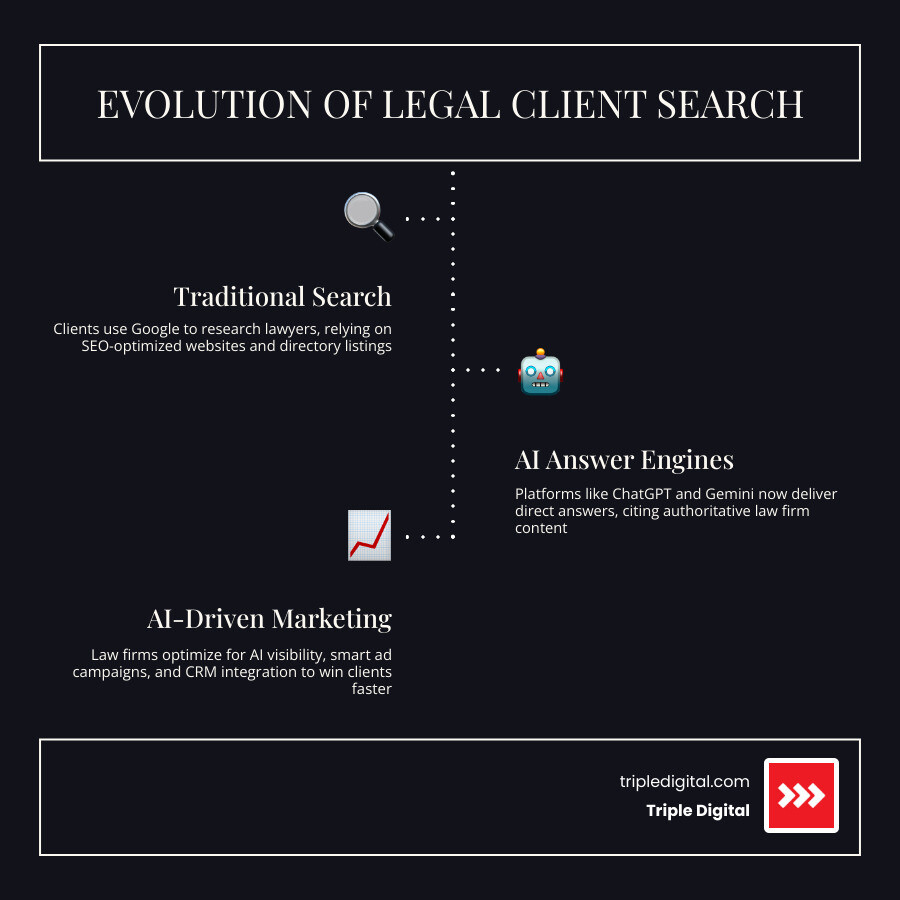
The Shift to AI-Driven Law Marketing vs. Traditional Methods
For decades, legal marketing was built on “gut feeling” tactics. Billboards, TV spots, and manual keyword bidding dominated the landscape. If you wanted to rank on Google, you hired an agency to manually write articles, tweak metadata, and adjust search bids every Tuesday morning.
In May 2026, those manual levers are rapidly becoming obsolete. AI-driven law marketing replaces guesswork with machine learning and real-time data-driven insights. Instead of waiting months to see if a marketing campaign works, AI systems analyze millions of data points to predict which strategies will drive signed cases today.
| Feature | Traditional Legal Marketing | AI-Driven Law Marketing |
|---|---|---|
| Decision Making | Based on intuition, historical trends, or agency “gut feelings.” | Grounded in real-time market data, competitor analysis, and predictive modeling. |
| Content Generation | Manual, slow, and expensive. Hard to scale across multiple practice areas. | Hyper-personalized, research-backed drafts generated in minutes and optimized for search. |
| PPC & Ad Bidding | Manual bid adjustments on keywords; high cost-per-click (CPC). | Autonomous bidding focused on signed cases, using broad match and creative signals. |
| Competitive Analysis | Occasional manual audits of competitor websites and ad spend. | 24/7 automated monitoring of competitor rankings, content gaps, and ad shifts. |
| Client Discovery | Limited to traditional search engine results pages (SERPs) and directories. | Omnichannel visibility across traditional search, social media, and AI answer engines. |
By transitioning to these advanced systems, law firms shift their focus from managing tedious marketing mechanics to refining high-level strategy. To learn more about how this technological shift is redefining the industry, explore our guide on AI Digital Marketing for Law Firms.
Core Benefits of AI-Driven Law Marketing
The most compelling reason to adopt AI-driven law marketing is the sheer scale of measurable results. Law firms leveraging these platforms report massive improvements in efficiency, lead quality, and revenue.
- Explosive Caseload Growth: Firms implementing data-informed AI systems have seen their caseloads scale significantly. For instance, some firms report a 4.5x increase in overall caseload, representing a 125% increase year-over-year.
- Highly Qualified Lead Generation: AI doesn’t just chase empty clicks or form fills. By analyzing user intent and feeding signed case data back into the marketing loop, AI platforms prioritize high-value leads. Law firms frequently report a 3-4x increase in monthly lead volume.
- Improved Efficiency Rates: Traditional marketing is a massive time sink. Solo lawyers and small firms often spend more than 15 hours a month on marketing tasks they dislike—or skip them entirely, losing ground to competitors. AI marketing platforms streamline this workflow, reducing the manual time investment to just 30 minutes of review per month while boosting operational efficiency by nearly 39%.
- Maximized ROI Tracking: Rather than wondering which billboard or radio ad actually brought in a client, AI integrations connect your marketing platforms directly to your case management software. This allows you to track ROI in real time, showing you exactly which search queries, ads, or AI citations led to a signed retainer.
To dive deeper into building a structured approach around these benefits, check out our comprehensive Guide to Law Firm AI Strategies.
Overcoming Ethical and Compliance Challenges
With great technological power comes great regulatory responsibility. Law firm marketing is fundamentally different from other industries because of strict Bar Association rules, client confidentiality requirements, and ethical obligations.
When using AI for content creation, firms must address several key challenges:
- Preserving Brand Authenticity: AI is an incredible tool for efficiency, but generic, robotic content ruins client trust. In legal services, clients seek empathy, deep expertise, and personal attention. AI should be viewed as a complement to human creativity, not a replacement. The final touch on any marketing asset must always come from a human hand to ensure your firm’s unique voice, values, and storytelling shine through.
- Maintaining Absolute Accuracy: Large language models (LLMs) are prone to “hallucinations”—generating confident but completely inaccurate legal information. Publishing incorrect legal advice on your blog doesn’t just hurt your SEO; it can lead to severe disciplinary action.
- Ensuring Bar Association Compliance: State bar associations have strict rules regarding lawyer advertising, client solicitation, and making unsubstantiated claims (such as calling yourself the “best” or guaranteeing specific outcomes). AI tools do not automatically understand these nuances unless guided by strict parameters.
- Protecting Data Privacy: Feeding sensitive client information or active case details into public AI models violates client-attorney privilege.
To navigate these hurdles safely, firms must establish a rigorous editorial workflow. AI should handle the heavy lifting of research, outlining, and initial drafting, while experienced attorneys review and approve every word before it goes live. For a detailed breakdown of how to write compliant, high-performing content with machine assistance, read about The Key to AI Written Content.
Optimizing for AI Overviews, Answer Engines, and Generative Search
The way potential clients find legal help is undergoing a massive evolutionary leap. We are moving away from traditional search engine results pages (where users scroll through a list of blue links) and toward generative search and answer engines.

Platforms like Google AI Overviews, ChatGPT, Gemini, Perplexity, and Claude synthesize information from multiple web sources to provide direct, conversational answers to user queries. If a user asks, “How do I find a business contract lawyer in Houston?”, the AI engine will summarize the options and cite specific law firms as authoritative sources.
Being cited in these generative answers is the new gold standard of digital visibility. It places your firm’s name, expertise, and website link directly in front of high-intent searchers. In fact, early adopters of AI search optimization have achieved remarkable results, such as a 107% increase in leads directly from ChatGPT, Gemini, Perplexity, and Claude within just four months of optimization.
To see how your firm can rank in these next-generation search environments, consult our Attorney Generative AI Rankings 2026.
Answer Engine Optimization (AEO) and Search Engine Optimization (SEO) Integration
Optimizing for this new landscape does not mean abandoning traditional SEO. Instead, Answer Engine Optimization (AEO) and Generative Engine Optimization (GEO) are natural evolutions of search engine optimization.
To rank in both traditional Google search and AI engines, your content strategy must adapt to how people naturally speak.
- Conversational, Question-Focused Content: When using voice search or typing into ChatGPT, users don’t search for “Houston business lawyer.” They type full, natural questions: “Do I need a lawyer to review a commercial lease agreement?” Your content must feature question-based headers that mirror these exact queries, followed by clear, direct, jargon-free answers.
- Establishing Topical Authority: AI models prefer sources that demonstrate exhaustive knowledge on a subject. Instead of writing a single, generic page about business law, build highly organized “content clusters” that cover every micro-topic—such as local zoning regulations, contract drafting timelines, and corporate compliance documentation.
- Leveraging E-E-A-T Signals: Google’s search algorithms and AI engines prioritize Experience, Expertise, Authoritativeness, and Trustworthiness (E-E-A-T). You can signal this authority by prominently featuring detailed attorney bios, verified client reviews, notable case results, and links to credible external legal resources.
We are proud to be at the forefront of this search revolution. To see how we help firms dominate these new search formats, read how Triple Digital LLC Unveils Groundbreaking AI Tool to Help Law Firms Outrank Competitors Online.
Strategies for Increasing AI Citations and Visibility
To turn your website into a primary source for AI engines, you must make it as easy as possible for AI crawlers to read, summarize, and cite your pages.
- Close Your Citation Gaps: AI engines rely heavily on established directories, local map listings, and legal databases to verify facts. If your firm’s name, address, and practice areas are inconsistent across the web, AI models will view your site as unreliable. Ensure your Google Business Profile, local directories, and bar association listings are perfectly aligned.
- Implement Structured Schema Markup: Use technical structured data (schema markup) on your website. This hidden code explicitly tells search engines and AI crawlers who you are, where you practice, what services you offer, and which articles you’ve written.
- Maintain Entity Clarity: Clearly define your firm’s “entity” online. Consistently link your website to your official social media profiles, press releases, and legal publications so AI models can easily connect the dots and recognize your firm as a trusted local authority.
Firms that execute these strategies effectively can achieve massive visibility leaps. Some firms have reported going from completely invisible in AI answers to ranking in the top three spots against competitors with a decade of traditional SEO dominance—resulting in an 11x increase in AI visibility in just 90 days.
Learn more about future-proofing your digital presence by reading Future Proof Your Firm: The AI Advantage in Legal Marketing.
Practical Applications: Content, PPC, and CRM Integration
To get the most out of AI-driven law marketing, you need to connect your front-end marketing efforts directly to your back-end business operations.

When AI tools, ad platforms, and client databases talk to one another, they form an automated marketing ecosystem that grows smarter and more efficient over time. To explore the wider software landscape, check out our list of the best AI Tools for Law Firm Marketing.
Transitioning to AI-Driven PPC and Ad Campaigns
Pay-per-click (PPC) advertising has evolved from manual keyword bidding into a highly automated, machine-learning-driven process. If you are still manually adjusting individual keyword bids, you are likely overpaying for clicks that don’t convert into signed cases.
Transitioning to AI-driven PPC requires shifting your focus from “levers” to “inputs”:
- Embrace Broad Match Keywords: Instead of restricting your ads to exact keyword matches, use broad match keywords paired with AI bidding. This allows Google’s machine learning to identify high-intent, natural-language searches—such as a user typing, “Who is the best corporate attorney in downtown Houston?”—and serve your ad at the perfect moment.
- Provide High-Quality Creative Assets: AI ad networks dynamically test different combinations of headlines, descriptions, images, and video clips to see what performs best. Your job is to feed the system high-quality, authentic video and photo assets that represent your firm’s brand.
- Optimize for Signed Cases, Not Just Clicks: Connect your ad accounts to your CRM so you can track offline conversions. When you feed data about actual signed retainers back into the ad platform, the AI learns to stop chasing cheap, irrelevant clicks and instead targets users who resemble your most valuable signed clients.
By letting machine learning handle real-time budget allocation across search and social channels, you can dramatically cut wasteful ad spend. To learn how to automate these campaigns safely, read our Guide AI Automation for Lawyers.
Integrating AI with CRMs and Practice Management Software
The ultimate goal of any marketing campaign is to sign more cases, and this is where CRM integration becomes critical. When an AI marketing platform is integrated with case management software (such as Clio or MyCase), the entire client intake pipeline becomes streamlined.
- Automated Client Intake: When a lead is generated through an AI-optimized blog post or ad, virtual intake assistants can immediately engage the prospect, qualify their case based on preset geographical and practice area parameters, and schedule a consultation directly on your calendar.
- Data Mining for Precise Targeting: Advanced data mining tools can scan public records, news cycles, and legal filings in real time to identify emerging opportunities. For example, if a major commercial zoning dispute is filed in Houston, AI can flag the signal and immediately draft highly relevant outreach campaigns targeting affected property owners.
- Continuous Learning Loops: By linking client billing, case outcomes, and intake data back to your marketing platforms, your firm can automatically calculate the exact cost-per-signed-case and adjust marketing budgets dynamically.
We specialize in building these advanced, data-driven pipelines. Discover how we are changing the legal tech landscape by reading Triple Digital Revolutionizing Legal Tech: Pinpoint Unveils Industry First Data Mining Software to Precisely Target Prospective Clients.
Selecting and Implementing AI Marketing Solutions
Choosing the right marketing software or vendor can feel overwhelming. To make an informed decision, your firm should evaluate potential solutions using a strict set of criteria:
- Data Security and Client Privacy: Ensure the platform complies with strict legal data-handling standards. It must never use your sensitive client data or proprietary case details to train public AI models.
- Seamless Software Integration: The solution must easily integrate with your existing website (e.g., WordPress), social media profiles, and legal CRMs. Avoid closed systems that create isolated data silos.
- Robust Compliance Guardrails: Look for platforms designed specifically for the legal industry. The tool should feature built-in approval workflows, ensuring no content is published without a manual human review.
- Predictive Modeling and Analytics: The vendor should provide transparent, real-time dashboards tracking actual business metrics—like cost-per-lead and signed cases—rather than vanity metrics like impressions or clicks.
To stay ahead of these technological shifts, read our analysis on Beyond the Bench: Key Trends Shaping the Legal Landscape.
Implementing AI-Driven Law Marketing for Solo and Small Firms
You don’t need a massive corporate budget to leverage the power of artificial intelligence. In fact, AI is the ultimate equalizer, allowing solo practitioners and boutique firms to effectively compete with national firms that have massive marketing budgets.
If you are a smaller firm, here is a step-by-step roadmap to implement AI marketing without stretching your resources:
- Audit Your Current Footprint: Ensure your Google Business Profile and local directory citations are 100% accurate and consistent to build a strong foundation for local SEO and AI citation engines.
- Start with an Automated Content Calendar: Use affordable AI legal content tools to generate practice-area-specific blog drafts and social media posts. Spend just 30 minutes a week reviewing, editing, and scheduling them.
- Consolidate Your Publishing: Use tools that allow for one-click publishing across your website, LinkedIn, and local business profiles to maximize your reach with minimal manual effort.
- Launch Targeted, AI-Driven PPC: Set up small-budget Google Ads campaigns using broad match and smart bidding, focusing on a highly specific geographic area (like a few zip codes in Houston) to maximize your return on investment.
- Set Up a Simple Intake CRM: Connect a basic client intake tool to your website so that every lead generated by your AI marketing is captured, tracked, and followed up on immediately.
Frequently Asked Questions about AI in Legal Marketing
Will AI replace traditional SEO for law firms?
No, AI is not going to kill SEO. Instead, traditional SEO is evolving. While AI answer engines are capturing a larger share of informational searches, more than 86% of clients still use Google to research and verify attorneys. High-quality content, fast page speeds, mobile responsiveness, and strong local Map Pack rankings remain the essential foundation for both search engines and AI engines alike.
How do law firms ensure AI-generated content is compliant?
Compliance is achieved through strict human oversight. You should never let an AI tool publish content directly to your website on autopilot. Establish a workflow where an attorney reviews every draft for legal accuracy, tone, and compliance with state bar rules before hitting publish.
What is the difference between SEO, AEO, and GEO?
- SEO (Search Engine Optimization) focuses on ranking your web pages higher in traditional search engine results (like Google’s top 10 blue links).
- AEO (Answer Engine Optimization) optimizes your content to be pulled directly into conversational featured snippets and direct answers.
- GEO (Generative Engine Optimization) focuses on structuring your content so that AI models (like ChatGPT, Gemini, and Claude) cite your firm as a primary source when answering user prompts.
Conclusion
The legal marketing landscape has permanently changed. As we look ahead in 2026, the firms that rely on outdated, manual marketing tactics will continue to see their client acquisition costs skyrocket. Conversely, forward-thinking firms that embrace AI-driven law marketing are positioning themselves to dominate both traditional search engines and emerging AI platforms.
At Triple Digital, we cut through the noise with a results-driven, “less fluff, more cases” approach. Based in Houston, Texas, we leverage advanced AI and precise data mining to help law firms target high-value cases, lower their client acquisition costs, and scale their caseloads with confidence.
Ready to future-proof your firm and show up where your clients are actually searching? Explore how we can help you capture more leads and cases by visiting our guide on AI Overviews today.