





Step-by-Step Guide to AI Overview Optimization for Lawyers
How AI Is Changing the Way Clients Find Lawyers
AI overview optimization for lawyers is the process of structuring your firm’s content, authority signals, and technical setup so Google and other AI engines select your website as a cited source in AI-generated answers — the block of text that now appears above every ad and organic result.
Here’s what that means in practice:
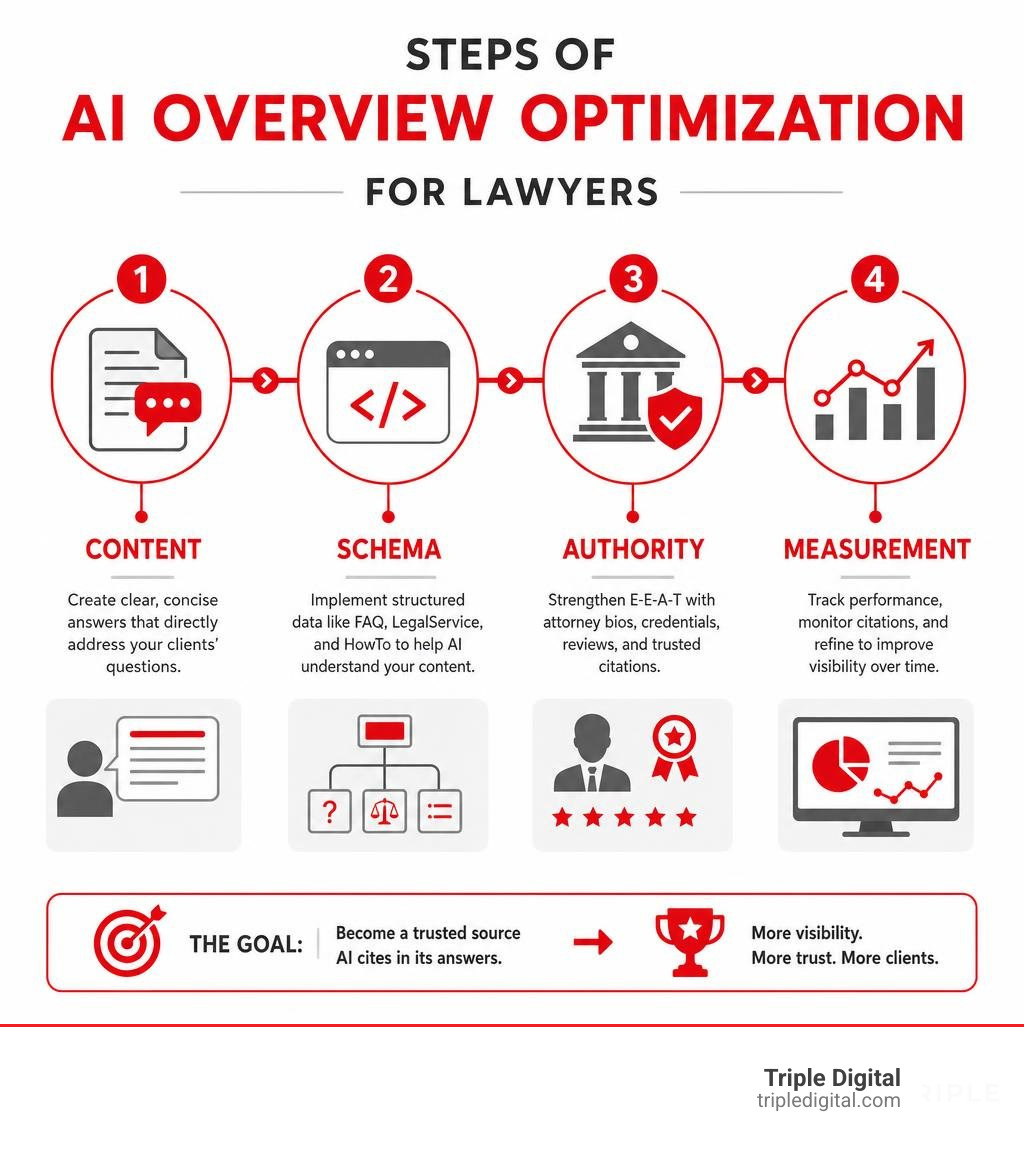
- Rank on page one — 76% of AI Overview citations come from pages already in the top 10
- Answer questions directly — lead each section with a 1-2 sentence plain-language answer
- Build topic clusters — create pillar pages per practice area with supporting sub-pages
- Add structured data — implement FAQ, LegalService, and HowTo schema markup
- Strengthen E-E-A-T — use named attorney bios, bar credentials, and third-party citations
- Stay consistent — keep firm name, location, and practice areas identical across every platform
Google launched its AI Overview feature in May 2024. Since then, the first thing a potential client sees when they search “what to do after a car accident” or “how long do I have to file a personal injury claim” is no longer your website. It’s an AI-generated summary — and it may not mention your firm at all.
The numbers tell the story clearly. AI Overviews now appear in over 70% of complex search queries. Law firm search impressions dropped a median 42% after Google expanded AI Overviews to more legal queries in late 2025. And over 60% of users now report turning to AI tools instead of Google for informational searches.
But here’s the part most firms are missing: cited sources actually receive 35% more organic clicks than non-cited competitors on the same results page. AI Overviews don’t destroy traffic — they redistribute it. The firms that understand this early are pulling ahead fast.
This guide gives you a step-by-step framework for becoming one of those firms.
AI overview optimization for lawyers glossary:
What is AI Overview Optimization for Lawyers?
AI Overview Optimization (AIO) is the strategic process of preparing your law firm’s digital footprint so that search engine artificial intelligence models recognize your content as the absolute best, most trustworthy answer to a user’s query. In the past, search engine optimization was about ranking blue links on page one. In 2026, optimization is about securing “Position 0” — the highly visible, synthesized block of text generated by Google’s Gemini engine at the very top of the search results page.
When a user types a complex legal question, Google does not just pull a single snippet from one website. Instead, it uses a technique called query fan-out. The AI engine breaks down the user’s main question into several micro-questions, searches its index for the most authoritative answers to those sub-questions, and then synthesizes those sources into a single, cohesive response.
This process has led to the rise of zero-click searches, where users find the exact legal information they need directly on the search page without clicking through to any website. For law firms, this sounds like a nightmare. However, by optimizing your site specifically for AIO, you ensure that your firm is the one cited in those interactive answer blocks. When Google builds an answer about Texas car accident laws, your cited link is right there, acting as an implicit endorsement from the search engine itself.
To learn more about the fundamentals of this shift, explore our comprehensive Guide to AI Overview for Attorneys.
How AI Overviews Differ from Traditional SEO and GEO
Understanding where AIO fits into the broader digital marketing landscape is crucial. Many legal marketers confuse traditional SEO, AIO, and Generative Engine Optimization (GEO). While they share foundational elements, they target different platforms, algorithms, and user behaviors.
| Feature | Traditional SEO | AI Overview Optimization (AIO) | Generative Engine Optimization (GEO) |
|---|---|---|---|
| Primary Target | Google’s core search algorithm | Google’s Gemini-powered AI Overviews | LLM-based platforms (ChatGPT, Perplexity, Claude) |
| Output Format | Standard list of blue links and local map packs | Synthesized text summaries with cited source cards | Conversational answers, recommendations, and lists |
| Search Intent Focus | Keyword matching and high-volume search queries | Multi-step informational and process-oriented queries | Conversational, highly specific research prompts |
| Traffic Impact | Direct clicks to high-ranking organic pages | Lower overall CTR, but highly qualified clicks to citations | Referral traffic through direct recommendations |
| Core Strategy | Keyword optimization, backlink building, local citations | Direct-answer formatting, structured schema, E-E-A-T | Brand mentions, digital PR, entity cross-verification |
Traditional SEO aims to rank your website for specific keywords like “Houston personal injury lawyer.” AIO focuses on answering the informational queries that prospective clients ask before they are ready to hire, such as “how are business assets divided in a Texas divorce.” GEO goes even broader, optimizing your entire digital footprint so that when someone asks ChatGPT, “Who is the most trusted estate planning attorney in Houston?”, the model recommends your firm based on patterns it has learned across the web.
Adapting to this multi-engine reality is the single greatest competitive advantage a modern firm can have. For a deeper dive into adjusting your overall marketing mix, read about how to Future-Proof Your Firm: The AI Advantage in Legal Marketing.
The Mechanics of AI Overview Optimization for Lawyers
AI search engines do not read your website the way humans do. They use large language models (LLMs) trained on vast datasets to perform pattern recognition. When an AI crawler indexes your law firm’s website, it is looking for entity clarity.
An entity is a clearly defined concept, person, organization, or place. To an AI, your law firm is not just a collection of keywords; it is an entity that must be linked to other trusted entities, such as your attorneys (Person entities), your office (LocalBusiness entity), and your legal practice areas (Service entities).
Furthermore, AI models rely heavily on brand mentions across the web to verify your firm’s authority. Before an AI engine recommends your firm in a synthesized answer, it cross-references your website content with third-party directories, news articles, and legal publications. If the patterns match across multiple trusted sources, the AI gains “confidence” in your entity, making your site far more likely to be cited.
To align your technical setup with these crawlers, see our guide on Guide AI SEO Services.
Why Traditional Featured Snippets Are Not AI Overviews
It is easy to look at an AI Overview and assume it is just a larger version of the classic Google featured snippet. However, the underlying technology is completely different.
Traditional featured snippets rely on single-source extraction. Google’s algorithm identifies one web page that answers a query well, pulls a paragraph, list, or table from that single page, and displays it at the top of the search results. If you don’t own that ranking page, you don’t get the snippet.
AI Overviews, powered by Google’s Gemini model, utilize multi-source synthesis. The engine analyzes dozens of top-ranking pages, extracts different data points from several of them, and weaves those points together into a completely new, conversational paragraph.
Because of this, an AI Overview can feature multiple citation links within a single sentence. This means your firm does not necessarily have to rank in position one organically to get cited; if you provide the most accurate, structured answer to a specific sub-question within a broader topic, the AI will pull your link into the citation cards.
To understand how these rankings are calculated in the era of generative search, check out the Attorney Generative AI Rankings 2026.
Core Content Strategies for AI Citations
To earn citations in AI-generated search results, your content must be structured for machine readability while remaining highly valuable to human readers. AI engines prioritize content that displays exceptional topical depth, legal accuracy, and clear jurisdiction statements.
Because legal topics fall under Google’s “Your Money or Your Life” (YMYL) guidelines, the algorithms are incredibly conservative. They will not cite a page that contains vague statements or lacks professional authority.
When writing legal content, always ground your writing in local statutes and official procedures, focusing on educational, high-level legal concepts. For example, if you are writing about Texas probate law, explicitly reference the Texas Estates Code. This gives the AI model the authoritative reference points it needs to verify your accuracy.
To master the balance between writing for AI models and human clients, read The Key to AI Written Content.
Building Topic Clusters and Pillar Pages
The days of writing isolated, keyword-stuffed blog posts are over. AI engines evaluate your website’s authority based on your entire content ecosystem. To prove your firm has the depth required to be cited, you must build comprehensive topic clusters.
A topic cluster consists of:
- A Pillar Page: A broad, highly comprehensive resource covering a major practice area (e.g., “The Complete Guide to Texas Estate Planning”).
- Supporting Sub-pages: Highly focused articles addressing specific sub-topics (e.g., “How to Choose a Trustee in Texas” or “What Is a Medical Power of Attorney?”).
- Strategic Internal Linking: Every supporting sub-page must link back to the pillar page using descriptive anchor text, and the pillar page must link out to the sub-pages.
This interconnected structure signals thematic authority to AI crawlers. It tells the search engine that you haven’t just written a single, lucky article; you have built an entire library of legal knowledge on the subject.
For a step-by-step roadmap on designing these clusters, check out our Guide to Law Firm AI Strategies.
Structuring Content with the Q&A Pattern
AI engines are designed to answer questions. Therefore, the easiest way to get cited is to make your content match the conversational queries users input. We recommend utilizing the Question-Answer-Elaboration pattern throughout your articles.
To implement this strategy:
- Use H2 or H3 headings that mirror actual questions prospective clients ask (e.g., “Do I need to go to court for a personal injury claim in Texas?”).
- Write a direct, concise answer immediately below the heading. This answer should be 1 to 4 lines long (roughly 40-60 words) and completely free of fluff or legal jargon.
- Elaborate on the answer in the paragraphs that follow, providing the necessary legal context, exceptions, and statutory references.
Additionally, format complex information into bulleted lists and tables. AI models disproportionately cite structured lists and tables because they are incredibly easy for the algorithm to parse and present within an AI Overview block.
For more tips on optimizing your content structure, explore our guide on AI Digital Marketing for Law Firms.
Technical and Authority Signals for AI Engines
All the high-quality content in the world won’t help you if AI crawlers struggle to access or understand your website. Technical SEO is the foundation upon which your AIO strategy is built.
AI bots require exceptional crawl efficiency. Your pages must load lightning-fast, render perfectly on mobile devices, and be easily indexed. If your site takes longer than 3 seconds to load, Google’s crawlers (and 53% of your mobile visitors) will move on, and the AI will look elsewhere for its citations.
To ensure your technical foundation is up to par, see our Guide to AI Automation for Lawyers.
Implementing Schema Markup and Technical SEO
Schema markup is a form of microdata added to your website’s HTML that helps search engines understand the exact meaning of your content. For AI search, structured data is non-negotiable. It translates your plain text into a structured format that AI models can read with 100% confidence.
Your firm should implement the following schema types:
- LegalService Schema: Defines your firm’s name, physical address, phone number, practice areas, and geographical service area.
- FAQPage Schema: Matches your H2/H3 question headings and direct answers, telling Google exactly where to find the short answers for its AI Overviews.
- Attorney/Person Schema: Links individual attorney bio pages to their specific credentials, bar admissions, and professional achievements.
Once implemented, regularly audit your structured data using Google’s Rich Results Test to ensure there are no errors or warnings that could block AI parsing.
For a list of technical tools that can assist with this process, review our breakdown of AI Tools for Law Firm Marketing.
E-E-A-T and the Role of Authoritative Citations
Because legal advice can dramatically impact a person’s life, Google’s search quality evaluator guidelines place immense weight on E-E-A-T: Experience, Expertise, Authoritativeness, and Trustworthiness. AI models are heavily programmed to look for these trust signals.
To build strong E-E-A-T signals:
- Create Detailed Attorney Bios: Every substantive article on your site should have a clear author byline linking to a comprehensive attorney bio page. Include bar admissions, court appearances, legal publications, and professional awards.
- Cite Primary Legal Sources: Do not just make legal claims; back them up by linking directly to official government portals, Texas state statutes, or local court rules.
- Earn Third-Party Mentions: Seek out mentions from local news outlets, bar associations, and respected legal directories. When AI engines find your firm’s name associated with high-authority legal organizations across the web, your entity trust score skyrockets.
By proving that your content is written by actual, licensed legal experts, you make it safe for the AI engine to quote you. For a look at how advanced data and authority signals intersect, read Beyond the Gavel: Using AI for Predictive Analytics in Legal Proceedings.
Measuring Success and Avoiding Common Mistakes
Measuring the impact of AI Overview Optimization requires shifting your focus away from traditional metrics like keyword rankings and raw organic traffic. Because AI search often results in zero-click queries, your standard tracking methods may show a decline in traffic even as your firm’s digital authority and actual lead generation grow.

To succeed in this new landscape, you must monitor your visibility inside AI summaries, track impression spikes in Google Search Console, and analyze referral traffic coming directly from AI platforms like ChatGPT and Perplexity.
To align your firm’s growth metrics with these modern search behaviors, read our Guide to AI Lawyer Growth Strategy.
How to Track AI Overview Optimization for Lawyers
While tracking AI search is more complex than tracking traditional search, it is entirely possible with the right tools and processes.
- Monitor Google Search Console: Look for sudden spikes in impressions on long-tail, informational keywords. If your impressions are rising but clicks remain flat, it is a strong indicator that your site is being cited in AI Overviews for those queries.
- Track AI Referral Traffic: Analyze your Google Analytics referral reports. Look for traffic coming from domains like
chatgpt.com,perplexity.ai, orcopilot.microsoft.com. These visitors have already been vetted by an AI and are highly qualified leads. - Perform Manual Spot-Checks: Regularly search your core informational topics in Google and note whether your firm appears in the AI Overview citation cards.
- Use Specialized Tracking Tools: Implement advanced search tracking tools designed to monitor AI search engine results pages (SERPs).
At Triple Digital, we understand the importance of staying ahead of these shifts. To see how we help firms dominate modern search, read about how Triple Digital Unveils Groundbreaking AI Tool to Help Law Firms Outrank Competitors Online.
Critical Mistakes That Block AI Citations
When attempting to optimize for AI search, many law firms fall into traps that actually destroy their search visibility. Avoid these critical errors:
- Using the
nosnippetMeta Tag: Some firms attempt to block Google from using their content in AI Overviews by addingnosnippettags to their site. This is a massive mistake. Blocking AI Overviews also blocks your site from appearing in traditional featured snippets and can severely damage your overall organic rankings. - Mass-Producing AI-Generated Content: Flooding your site with low-quality, unedited AI content to “scale” your SEO will trigger Google’s helpful content penalties. AI engines want original attorney insights, not recycled versions of their own training data.
- Ignoring Non-Google Platforms: While Google remains dominant, millions of professionals use Perplexity and ChatGPT for research. If your site isn’t indexed by Bing (which powers Copilot) or optimized for LLM crawlers, you are missing a massive chunk of the market.
- Abandoning Traditional SEO: AIO is an evolution of SEO, not a replacement. You cannot rank in AI Overviews if your site doesn’t already rank on page one organically. Keep building quality backlinks and optimizing your local presence.
Frequently Asked Questions about AI Overviews
How do AI Overviews affect local Map Pack rankings?
Currently, high-intent local queries (such as “Houston personal injury lawyer near me”) are largely protected from AI Overviews. Google understands that when a user has immediate intent to hire, they want to see the local 3-pack with maps, reviews, and contact details, not a lengthy text summary.
However, the funnel above the Map Pack is shrinking. Informational searches that lead up to hiring are heavily dominated by AI. To ensure your local presence remains visible to AI engines, keep your Google Business Profile fully optimized and ensure your Bing Places listings are claimed and accurate, as Bing serves as a primary data source for tools like ChatGPT and Copilot.
Do I need a separate SEO strategy for AI Overviews?
No. You do not need a separate strategy, but you do need to add specific layers to your existing SEO efforts. The foundational elements of strong SEO — high-quality content, clean technical structure, and strong backlinks — are the exact same signals AI engines use to evaluate authority.
To optimize for AI Overviews, you simply need to refine how that content is presented. This means adding structured schema markup, formatting your copy with clear Q&A patterns, and focusing heavily on E-E-A-T signals.
How long does it take to appear in AI search results?
There is no guaranteed timeline, but firms with established authority can see results relatively quickly. If you already rank on page one for a specific query, updating that page with a structured “answer block” and requesting a reindex via Google Search Console can result in your site being cited in an AI Overview within a few days. For brand-new sites or highly competitive topics, building the necessary topical authority and entity trust can take several months of consistent publishing and optimization.
Conclusion
The legal search landscape in 2026 demands a shift from keyword-centric tactics to entity-based authority. Google’s AI Overviews, along with conversational search engines like ChatGPT and Perplexity, have fundamentally changed how prospective clients find and evaluate attorneys. By structuring your website for machine readability, building deep topic clusters, and proving your expert credentials, you can secure your spot at the very top of the modern search results page.
At Triple Digital, we specialize in helping law firms navigate these technological shifts. We take a results-driven, “less fluff, more cases” approach to digital marketing, leveraging advanced AI and data mining to put your firm in front of the clients who need you most.
If you are ready to future-proof your firm’s digital presence and dominate AI search, explore our specialized services for AI Overviews and let us help you turn search visibility into signed cases.