





Pillar Content and Beyond: Crafting a Law Firm Content Strategy
Why Most Law Firms Struggle to Turn Content Into Clients
Meta Title: Pillar Content and Beyond: Crafting a Content Strategy Law Firms Guide
Meta Description: Discover how to build an authoritative content strategy law firms need to rank on Google, build trust, and convert high-intent searchers into clients.
Slug: content-strategy-law-firms-guide

A strong content strategy for law firms is the difference between a website that quietly collects dust and one that consistently brings in qualified leads. Yet most firms either publish randomly — hoping something sticks — or avoid content altogether and rely solely on referrals.
That approach is getting more expensive every year.
Here is what a law firm content strategy involves, in plain terms:
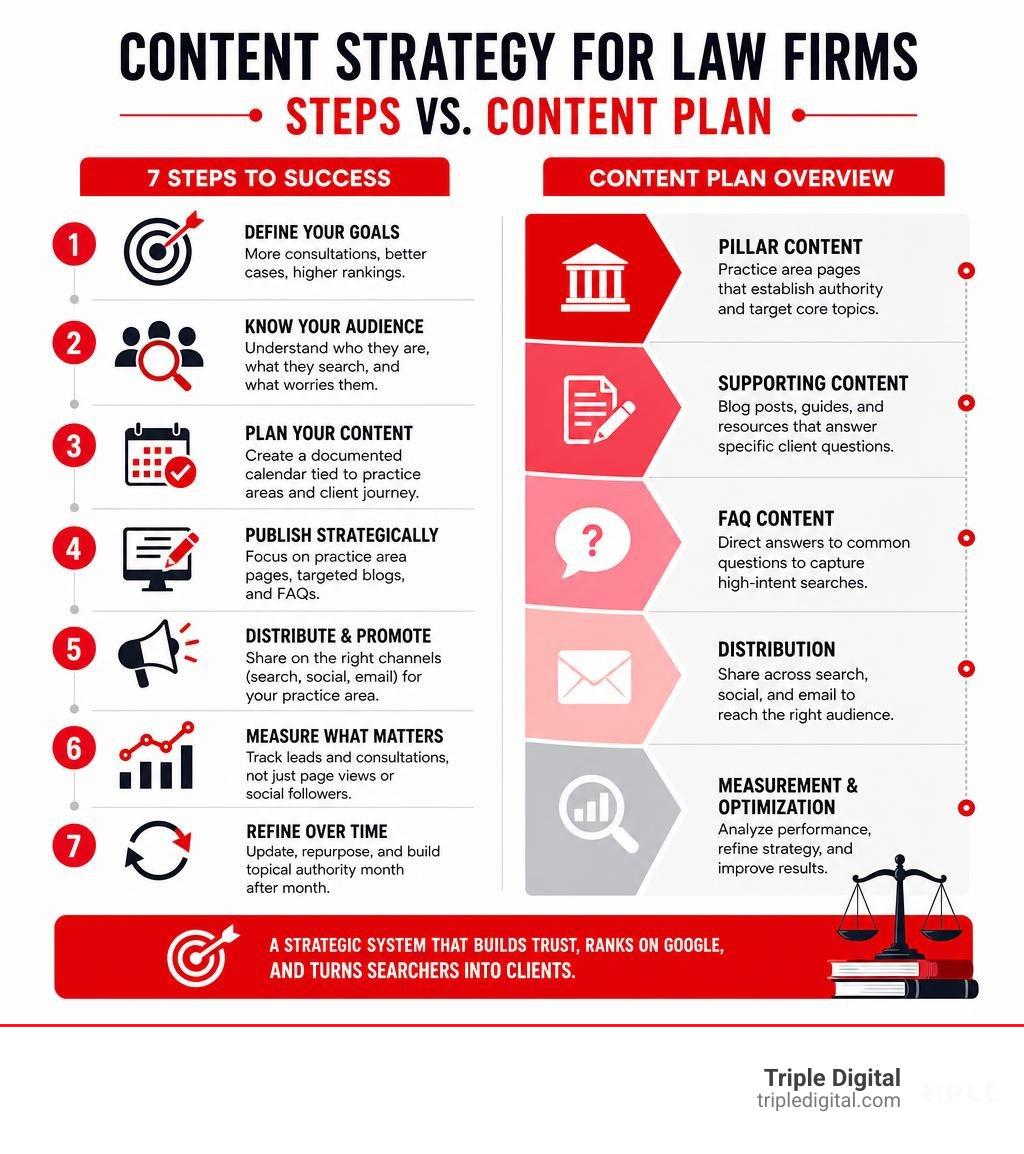
- Define your goals — more consultations, better-quality cases, higher Google rankings, or all three
- Know your audience — map out who your ideal clients are, what they search for, and what fears they carry
- Plan your content — create a documented calendar tied to your practice areas and client journey stages
- Publish strategically — prioritize practice area pages, targeted blog posts, and FAQ content over random topics
- Distribute and promote — share content on the right channels (search, social, email) for your practice area
- Measure what matters — track leads and consultations, not just page views or social followers
- Refine over time — update, repurpose, and build topical authority month after month
The numbers back this up. 96% of people seeking legal advice use a search engine at some point in their process. And 74% of prospects visit a law firm’s website before taking any action — meaning your content is often the first real impression you make.
Firms that treat content as a structured system — not a box to check — generate three times more leads than those relying on referrals alone.
This guide walks you through exactly how to build that system.
Quick content strategy law firms terms:
What is a Content Strategy for Law Firms (And Why Volume Alone Fails)?
Many attorneys treat content marketing like a race to see who can hit “publish” the most times. They hire cheap agency vendors to churn out generic, 500-word articles on broad legal definitions.
We call this the productivity illusion. You see new pages popping up on your site, so you feel productive. But your phone isn’t ringing. Why? Because volume without a deliberate strategy merely accumulates digital clutter; it doesn’t compound into a business asset.
To understand why your current efforts might be falling flat, we must separate two critical concepts:
- Content Strategy: This is your high-level, conceptual blueprint. It defines why you are creating content, who you are trying to reach, which practice areas you want to grow, and how you will measure business success.
- Content Plan: This is the tactical logistics. It details what will be written, who will write and review it, and when it will be published on your editorial calendar.
If you build a plan without a strategy, you end up writing estate planning tips when your firm is actually trying to attract high-value commercial litigation cases. This dilutes your brand, confuses your visitors, and wastes your marketing budget.
Furthermore, search engines have evolved. Gone are the days when having 1,000 thin pages helped you rank. Google now evaluates websites using strict E-E-A-T guidelines: Experience, Expertise, Authoritativeness, and Trustworthiness.
Because legal advice falls under the “Your Money or Your Life” (YMYL) category, search engines hold legal websites to the absolute highest standards. If your content is written by a generalist writer who doesn’t understand the law, search algorithms — and human readers — will spot it instantly.
To build a site that ranks and converts, you need a documented plan built around your actual caseload goals. For a deeper look at why this shift is mandatory for modern practices, explore our guide on Why Do Law Firms Need a Content Marketing Strategy?
Structuring the Legal Buyer’s Journey: Attract, Educate, and Convert
When a person experiences a legal crisis, they don’t immediately open Google and type “hire a lawyer right now.” They begin by researching their symptoms, their worries, and their immediate next steps.
To turn these searchers into signed clients, your content strategy law firms framework must mirror the classic marketing funnel. You must meet prospects where they are, answer their questions, and guide them step-by-step toward scheduling a consultation.
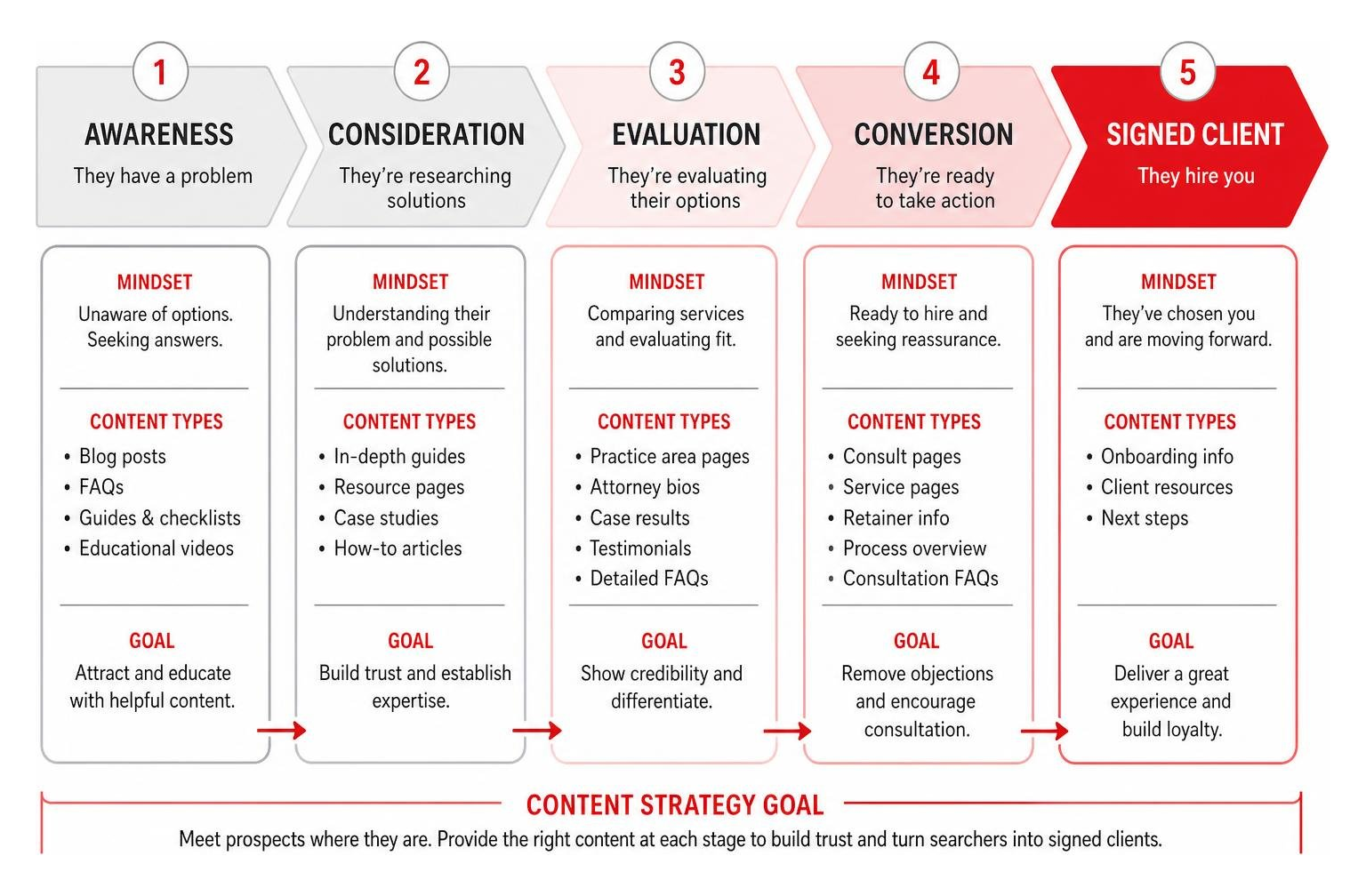
Mapping your content to this funnel ensures you aren’t trying to close a deal on the very first touchpoint. Instead, you build a relationship based on helpful, educational resources. To understand how this funnel fits into your overall conversion rate optimization, read about From Clicks to Clients – The Ultimate Law Firm CRO Strategy.
Top-of-Funnel (TOF): Attracting Prospects with Educational Content
At the Top of the Funnel, prospects are looking for answers to broad, educational questions. They might be sitting at their kitchen table at 10 PM, highly stressed, typing queries like:
- “What is the difference between a patent and a trademark?”
- “How do I register a trademark for my business?”
- “What should be included in a standard business partnership agreement?”
Your goal here is not to sell your services. It is to provide clear, simple, and deeply helpful answers. TOF content typically takes the form of blog posts, short-form explainer videos, and interactive tools (like a child support calculator).
To rank for these queries, you must master local search intent. By targeting localized, long-tail keywords, you attract high-intent local searchers rather than national traffic that can never hire you anyway. For actionable writing frameworks that capture this early-stage traffic, check out The Ultimate Guide to Blog Writing for Law Firms.
Middle-of-Funnel (MOF): Building Trust Through a Content Strategy for Law Firms
Once a prospect understands their legal situation, they move to the Middle of the Funnel. They know they have a problem, they realize they likely need professional representation, and now they are evaluating their options. They are asking: “Can I trust this specific firm to handle my future?”
This is where you showcase your real-world experience. The most effective MOF content formats include:
- Anonymized Case Studies: Walk readers through a past case using a strict Problem to Strategy to Result framework. Describe the client’s initial fears, the unique legal strategy you built, and the successful resolution.
- Deep-Dive Guides: Comprehensive, bookmarkable resources (such as a 3,000-word guide on navigating probate) that signal ultimate authority.
- Behind-the-Scenes Video: Short clips showing your team preparing for trial or explaining your firm’s core philosophy on justice.
By focusing on storytelling and concrete results, you build an emotional connection. Learn more about how to produce these trust-building assets in our breakdown of Content Creation for Attorneys.
Bottom-of-Funnel (BOF): Converting High-Intent Leads into Clients
At the Bottom of the Funnel, the prospect is ready to make a decision. They are on your site, looking at your specific practice pages, and evaluating your contact form. They need a final, frictionless nudge to reach out.
Your BOF content must be highly optimized, conversion-focused, and direct. This includes:
- Dedicated Practice Area Pages: Highly specific landing pages for your core practice areas (e.g., “Houston Commercial Real Estate Disputes” rather than a general “Business Law” page).
- Clear Call-to-Actions (CTAs): Direct, low-pressure prompts like “Schedule Your Confidential Case Evaluation Today” rather than generic “Submit” buttons.
- Attorney Bios: Professional profiles that highlight not just your credentials, but your personal approach to client care.
Every word on these pages must be designed to reduce anxiety and make contacting your office as easy as possible. Discover how to write high-converting copy in our guide, Write Your Way to Clients – Effective Legal Content Strategies.
Balancing Search Engine Optimization with Human-Centered Authenticity
One of the biggest mistakes we see law firms make is writing solely for search engine algorithms. They stuff keywords into sentences until the text sounds like it was written by a broken robot.
But search engines don’t sign retainer agreements; human beings in distress do.
Your content must strike a perfect balance. It needs to be technically optimized so Google can find and index it, but it must be written with the warmth, empathy, and clarity that a real person needs during a difficult time. For advanced strategies on building this balance, explore our resources on Advanced SEO – Authoritative Content.
Optimizing for GEO and AI Search in 2026
As we navigate July 2026, the search landscape has shifted dramatically. Traditional search engine optimization is no longer just about ranking in the “blue links.” We are now firmly in the era of Generative Engine Optimization (GEO).
With Google’s AI Overviews and other generative engines dominating search results, your content needs to be structured so AI systems can easily digest, synthesize, and cite your firm as the primary authority.
To optimize for AI search, you must:
- Implement FAQ Schema and Structured Data: This helps search engines instantly identify your answers to common legal questions.
- Use Clear, Bulleted Summaries: AI engines love to scrape and display concise, bulleted lists at the top of search results.
- Build Deep Topic Clusters: Group your content around central pillar pages to signal clear topical authority to search crawlers.
For a deeper analysis of how these technological shifts are rewriting the legal marketing playbook, read Beyond the Bench: Key Trends Shaping the Legal Landscape 2.
Maintaining Radical Authenticity in a Content Strategy for Law Firms
With the explosion of generative AI tools, the internet is currently drowning in a sea of beige, generic legal tips. Prospects can smell a prompt-engineered, copy-pasted blog post from a mile away. It builds zero trust and actually drives users off your site.
To combat AI fatigue, your firm must lean into radical authenticity.
- Use first-person pronouns (“I” and “We”) to share your specific philosophy on client care.
- Share real, raw stories of the challenges your clients have overcome (while strictly maintaining confidentiality).
- Keep your language simple. The average legal consumer reads at a 9th-grade level when stressed. Strip out the complex legalese and write like you are speaking to a friend across a kitchen table.
AI tools are fantastic assistants for brainstorming, outlining, and structuring your thoughts, but they should never replace the authentic human voice of an experienced attorney. Learn how to leverage technology safely without losing your brand’s soul in The Key to AI-Written Content.
Modern Distribution, ROI Measurement, and Avoiding Common Pitfalls
Creating incredible content is only half the battle. If you publish a masterpiece blog post but no one knows it exists, it cannot help your firm grow. You need a reliable distribution system and a clear way to measure whether your efforts are actually generating cases. For an overview of how these channels work together, see our comprehensive guide on Digital Marketing Strategies Law Firm.
The Speak-to-Repurpose Workflow for Busy Attorneys
We know what you are thinking: “I’m a busy attorney. I don’t have twenty hours a month to write blog posts and record videos.”
You don’t have to. The secret to a highly efficient content strategy is the Speak-to-Repurpose Workflow.
Instead of staring at a blank document, block out just 30 minutes once a month. Record yourself naturally explaining a complex legal concept, answering a common client question, or discussing a recent court ruling.
That single 30-minute recording can be transformed into:
- 2-3 comprehensive blog posts
- A series of short-form, vertical “searchable shorts” for social media
- 5-10 LinkedIn or Facebook text posts
- An educational email newsletter for your past and current contacts
By using transcription and smart editing tools, you preserve your authentic voice and expertise while scaling your content output with minimal effort. Dive deeper into these automated workflows in our Guide to Law Firm AI Strategies and explore how automation drives growth in AI-Driven Law Marketing.
Key Performance Indicators (KPIs) That Actually Matter
Many law firms get distracted by “vanity metrics” — likes, views, and follower counts. While these numbers look nice on a slide deck, they do not pay the bills.
To measure the true return on investment of your content strategy, you must focus on business-driving metrics:
| Vanity Metrics (What to Ignore) | Business Metrics (What to Track) |
|---|---|
| Raw page views | Organic goal conversions (form submissions, calls) |
| Social media followers | Scroll depth and time on page (indicates real engagement) |
| Video views (under 3 seconds) | Direct messages or consult requests from content |
| General search impressions | Local search visibility for high-intent keywords |
By tracking how many signed cases originate from your organic content pages, you can confidently allocate your marketing budget to the topics and channels that actually drive revenue.
Common Pitfalls: Jargon, Inconsistency, and Ethical Violations
As you execute your content strategy, watch out for these common traps that can stall your progress or get you into hot water:
- The Jargon Trap: Writing for other lawyers instead of your potential clients. Keep your reading level accessible and focus on practical answers.
- The Inconsistency Trap: Publishing ten articles in a single week and then going completely silent for six months. A steady, predictable publishing cadence (e.g., two high-quality articles per month) always wins.
- Ethical Violations: Forgetting ABA Model Rules 7.1 through 7.3. Never guarantee specific outcomes, do not claim uncertified “specialist” or “expert” status unless formally certified in your jurisdiction, and never discuss active cases without explicit, written client consent.
Frequently Asked Questions about Legal Content Strategy
How long does it take for a law firm’s content to rank on Google?
Generally, a systematic content strategy begins showing measurable organic ranking improvements within 90 to 180 days (3 to 6 months).
Because organic search builds compounding authority, your results will continue to grow over a 12-to-18-month horizon. While paid advertising campaigns stop generating leads the moment you stop funding them, organic content acts as a long-term business asset that continues to bring in clients for years after publication.
Can law firms use AI to write their website content?
You can use AI as a powerful drafting assistant for research, outlining, and content structuring, but you should never publish raw, AI-generated legal text.
Google’s algorithms are highly sophisticated at identifying low-effort, automated content, and publishing unedited AI text can severely penalize your site’s search rankings. More importantly, AI tools can hallucinate incorrect legal statutes, creating massive liability risks for your practice. Always ensure a qualified legal professional reviews, edits, and adds real-world experience to every piece of content before it goes live.
How much should a law firm budget for content marketing?
Content marketing budgets vary based on your practice area, your local market competition, and your growth goals.
On average, small-to-mid-sized firms investing in a professional, agency-managed content and SEO strategy allocate between $3,000 and $7,000 per month. While this requires an upfront commitment, the long-term cost-per-lead of organic content is significantly lower than continuous pay-per-click (PPC) campaigns.
Partner with Experts to Turn Clicks into Signed Cases
Building an authoritative, high-converting content strategy takes time, consistency, and deep technical expertise. When you are busy managing active cases and running your practice, finding the hours to write, optimize, and distribute content can feel impossible.
That is where we come in.
At Triple Digital, we help law firms cut through the fluff and build data-driven marketing systems designed for one thing: getting more cases. We combine human-centered legal storytelling with advanced search engine optimization, AI workflows, and precise local targeting to turn your website into a reliable client acquisition engine.
Ready to stop guessing and start growing your caseload? Schedule a Meeting with our team today to build a content strategy tailored to your firm’s goals.