





Why your law firm needs an AI upgrade today
AI Tools for Lawyers: The Legal Tech Revolution Your Firm Can’t Afford to Ignore
AI tools for lawyers are no longer a futuristic concept — they’re what your competitors are using right now to win more clients, bill more hours, and outpace firms still relying on manual workflows.
Here are the top AI tools legal professionals are using today:
| AI Tool | Best For | Type |
|---|---|---|
| Harvey | Contract analysis, legal research, enterprise workflows | Legal-specific |
| CoCounsel (Thomson Reuters) | Legal research, document review, brief drafting | Legal-specific |
| Lexis+ AI | Legal research, citation verification | Legal-specific |
| Claude | Document drafting, confidential research | General-purpose |
| ChatGPT | Drafting, summarization, client communication | General-purpose |
| Clio / MyCase | Case management, billing, client intake | Practice management |
| Relativity | E-discovery, document review | Legal-specific |
| Lex Machina | Litigation analytics, judge and counsel research | Legal-specific |
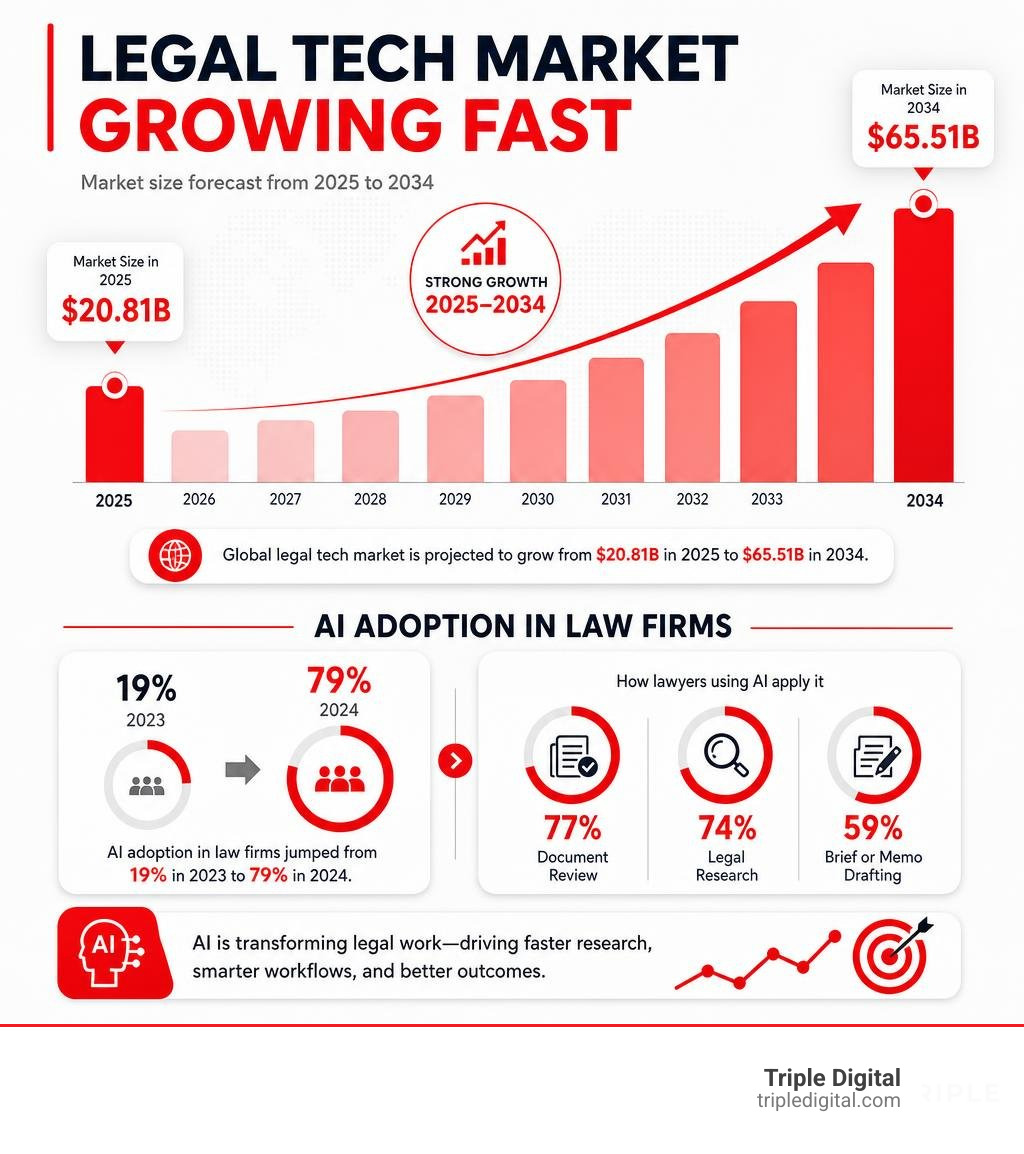
The numbers tell the story clearly. AI adoption in law firms jumped from just 19% in 2023 to 79% in 2024 — one of the fastest technology adoption curves any professional industry has ever seen. And the global legal tech market, valued at $20.81 billion in 2025, is on track to hit $65.51 billion by 2034.
This isn’t hype. Among lawyers already using AI, 77% use it for document review, 74% for legal research, and 59% for brief or memo drafting — tasks that used to eat entire days.
Your clients expect faster turnaround. Your competitors are getting it. The question isn’t whether to adopt AI — it’s which tools to use and how to use them without putting your firm at risk.
This guide breaks it all down.
Simple guide to AI tools for lawyers terms:
Understanding the landscape of AI tools for lawyers
To make sense of the rapidly expanding legal tech ecosystem in 2026, we have to look past the buzzwords. Artificial intelligence in law isn’t a single, uniform technology. Instead, it is a spectrum of tools ranging from traditional machine learning algorithms to advanced generative models and autonomous agents.
Traditional machine learning excels at pattern recognition, classification, and predictive modeling. For years, we have used these tools to power predictive coding in e-discovery or to run analytics on judge decisions. These systems are highly structured; they look at historical data to spot trends but cannot generate new text or reasoning.
Generative AI, on the other hand, is built on Large Language Models (LLMs). It understands syntax, context, and semantic meaning, allowing it to summarize massive PDF files, draft complex contract clauses, and answer open-ended legal questions in plain English. Rather than simply finding a needle in a haystack, generative AI can write a comprehensive memo explaining why that needle matters.
Understanding how to balance these technologies is the core of modern Law Firm AI Strategies. By combining the structured precision of machine learning with the creative and drafting capabilities of generative AI, firms can build a highly resilient, modern practice.
General-purpose LLMs vs legal-specific AI tools for lawyers
When looking to integrate AI into your daily practice, you will face an immediate choice: do you use general-purpose tools like ChatGPT, Claude, Gemini, and Microsoft Copilot, or do you invest in legal-specific platforms like Harvey, CoCounsel, Lexis+ AI, or Irys One?
General-purpose models are incredibly versatile and cost-effective. They are fantastic for drafting marketing content, summarizing general business emails, translating documents, or writing basic code. However, they lack direct integration with authoritative legal databases and, by default, may use your inputs to train their public models—creating severe confidentiality risks.
Legal-specific platforms are engineered to solve these exact limitations. They are built on top of advanced LLMs but are securely “grounded” in verified databases of case law, statutes, and regulations. They feature strict security protocols, including zero data retention policies, to protect attorney-client privilege.
| Feature | General-Purpose LLMs (ChatGPT, Claude, Gemini) | Legal-Specific AI Platforms (Harvey, CoCounsel, Lexis+ AI) |
|---|---|---|
| Primary Use Cases | General drafting, brainstorming, content creation, email summaries | Legal research, contract analysis, brief drafting, citation verification |
| Data Security | Public models may train on your inputs (unless enterprise tier is purchased) | Enterprise-grade security; absolute zero data retention policies |
| Hallucination Risk | High; prone to fabricating case law and legal citations | Low; outputs are strictly grounded in verified legal databases |
| Integrations | General office suites, APIs, generic web browsers | Document Management Systems (DMS) like iManage, NetDocuments, Clio |
| Typical Cost | Free to $20–$30 per user/month | $200 to $1,200+ per user/month |
The shift to agentic AI tools for lawyers in 2026
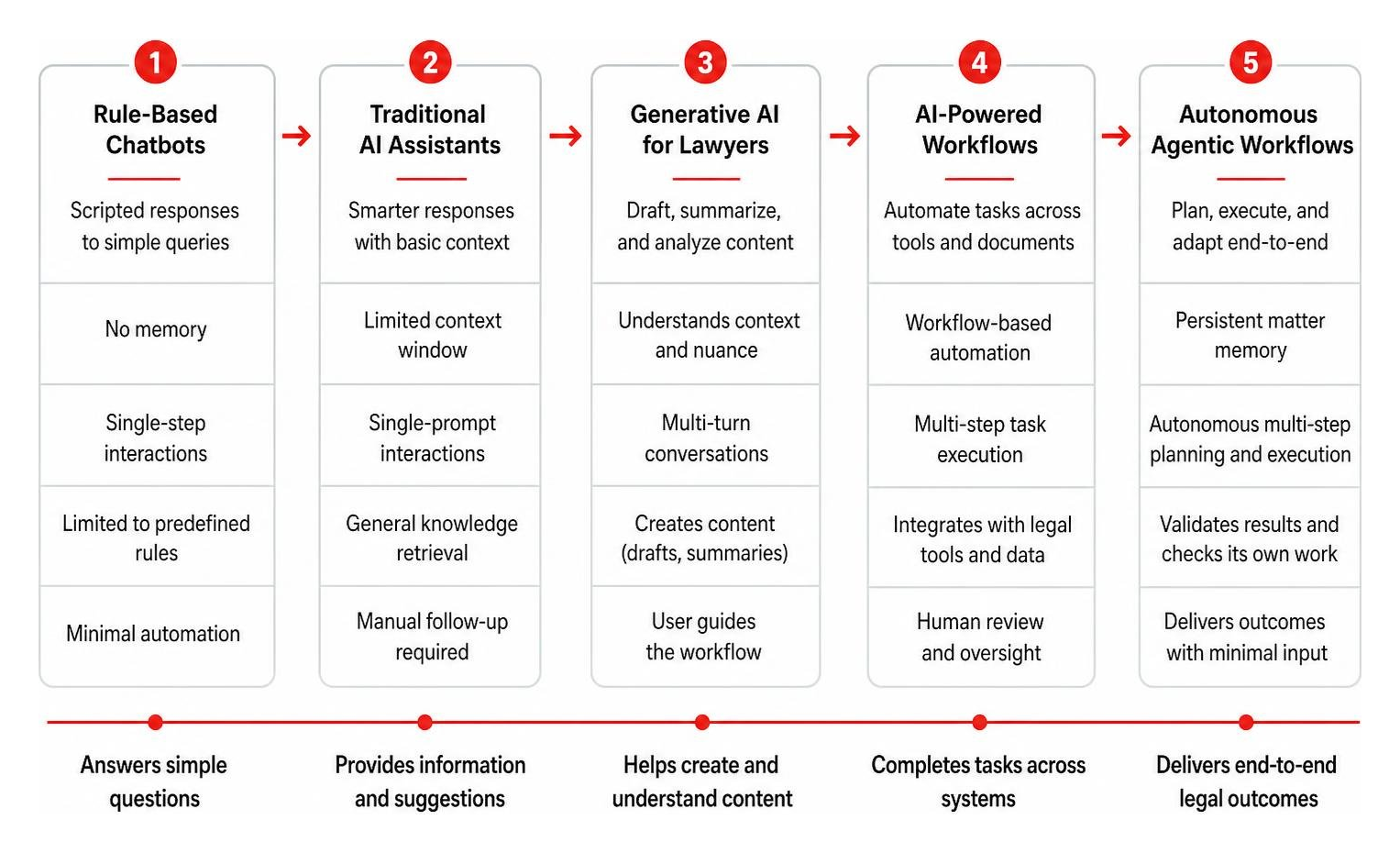
We have officially moved past the era of simple, single-prompt chatbots. In 2026, the legal industry is undergoing a massive shift toward “agentic AI.”
Traditional generative AI is passive—it waits for you to type a prompt, gives you an answer, and immediately forgets the interaction. Agentic AI tools, however, operate as active, autonomous assistants. They can plan multi-step workflows, execute complex sequences of tasks, check their own work, and collaborate with other software systems.
For example, an agentic system like Legora aOS or Harvey Agents doesn’t just draft a document when asked. It can scan an entire incoming case file, identify missing medical chronologies, cross-reference those gaps with state-specific filing deadlines, generate a custom task list for your paralegal, and draft the initial demand letter—all in one cohesive workflow.
Furthermore, these tools utilize persistent matter memory. They build a living, navigable record of a legal matter over time. The AI remembers the settled positions, key parties, and case facts across different sessions, meaning you never have to start from scratch when querying your files. This level of automation is redefining what is possible with AI automation for lawyers.
Key use cases transforming daily legal workflows
AI is no longer just an administrative assistant; it is actively transforming how substantive legal work gets done in firms of all sizes. By delegating high-volume, document-heavy tasks to AI, attorneys can focus their energy on high-level strategy and client advocacy.

Legal research and document drafting
Legal research has historically been one of the most time-consuming aspects of practice. AI tools have compressed this process from days to minutes. Platforms like Lexis+ AI and CoCounsel allow you to type natural-language questions and receive structured answers complete with direct citations to verified statutes and case law.
When it comes to drafting, these tools act as highly sophisticated drafting partners. They can generate initial outlines of motions, construct customized pleadings, or draft trial briefs. However, the rise of generative AI has also highlighted the danger of “hallucinations”—where an AI confidently fabricates non-existent case citations.
To combat this, modern legal AI platforms utilize “citation firewalls” or source-grounding systems. These systems automatically check every generated citation against primary federal and state sources, dropping any claim that cannot be verified. This ensures your filings remain accurate, professional, and fully compliant with court rules. For an in-depth look at how different models perform, check out our Attorney Generative AI Rankings 2026.
Contract intelligence and due diligence
In transactional law, review and due diligence can be incredibly tedious. AI-driven contract intelligence tools can analyze thousands of contracts in minutes, extracting key clauses, identifying hidden liabilities, and summarizing complex terms.
Using platforms like Ruli AI or Spellbook, transactional lawyers can:
- Run Tabular Reviews: Extract liability caps, warranty periods, and change-of-control provisions across hundreds of agreements simultaneously, structuring the findings into clean data grids.
- Apply Playbook Redlining: Upload your firm’s or client’s negotiating playbooks directly into Microsoft Word. The AI will scan incoming contracts, flag clauses that deviate from your playbook, and suggest redlines with tracked changes.
- Automate Due Diligence: Scan share purchase agreements or corporate structures to instantly flag regulatory risks, non-compete overlaps, or compliance gaps.
These tools allow in-house legal departments and corporate law firms to complete diligence in hours instead of weeks, significantly lowering outside counsel costs and accelerating deal timelines.
Ethical considerations, data security, and compliance
As legal professionals, our ethical obligations do not take a back seat to technological efficiency. When adopting AI tools for lawyers, we must carefully navigate issues of client confidentiality, algorithmic bias, and professional responsibility.
Maintaining attorney-client privilege
The most critical risk when using consumer-grade AI tools like the free tier of ChatGPT is data leakage. When you input client information into a standard public model, that data may be stored on external servers and used to train future iterations of the public model. This constitutes a severe breach of client confidentiality and can instantly waive attorney-client privilege.
To protect your practice, always ensure that your legal tech stack relies on private endpoints and enterprise-grade security. Look for vendors that offer:
- Zero Data Retention (ZDR): A strict contractual guarantee that your uploaded documents, prompts, and outputs are never stored permanently by the LLM provider and are never used for model training.
- Strict Compliance Certifications: Ensure the platform is certified under SOC 2 Type II, ISO 27001, and, if you handle medical records or European data, HIPAA and GDPR.
- Tenant Isolation: Your firm’s data should be stored in an isolated, encrypted digital vault, completely segregated from other users’ data.
Mitigating hallucinations and ensuring accuracy
Under the rules of professional responsibility, attorneys have a duty of competent representation and a duty of supervision over their work product—including work generated by technology. Relying blindly on an AI-generated draft without thorough verification is a recipe for court sanctions.
To safely use AI in your practice, implement a strict “human-in-the-loop” protocol. Every single citation, statutory reference, and factual assertion generated by an AI must be manually verified against primary sources by a qualified legal professional before it leaves your office. Think of the AI as an incredibly fast junior associate: they can do the heavy lifting, but the partner must always review and sign off on the final product.
How to evaluate and choose the right AI platform for your firm
With hundreds of legal AI tools flooded into the market, choosing the right platform for your firm can feel overwhelming. Signing up for multiple expensive subscriptions without a clear strategy is a fast track to tool fatigue and wasted budget.
When evaluating a new AI tool, use the following checklist to guide your decision:
- Practice Area Alignment: Does the tool solve your specific bottlenecks? A personal injury firm needs robust medical record summarization and intake automation, while an M&A firm requires advanced contract comparison and tabular review.
- Data Security and Compliance: Does the vendor provide a written guarantee of zero data training on your proprietary files? Do they hold SOC 2 Type II or ISO 27001 certifications?
- Ease of Use and Integrations: Does the tool plug directly into the software your firm already uses, such as Microsoft Word, Outlook, iManage, Clio, or MyCase? If a tool requires your staff to constantly jump between five different platforms, adoption rates will plummet.
- Accuracy and Traceability: Can the tool cite its sources? Does it provide direct links to the exact paragraphs in the source documents so you can easily verify its findings?
- Pricing Transparency: Are there hidden costs like implementation fees, training costs, or usage-based credit charges that will surprise your accounting department?
Implementation and staff training strategies
Buying great software is only half the battle; the real challenge is getting your team to use it. To maximize your return on investment, we recommend a structured, staged rollout:
- Stage 1: Identify the Bottlenecks: Audit your current workflows. Where are your attorneys and paralegals spending the most non-billable time? Start by targeting a single, high-impact bottleneck, such as contract review or initial client intake.
- Stage 2: Run a Pilot Program: Select a small group of tech-forward attorneys and paralegals to test the tool on real-world, non-confidential scenarios. Use this pilot to gather feedback and build internal “champions.”
- Stage 3: Establish Written Protocols: Draft a clear, firm-wide AI policy. Define exactly which types of data can be entered into the system, outline the mandatory manual verification steps, and establish clear lines of accountability for AI outputs.
- Stage 4: Provide Continuous Training: Don’t just hand over a login. Provide structured, hands-on training sessions. Teach your staff how to write precise prompts, how to utilize persistent matter memory, and how to spot potential hallucinations.
Frequently Asked Questions about AI in the legal profession
Will AI replace human lawyers?
No, AI will not replace human lawyers. While AI excels at speed, scale, and pattern recognition, it completely lacks human elements like empathy, strategic judgment, ethical decision-making, and the ability to build trust.
A computer cannot hold a client’s hand during a difficult deposition, navigate the emotional nuances of a custody dispute, or read the subtle body language of a jury. Instead, AI acts as a powerful complement—a tireless “junior associate” that handles the tedious administrative work so you can focus on advocacy and relationship-building.
What are the typical pricing models for legal AI software?
Legal AI software generally uses one of three pricing structures:
- Per-Seat Subscriptions: A flat monthly or annual fee per user (typically ranging from $200 to $1,200+ per seat for advanced legal-specific tools).
- Usage-Based Credits: A lower base subscription fee combined with a pay-as-you-go model, where you purchase credits to run complex document analyses or deep research queries.
- Enterprise Licensing: Customized flat-rate annual contracts designed for large firms or corporate legal departments with unlimited usage.
Tip: Always ask vendors about hidden costs, such as onboarding fees, mandatory training packages, or data migration charges.
How do legal AI tools handle sensitive client data?
Reputable legal AI tools protect sensitive client data by using end-to-end encryption (both in transit and at rest), isolated tenant environments, and strict data-handling policies. They establish private API connections with LLM providers to guarantee that your data is never stored, monitored, or used to train public AI models.
Supercharge your firm’s growth with intelligent marketing
While upgrading your internal legal workflows with AI is critical for efficiency, leveraging artificial intelligence for your firm’s growth is how you dominate your market.
At Triple Digital, we help law firms in Houston, TX, and across the United States turn technological change into a massive competitive advantage. We specialize in high-impact lead generation and case acquisition, utilizing advanced data mining and AI-driven targeting to connect your firm with high-intent clients.
We don’t believe in fluffy metrics or vague promises. Our approach is simple: less fluff, more cases. Whether you are looking to optimize your visibility in search engines, capture high-value cases through targeted PPC campaigns, or position your firm to win in the era of Google’s search generative experience, we have the tools and expertise to make it happen.
To explore how we can help you build a future-proof firm, check out our resources on AI Tools for Law Firm Marketing and read our complete guide on Future-Proof Your Firm: The AI Advantage in Legal Marketing.
Ready to scale your case volume? Let’s talk. Explore our digital marketing services today to start driving real, measurable results for your practice.