





Move Over SEO and Learn How to Optimize Legal Services for AI Search
The Search Revolution Law Firms Can’t Afford to Ignore
AI search optimization for legal services is the practice of making your law firm visible — and recommendable — inside AI-generated answers on platforms like ChatGPT, Perplexity, Google Gemini, and Microsoft Copilot.
Here’s what that looks like in practice:
- Audit your AI footprint — search your firm name and practice area queries in major AI tools to see if you appear
- Build a consistent entity — ensure your firm name, address, phone, and practice areas match across your website, Google Business Profile, and legal directories like Avvo and Justia
- Create answer-first content — write FAQ pages, practice area guides, and structured content that directly answers the questions your clients are asking AI
- Earn authoritative mentions — get listed and reviewed on platforms that AI engines treat as trusted sources
- Implement structured data — add LegalService, Attorney, and LocalBusiness schema markup so AI systems can read and cite your firm accurately
- Track AI citations — monitor whether and how often AI tools recommend your firm for relevant queries
Something big has shifted in how people find lawyers.
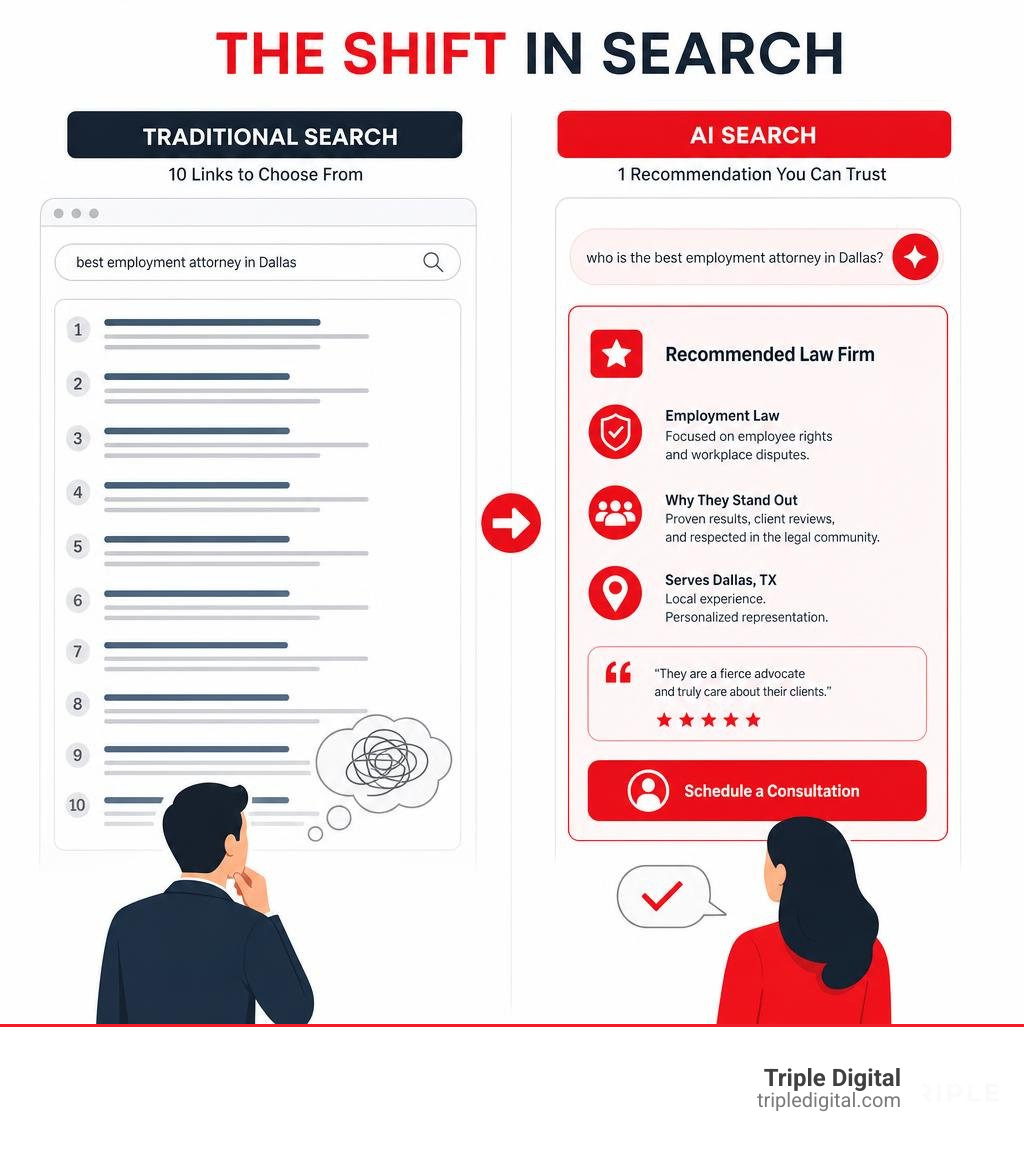
Not long ago, a potential client with a legal problem would open Google, scan ten blue links, and click through to a few law firm websites. That journey is changing fast.
Today, that same person opens ChatGPT or Perplexity, types a question like “who is the best employment attorney in Dallas,” and gets a single, confident recommendation — not a list of options to browse.
If your firm isn’t in that answer, you simply don’t exist for that client.
According to recent data, roughly 41% of legal searches now involve AI in some form, and that number is projected to surpass 60% within the next 18 months. Meanwhile, 60% of Google searches already end without a single click — meaning even ranking on page one no longer guarantees anyone sees your firm.
This isn’t a distant trend. It’s happening right now, and most law firms are completely unprepared for it.
The good news? Less than 6% of law firms have completed the foundational work needed to appear in AI-generated answers. That means the window to get ahead of your competitors is still wide open — but it won’t stay that way for long.
Why Your Firm Needs AI Search Optimization Legal Services
Traditional search engine optimization (SEO) has served law firms well for decades. But as we navigate June 2026, relying solely on traditional keyword-focused strategies is a fast track to digital invisibility.
To understand why your firm must transition to AI search optimization legal services, we have to look at how user behavior has fundamentally evolved. When a prospective client is in a high-stress legal situation, they do not want to read through ten different 2,000-word blog posts to find out if they have a case. They want immediate, direct, and authoritative answers. AI search tools give them exactly that.
By implementing Guide to AI SEO Services, law firms can position themselves directly within these conversational outputs. This is not about getting a user to click a link; it’s about training Large Language Models (LLMs) to recognize your firm as the definitive solution to a user’s legal problem.
When your firm is cited as the recommended answer in a ChatGPT or Perplexity query, it acts as a digital warm introduction. The AI acts like a trusted concierge rather than an agnostic bulletin board. This builds immediate credibility, driving high-intent leads that convert into signed cases much faster than traditional traffic sources. If you want to keep your firm ahead of the curve, you must learn to Future-Proof Your Firm: The AI Advantage in Legal Marketing by optimizing for these generative engines.
How AI Search Engines Evaluate and Recommend Law Firms
Traditional search engines rank web pages based on keywords, backlink counts, and technical on-page signals. AI search engines, however, evaluate entire concepts and entities. They don’t just look at what is written on your website; they synthesize information from across the entire web ecosystem to determine if your firm is credible.
To get a clearer picture of how these platforms operate, explore our comprehensive Guide to AI Overview for Attorneys. In short, when a user asks an AI engine for a recommendation, the model performs a real-time retrieval process. It scans its training data and live web sources, looking for consistent verification of your firm’s practice areas, geographic location, peer recognition, and client satisfaction.
This system relies heavily on E-E-A-T (Experience, Expertise, Authoritativeness, and Trustworthiness). Because legal services fall under Google’s “Your Money or Your Life” (YMYL) classification, the threshold for trust is incredibly high. If the AI finds conflicting information about your office location or practice areas across different directories, it will simply skip your firm to avoid recommending an unverified business. To see where the industry stands today, check out the Attorney Generative AI Rankings 2026.
To help visualize this transition, here is a breakdown of how traditional SEO compares to AI search optimization:
| Feature/Metric | Traditional SEO | AI Search Optimization (GEO/AEO) |
|---|---|---|
| Primary Goal | Rank in the top 10 organic blue links | Be cited/recommended as the direct answer |
| Search Intent Focus | Keyword matching (e.g., “Houston business contract lawyer”) | Conceptual queries (e.g., “how to structure a business partnership”) |
| Core Ranking Signals | Backlink quantity, keyword density, technical site speed | Entity consistency, structured schema, directory verification |
| Content Strategy | High-volume, long-form keyword-optimized articles | Factual density, direct Q&A formats, Brand Facts pages |
| User Experience | Clicks to website required for conversion | Zero-click answers where AI provides the lead source |
| Failure Risk | Dropping to page two of Google | Complete digital invisibility in AI recommendations |
Core Ranking Factors in AI Search Optimization Legal Services
For an AI model to recommend your firm, it must find a clear web of trust pointing to your brand. AI engines do not rely on a single source of truth; they cross-reference data from multiple points across the web. This is why AI-Driven Law Marketing focuses heavily on building off-site authority signals.
The core ranking factors for AI retrieval include:
- Entity Verification: The absolute consistency of your firm’s name, address, phone number (NAP), and attorney credentials across all indexed directories.
- Citation Trust: How often your firm is referenced by authoritative legal publications, state bar associations, and peer-reviewed listings.
- Factual Sentiment: The overall tone and volume of your client reviews on platforms like Google Business Profile, Avvo, and Martindale-Hubbell.
- Data Source Accessibility: How easily AI crawlers can parse your website’s technical infrastructure, specifically through structured schema markup.
Content Strategy and Formats for Generative Search Engines
AI engines do not read content the way humans do, nor do they scan it like old-school search crawlers looking for keyword density. They use vector representations to compress information and match user queries based on intent.
This means that long, fluff-filled intros and keyword-stuffed paragraphs are actively harmful. To optimize your content, you must focus on factual density and structural clarity. We recommend learning The Key to AI Written Content to understand how to structure articles that LLMs can easily retrieve and quote.
When writing for AI platforms, keep your claims anchored to verifiable facts, specific statutes, or official case citations. Write in a neutral, third-person objective tone. Instead of saying, “We fight tirelessly for the justice you deserve,” write, “Our Houston-based firm has assisted over 500 local businesses with corporate restructuring since 2018.” The latter gives the AI concrete, citable facts that it can use to answer a user’s question. For a deeper dive into these strategies, read our guide on AI Digital Marketing for Law Firms.
High-Performing Content Formats for AI Retrieval
Certain content formats are highly favored by AI retrieval systems because they match the natural, conversational way users prompt these systems.
- FAQ Sections: Adding concise, direct Q&A blocks to your practice area pages makes them highly eligible for citation. Answer the core question in the first two sentences, then provide context.
- Brand Facts Pages: A dedicated page summarizing your firm’s founding year, practice areas, notable verdicts, and attorney bios in a clean, factual layout. This serves as an easy-to-read reference sheet for AI bots.
- Decision-Stage Content: Articles comparing different legal options (e.g., “LLC vs. S-Corp for Texas Businesses”) perform incredibly well because they address the exact research phase of a potential client’s journey.
- Content Clusters: Building deep topical authority by writing a comprehensive cornerstone page on a primary practice area, supported by multiple tightly-linked sub-pages addressing specific long-tail questions.
To streamline this process, lawyers should leverage specialized AI Tools for Law Firm Marketing to identify keyword gaps and structure content efficiently.
Off-Site Authority: Directories, Reviews, and Entity Verification
Your website is only one piece of the puzzle. When an AI search engine decides which law firm to recommend, it looks at your entire digital footprint. Legal directories like Avvo, Justia, Martindale-Hubbell, and Super Lawyers serve as primary verification points. Because these directories have already verified your attorney credentials, AI systems treat them as highly trusted data sources.
This makes maintaining absolute NAP consistency across the web non-negotiable. If your address is listed as “Suite 400” on your website but “Ste. 400” on Avvo, or if your phone number varies across local profiles, it weakens your entity clarity. This is a core pillar of any successful Guide to AI Lawyer Growth Strategy.
Furthermore, client reviews are a massive signal for AI search engines. LLMs analyze not just the volume of your reviews, but the sentiment and specific keywords used within them. A review that says, “They helped me resolve my Houston breach of contract dispute quickly,” tells the AI exactly what you do, where you do it, and that you do it well.
Measuring Visibility and Auditing Your AI Footprint
A challenge of AI search optimization is that traditional rank-tracking tools cannot measure your performance. AI answers are dynamic, personalized, and often result in zero-click searches.
To measure your visibility, you must look at your server logs. By analyzing your server logs, you can identify when AI bots (such as GPTBot, ClaudeBot, or PerplexityBot) crawl your site. If these bots are actively accessing your practice area pages and FAQ sections, it is a strong signal that your content is being integrated into their candidate sets.
Additionally, we recommend implementing Guide AI Automation for Lawyers to automate the tracking of AI mentions and run regular monthly audits of how your firm is recommended across different platforms.
Actionable Strategies for AI Search Optimization Legal Services
To start improving your AI search visibility today, we recommend executing these five actionable steps:
- Use a Citation Bookmarklet: Create a custom browser bookmarklet to extract the linked source URLs from AI-generated answers. Run queries like “best corporate attorney in Houston” on Perplexity, extract the sources, and see which directories or competitor sites are being cited.
- Implement LegalService Schema: Add detailed JSON-LD structured data to your website, specifying your legal practice subtypes (e.g., Attorney or Notary), geographic coordinates, and office hours.
- Claim Your Foursquare Profile: Many AI platforms (including Apple Maps and various local search integrations) pull up to 70% of their local business data from Foursquare rather than Google. Claim and optimize this profile immediately.
- Optimize Your Google Business Profile Categories: Ensure your primary category matches your exact practice specialty (e.g., “Corporate Attorney”) rather than a generic “Lawyer” label.
- Front-Load Your Answers: Structure your web content so that the direct answer to a legal question is positioned within the first 100 words of your page, cutting out long conversational preambles.
Frequently Asked Questions About AI Search for Lawyers
What is the difference between AEO and GEO?
Answer Engine Optimization (AEO) focuses on getting your firm cited as the direct, spoken, or written answer when a user asks an AI assistant a specific question. Generative Engine Optimization (GEO) is a broader discipline that focuses on optimizing your entire digital footprint so that generative AI models synthesize, summarize, and recommend your firm across comprehensive, multi-step search queries.
Does traditional SEO still matter for law firms?
Yes, absolutely. AI search engines use indexed web content as their primary source material. If your website does not have a strong technical SEO foundation, high-quality backlinks, and clean crawlability, AI bots will not be able to access or trust your content. A successful digital strategy must be a hybrid of both traditional SEO and AI search optimization.
How long does it take to see results from AI SEO?
Firms with an existing website, established domain authority, and verified directory profiles can begin seeing their first AI citations within 30 to 60 days of optimization. For highly competitive or long-tail practice-area queries, building a compounding citation advantage typically takes between 60 and 120 days of consistent content and entity optimization.
Turn AI Search Into New Clients with Triple Digital
The digital landscape has shifted, and the window to dominate AI search results is closing. While your competitors are still pouring money into expensive PPC bids and outdated keyword strategies, you have the opportunity to capture high-intent cases before they ever click a traditional search link.
At Triple Digital, we don’t believe in vanity metrics or fluff. We are a results-driven digital marketing agency based in Houston, Texas, specializing in precise lead generation and case acquisition for law firms. By leveraging advanced data mining and cutting-edge AI search optimization legal services, we ensure your firm is the trusted authority that AI engines recommend first.
Ready to see if AI is currently sending your ideal clients to your competitors? Schedule a consultation with our team today for a free, live AI search audit of your firm. Let’s get to work on winning your next case.