

ChatGPT SEO Optimization Tips: From Prompt to Page One
Search Is Changing Fast — Here’s What Smart Marketers Are Doing About It
The most effective chatgpt seo optimization tips in 2026 aren’t about gaming an algorithm. They’re about making your content easy for AI to find, trust, and cite.
Quick answer — the top ChatGPT SEO optimization tips:
- Allow OpenAI’s crawlers (GPTBot, OAI-SearchBot, ChatGPT-User) in your robots.txt
- Submit your sitemap to Bing Webmaster Tools
- Add an llms.txt file to your site root
- Structure content with direct answers at the top (BLUF method)
- Use question-shaped H2 headings and 120-180 word sections
- Add FAQPage, Organization, and Speakable schema markup
- Build brand mentions on Reddit, Quora, and third-party review platforms
- Include specific, verifiable statistics throughout your content
- Use ChatGPT for ideation, keyword clustering, and technical audits — not for publishing raw content
- Track referral traffic from ChatGPT using utm_source=chatgpt.com in GA4
Here’s the reality check: ChatGPT now has over 300 million weekly users and processes more than 1 billion queries every day. Zero-click searches have hit nearly 60% of all queries. Gartner predicts a 25% drop in traditional search volume by 2026.
That means fewer people are clicking blue links. More are getting answers directly from AI.
For law firms, this shift is urgent. If your firm isn’t showing up in AI-generated answers, you’re invisible to a fast-growing segment of potential clients — people who never make it to Google’s results page at all.
The good news? You don’t need to rebuild your entire marketing strategy. You need to understand how AI search engines like ChatGPT find and cite content — and then make a few targeted, high-leverage changes.
This guide covers both sides of the equation: how to use ChatGPT to sharpen your SEO strategy, and how to optimize your site so ChatGPT recommends you.
SEO vs. GEO: The New Search Reality in 2026
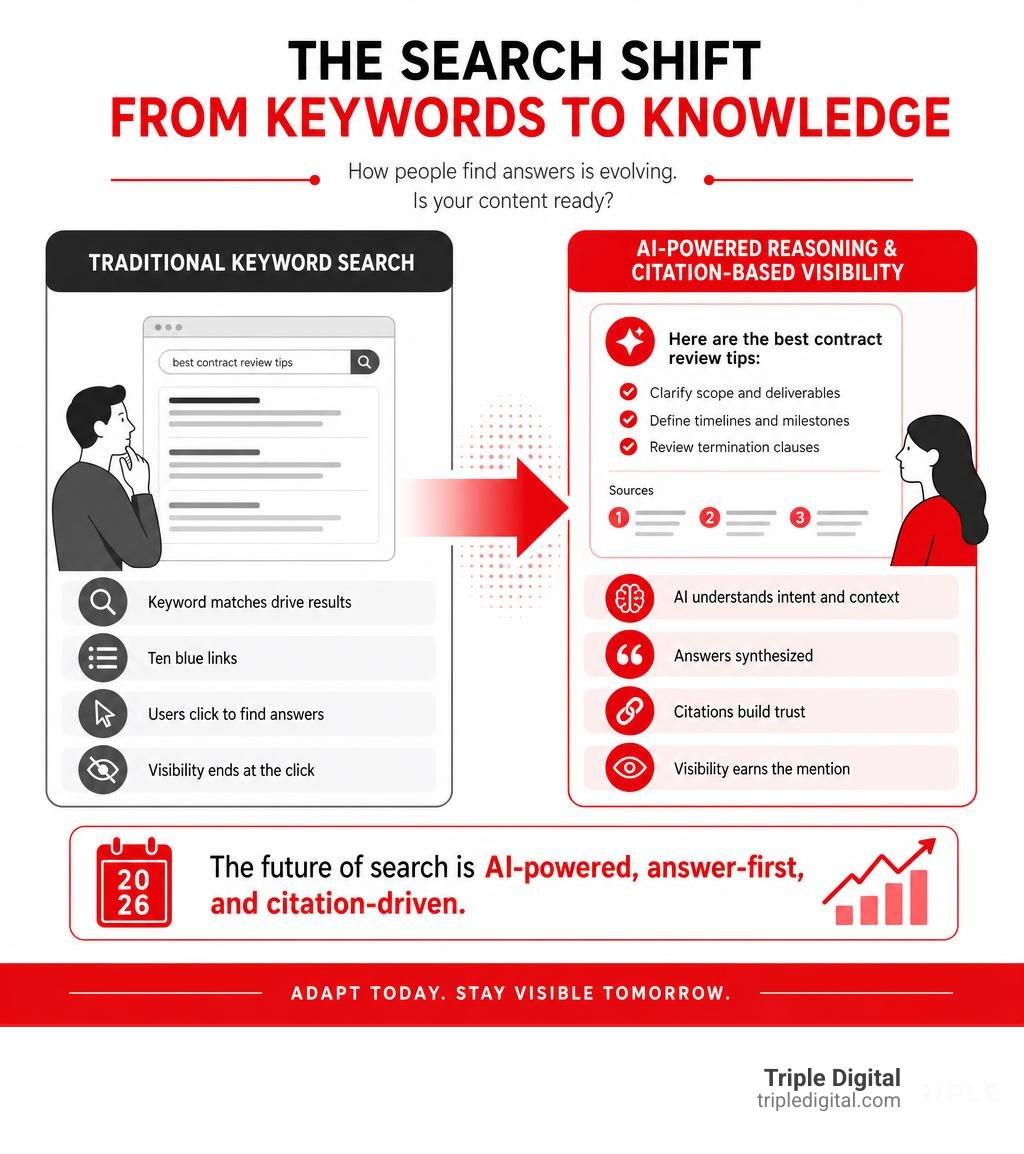
To win in this new landscape, we have to understand the fundamental shift from traditional Search Engine Optimization (SEO) to Generative Engine Optimization (GEO).
Traditional SEO was built for the Retrieval Economy. A user typed a keyword, and Google retrieved a list of ten blue links. The user did the heavy lifting of clicking, reading, and synthesizing the information.
GEO is built for the Reasoning Economy. When a user asks ChatGPT a complex question, the AI doesn’t just hand over links. It crawls the web, extracts relevant chunks of information, synthesizes a single, cohesive answer, and adds citation footnotes.

According to a landmark Princeton University study, the rules for winning these citations are completely different from traditional ranking signals. While traditional SEO relies heavily on domain authority and backlink profiles, GEO rewards “content-answer fit,” semantic structure, and information density. In fact, the Princeton study revealed that optimizing for “fact density” (including exact statistics, data, and direct quotes) can boost the visibility of lower-ranked websites by up to 40% in AI responses.
This means a smaller, highly focused website can easily out-cite a massive competitor if its content is structured perfectly for AI extraction. We call this capturing “Share of Model” rather than “Share of Voice.” You can read more about this shift in our guide on Winning the AI Search Trial with Generative Engine Optimization.
To help visualize this transition, here is a direct comparison of the two disciplines:
| Feature | Traditional SEO | Generative Engine Optimization (GEO) |
|---|---|---|
| Primary Goal | Rank #1 on a search engine results page (SERP) | Secure citation footnotes and direct brand recommendations |
| User Behavior | Clicks on blue links to read multiple sources | Reads a single, synthesized answer on the AI interface |
| Key Metric | Organic impressions and Click-Through Rate (CTR) | Share of Model (how often the AI recommends your brand) |
| Core Ranking Signals | Backlinks, keyword density, domain authority | Fact density, semantic structure, third-party consensus |
| Content Style | Long-form, keyword-optimized articles | Modular, direct, “Wiki-Voice” prose with high data density |
While traditional SEO isn’t dead, it is no longer enough. To capture high-value leads and cases, we must optimize for both human searchers and AI agents.
Technical Setup: Preparing Your Site for AI Crawlers
If AI bots cannot crawl your website, you do not exist in the generative search landscape. ChatGPT does not magically know everything about your business; it relies on a sophisticated real-time retrieval pipeline to fetch live web data.
To make your site accessible, you must open the door to OpenAI’s three distinct crawlers:
- GPTBot: This crawler gathers public web data to train OpenAI’s underlying large language models.
- OAI-SearchBot: This is the real-time search crawler used by ChatGPT Search (formerly SearchGPT) to index pages for live queries.
- ChatGPT-User: This bot is triggered on-demand when a user explicitly asks ChatGPT to browse a specific URL in real-time.
Because ChatGPT Search relies heavily on Microsoft Bing’s index to locate candidate URLs, your first step is verifying your site in Bing Webmaster Tools. If your site is not indexed by Bing, ChatGPT will struggle to find you during real-time web searches. Additionally, wiring up IndexNow ensures that any new content or updates you publish are instantly pushed to Bing, making them immediately available for AI retrieval. For a comprehensive look at how these technical pieces fit together, check out our Guide to AI SEO Services.
Essential robots.txt and llms.txt Configurations
Many webmasters mistakenly blocked all AI crawlers during the initial AI boom, fearing content scraping. However, for commercial brands and law firms looking for client acquisition, blocking these bots is digital suicide. It removes your brand from the model’s memory and prevents it from recommending your services.
To ensure proper access, update your robots.txt file. Make sure you do not block the critical OpenAI agents. Your robots.txt file should explicitly allow them:
User-agent: GPTBot Allow: /
User-agent: OAI-SearchBot Allow: /
User-agent: ChatGPT-User Allow: /
In 2026, a new standard has emerged alongside robots.txt: the llms.txt file. This is a plain-text manifest file placed directly in your website’s root directory (e.g., yourfirm.com/llms.txt).
Think of llms.txt as a clean, markdown-formatted cheat sheet designed specifically for AI models. It strips away the heavy CSS, client-side JavaScript, and navigation clutter, providing a highly legible summary of your site’s core offerings, pricing, and key informational pages. This allows AI bots to quickly grasp your brand’s entity details without wasting crawl budget on non-essential pages. We discuss this technical setup further in our guide on Winning the AI Search Trial with Generative Engine Optimization.
Implementing Schema Markup for AI Scannability
Structured data (schema markup) acts as a direct translator between your website and an AI’s retrieval engine. Pages with advanced structured data receive 3.2x more AI citations than pages with basic or missing markup.
By feeding search engines clean, machine-readable JSON-LD code, you give AI models the confidence to pull your data into their synthesized answers. The most critical schemas for AI optimization include:
- Speakable Schema: This identifies sections of a page that are highly suited for text-to-speech conversion and voice search. It has shown the strongest correlation with AI Overview citations.
- FAQPage Schema: Explicitly maps out questions and answers, making it incredibly easy for an LLM to extract clean Q&A pairs.
- Organization Schema: Establishes your brand’s identity, physical address, and contact details, which is vital for local AI recommendations.
- Person Schema: Links your content to real human authors, establishing the expertise and authority that AI models look for to avoid hallucinations.
For legal professionals, implementing these structured signals is crucial for building trust with algorithmic search engines. To learn how to execute this specifically for legal practices, explore our Guide AI Overview Optimization for Lawyers.
Actionable ChatGPT SEO Optimization Tips for Content Creators
Once your technical foundation is secure, you must write content that aligns with “Content-Answer Fit.” AI models process text in semantic chunks of 100 to 300 words. If your content is filled with fluff, introductory throat-clearing, and vague marketing jargon, the AI will bypass your page in favor of a more direct source.
To make your content highly citable, adopt a neutral, authoritative “Wiki-Voice” tone. Avoid subjective phrases like “we believe,” “in our opinion,” or “we are the best.” Instead, write declarative, encyclopedic sentences.
Furthermore, saturate your content with fact density. AI models are designed to find and present verifiable facts. If you state a claim, back it up immediately with original statistics, direct expert quotes, or primary source citations. Aim for 2 to 3 specific data points for every 300 words of content. To understand how to balance AI utility with human readability, read our insights on The Key to AI Written Content.
Structuring Content with the BLUF Method
The most effective formatting framework for GEO is the BLUF method: Bottom Line Up Front.
LLMs suffer from a technical limitation known as the “Lost in the Middle” phenomenon, where they pay the most attention to the very beginning and the very end of a document. In fact, data shows that 44.2% of all AI citations are extracted from the first 30% of a web page.
To optimize for this:
- Lead every major section (H2) with a direct, 40-to-60-word answer block that summarizes the conclusion immediately.
- Structure your subheadings as clear, natural-language questions (e.g., “How much does a personal injury lawyer cost in Texas?”).
- Keep your informational paragraphs concise, ideally between 120 and 180 words. This length aligns perfectly with the typical paragraph size of an AI’s synthesized response, making it incredibly easy for the crawler to extract your text verbatim.
For a deeper dive into crafting highly structured legal copy, read our guide on Content Creation for Attorneys.
Off-Page Signals and Brand Mentions
ChatGPT does not form recommendations in a vacuum. It validates its training data by scanning the broader internet consensus. If your brand is only mentioned on your own website, ChatGPT treats you as a statistical anomaly and will likely ignore you.
To build “internet consensus,” you must cultivate brand mentions and reviews across trusted, third-party platforms. High mention volume on community forums like Reddit and Quora correlates with a massive 4x increase in AI citations. When users ask ChatGPT for real-world recommendations (e.g., “Who is a highly rated business litigation attorney in Houston?”), the model actively crawls discussion threads, independent review sites, and online directories to synthesize its answer.
Additionally, creating a Wikidata entity for your business provides a clean, machine-readable record of your brand’s attributes, which feeds directly into LLM training datasets. For more on building off-site authority, read our piece on Advanced SEO Authoritative Content.
How to Use ChatGPT for SEO Strategy and Ideation
Now let’s flip the coin: how do you use ChatGPT to make your daily SEO workflows faster and smarter?
The golden rule of AI-assisted SEO is simple: use ChatGPT as a strategic brainstorming partner, not as a cheap ghostwriter.
Publishing unedited, bulk AI content is a fast track to getting penalized by search engines. However, ChatGPT is incredibly powerful for content ideation, mapping user intent, building topical authority, and optimizing user experience (UX) to turn search traffic into actual cases.
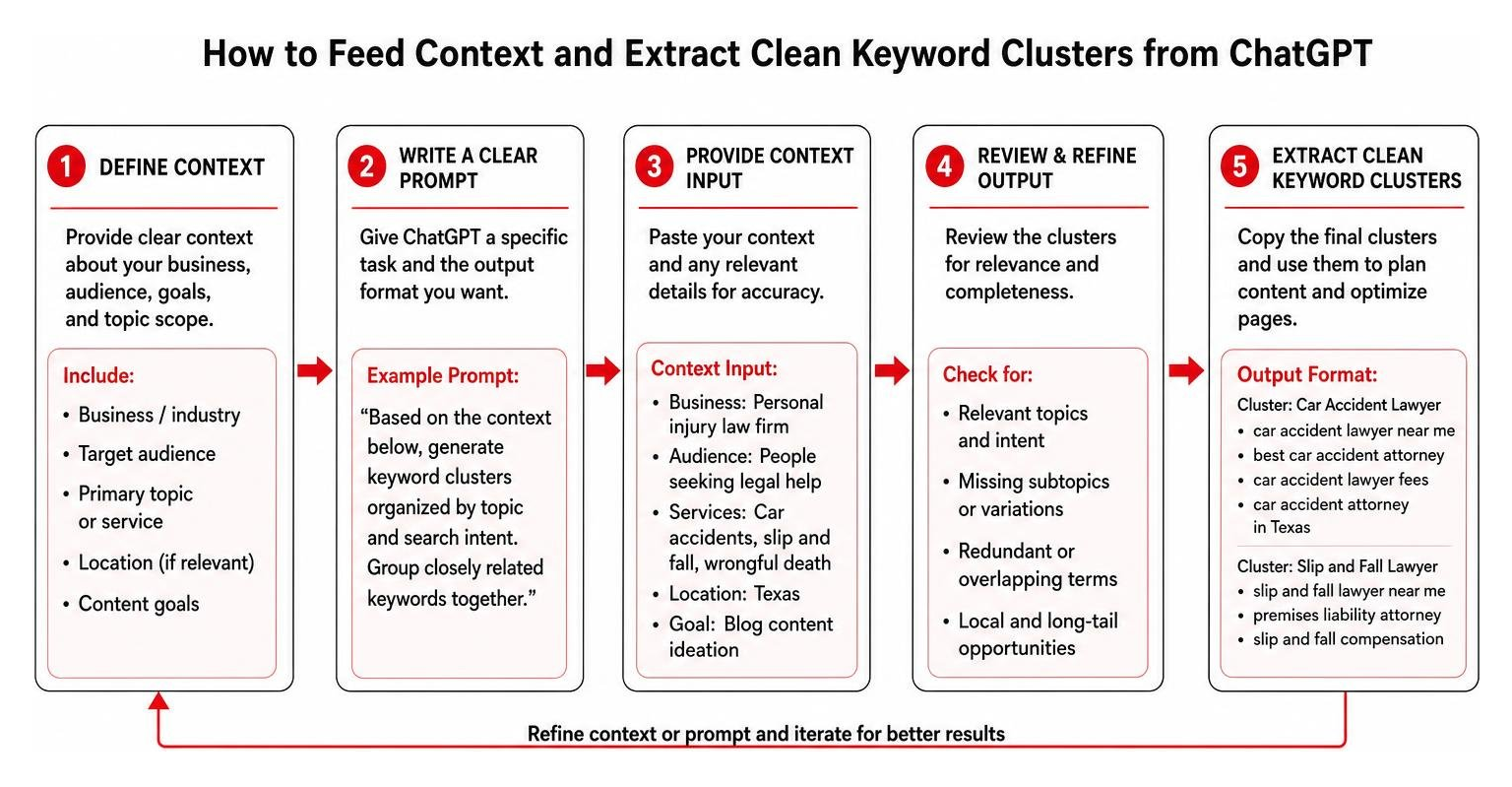
By using custom SEO GPTs built by industry experts, you can tap into specialized workflows that analyze user behavior and conversion rate optimization (CRO) opportunities, ensuring your site doesn’t just drive clicks, but actively signs clients.
ChatGPT SEO Optimization Tips for Keyword Research
Traditional keyword tools show you search volume, but they often fail to capture the complex, conversational search queries of the generative era. ChatGPT is excellent for semantic expansion and intent classification.
Instead of asking for a generic list of keywords, use highly structured, audience-anchored prompts. For example, you can prompt ChatGPT:
“Act as an expert SEO strategist. Analyze the search journey of a small business owner in Houston who is dealing with a breach of contract issue. Generate a list of 15 long-tail, question-based keywords that reflect their immediate concerns, categorized by informational and transactional search intent. Group these into a semantic topic cluster around a central pillar page.”
This approach allows you to map out comprehensive topic clusters that cover the entire buyer journey. To learn how to structure these keyword maps for your firm, check out our resource on Keyword Research for Lawyers: Getting More Clients Online.
ChatGPT SEO Optimization Tips for Technical Audits
You don’t need to be a software engineer to run a technical SEO check. ChatGPT can act as a highly efficient junior developer, helping you diagnose crawl issues and generate structured code.
You can paste raw technical data directly into ChatGPT to solve common errors:
- Robots.txt Analysis: Paste your robots.txt file and ask, “Are there any directives here blocking OpenAI, Google, or Bing crawlers from accessing my high-priority service pages?”
- Redirect Mapping: Paste a list of URLs to quickly map out redirect chains and identify crawl budget waste.
- Schema Generation: Provide a paragraph of text and ask ChatGPT to generate flawless JSON-LD schema markup (such as FAQPage or Organization schema) without any syntax errors.
- Log File Analysis: Input raw server log data to identify how frequently search engine bots are crawling your site.
Using AI to automate these repetitive technical tasks frees up your time to focus on high-level growth strategies. For a complete blueprint on managing your technical health, read our guide on Mastering Law Firm SEO: Your Blueprint for Online Success.
Measuring Your AI Search Visibility and Referral Traffic
“What gets measured gets managed.” But how do you track rankings when there is no “page one” or traditional SERP in ChatGPT?
Measuring GEO performance requires a shift in analytics. Since late 2025, ChatGPT has started appending a specific referral tag to its citation links: utm_source=chatgpt.com. This means you can easily isolate and track direct referral traffic from ChatGPT inside Google Analytics 4 (GA4).
To do this in GA4:
- Navigate to Reports > Acquisition > Traffic Acquisition.
- Filter or search for “chatgpt.com” under the Session Source/Medium dimension.
- Monitor how many sessions, engaged sessions, and conversions are originating directly from AI citations.
Additionally, you should conduct manual baseline citation audits. Identify the top 10 to 20 conversational prompts your potential clients would ask ChatGPT when looking for services in your market (e.g., “How do I choose a business litigation attorney in Houston?”). Run these prompts monthly, document whether your brand is cited, and track your “Share of Model” relative to your competitors. For an in-depth look at how legal brands are ranking in generative search, explore our Attorney Generative AI Rankings 2026.
Frequently Asked Questions About AI Search
Does ChatGPT crawl my website directly?
Yes and no. ChatGPT uses its training crawler, GPTBot, to build its long-term parametric memory. However, for real-time queries (ChatGPT Search), it relies heavily on OAI-SearchBot and Microsoft Bing’s real-time index to retrieve live web pages. It then extracts content from those candidate URLs to synthesize its final answer.
Should I block AI crawlers in my robots.txt?
For commercial businesses and law firms, blocking AI crawlers is highly discouraged. Doing so removes your brand from the AI’s knowledge base, meaning ChatGPT will never cite your content, recommend your services, or display your brand during commercial searches.
How does ChatGPT decide which websites to cite?
ChatGPT prioritizes sources based on four main levers:
- Bing Search Visibility: The page must rank well within Bing’s live index.
- Extractability: The content must be structured in clean, modular, machine-readable formats (like the BLUF method and schema markup).
- Fact Density: The presence of verifiable statistics, data, and direct quotes.
- Internet Consensus: Off-site validation from trusted platforms like Reddit, Wikidata, and third-party review directories.
Dominate the Generative Era with Triple Digital
Optimizing for the AI search revolution can feel overwhelming, but you don’t have to navigate this transition alone.
At Triple Digital, we are a Houston-based digital marketing agency specializing in lead generation and case acquisition for law firms. Our USP is a results-driven, “less fluff, more cases” approach, leveraging AI and data mining for precise client targeting. We don’t care about vanity metrics; we care about bringing high-value cases to your firm.
Whether you need to overhaul your technical schema, optimize your content for AI scannability, or build a dominant online presence that AI search engines cannot ignore, we have the expertise to make it happen.
Ready to make your brand win ChatGPT? Let’s talk. Check out our insights on SEO Agency for Lawyers: How to Spot a Legal Marketing Unicorn or contact us today to schedule your strategic consultation.