


Paid Online Advertising: The Clear Breakdown of Formats and Strategies
Paid Online Advertising Gives Law Firms Faster, Measurable Reach
Paid online advertising means paying platforms such as Google, LinkedIn, Meta, or YouTube to show an ad to a selected audience. For law firms, it can put a practice area, location, and clear next step in front of people who are actively searching for help – or who match the profile of a likely client.
A smart starting point is simple:
- Pick one business goal, such as qualified consultation requests.
- Choose a channel that matches intent, often search ads for urgent legal needs.
- Set up conversion tracking before spending.
- Start with a controlled test budget, then improve ads, targeting, and landing pages based on results.
Unlike SEO and other organic marketing, which can build visibility over time, paid ads can generate traffic as soon as a campaign is approved. You still need strong messaging, a useful landing page, and careful measurement. Paying for clicks does not guarantee cases.
This guide breaks down the main ad formats, auction and pricing models, campaign setup steps, and the 2026 changes affecting targeting, AI, and privacy.
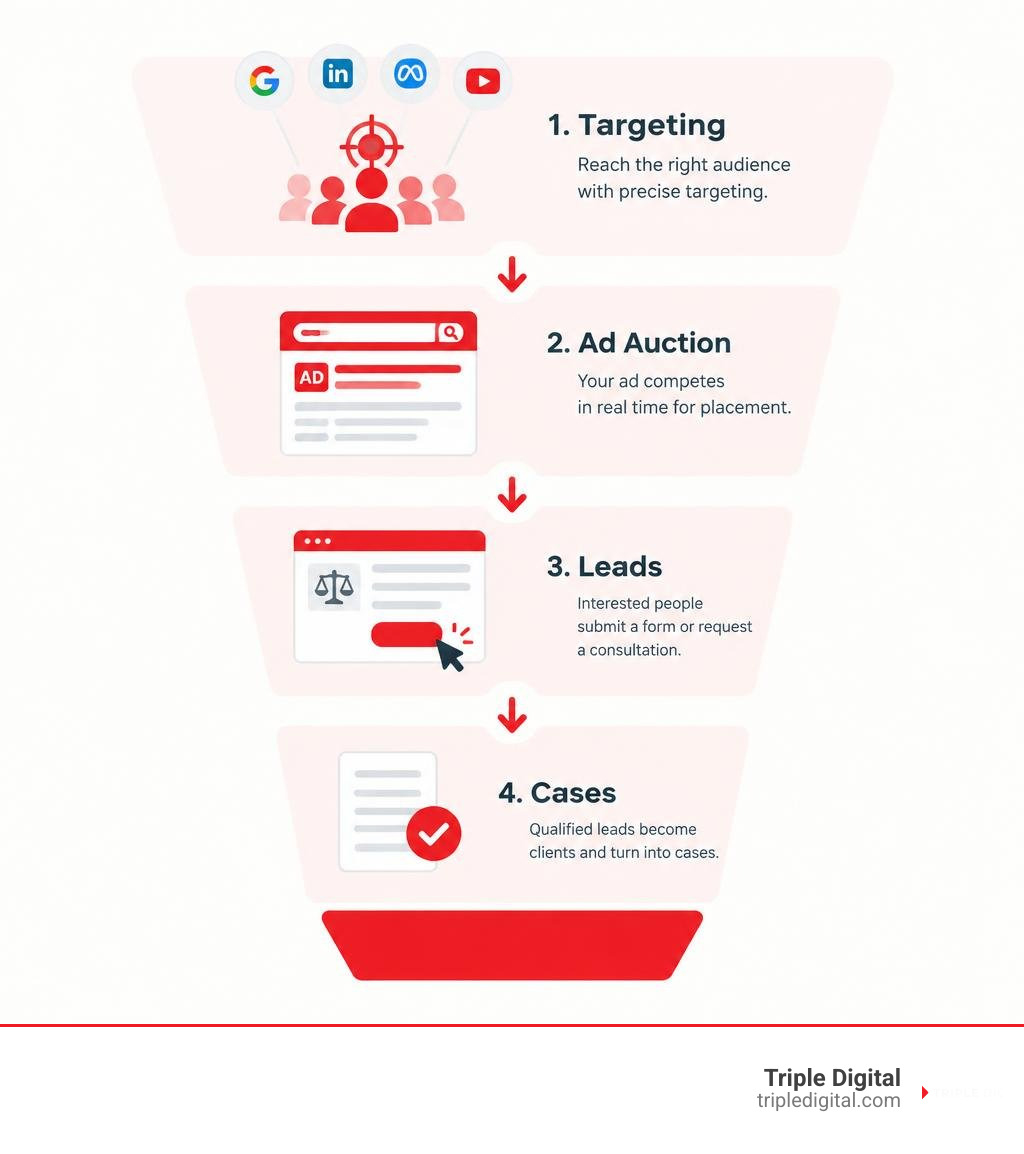
Paid online advertising vocab to learn:
Understanding Paid Online Advertising vs. Organic Marketing
Every marketing strategy balances speed, cost, and longevity. Organic marketing—such as search engine optimization (SEO), organic social media posts, and content publishing—builds equity over time. It can take months of steady publishing and technical optimization to rank organically on page one.
Paid media works on demand. When you purchase advertising placements, your content appears in front of your chosen audience instantly. Think of organic marketing like buying real estate where you build equity slowly, while paid ads are like renting premium storefront space right on Main Street during rush hour.
| Feature | Organic Marketing (SEO, Content) | Paid Online Advertising (PPC, Social Ads) |
|---|---|---|
| Speed to Visibility | Slow (3 to 12 months for traction) | Immediate (as soon as ads are approved) |
| Cost Structure | Upfront time and content creation costs | Direct spend per click, impression, or action |
| Audience Intent Control | Passive; relies on algorithms ranking pages | Active; precise targeting by keyword and persona |
| Traffic Longevity | Sustained traffic after initial ranking | Stops when campaign budget is exhausted |
| Scalability | Limited by search volume and crawl cycles | Highly scalable by increasing ad budget |
| A/B Testing Speed | Requires weeks or months of data collection | Provides rapid statistical feedback in days |
Neither channel replaces the other. The most successful organizations run both in parallel to capture broad search engine results page (SERP) real estate.
Core Mechanics of the Real-Time Ad Auction
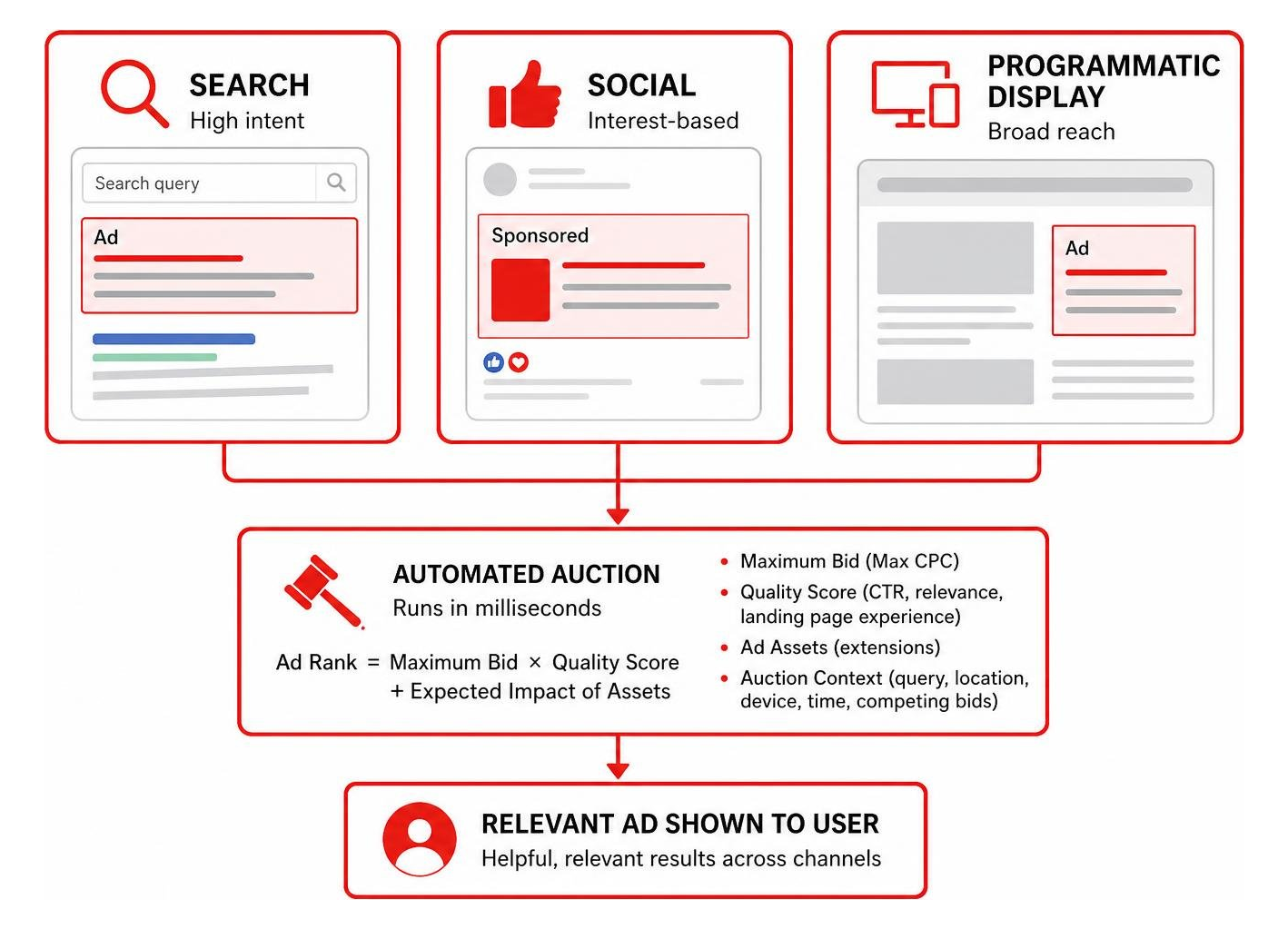
When a user performs a search on Google or loads a feed on LinkedIn, an automated auction runs in milliseconds behind the scenes. Platforms do not simply award top placement to the highest bidder; they calculate an Ad Rank to ensure users see helpful, relevant results.
On Google Ads, for instance, your Ad Rank depends on several key variables:
- Maximum Bid (Max CPC): The highest amount you are willing to pay for a user’s click.
- Quality Score: A score based on expected click-through rate (CTR), ad relevance to the user query, and the quality of your landing page experience.
- Ad Assets (Extensions): The anticipated performance boost from phone numbers, sitelinks, structured snippets, and location assets.
- Auction Context: The user’s search terms, physical location, device, time of day, and competing bids.
Because Quality Score directly impacts your Ad Rank, high-relevance ads with clean landing pages often pay less per click than low-relevance competitors bidding higher amounts. In an auction model, the actual cost-per-click (actual CPC) is usually just the minimum amount needed to beat the Ad Rank of the competitor below you.
Key Benefits of Paid Online Advertising for Fast Growth
Paid campaigns give businesses immediate control over lead acquisition. Rather than waiting for search algorithms to index new pages, marketing teams can deploy foundational paid advertising options to capture real-time demand.
Key benefits include:
- Granular Audience Segmentation: Filter traffic by zip code, search queries, company size, job title, and income bracket.
- Controlled Budget Pacing: Platforms allow strict daily and monthly budget caps, so you never spend more than planned.
- Clear Return on Ad Spend (ROAS): Direct tracking connects individual clicks to form submissions, phone calls, and revenue.
- High-Intent Lead Capture: Search ads position your brand in front of prospects experiencing an urgent need.
At Triple Digital, our Houston-based team focuses on a data-backed approach for legal practices: less fluff, more cases. Using advanced data mining and AI targeting, we help firms eliminate wasted clicks and capture high-intent inquiries.
Core Formats and Channels Across Modern Digital Media
Selecting the right ad channel depends on your target market and the buyer’s stage in the decision funnel. Modern advertising requires a multi-touch approach where channels work together across search engines, social feeds, and display placements. You can explore our breakdown of modern paid ad campaigns to see how diverse formats coordinate inside a full-funnel strategy.
Search Engine Marketing and Pay-Per-Click Ads
Search Engine Marketing (SEM)—often called pay-per-click (PPC)—places text ads directly at the top of search engine results when users look up specific terms.
Because search ads target users actively seeking solutions, they routinely produce the highest conversion rates. Setting up intent-driven search ads lets you bid on high-value terms like “business contract lawyer” or “Houston tax attorney” while using negative keywords to block unqualified traffic.
To maximize real estate, use rich ad assets:
- Sitelink Assets: Direct users to specific service subpages.
- Call Assets: Display clickable phone numbers on mobile devices.
- Callout Assets: Highlight key differentiators, such as “Available 24/7” or “Free Case Review.”
- Location Assets: Link directly to your Google Business Profile to attract local searchers.
For specialized firms, such as those running personal injury PPC campaigns, precision keyword matching and negative keyword lists prevent expensive, accidental clicks from non-relevant searches.
Paid Social Media and Professional Networking Ads
While search ads capture existing demand, paid social media introduces your solutions to prospects browsing their favorite networks.
Each social channel offers distinct strengths:
- Meta (Facebook & Instagram): Excellent for demographic, behavioral, and retargeting campaigns. For instance, running targeted Facebook advertising helps engage local communities with informative video content and downloadable guides. The average Facebook CPM benchmark is roughly $13.75, making it an affordable channel for top-of-funnel reach.
- LinkedIn Ads: The premier platform for B2B lead generation. LinkedIn Ads deliver some of the highest ROAS figures across major ad networks because you can target by company name, job seniority, and professional skills. HubSpot found that LinkedIn Text Ads generated a click-through rate 60% higher than their average across other social networks.
- Pinterest: A visual discovery platform where 85% of weekly users have made a purchase based on Pins seen from brands.
- TikTok: Fast-growing video platform ideal for short-form, authentic storytelling that connects with younger demographics.
By utilizing pinpoint audience targeting, organizations can isolate prospective clients without wasting budget on uninterested users.
Programmatic Display, Native, and Video Ads
Programmatic display advertising uses automated algorithms to buy ad space across millions of websites, mobile apps, and video platforms.

- Display Banners: Visual image ads served across the Google Display Network (GDN) or independent ad exchanges, effective for brand awareness and retargeting site visitors.
- Native Advertising: Sponsored articles and recommended content that match the visual look and editorial feel of the hosting publication.
- Video & Connected TV (CTV): High-impact video placements running on YouTube, Prime Video, or smart TV apps. These formats allow brands to tell memorable visual stories while tracking digital engagement metrics like view completion rates.
For law practices evaluating overall channel mix, our comprehensive overview on paid advertising for lawyers provides direct guidance on choosing between search, social, and display channels.
Pricing Models, Bidding Strategies, and Budget Management
Understanding digital media pricing models ensures you choose the right billing structure for your specific campaign objectives.
Breaking Down Pricing Models: CPC, CPM, CPA, and CPV
Platforms offer multiple pricing structures depending on whether your goal is visibility, traffic, video engagement, or completed actions:
- Cost-Per-Click (CPC): You pay only when a user clicks your ad. This is standard for search ads and direct-response campaigns where website traffic is the main objective.
- Cost-Per-Thousand Impressions (CPM): You pay for every 1,000 times your ad is shown, regardless of whether users click. CPM is standard for brand awareness, display banners, and social media reach campaigns.
- Cost-Per-Acquisition (CPA): You pay or optimize toward a specific conversion event, such as a contact form submission or phone call.
- Cost-Per-View (CPV): Common in video marketing (like YouTube In-Stream ads), where you pay only when a viewer watches 30 seconds of your video (or the full duration if shorter) or interacts with a card.
Smart Bidding and AI-Powered Automation
Google Ads and other major platforms rely heavily on Smart Bidding—a subset of automated bidding strategies that use machine learning to optimize for conversions in every single auction.
Key automated bid strategies include:
- Target CPA (tCPA): Sets bids automatically to help you get as many conversions as possible at or below your target cost-per-acquisition. Google analyzes real-time contextual signals—such as device, browser, operating system, time of day, and location—to adjust bids dynamically.
- Target ROAS (tROAS): Optimizes bids to maximize conversion value while maintaining a specific return on ad spend percentage (e.g., aiming for a 400% ROAS).
- Maximize Conversions: Spends your entire daily budget to capture the highest possible number of conversions without requiring a specific CPA target.
- Maximize Clicks: Adjusts bids to get the maximum number of visits within your allocated daily budget.
For new campaigns with limited historical data, starting with Manual CPC gives you full control over keyword bids. Once your account accumulates 30 or more conversions within a 30-day window, transitioning to Target CPA or Target ROAS allows machine learning models to identify high-converting prospects efficiently.
Step-by-Step Guide to Launching a High-Performing Campaign
Executing a profitable paid advertising strategy requires systematic planning and testing.
Setting SMART Goals and Configuring Conversion Tracking
Before spending your first dollar, establish Specific, Measurable, Achievable, Relevant, and Time-bound (SMART) goals. For a professional service firm, a SMART goal might be: “Generate 25 qualified consultation form submissions at a cost per lead under $120 over the next 30 days.”
Accurate tracking is the bedrock of paid advertising. Install your tracking tags (such as the Google Tag, Meta Pixel, and LinkedIn Insight Tag) across your website using Google Tag Manager.
Configure primary conversion actions:
- Contact form submissions
- Click-to-call phone calls from mobile ads
- Live chat initiations
- Appointment scheduling confirmations
When running ads in regulated industries, maintaining strict compliance is vital. Review our resource on ethical advertising compliance to ensure your tracking and messaging meet all professional standards.
Creative Development, Copywriting, and Landing Page Alignment
Your ad copy must connect directly with user intent. An effective ad clearly presents your core value proposition and includes an actionable call to action (CTA).
- Headlines: Lead with the primary keyword and key benefit (e.g., “Injured in Houston? Speak With an Attorney Today”).
- Descriptions: Detail your strengths, experience, and what the prospect gains by contacting you.
- Message Match: Ensure the ad headline matches the primary headline on your landing page. If an ad promises a free case assessment, the landing page must immediately provide a clean form to request that assessment.
Never send paid traffic to your homepage. Homepages contain too many distractions and navigation links. Direct paid visitors to dedicated, fast-loading landing pages with clear contact forms, trust badges, client testimonials, and no exterior navigation menu.
Monitoring, A/B Testing, and Continuous Campaign Optimization
Paid advertising is not a “set-and-forget” channel. Accounts require weekly maintenance to eliminate waste and reallocate budget toward top-performing segments.
Essential weekly optimization tasks:
- Search Term Mining: Review actual user search queries and add irrelevant terms to your negative keyword list.
- A/B Testing Creative: Run 2 to 3 ad variations per ad group. Compare CTR and conversion rates, pause underperforming variants, and introduce new copy tests.
- Bid and Budget Adjustments: Increase spend on high-converting geographic locations or devices (desktop vs. mobile) while lowering bids on poor performers.
- Audience Exclusions: Exclude existing clients, current employees, and past converters from top-of-funnel campaigns to conserve budget.
For firms that want experienced oversight without unnecessary overhead, our guide to professional PPC management outlines what to expect from a dedicated marketing partner.
Emerging Trends Shaping Paid Online Advertising in 2026
The digital advertising ecosystem continues to evolve rapidly. Staying ahead of these shifts ensures your budget remains efficient:
- AI-Driven Creative & Dynamic Asset Generation: Advertising engines increasingly assemble headlines, descriptions, and imagery in real time based on what is most likely to convert an individual user.
- First-Party Data Integration: As third-party cookies phase out, platforms rely on privacy-safe first-party data. Tools like Shopify Audiences allow ecommerce brands to leverage first-party commerce signals, helping businesses like BUBS Naturals achieve ROAS figures as high as 3x.
- Clean Rooms and Privacy-Safe Measurement: Cloud-based data clean rooms (such as Amazon Marketing Cloud) allow advertisers to analyze customer journeys and multi-touch attribution without exposing personal identifying information.
- AI-Enhanced Predictive Bidding: Modern ad platforms analyze thousands of real-time signals per auction to predict conversion probabilities. You can learn more about how machine learning impacts campaign precision in our guide to AI-driven ad targeting.
Unifying Paid and Organic Search for Market Dominance
The most effective marketing teams do not view paid and organic marketing as competing silos. Instead, they use them as mutually reinforcing assets:
- Mining Paid Search Terms for SEO: Use search query reports from Google Ads to uncover high-converting long-tail keywords, then write comprehensive organic articles around those exact topics.
- Retargeting Organic Visitors: When prospects discover your website via an organic blog post, serve them targeted retargeting ads across Meta or LinkedIn to guide them back to a consultation page.
- SERP Dominance: Bidding on your own brand keywords while holding the #1 organic position ensures competitors cannot siphon away high-intent prospects searching for your business by name.
To see how legal teams structure these multi-channel programs, check out The Definitive Guide To Paid Advertising For Lawyers and our framework in Ad Vantage Mastering Paid Advertising For Law Firms.
Frequently Asked Questions About Paid Advertising
What is the minimum budget required to start paid online advertising?
There is no universal minimum spend for platforms like Google Ads or Meta Ads, allowing you to set daily budgets as low as $10 to $20. However, to gather statistically significant conversion data within a reasonable timeframe, most businesses start with a testing budget of $1,500 to $3,000 per month. In competitive fields like legal services, higher cost-per-click averages may require a larger starting investment to generate consistent weekly inquiries.
How do I choose between Google Search Ads and paid social media ads?
Base your choice on user intent. If your prospects have an immediate, urgent need (such as hiring an attorney after an incident or repairing a broken air conditioner), Google Search Ads are best because they capture active search intent. If your service requires educating prospects or targeting specific professional titles and demographics (such as corporate compliance consulting), paid social media on LinkedIn or Meta is often more effective.
Will running paid ads have any direct impact on my organic SEO rankings?
No. Running Google Ads or social ads has no direct algorithmic impact on your organic search rankings. Google maintains a strict separation between its advertising services and organic search indexing. However, paid ads provide valuable indirect benefits: they increase overall brand awareness, drive direct brand searches, and reveal high-converting keywords that you can target with your organic content strategy.
Maximize Growth by Mastering Your Paid Ad Strategy
Paid online advertising gives organizations complete control over their growth rate, targeting precision, and market visibility. By choosing the right mix of search, social, and programmatic display ads—and pairing them with automated Smart Bidding and dedicated landing pages—you can build a scalable customer acquisition engine.
If you are ready to eliminate wasted ad spend and scale your practice with a predictable pipeline of qualified client inquiries, explore our framework for dominating your legal market with a dedicated marketing partner. You can also browse our full range of growth services, contact our team directly, or schedule a meeting with our Houston specialists at Triple Digital today.