





How to Win the Click: Google Ads for Lawyers Explained
Google Ads for law firms puts your practice in front of people who are actively searching for legal help right now — not people who might need a lawyer someday.
Here’s a quick summary of what you need to know:
| Question | Quick Answer |
|---|---|
| Does it work for law firms? | Yes — especially for high-urgency practice areas like personal injury, criminal defense, and family law |
| How fast do leads come in? | Most firms see enquiries within 2-4 weeks of launch |
| How much does it cost? | $5–$300+ per click depending on practice area and location |
| What’s a realistic cost per lead? | $30–$100 for most practice areas in 2026 |
| What conversion rate should you aim for? | Minimum 8% from click to enquiry |
| Should you use Smart Campaigns? | No — standard Search campaigns give you far more control |
The legal industry is one of the most competitive and expensive categories in all of Google Ads. Some personal injury keywords cost over $100 per click. One wrong setting — like leaving the Display Network turned on — can burn through your budget fast with almost nothing to show for it.
But when campaigns are set up correctly, the returns can be significant. A well-run Google Ads campaign can deliver a steady flow of qualified leads while your competitors are still waiting on SEO to kick in.
This guide from Triple Digital walks you through everything — from campaign structure and keyword strategy to bidding, landing pages, and intake — so you can run Google Ads that actually sign cases.
For a broader look at paid advertising options beyond Google, see The Definitive Guide to Paid Advertising for Lawyers.
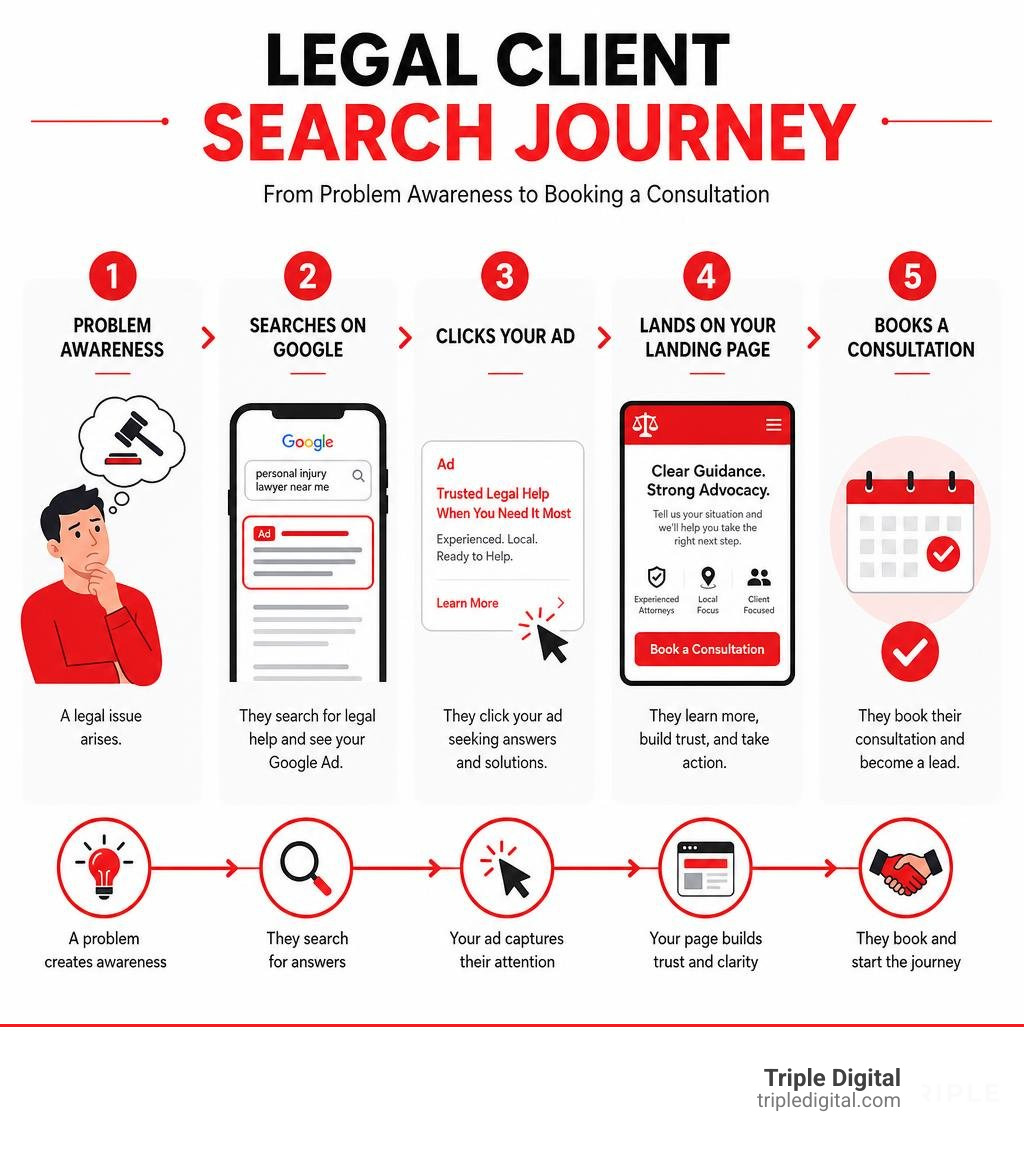
Is Google Ads for Law Firms the Right Choice for Your Practice?
Every law firm wants more clients, but not every firm should use Google Ads. To understand why, we have to look at search intent.
Google Ads thrives on high-intent searches. When someone searches for a “car accident lawyer near me” or a “divorce attorney in Houston,” they aren’t looking for a casual blog post. They have an immediate, pressing problem, and they are ready to hire professional representation.
This is fundamentally different from platforms like Facebook, which are disruption-based. On social media, users are browsing photos of their friends’ vacations when an ad appears. While social platforms are excellent for building brand awareness, they capture users at a completely different stage of the client journey. For a deeper dive into how these platforms compare, read our analysis on The Verdict Is In: Are Facebook Ads a Win for Your Law Firm? and learn How Facebook Advertising Can Bring Traffic to Your Website.
For Google Ads, success comes down to capturing the prospect at the exact moment they decide to take action. If you want to learn the foundational principles of this approach, check out our guide on Ad Vantage: Mastering Paid Advertising for Law Firms.
High-Performing Practice Areas in Google Ads
While Google Ads can work for almost any B2C or B2B practice, certain practice areas have economics and search behaviors that make them exceptionally profitable:
- Personal Injury: The competition is fierce, and clicks are expensive (often $100 to $300+). However, because a single successful case can yield significant fees, the return on investment (ROI) remains highly attractive for firms with the budget to compete.
- Family Law: Divorce and child custody matters have high search volumes and strong emotional urgency. Family law firms frequently generate leads at $30 to $60 per lead, with conversion rates hovering between 18% and 21%.
- Criminal Defense & DUI: When someone is arrested, they need a lawyer immediately. They do not browse for days; they call the first highly rated attorney they find on Google.
- Bankruptcy Law: This practice area consistently boasts some of the highest conversion rates in legal PPC, often exceeding 13%, driven by individuals seeking immediate financial relief.
- Estate Planning: Clicks are relatively affordable ($5 to $15), making it an excellent practice area for firms starting with smaller budgets.
- Immigration Law: High search volume and clear, intent-driven queries make immigration services highly suited for targeted local campaigns.
Managing High Cost-Per-Click (CPC) and Competition
Let’s address the elephant in the courtroom: legal keywords are expensive. Across all industries, the average cost-per-click is around $8. In the legal sector, the average CPC jumps to $22.75, with highly competitive personal injury terms regularly exceeding $100 to $200 per click.
How do you survive in such an expensive environment? You focus on your Quality Score.
Google doesn’t just show the ad of the highest bidder. They use a Quality Score (graded 1 to 10) to measure how relevant and helpful your ad is to the searcher. This score is calculated based on three factors:
- Expected Click-Through Rate (CTR): How likely is someone to click your ad? (Aim for a minimum CTR of 5%).
- Ad Relevance: Does your ad copy directly match the search query?
- Landing Page Experience: Is your landing page fast, mobile-friendly, and directly related to what the user searched for?
Improving your Quality Score has a massive financial benefit. A keyword with a Quality Score of 10 can receive up to a 50% discount on its cost-per-click, while a poor Quality Score of 3 can increase your costs by 60%. By focusing on relevance, smaller firms can outcompete massive advertising budgets.
Structuring and Optimizing Campaigns for Maximum ROI
A disorganized Google Ads account is the fastest way to waste money. If you dump all your keywords into a single campaign with one generic ad, Google will struggle to match your ads to user intent, and your Quality Score will suffer.
To see how this fits into your firm’s broader growth strategy, read our comprehensive resource on Paid Advertising for Lawyers.
Setting Up Your Google Ads for Law Firms Account
To build a campaign that converts, you must structure your account with tight, thematic organization. Here is how we recommend setting up your campaigns:
- Segment by Practice Area: Never mix practice areas. If you handle both criminal defense and family law, they must be in separate campaigns with independent budgets. This prevents a high-volume area from consuming your entire daily budget.
- Tightly Themed Ad Groups: Within your Family Law campaign, create separate ad groups for “Divorce Lawyer,” “Child Custody,” and “Child Support.”
- Refined Geographic Targeting: Go to your campaign settings and change the location option from the default “Presence or interest in” to “Presence: People in or regularly in your targeted locations.” This simple change stops your ads from showing to people outside your jurisdiction who are simply researching local laws.
- Ad Scheduling: If you don’t have anyone to answer the phone at 2:00 AM, consider scheduling your ads to run only during business hours, or ensure you have a robust after-hours answering service in place.
Designing High-Converting Landing Pages
Sending paid traffic to your website’s homepage is one of the most expensive mistakes you can make. A homepage typically converts traffic at a modest 2% to 3%. A dedicated, optimized landing page can easily achieve conversion rates of 8% to 15% or higher.
When clicks cost $100, doubling your conversion rate cut your cost-per-lead in half.
To build a landing page that converts clicks into clients, ensure it includes:
- Message Match: The headline of your landing page must exactly match the promise of the ad. If they clicked an ad for “Houston Divorce Attorney,” the landing page should say “Houston Divorce Attorney,” not “General Civil Litigation.”
- Immediate Trust Signals: Display bar memberships, client testimonials, awards, and case results above the fold where they are immediately visible.
- Frictionless Calls to Action (CTA): Give users two clear options to connect: a prominent, clickable phone number and a short, simple contact form (asking for just name, phone, email, and a brief description).
- Mobile-First Design: Over 70% of legal search clicks come from mobile devices. If your landing page takes more than three seconds to load on a smartphone, your prospect will hit the back button.
For a step-by-step framework on turning traffic into signed cases, read From Clicks to Clients: The Ultimate Law Firm CRO Strategy and explore our complete Guide to Conversion Optimization.
Optimizing the Intake Process for Google Ads for Law Firms
You can run the most perfect google ads for law firms campaign in the world, but if your intake process is slow, your ROI will be zero.
In digital marketing, there is a concept known as “speed to lead.” If a prospect submits a contact form and you do not call them back within 5 minutes, the chances of contacting them drop by 80%. By the time you call them back two hours later, they have already called three other law firms and hired one of them.
- Answer Every Call: Ensure you have dedicated staff or a high-quality legal answering service to pick up calls on the first ring, 24/7.
- Train Your Intake Team: The person answering the phone should be empathetic, professional, and trained to qualify leads immediately.
- Follow Up Fast: Use automated text messages and email confirmations to let form-submitters know you received their inquiry and are reviewing it immediately.
For actionable advice on maximizing your intake performance, read about how to Increase Conversion Rate Law Firms.
Bidding Strategies and Tracking Success Metrics
To get the most out of your ad spend, you need to understand how Google’s bidding systems work and how to measure your results accurately.
Smart Campaigns vs. Manual Control
When you set up a new Google Ads account, Google will strongly encourage you to use “Smart Campaigns” or “Performance Max” campaigns. These automated options promise to handle everything for you using Google’s AI.
For most law firms, Smart Campaigns are a costly gamble.
Smart campaigns often display your ads across the Google Display Network, YouTube, and mobile apps where search intent is incredibly low. This can result in up to 95% of your impressions occurring on placements that convert at miserable rates, leading to incredibly high costs per conversion.
To help you choose the right bidding approach, here is a comparison of your options:
| Bidding Option | How It Works | Best For | Pros & Cons |
|---|---|---|---|
| Manual CPC | You set the exact maximum amount you are willing to pay for a click on each keyword. | New campaigns with limited budgets. | Pros: Total control over spend. Cons: Requires constant manual adjustments. |
| Maximize Clicks | Google’s system automatically sets bids to get as many clicks as possible within your budget. | Building initial data and traffic. | Pros: Great for quick traffic. Cons: Doesn’t optimize for lead quality. |
| Smart Bidding (Target CPA / Maximize Conversions) | Google uses machine learning to adjust bids in real-time to secure conversions. | Established campaigns with at least 30 conversions in 30 days. | Pros: Highly efficient at scale. Cons: Needs solid conversion data to work. |
| Smart Campaigns | Google automates targeting, bidding, and ad creation across all networks. | Very small businesses with no time or marketing help. | Pros: Easy to set up. Cons: High risk of wasted spend on irrelevant networks. |
We recommend starting with Standard Search campaigns using Manual CPC or Maximize Clicks. Once your campaign is consistently generating conversions and has gathered enough data, you can safely transition to Smart Bidding strategies like Target CPA (Cost Per Acquisition).
To learn how data and analytics can revolutionize your firm’s entire marketing strategy, read Measure Up: How Analytics Can Transform Your Legal Marketing.
Essential Metrics and Offline Conversion Tracking
To keep your campaigns profitable, you must track the metrics that actually impact your bottom line. Do not get distracted by vanity metrics like “impressions.” Instead, focus on these five key performance indicators (KPIs):
- Click-Through Rate (CTR): The percentage of people who click your ad after seeing it. Aim for a minimum of 5%.
- Conversion Rate: The percentage of clickers who contact your firm. Successful legal campaigns should target a minimum conversion rate of 8%.
- Cost Per Lead (CPL): How much you pay to get a phone call or form submission.
- Cost Per Acquisition (CPA): The actual cost to sign a new, paying client.
- Search Impression Share: The percentage of searches your ads appeared on compared to the total available searches in your target area.
To track these metrics accurately, you must implement call tracking with dynamic number insertion (DNI). Since the vast majority of high-value legal leads come through phone calls rather than forms, call tracking allows you to trace every phone call back to the exact keyword and ad that generated it.
Furthermore, you should set a minimum call duration threshold (such as 60 to 90 seconds) in your tracking software to filter out spam and hang-ups, ensuring Google’s smart bidding algorithms only optimize for genuine, high-quality inquiries.
To understand why tracking numbers are the foundation of legal lead generation, read Why Tracking Numbers Are So Important to Track Leads.
Frequently Asked Questions About Legal PPC
How much do Google Ads typically cost for law firms?
The cost of running Google Ads varies significantly based on your practice area and geographic location. On average, legal keywords cost around $22.75 per click, but personal injury terms can easily reach $100 to $300+ per click.
In terms of monthly budgets, we recommend the following starting points:
- Estate Planning / Bankruptcy: $1,500 to $3,000 per month.
- Family Law / Criminal Defense: $2,000 to $5,000 per month.
- Personal Injury: $10,000 to $20,000+ per month to remain competitive in major metropolitan areas like Houston.
Most law firms generate qualified leads at an average cost of $30 to $100 per lead across standard practice areas in 2026.
How long does it take for Google Ads to start generating leads?
Unlike search engine optimization (SEO), which can take six months to a year to show results, Google Ads works quickly. Most properly structured campaigns start generating phone calls and form submissions within 2 to 4 weeks of launching.
However, it typically takes 60 to 90 days of continuous data collection to fully optimize your campaigns, build an extensive negative keyword list, and identify which search terms yield the most profitable, signed cases.
Should I hire a specialized legal marketing agency?
While you can manage Google Ads in-house, the high cost of legal clicks makes mistakes incredibly expensive. A generalist marketing agency might understand the basics of PPC, but they often lack the specialized knowledge required for the legal vertical.
Partnering with a specialized legal marketing agency offers major advantages:
- Legal-Specific Negative Keyword Libraries: Experienced legal marketers maintain databases of thousands of negative keywords (such as “free legal aid,” “law schools,” or “pro se”) to block irrelevant traffic on day one, immediately cutting out 20% to 40% of wasted ad spend.
- Proven Landing Page Templates: They already know what layouts, trust signals, and copy convert legal searchers at double-digit rates.
- Ethics and Compliance: They understand bar association advertising rules, ensuring your ad copy remains fully compliant.
- Transparent Account Ownership: A reputable agency will build your campaigns inside an account that you own, ensuring you retain all your historical data and campaign assets even if you part ways.
Conclusion
Google Ads remains one of the fastest, most reliable ways to scale a law practice. By targeting high-intent searches, building highly relevant campaign structures, directing traffic to dedicated landing pages, and responding to leads instantly, your firm can build a highly profitable case acquisition engine.
At Triple Digital, we believe in a results-driven, “less fluff, more cases” approach. Based in Houston, Texas, we specialize in high-efficiency lead generation and case acquisition for law firms. We leverage advanced data mining and precise targeting to ensure your budget is spent on high-value cases, not wasted clicks.
If you are ready to stop paying for clicks that don’t deliver and start signing more clients, explore our specialized services for Paid Advertising for Lawyers and let us help you grow your practice.