




Probate Law Firm Marketing: How to Win High-Value Estate Leads in AI Search
How Is AI Search Transforming Probate Client Acquisition in 2026?
The search landscape covered in “Probate Law Firm Marketing: How to Win High-Value Estate Leads in AI Search” demands that probate firms build a digital presence that generative engines recognize as authoritative, empathetic, and locally precise—through structured entity schema, proprietary data, interactive tools, and rapid, compassionate follow-up. The path a grieving personal representative or named executor takes to find legal representation has shifted dramatically. Where executors once turned to search engines and clicked through the top three blue links or scrolled through static legal directories, they now engage in multi-turn conversational searches using Google AI Overviews, Perplexity, and ChatGPT.
Instead of typing a disjointed keyword phrase like “probate lawyer near me,” searchers in 2026 type or speak complete real-world dilemmas: “My father passed away with real estate in Harris County and no will; what is the timeline to get letters of administration, and which top-rated local probate attorneys handle contested estates?”
This shift makes the traditional “digital yellow pages” directory model obsolete. With approximately 2.4 million probate filings occurring annually across the United States, standing out among the competition is harder than ever. There are nearly 7,000 more estate planning and probate practices operating nationwide today than there were a decade ago. Simply having a digital business card website is no longer sufficient to attract high-value estate administrations.
When an AI engine processes a query, it synthesizes information from dozens of trusted data sources to present a single, authoritative recommendation. Generative engines do not evaluate firms based on keyword frequency alone. They assess topical depth, structured entity validation, verified client sentiment, and technical accuracy. For a firm to be recommended as the premier choice, it must demonstrate legal authority, deep empathy, and verifiable local expertise.
We help legal practices adapt to this new search environment through comprehensive law firm digital marketing for AI visibility. At Triple Digital, our Houston-based team focuses on a data-backed, “less fluff, more cases” methodology. By engineering your digital presence for generative engines, we ensure your firm consistently surfaces when families face complex estate matters and need immediate, trustworthy counsel.
What Are the Core Differences Between Attorney and Investor Probate Leads?
A fundamental mistake many digital marketers make is treating probate leads for attorneys the same as probate leads for real estate investors. Real estate wholesalers and investors routinely scrape public courthouse filings to blast aggressive direct mail postcards and cold calls offering “fast cash for your inherited house.”
When law firms adopt similar high-pressure acquisition tactics, it invariably backfires. Executors are fiduciaries carrying immense legal responsibility while navigating personal grief; treating them like motivated property sellers alienates them and harms your professional standing.
| Lead Dimension | Real Estate Investor Strategy | Estate Administration Attorney Strategy |
|---|---|---|
| Target Persona | Distressed heirs wanting quick asset liquidation | Appointed executors, administrators, and fiduciaries |
| Core Value Proposition | Immediate cash purchase of physical real estate | Legal risk mitigation, court compliance, and asset protection |
| Messaging Tone | Direct, urgent, transactional | Calm, educational, authoritative, empathetic |
| Conversion Timeline | Fast impulse decisions (7–21 days) | Deliberate, consultative vetting (30–90 days) |
| Compliance Rules | Real estate disclosure standards | Strict state bar advertising rules and fiduciary ethics |
| Primary Channels | Courthouse scrapers, cold calls, bulk SMS, direct mail | AI search, interactive calculators, professional referrals |
Navigating an estate involves statutory creditor notifications, inventory filings, beneficiary accountings, and tax liabilities. Appointed executors live under constant anxiety that a procedural misstep could lead to personal financial liability or family litigation.
Attorneys who rely on automated probate lead filtering systems can screen for complex, high-asset estates that require formal administration rather than quick asset liquidation.
Understanding Executor Psychology and Fiduciary Pressure
Serving as an executor is often an exhausting, thankless task. The individual is dealing with funeral arrangements, family dynamics, and a mountain of unfamiliar legal paperwork. Their core psychological driver is not finding the cheapest service; it is avoiding mistakes, protecting their family’s legacy, and shielding themselves from personal liability.
Research shows that 81% of consumers demand complete brand trust before committing to high-stakes professional services. When an executor encounters aggressive sales messaging, their defense mechanisms go up. To win these cases, your marketing must validate their stress, explain their fiduciary duties in plain English, and provide reassuring clarity.
Framing Legal Value Over Asset Liquidation
Your top-of-funnel messaging must distinctly separate legal guidance from asset liquidation. Rather than highlighting quick resolutions, frame your expertise around statutory creditor bar dates, avoiding probate litigation, resolving complex multi-jurisdictional assets, and executing tax-efficient distributions.
By presenting your firm as an objective, steady fiduciary partner rather than a transactional vendor, you attract higher-net-worth estates that require sophisticated legal counsel.
Which Lead Generation Channels Deliver the Highest ROI for Probate Law Firms?
Securing high-asset estate administrations requires a balanced, multi-channel marketing engine. Relying solely on a single source leaves your firm vulnerable to platform and algorithm changes.
Integrating targeted channels creates a compounding acquisition system for your probate practice that attracts clients across every stage of their search.
Channel 1: State-Specific Probate Cost and Timeline Calculators
Static web forms that say “Contact Us for a Free Consultation” are ineffective for attracting hesitant executors. In fact, 76% of legal website visitors leave without taking action when a page lacks interactive resources.
In contrast, calculator-based funnels capture 8–12% of visitors as qualified leads—a substantial increase over the 1–2% conversion rate typical of static forms. Interactive legal tools convert roughly 67% better than static downloadable PDFs because they deliver immediate, personalized clarity.
A well-architected calculator prompts the searcher for basic estate parameters:
- Estimated gross value of the estate
- Types of assets involved (real property, business interests, brokerage accounts)
- Whether a valid original will exists
- Expected beneficiary alignment or potential disputes
In exchange for this information, the user receives an instant breakdown of estimated statutory court fees, required publication timelines, and procedural requirements, while delivering a pre-qualified, data-rich lead directly into your intake software.
Channel 2: High-Yield Professional Referral Compacts
Professional referral networks remain an exceptional source of high-margin legal clients, closing at a 25–40% conversion rate. The challenge is that many attorneys treat referrals as passive occurrences rather than an active marketing channel.
Winning firms build formal, reciprocal referral networks with:
- Certified Public Accountants (CPAs) dealing with post-mortem estate tax returns
- Wealth managers and certified financial planners needing estate distributions cleared
- Life insurance advisors assisting beneficiaries with claim payouts
- Local funeral home directors who are asked daily for trusted legal recommendations
Maintaining these relationships requires structured, value-added communication. Co-hosting webinars, distributing quarterly statutory update briefs, and maintaining a reliable cross-referral cadence ensures your firm stays top-of-mind.
Channel 3: Local Pack and Google Business Profile Optimization
For localized estate administration, physical proximity and verified reviews influence local map pack rankings more than broad backlink volume. When an executor searches for legal counsel in their county, the Google Map Pack captures the vast majority of initial clicks and calls.
Optimizing your Google Business Profile requires:
- Selecting precise primary and secondary categories (e.g., “Estate Planning Attorney,” “Legal Services”)
- Defining exact county service boundaries rather than overly broad metro areas
- Structuring multi-practitioner profiles correctly so individual partners do not compete with the primary firm listing
- Building a steady review acquisition engine using practical frameworks for local SEO success
- Populating an active Q&A section with detailed, executor-specific answers that feed AI search entity graphs
Channel 4: Targeted Life-Event Paid Search Campaigns
Paid search delivers predictable, immediate lead flow when campaigns are built around specific intent rather than broad practice keywords. In competitive metropolitan markets, Google Ads clicks for probate terms range between $5 and $25, with cost per qualified lead averaging between $60 and $180.
To maintain positive unit economics, avoid bidding on broad informational queries. Focus your budget on high-intent, phrase- and exact-match keywords:
"hire probate lawyer for letters testamentary""probate attorney without a will in [County]""independent administration probate lawyer cost"
Route this paid traffic directly to dedicated calculator landing pages rather than your generic homepage. Implement retargeting campaigns on Meta and display networks using calm, educational video messaging to guide prospects who didn’t book an initial consultation on their first visit.
How Do You Optimize Law Firm Content for Generative Search and AI Citations?
Generative Engine Optimization (GEO) is the practice of structuring your firm’s digital footprint so AI models select your content as the definitive answer for search prompts. Modern AI engines do not simply index pages; they extract factual triplets and assess entity authority across the web, as detailed in our guide covering generative engine optimization.
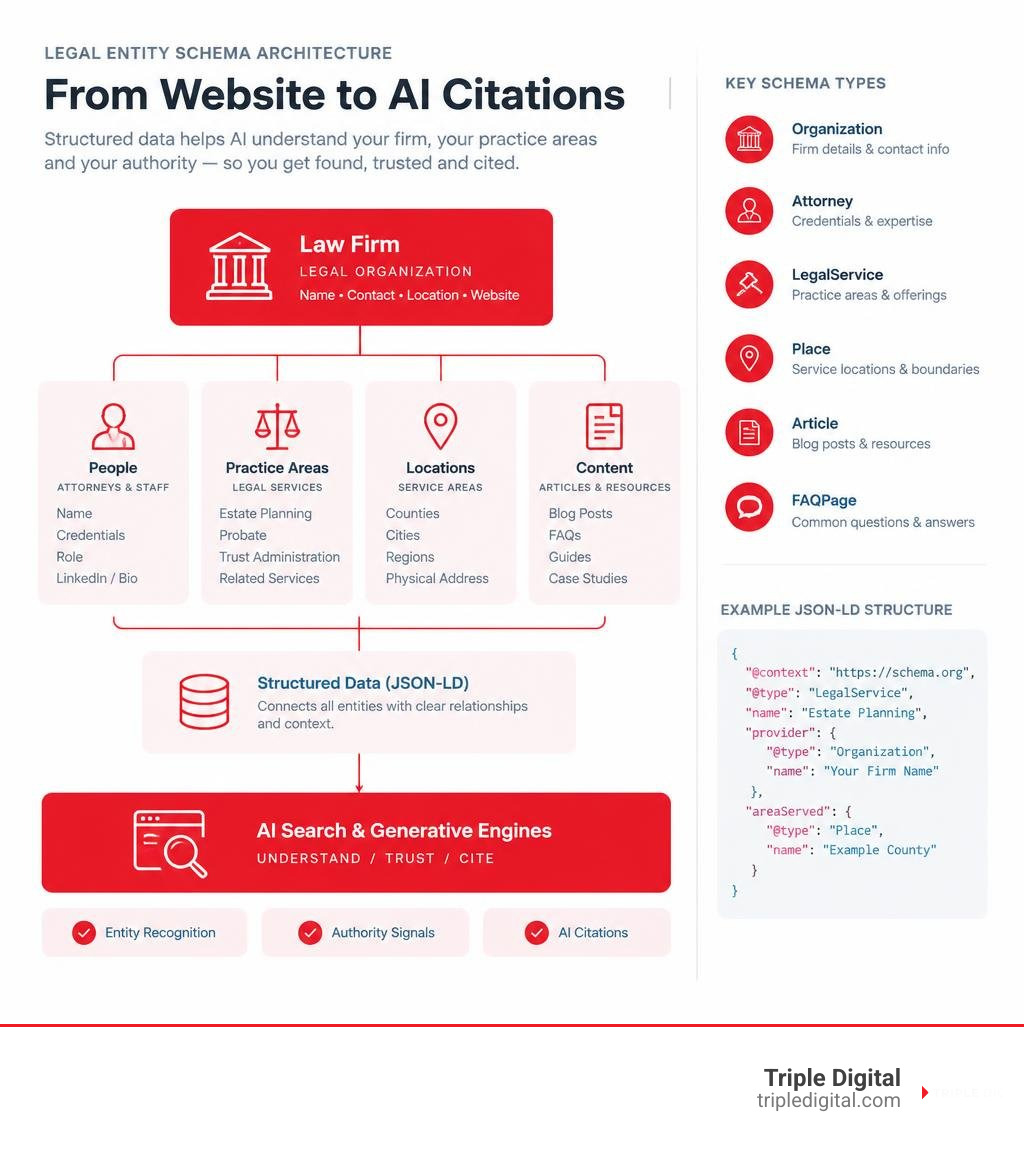
Implementing Legal and Entity Schema Architecture
AI crawlers rely on structured schema markup to understand the context of your legal content without ambiguity. Implementing comprehensive JSON-LD schema across your site establishes strong entity signals.
Essential schema types include:
LegalService: Defines your firm’s physical coordinates, operating jurisdictions, verified phone numbers, and official business credentials.Person: Outlines individual attorney biographies, bar admissions, state bar numbers, and professional associations.Service: Distinctly categorizes practice sub-specialties, such as formal probate administration, muniment of title, small estate affidavits, and ancillary probate.FAQPage: Explicitly connects complex estate questions with clear, direct legal answers.Article: Verifies authorship, review credentials, and original publication dates for educational content.
Organizing your site into distinct topical silos—where core practice pages link to supportive sub-topics—ensures search crawlers easily grasp your firm’s topical depth, as outlined in our guide to modern law firm SEO.
Publishing Proprietary Data and Firm Statistics to Earn AI Citations
Large language models prioritize data-dense, verifiable content over generic legal overviews. When your site publishes proprietary practice data, AI engines frequently cite your firm as the primary authority.
Integrate specific data points into your articles, such as:
- Average court processing days to obtain Letters Testamentary across local county courts
- Percentage of estates that resolve without beneficiary litigation when using independent administration
- Historical local county court filing volume trends
Effectively optimizing content for Perplexity requires formatting these data points in clean HTML tables and concise summary bullets that AI models can extract cleanly.
Utilizing Social Content and Video for Cross-Platform AI Indexing
A major evolution in search is that AI engines actively index and extract content from social media platforms, including Instagram captions, YouTube transcripts, and video descriptions.
When an attorney publishes short-form videos explaining specific estate administration topics—such as “What happens at an initial probate court hearing in Texas?”—AI search models index that spoken transcript. Consistent, educational social posting builds your firm’s semantic footprint and reinforces entity authority across search engines, even if individual posts receive modest day-to-day engagement.
Why Do Probate Firms Lose Mid-Funnel Leads and How Can You Nurture Them?
Most law firms focus heavily on top-of-funnel clicks, but lose prospective clients in the middle of the funnel. An executor might search for information, calculate estate costs, and download a checklist, but hesitate for weeks before retaining counsel.
With 53% of consumers across all income levels tightening budgets, executors are cautious about legal expenditures. Compounding this issue is a widespread industry communication gap: 26% of law firms never respond to web form inquiries, and another 39% take over two hours to follow up.
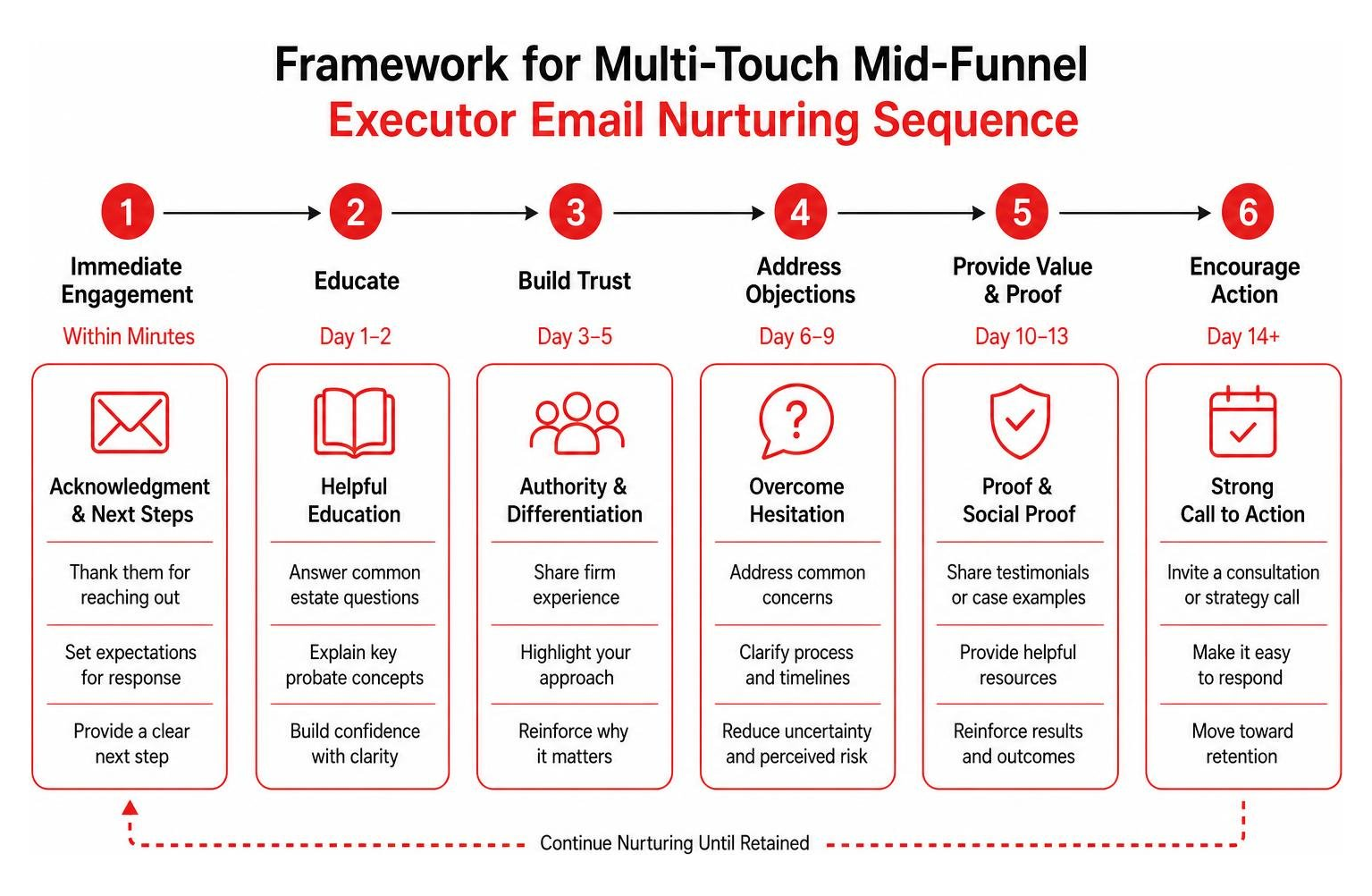
Firms that solve response latency and implement systematic nurturing capture the market share that other practices let slip away, using proven principles from Client Acquisition: Your Roadmap to a Thriving Practice.
Eliminating Lead Response Latency

Lead response time is often the single biggest variable in digital legal marketing conversion. Reaching an inquiring executor within 5 minutes produces an approximate 400% lift in lead-to-consultation conversions compared to responding after 30 minutes.
Grieving executors rarely fill out multiple lengthy contact forms. They reach out to one or two well-reviewed firms; the first practice that responds with empathy, answers their immediate baseline questions, and provides a clear next step almost always wins the case. Implementing 24/7 AI-assisted intake workflows ensures after-hours inquiries are instantly greeted, pre-qualified, and booked directly onto your calendar.
Designing Empathy-Driven Multi-Touch Email Sequences
Because the window between an individual’s passing and the formal retaining of legal counsel often spans 30 to 90 days, automated email nurturing is essential.
A successful nurturing sequence delivers calm, educational value over several weeks:
- Touchpoint 1 (Day 1 – Immediate): Estate Asset Inventory Checklist (A step-by-step spreadsheet for identifying probate vs. non-probate assets).
- Touchpoint 2 (Day 4): The Executor Fiduciary Roadmap (A guide outlining the personal liability protections every executor needs to establish).
- Touchpoint 3 (Day 9): Statutory Creditor Timelines (An explanation of state-specific creditor notice periods and how formal probate bars untimely claims).
- Touchpoint 4 (Day 16): Transparent Fee Overview (An honest breakdown of hourly rates, flat-fee options, and how legal fees are typically paid from estate assets rather than the executor’s personal pocket).
- Touchpoint 5 (Day 25): Case Study on Resolving Beneficiary Disagreements (Practical advice on keeping family communications constructive and out of the courtroom).
Building Trust Through In-Person Workshops and Validation Platforms
Digital discovery must be backed by authentic third-party validation. Today, 56% of consumers trust online reviews as much as or more than personal recommendations, and 70% consult legal directories and review profiles (including Avvo, Martindale-Hubbell, and Google Business Profile) before making a hiring decision.
Complement your online presence by hosting monthly community educational seminars on topics like “Navigating Estate Administration and Probate in Your County.” These low-pressure workshops allow adult children, surviving spouses, and executors to meet your team, ask general procedural questions, and build personal trust before formally signing a retainer.
What Key Metrics and Tracking Systems Prove Real Marketing ROI?
To ensure your marketing budget produces sustainable, profitable firm growth, you must look beyond surface-level vanity metrics. Tracking pageviews or raw impressions won’t show whether your campaigns are generating high-value estate files.
Using proven strategies for data-powered lead generation, your firm should track these core performance indicators:
- Cost Per Qualified Lead (CPQL): The total marketing spend divided by leads that meet your estate asset threshold.
- Speed to First Contact: The median number of minutes between an executor submitting an inquiry and a live intake specialist reaching them.
- Intake-to-Retainer Conversion Rate: The percentage of qualified initial consultations that convert into active, paying estate files (benchmark: 25–40%).
- Average Retainer Value: The gross legal fee realized per probate administration case.
- AI Citation Share: How frequently your firm’s domain, attorneys, and data points appear as sources within conversational AI engines.
Building predictable organic search authority takes time. A newly launched web domain typically requires 6 to 9 months of consistent content publication, technical schema implementation, and entity development to generate predictable lead volume.
However, established practices that optimize their Google Business Profiles, implement calculator funnels, and activate local review workflows often see meaningful improvements in qualified inquiries within 60 days. Deploying Dynamic Number Insertion (DNI) across your campaigns ensures accurate attribution, linking every retained case back to the specific search query, ad, or directory listing that generated it.
Frequently Asked Questions About Probate Law Firm Marketing
How long does it take for a probate law firm to see measurable results from SEO and AI search optimization?
For a brand-new domain, expect 6 to 9 months of consistent technical structuring, schema deployment, and authoritative content generation to achieve steady organic lead flow. For established domains, optimizing your Google Business Profile, launching interactive calculator landing pages, and improving your review pipeline can yield measurable increases in qualified consultations within 60 days.
Why do static “Contact Us” forms fail to convert high-value probate leads compared to interactive tools?
Executors are often overwhelmed by legal uncertainty and reluctant to commit to a direct sales conversation right away. Interactive tools—such as state-specific probate cost and court timeline calculators—provide immediate value by answering pressing procedural questions. This approach converts 8–12% of website visitors into qualified leads, compared to just 1–2% for standard static contact forms.
What should a probate law firm do if competitors are dominating the local Google Map pack?
Focus on verified entity signals, review velocity, and localized relevance rather than broad backlink acquisition. Ensure your Google Business Profile categories are nested correctly, build detailed county-level service pages, and set up an automated post-case review workflow. Pairing this with reciprocal referral compacts with local CPAs and funeral directors builds the local entity authority Google and AI engines prioritize.
How Can Your Law Firm Take the Next Step Toward AI Search Dominance?
Winning high-value probate and estate administration cases in 2026 requires moving beyond outdated digital marketing tactics. Sponsoring static directory listings and relying on passive word-of-mouth is no longer enough to maintain a thriving practice in a competitive market.
Dominating your local market requires a modern, integrated strategy:
- Generative Engine Optimization (GEO): Structuring your website with deep entity schema, proprietary statistics, and clear answers that AI search engines can cite.
- High-Converting Interactive Assets: Replacing static contact forms with state-specific cost and timeline calculators that capture qualified executor leads.
- Compassionate Intake and Mid-Funnel Nurturing: Responding to new inquiries within five minutes and supporting hesitant executors with educational email sequences.
- Local Search and Reputation Authority: Optimizing your local entity footprint across Google Business Profile, social channels, and legal validation platforms.
Executing this strategy requires technical precision, deep data analytics, and an understanding of legal marketing ethics. At Triple Digital, our team builds high-performing acquisition systems designed specifically for growing law firms.
If you are ready to expand your practice with high-value estate files, schedule a discovery meeting with Triple Digital today. We will audit your current AI visibility, identify middle-of-the-funnel opportunities, and build an actionable plan to help your firm lead its market.