





Everything You Need to Know About Generative Engine Optimization
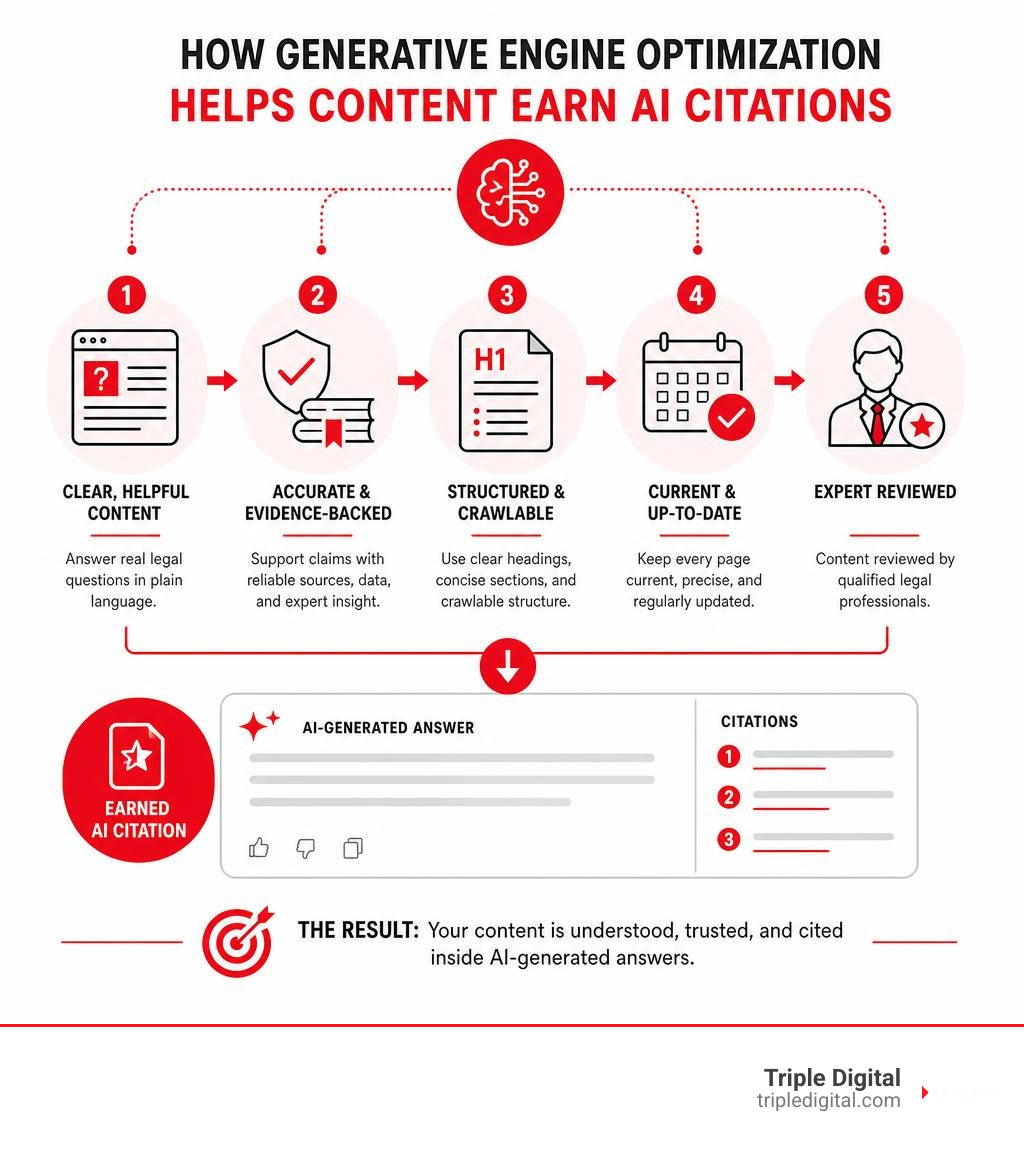
Generative engine optimization is the practice of making your website easier for AI-powered search tools to understand, trust, summarize, and cite. For law firms, that means publishing clear, accurate, evidence-backed pages that directly answer client questions – not just trying to rank another blue link on Google.
Start with the basics:
- Answer real legal questions in plain language.
- Support factual claims with reliable sources, data, and expert insight.
- Use clear headings, concise sections, and crawlable page structure.
- Keep every page current, precise, and reviewed by qualified legal professionals.
This matters because search is changing from a list of links into a generated answer with a small set of cited sources. When Google displays an AI Overview, webpages see an average click-through rate that is 34.5% lower than comparable searches without one. Visibility inside the answer itself is becoming part of the lead-generation fight.
Generative engines such as Google AI Overviews, ChatGPT, Perplexity, and Bing-powered experiences retrieve information from web sources, assess relevance, and combine it into a response. A firm that provides the most useful, well-supported explanation may earn a citation even when it is not the biggest site in the market.
GEO does not replace SEO. It builds on it. Technical accessibility, useful content, and strong organic search foundations still matter. But for firms relying on outdated keyword tactics alone, GEO creates a new way to compete for high-intent legal searches – where potential clients increasingly get their first answer.
Generative engine optimization glossary:
Understanding Generative Engine Optimization and How It Works
Search engines no longer function solely as digital filing cabinets that spit out a list of web addresses. Today, systems rely on sophisticated retrieval-augmented generation (RAG) pipelines. When a user asks a nuanced legal or business question, the generative engine initiates a process known as query fan-out, firing off multiple sub-queries concurrently to gather top-tier source material across the index.
Once these source documents are retrieved, large language models (LLMs) synthesize the context, cross-reference data points, and craft a single, fluid response complete with inline citations. Securing a spot within those citations requires deep semantic relevance rather than surface-level keyword frequency.
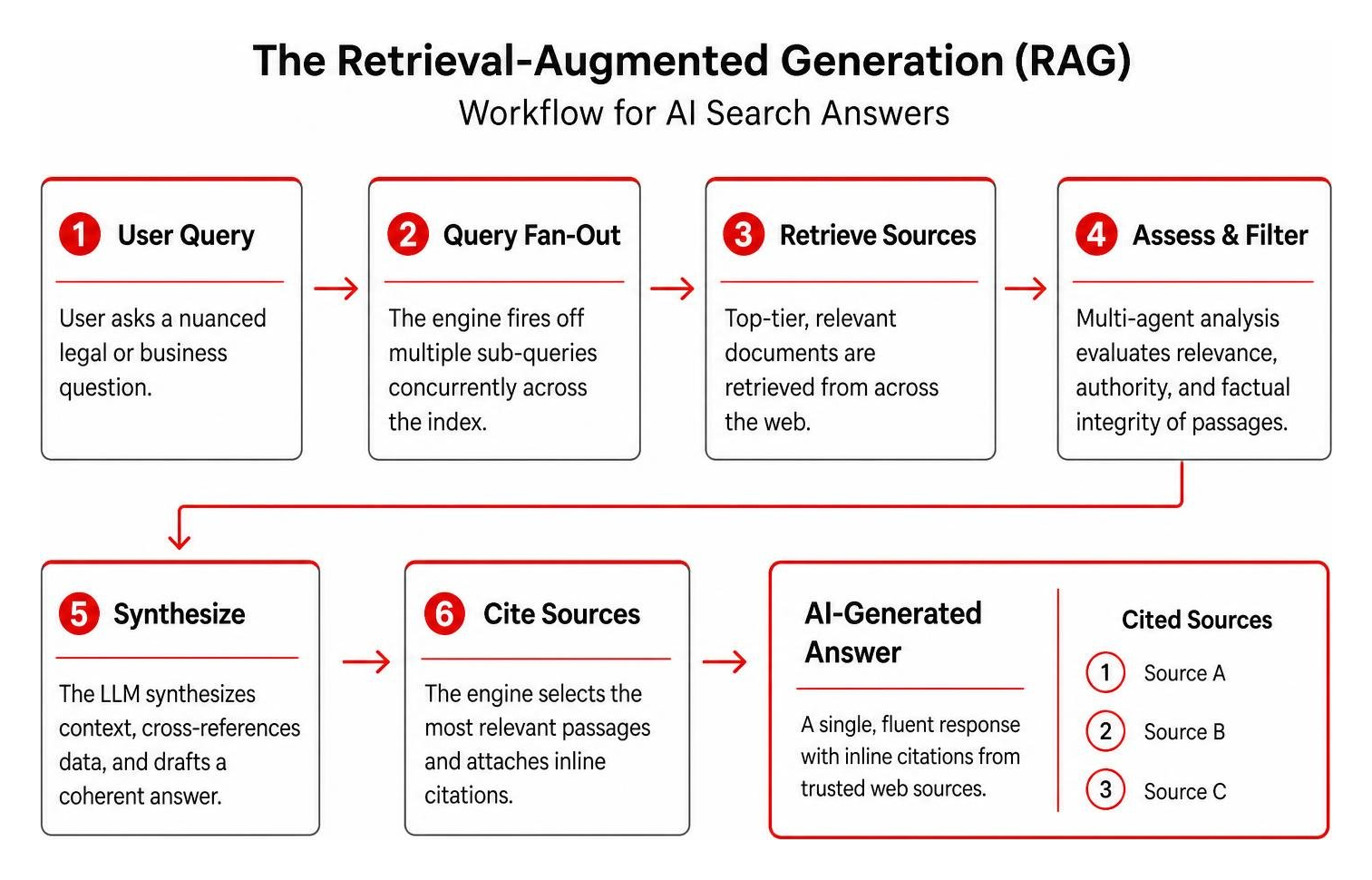
Multi-agent analysis pipelines assess the semantic density, authority, and factual integrity of candidate passages. If your page provides direct, verifiable answers that an LLM can parse and summarize without ambiguity, your content gets attributed inside the generated answer.
Core Differences Between SEO and Generative Engine Optimization
Traditional search engine optimization focuses primarily on ranking a specific URL in a vertical list of ten organic links. GEO expands that objective: your goal is to become the underlying knowledge source that an AI quotes, references, and highlights.
| Optimization Metric | Traditional SEO | Generative Engine Optimization (GEO) |
|---|---|---|
| Primary Goal | High ranking on the SERP | Direct citation & attribution in synthesized answers |
| Content Strategy | Keyword placement & topical depth | Factual density, expert quotes, & specific statistics |
| Authority Signals | Backlink counts & Domain Rating | Branded web mentions, factual accuracy, & E-E-A-T |
| User Interaction | Direct link clicks from rankings | Zero-click synthesis reads & high-intent citation clicks |
| Core Measurement | Keyword positions & organic traffic | Position-Adjusted Word Count & Subjective Impression |
Achieving success across both channels involves winning the AI search trial with generative engine optimization while sustaining advanced SEO authoritative content across your site architecture.
The Shift from Linear SERP Rankings to Synthesized AI Overviews
The rise of conversational queries has transformed search real estate. Users no longer type fragmented phrases like “car accident lawyer statutory limits”; they submit full conversational questions. Generative platforms respond with comprehensive answer boxes, satisfying user intent directly on the screen.

This evolution fuels zero-click behavior, where users find immediate answers without clicking a traditional listing. However, when an AI Overview features your brand as an authoritative reference, the traffic you do receive is exceptionally qualified. At Triple Digital, our Houston-based team regularly observes that visitors arriving via generative citations convert at significantly higher rates because the AI has already framed your firm as a verified authority. Understanding how to appear in AI Overviews is essential for retaining visibility as answer-box real estate expands.
High-Impact Content Strategies for AI Visibility
To rank in AI-driven answer engines, content must go beyond generic overviews. Generative models look for non-commodity information—content that provides unique analysis, proprietary data, concrete legal principles, or direct practitioner insights. Structuring your content around the complete guide to modern law firm SEO provides the foundational crawlability and topical authority that generative platforms demand.
The foundation of modern generative visibility rests on an expanded credibility framework: E-E-A-T-R (Experience, Expertise, Authoritativeness, Trustworthiness, and Readability). LLMs parse sentence structures to determine whether a passage represents real-world authority or repetitive filler. Factual density—the number of verified facts, statistics, and definitions per paragraph—directly impacts whether an engine chooses your text as a source.
Evidence-Based Generative Engine Optimization Strategies That Drive Citations
Rigorous academic and industry research on GEO reveals clear performance lifts when specific content elements are integrated into web pages. Rather than guessing what algorithms prefer, we rely on benchmarked techniques that consistently improve source visibility:
- Quotation Addition: Incorporating direct quotations from credentialed experts yields up to a 41% improvement in Position-Adjusted Word Count.
- Statistics Addition: Backing factual assertions with quantitative figures delivers an improvement of up to 37% on Subjective Impression on platforms like Perplexity.ai.
- Source Citations: Explicitly referencing foundational studies, official statutes, or verifiable industry reports boosts overall source visibility by over 40% across diverse queries.
- Branded Web Mentions: Off-site brand mentions hold a correlation of 0.664 with generative overview appearances—more than double the correlation of traditional Domain Rating (0.326).
- Fluency and Plain Language: Structuring answers in direct Q&A formats (<300 characters per core answer) accelerates LLM extraction during multi-agent synthesis.
To see how these techniques translate to specific platforms, review our guide on how to optimize content for Perplexity and make the AI bots love you.
The Rank-5 Inversion Effect and Leveling the Playing Field
One of the most remarkable findings in generative engine research is the “Rank-5 Inversion.” In traditional search, the page holding the number one organic spot captures the lion’s share of clicks, while lower-ranking results receive minimal attention. Generative engines evaluate content differently.
Research demonstrates that applying the “Cite Sources” method to websites sitting in the fifth SERP position led to a massive 115.1% increase in AI visibility. Conversely, pages in the top organic position sometimes experienced visibility drops when relying solely on legacy authority signals without factual optimizations.
This dynamic levels the playing field for boutique practices and regional creators. You do not need to possess the highest backlink profile in the nation to be cited; if your content delivers superior semantic contribution, structured evidence, and concise answers, the generative engine will prioritize your page. Explore our guide to AI overview for attorneys to see how challenger firms capitalize on this shift.
Measuring AI Search Performance and Essential Metrics
Tracking success in generative search requires looking beyond standard organic ranking positions. Because an AI engine synthesizes a unique answer for every user prompt, visibility must be evaluated along multi-dimensional scales.

Quantifying Visibility Beyond Click-Through Rates
Evaluating AI visibility relies on tracking how extensively and prominently your domain is integrated into synthesized responses. The standard metrics for GEO include:
- Position-Adjusted Word Count: Measures how many words in the AI’s generated response are attributed to your content, weighted heavily by how early the citation appears in the answer.
- Subjective Impression: A composite evaluation scoring relevance, influence, factual uniqueness, and click likelihood of the cited text.
- Attribution Accuracy & Faithfulness: How precisely the AI conveys your published data without distorting the underlying legal or factual context.
- Answer Dominance: The proportion of key information points within a synthesized overview that trace directly back to your domain.
Our analysis in attorney generative AI rankings 2026 breaks down how these benchmarks shape digital market share across major practice areas.
Monitoring Tools and Official Search Engine Protocols
Search platforms provide dedicated reporting tools to help webmasters monitor generative visibility:
- Google Search Console Generative AI Reporting: Tracks impressions, cited URLs, and query themes generated within Google AI Overviews.
- Bing Webmaster Tools AI Performance Report: Delivers granular data on how Copilot and Bing Chat cite your website within conversational answers.
- Automated LLM Evaluation Prompts: Running systematic prompt testing across ChatGPT, Gemini, and Claude to assess answer share-of-voice and source attribution.
As detailed in our breakdown to move over SEO and learn how to optimize legal services for AI search, continuous monitoring ensures your content remains the authoritative source of truth for conversational answer engines.
Common GEO Myths, Limitations, and Technical Pitfalls
As with any major technological evolution, misinformation can lead site owners down counterproductive paths. Let us separate factual optimization from common misconceptions.
Debunking Ineffective Tactics and AI Markup Files
Several widespread myths have circulated regarding AI search optimization:
- Myth 1: You must create an
llms.txtfile. Major search engines, including Google, have clarified that special AI text files or non-standard protocols are entirely unnecessary. AI crawlers evaluate standard, accessible HTML. - Myth 2: Extreme content chunking helps LLMs. Chopping articles into disjointed, bite-sized fragments strips away crucial context. Models prefer coherent, contextually rich documents with clear heading hierarchies.
- Myth 3: Keyword stuffing still works if you target conversational phrases. Repeating conversational queries artificially decreases fluency and degrades topical authority, resulting in lower citation rates.
- Myth 4: Fabricated or automated citations fool AI systems. Generative models utilize cross-verification algorithms; uncited or false assertions get filtered out during the synthesis phase.
For a grounded look at sustainable practices, review our guide AI overview optimization for lawyers.
Managing Hallucinations and Algorithmic Volatility
Generative engines are dynamic black-box systems. Algorithmic updates and model retraining can cause temporary shifts in how queries are synthesized. Furthermore, factual distortion remains a risk when LLMs misinterpret ambiguous text.
To safeguard your brand, maintain strict precision in your published copy. Define legal and technical terminology clearly, state numerical thresholds explicitly, and run regular editorial reviews to verify that your informational guides leave no room for algorithmic misinterpretation.
Frequently Asked Questions About Generative Engine Optimization
Does generative engine optimization replace traditional SEO?
No. GEO and traditional SEO operate in complete synergy. Generative engines rely on search engine crawlers and core indexation systems to discover content. Maintaining strong technical SEO, clear site architecture, and fast load speeds is essential before an AI engine can parse and cite your pages.
How does GEO help smaller websites outrank larger competitors?
Generative engines prioritize direct answers, factual density, and verified evidence over raw domain authority. Through the rank-5 inversion effect, smaller websites that provide well-researched data, expert quotes, and concise summaries frequently win top citations over larger legacy sites that offer generic content.
What is the single most impactful on-page tactic for GEO?
Adding verifiable statistics and direct expert quotations is the single most effective on-page optimization. Research demonstrates that pairing quantitative data with authoritative sourcing can boost generative visibility by up to 40%, making your content far easier for LLMs to validate and cite.
Building a Resilient Generative Search Strategy
The migration toward generative search represents an incredible opportunity for businesses prepared to lead with substance. As answer engines claim a larger share of user attention, winning digital visibility requires moving beyond basic keyword optimization to deliver authoritative, evidence-rich content that AI engines trust.
At Triple Digital, we help firms navigate this transformation with a results-driven, “less fluff, more cases” approach. By combining advanced data mining with cutting-edge generative optimization, we ensure your firm remains the primary authority in conversational search. Ready to future-proof your digital presence? Schedule a meeting with our team to build your custom generative search roadmap today.