




Can Legal Snippet Optimization Win More Clients for Your Practice?
Legal snippet optimization starts with a clear answer. On each practice page, put a common client question in a heading and answer it right below in a short, accurate paragraph. Use a numbered list for steps, cite the law when it matters, and keep your attorney and firm details current. This gives Google clear passages to consider for featured snippets and AI Overview citations.
Those placements can put your firm in front of people looking for legal help. But visibility alone does not win a case. The page still needs to help readers understand their options and make it easy to contact you.
I’m Paul Taylor, president of Triple Digital, and I bring more than 28 years of marketing and growth experience to law firm lead generation. In this guide, I’ll show you how to apply Legal snippet optimization without losing sight of the goal: more qualified inquiries.
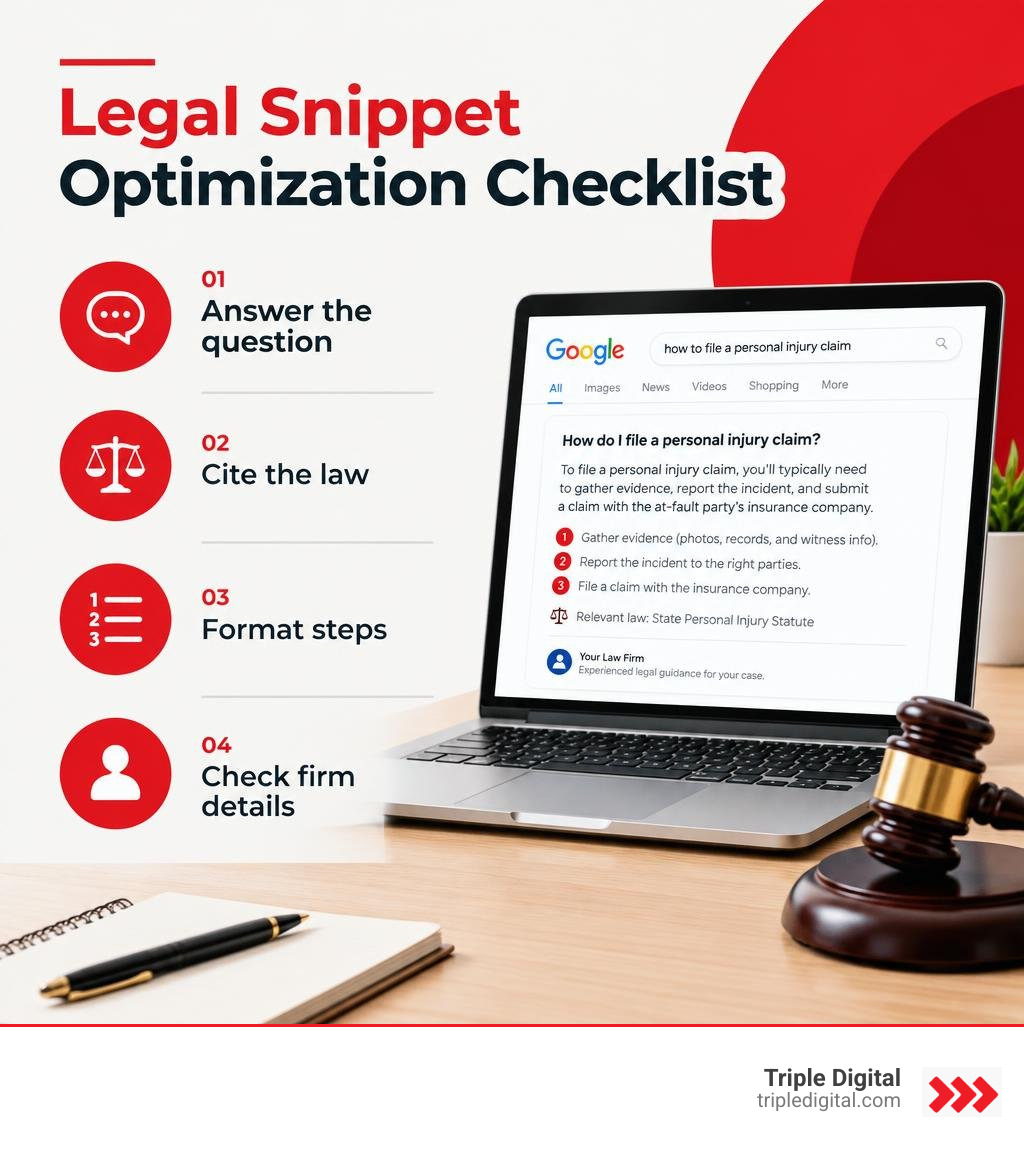
Key Legal snippet optimization vocabulary:
Understanding the Modern Legal SERP: Featured Snippets vs. AI Overviews
The search engine results page (SERP) looks drastically different than it did just a few years ago. With Gartner predicting traditional search engine volume would drop 25% by 2026, the battle for legal visibility has shifted from merely ranking on page one to claiming direct answer real estate. Today, AI-driven traffic has surged, growing 187% across 2025 alone—expanding nearly eight times faster than standard human browsing traffic.
For attorneys, visibility now hinges on two distinct yet interconnected SERP surfaces: classic featured snippets (often referred to as position zero) and multi-source AI Overviews. While both serve to answer a searcher’s question instantly, their underlying extraction mechanics, display formats, and user intent profiles differ significantly.
| Feature Dimension | Featured Snippets | Google AI Overviews |
|---|---|---|
| Primary Data Source | Single authoritative webpage passage | Multi-source synthesis across several indexed pages |
| Placement on SERP | Position zero (above traditional organic links) | Top of SERP (can expand, push down organic, or embed snippets) |
| Content Mechanics | Direct quotation or tabular pull | Generative summary citing multiple corroborating links |
| Search Intent | Quick definitions, specific deadlines, procedural steps | Complex legal queries, comparative law, multi-part scenarios |
| Click-Through Behavior | High visibility, direct traffic for deeper research | Brand citation, multi-link evaluation, synthesis browsing |
Understanding the distinction between these surfaces is critical when navigating modern AI search visibility. Featured snippets pull an exact excerpt from a single site to resolve direct informational queries. In contrast, generative synthesis engines evaluate multiple pages to generate a comprehensive answer, linking out to top supporting sources.

Both features frequently appear alongside People Also Ask (PAA) accordions, creating layered search results where structured passages win the vast majority of visual attention.
The Primary Types of Legal Rich Snippets
To capture these high-value positions, legal practices must structure their websites for the specific snippet formats Google serves:
- Paragraph Snippets: These appear primarily for direct informational queries (e.g., “What is a deposition?”). Google extracts a clean 40 to 60-word definition that directly answers the core question.
- List Snippets (Ordered and Unordered): Used for chronological procedures or multi-element legal criteria (e.g., “Steps in estate probate” or “Requirements for forming an LLC”).
- Table Snippets: Ideal for displaying comparative legal data, such as statutory filing deadlines or comparative fault thresholds across jurisdictions.
- Video Snippets: Extracted time-stamped segments from informative legal videos answering specific procedural questions.
- Local Pack Integration: Geo-targeted rich snippets displaying firm reviews, office hours, and Google Business Profile data alongside standard search answers.
Integrating these formats into your practice content is a foundational pillar of comprehensive law firm search strategies.
How Google’s Passage Indexing Shapes Answer Engine Retrieval
Underneath both rich snippets and AI Overviews lies Google’s passage indexing technology. Rather than indexing and evaluating a 2,500-word practice page as a single monolithic block of text, natural language processing algorithms evaluate individual sections—or passages—independently.
This means a single, well-organized legal guide can rank for multiple distinct informational queries simultaneously if each subtopic is cleanly segmented. By understanding foundational generative engine optimization, firms can write modular content blocks where each heading acts as an entry point for answer extraction.
The Strategic Playbook for Legal Snippet Optimization
Winning position zero and securing citations in generative answer blocks requires an intentional editorial structure. Search engines prioritize clarity, conciseness, and verifiable authority over flowery prose.
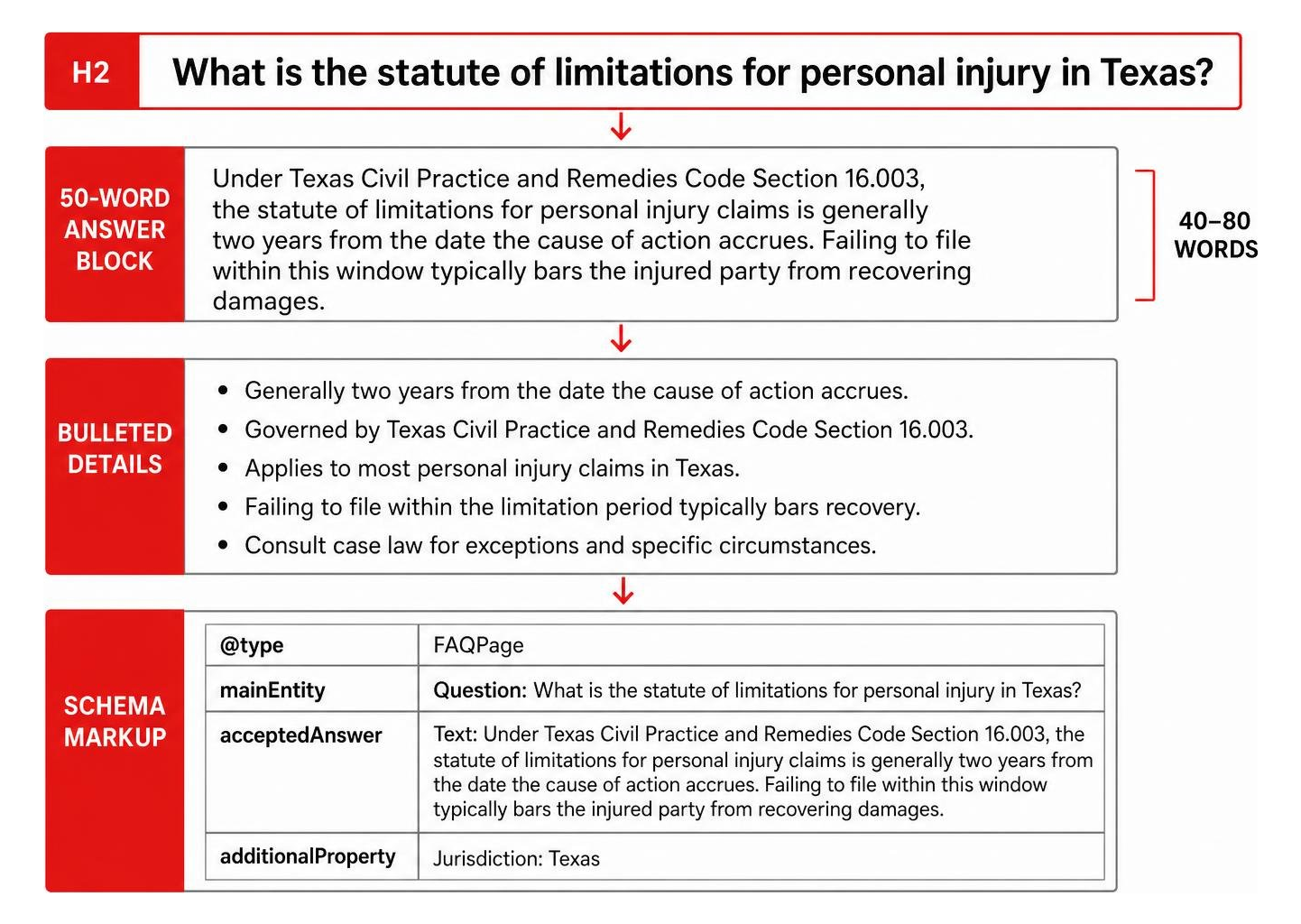
Our proven framework relies on the answer-first methodology. Instead of burying answers beneath lengthy introductions, our Houston-based team at Triple Digital implements a strict “less fluff, more cases” rule: address the user’s explicit question within the first 40 to 80 words beneath the subhead before elaborating on nuances.
Adopting this format allows search bots to effortlessly lift your copy, positioning your firm as the definitive authority using high-intent search ranking tactics.
Executing Legal Snippet Optimization Across Practice Area Pages
When deploying this strategy across your practice area pages, consistency is paramount. Each major page should follow a clear hierarchical structure:
- Question-Based Headings (H2 and H3): Match the natural phrasing prospective clients use when searching legal issues (e.g., “How Does Child Support Work in Texas?”).
- Immediate Direct Summary: Deliver a clear, self-contained definition or rule within 40 to 60 words immediately following the heading.
- Statutory and Regulatory References: Name specific statutes, legal codes, and judicial rules to give search engines verifiable trust anchors.
- Scannable Ordered and Unordered Lists: Outline procedural timelines, statutory factors, or qualification criteria using clear bullet points.
- Supporting Explanatory Content: Expand on exceptions, case studies, and practical considerations to build comprehensive topical depth.
Structuring practice areas in this manner transforms standard marketing copy into structured legal content pillars that search algorithms favor for both rich snippets and answer engine retrieval.
Technical Schema Markup for Legal Snippet Optimization
Content formatting provides the visual framework, but structured data (JSON-LD schema markup) provides the machine-readable foundation. Research on knowledge-graph-grounded Large Language Models (LLMs) demonstrates that factual retrieval accuracy increases from roughly 16% to over 50% when structured data is part of the retrieval layer.
To maximize your firm’s snippet visibility, ensure your pages incorporate these critical schema types:
- FAQPage Schema: Marks up question-and-answer pairs, signaling direct answers directly to Google’s indexing pipeline.
- LegalService Schema: Identifies your firm as a verified legal entity, defining practice areas, geographic service areas, physical addresses, and contact credentials.
- Person Schema: Applied to attorney bio pages to establish Experience, Expertise, Authoritativeness, and Trustworthiness (E-E-A-T), detailing bar admissions, education, and legal specializations.
- Organization Schema: Connects your firm’s brand identity across web directories, social profiles, and legal publications.
Auditing and Upgrading Your Legal Content for Maximum Snippet Capture
Maximizing your legal snippet reach requires routine auditing of existing assets. Law firms do not need to rewrite their entire website from scratch; instead, focus on upgrading high-performing pages that already hold top-10 organic rankings.
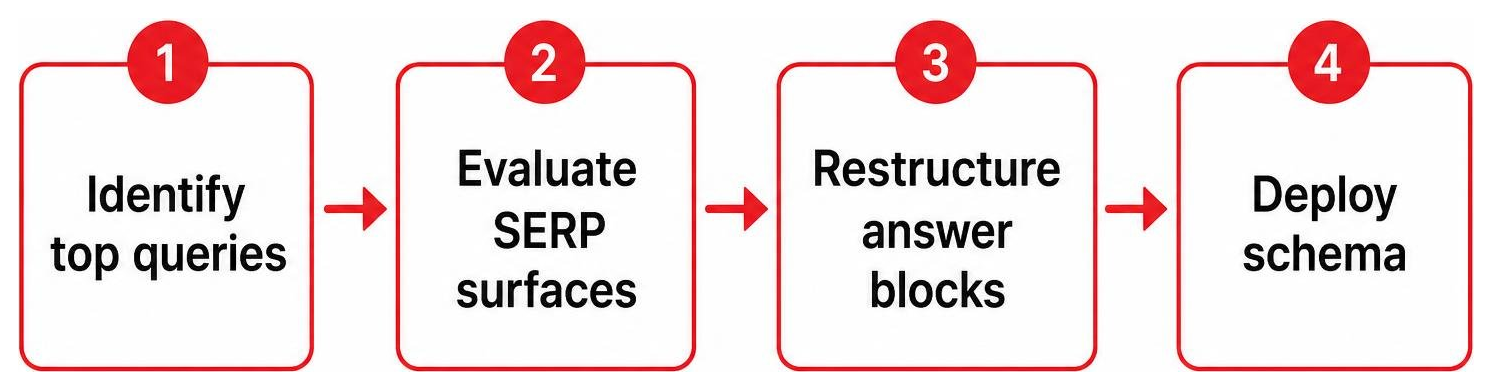
Start by evaluating performance with Google Search Console to identify queries where your practice ranks on page one but lacks a rich snippet or AI Overview citation.
Here is our quarterly checklist for auditing legal snippet performance:
- Identify High-Impression Keywords: Pull queries where your firm ranks in positions 2 through 8. These represent prime opportunities for snippet displacement.
- Analyze SERP Layouts: Check whether the target query triggers a paragraph snippet, a list snippet, an AI Overview, or a PAA block.
- Refactor Page Headings: Update subheadings to match user query syntax precisely.
- Condense Target Passages: Edit the first 50 words below each target heading to provide a tighter, more direct answer.
- Validate Schema Markup: Run your pages through the Google Rich Results Test to ensure JSON-LD code is free of syntax errors.
- Implement an llms.txt File: Add a standardized
/llms.txtfile at your domain root to help AI search crawlers parse practice areas, attorney credentials, and firm services accurately. - Cross-Source Entity Verification: Ensure firm names, attorney bios, and practice specializations are identical across state bar directories, legal portals, and review sites.
Integrating Local SEO Signals and Google Business Profiles
Legal snippet optimization works hand-in-hand with local search signals. When potential clients search for legal help, Google frequently pairs snippet answers with local pack map results and Google Business Panels.
Maintaining absolute Name, Address, and Phone (NAP) consistency across local directories and capturing authentic client reviews directly strengthens your firm’s entity authority. When Google recognizes your practice as a prominent local institution, your content gains higher algorithmic trust, making your informational passages more likely to be featured in answer engine results. You can read more about maximizing local practice visibility in our dedicated local search guide.
Balancing Traditional Search Quality with AI Answer Engine Demands
A common pitfall in snippet optimization is producing sterile, robotic content that appeals only to search bots while failing to engage human clients. With 79% of legal professionals now utilizing AI tools in their workflows, search engines have become adept at identifying low-value, mass-produced text.
To retain prospective clients who click through from a snippet, maintain an authoritative yet compassionate tone. Provide clear legal guidance, cite applicable state statutes, and outline standard procedural steps while always including a clear, accessible path for the reader to schedule a consultation with your firm.
Frequently Asked Questions About Legal Snippet Optimization
What is the difference between a featured snippet and an AI Overview for law firms?
A featured snippet quotes a specific text passage from a single webpage to answer a query directly in position zero. An AI Overview synthesizes information from several authoritative websites, generating an AI-crafted summary that includes linked citation cards to the underlying sources.
How long does it take for legal snippet optimizations to appear on Google?
Once you restructure your page headings, implement direct answer passages, and deploy FAQPage schema, search engines typically process the updates during their next crawl cycle—often within several days to a few weeks depending on your site’s crawl frequency and authority.
Can a single practice page win both a featured snippet and an AI Overview citation?
Yes. Because both featured snippets and AI Overviews rely on the same foundational architecture—passage indexing, direct answer summaries, clear heading structures, and structured schema markup—a properly optimized legal page can simultaneously secure position zero and be cited within the AI Overview.
Transforming SERP Visibility into Retained Legal Clients
Capturing rich snippets and AI Overview citations is one of the most effective ways to establish instant authority at the exact moment a prospective client searches for legal help. By structuring your website around concise, answer-first passages, verifying your data through schema markup, and maintaining consistent entity signals, your firm can dominate modern search results.
At Triple Digital, we specialize in cutting through digital marketing noise with data-backed strategies designed to generate qualified case leads for law firms. If you are ready to elevate your search presence and start capturing high-value cases with AI overviews, our team is here to help you lead your market.