





Website Conversion Rate Optimization Services: Turn Traffic Into Cases
Website conversion rate optimization services are professional solutions that turn existing website visitors into leads, clients, or customers — without spending more on ads or SEO.
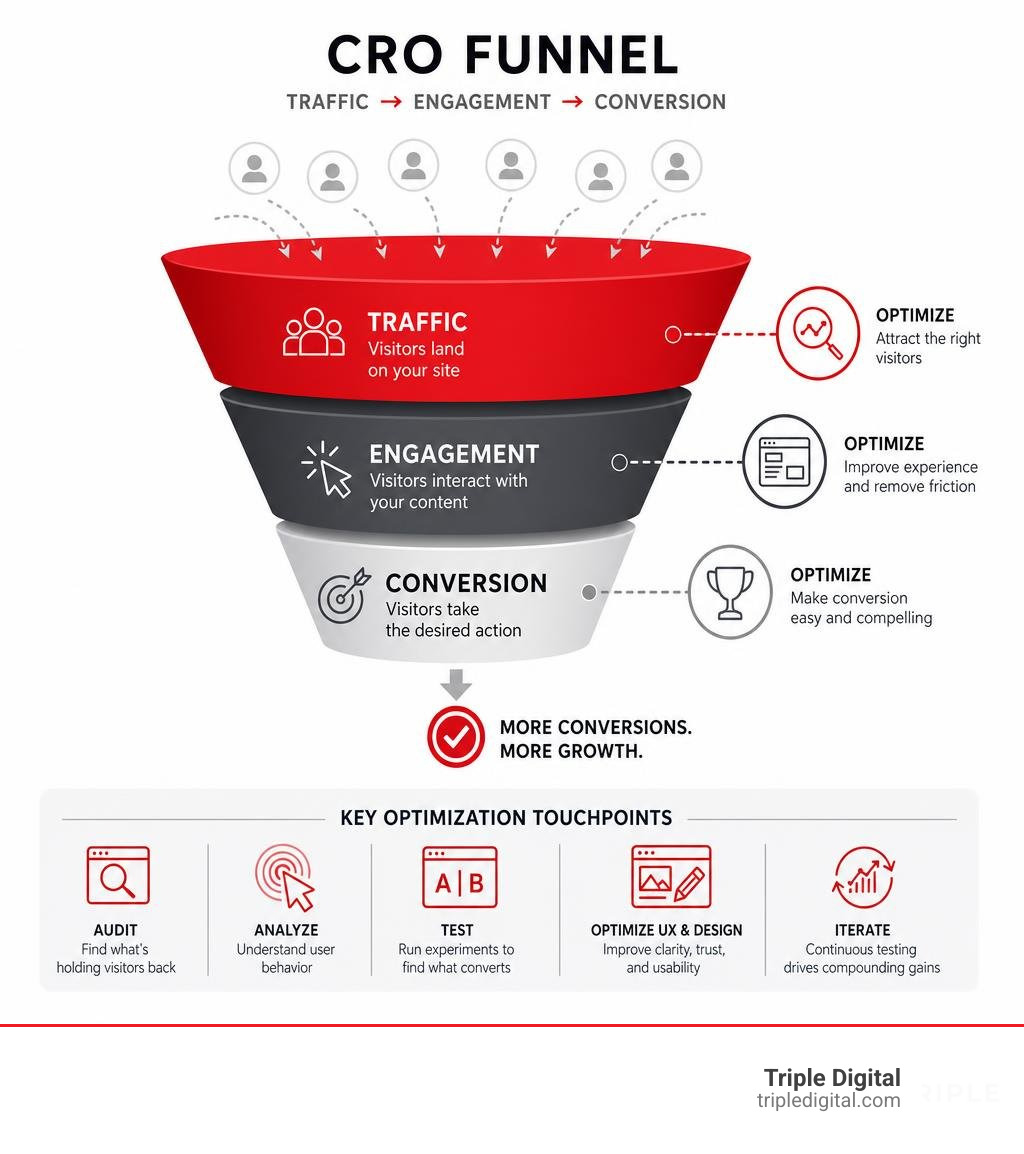
Here’s what they typically include:
- CRO Audit – A deep analysis of your site to find where visitors drop off
- User Behavior Analysis – Heatmaps, session recordings, and click tracking to understand what users actually do
- A/B Testing – Running controlled experiments on headlines, CTAs, forms, and layouts to find what converts best
- UX and Design Optimization – Fixing friction points that stop visitors from taking action
- Ongoing Experimentation – Continuous testing cycles that compound gains over time
Most law firms pour budget into SEO and paid ads — and the traffic shows up. But the calls don’t follow.
The reason is almost never the traffic itself. It’s what happens after the click.
E-commerce sites typically convert only 1–3% of their visitors. Professional services sites — including law firms — often sit even lower. That means for every 100 people who land on your site, 97 or more leave without ever reaching out.
That gap between traffic and revenue is exactly what website conversion rate optimization is designed to close. Instead of chasing more visitors, CRO focuses on getting more value from the visitors you already have.
Think of it this way: doubling your conversion rate has the same revenue impact as doubling your traffic — but at a fraction of the cost.
Professional CRO services combine data analysis, behavioral psychology, and systematic testing to find the specific reasons your visitors aren’t converting — and then fix them, one experiment at a time.
Quick website conversion rate optimization services terms:
Why Your Business Needs Professional Website Conversion Rate Optimization Services
When we talk about digital marketing, the conversation usually revolves around traffic acquisition. Businesses pay for search engine visibility, buy social media ads, and sponsor local events to get clicks. But traffic is only half of the equation. If your website is a leaky bucket, pouring more water into it won’t solve your thirst.
A website’s conversion rate is calculated by dividing the total number of conversions (such as form submissions, phone calls, or consultations booked) by the total number of unique visitors, then multiplying by 100. For example, if your law firm’s landing page receives 1,000 visitors in a month and generates 20 consultation requests, your conversion rate is 2%.
For professional service providers, especially in highly competitive local markets like Houston, TX, those 20 leads represent the lifeblood of the business. However, it also means 980 potential clients clicked away. Professional website conversion rate optimization services exist to rescue those lost opportunities. By identifying and removing the friction points that cause high bounce rates, CRO transforms passive readers into active clients.
To truly understand how to capture this traffic, check out our guide on how to Increase Conversion Rate Law Firms.
What to Expect from Website Conversion Rate Optimization Services
A professional CRO campaign is not built on guesswork, “gut feelings,” or aesthetic trends. It is a highly structured, scientific process. When you partner with a specialized agency, you can expect a comprehensive roadmap designed to eliminate customer apathy.
- Discovery Audit: This is the diagnostic phase. We dive deep into your historical analytics data to find out where your website is leaking leads. We look for pages with unusually high bounce rates, drop-offs in your intake forms, and technical glitches across different browsers and mobile devices.
- Heuristic Review: A usability expert manually walks through your website, evaluating it against proven user experience (UX) principles. We analyze the visual hierarchy, the clarity of your value proposition, and the ease of navigation.
- User Journey Analysis: We map out the exact paths visitors take from their initial landing page to the final conversion point. This allows us to identify the critical “friction points” — such as confusing menus, slow page load speeds, or intimidating intake forms — that cause prospective clients to abandon your site.
To explore this process in greater detail, read our comprehensive Guide Conversion Optimization.
How Website Conversion Rate Optimization Services Integrate with SEO and PPC
Many businesses view SEO, PPC, and CRO as separate, isolated strategies. In reality, they are deeply interconnected components of a single marketing ecosystem.
Search Engine Optimization (SEO) and Pay-Per-Click (PPC) advertising are designed to drive high-intent traffic to your website. But driving traffic to an unoptimized website is incredibly expensive. High click prices in the legal industry mean that every wasted visit directly hurts your bottom line.
When you implement professional website conversion rate optimization services, you turn CRO into a powerful force multiplier:
- Lower Cost Per Acquisition (CPA): If you double your conversion rate, you effectively cut your cost-per-lead in half. Your PPC campaigns suddenly become twice as profitable without increasing your daily ad budget.
- Improved Quality Scores: Search engines like Google reward websites that provide excellent user experiences. Lower bounce rates and longer dwell times signal to Google that your page is highly relevant, which can improve your organic rankings and lower your PPC costs.
- Seamless Omnichannel Marketing: Whether a prospect finds you through a Google search, a paid social media ad, or an email newsletter, a consistent, conversion-optimized landing page structure ensures they are guided seamlessly toward taking action.
To learn more about keeping your marketing channels aligned, read about how to Stop Leaking Leads with a Better B2B Marketing Funnel.
The Scientific Approach to Website Audits and User Behavior Analysis

To make your website convert, we must stop guessing what your audience wants and start analyzing what they actually do. A scientific CRO audit relies on a combination of quantitative data (the “what”) and qualitative data (the “why”) to make informed, revenue-driven decisions.
Mapping the User Journey with Heatmaps and Session Recordings
Standard web analytics can tell you that a user left your page, but they cannot tell you why. That is where advanced user behavior tools like Hotjar and Microsoft Clarity come in.
- Click Maps: These visual overlays show exactly where users are clicking on your pages. Are they trying to click on non-link elements? Are they ignoring your primary Call-to-Action (CTA)? Click maps reveal if your layout is confusing.
- Scroll Maps: A scroll map shows how far down a page your visitors travel before leaving. If your most compelling testimonial or your contact form is placed below the fold, and only 20% of users scroll that far, 80% of your audience is missing your best pitch.
- Session Replays: Watching anonymized recordings of actual users navigating your site is incredibly eye-opening. You can see exactly where users hesitate, where they rage-click on broken elements, and where they get confused by complex navigation menus.
By identifying these exact drop-off points, we can surgically target the elements of your website that are actively turning potential clients away.
Setting Up the Testing Infrastructure
Once we have gathered behavioral data and formulated hypotheses, we set up a robust testing infrastructure to validate our ideas.
- A/B Testing (Split Testing): This involves creating two versions of a webpage (Version A and Version B) and splitting your traffic evenly between them. We might test a benefit-driven headline against a generic headline to see which one drives more form submissions.
- Multivariate Testing: For high-traffic websites, we can test multiple variations of different elements simultaneously to understand how they interact with one another.
- Rigorous QA Process: Before any test goes live, it must undergo strict Quality Assurance (QA) testing. We verify that the test renders perfectly across all major browsers (Chrome, Safari, Edge) and devices (iOS, Android) so that technical bugs do not skew our experimental data.
High-Impact Elements to Test and Optimize for Maximum Revenue

While every website is unique, certain high-impact elements consistently yield the highest conversion lifts when optimized correctly.
Optimizing CTAs, Copy, and Page Layouts
Your website’s copy and visual layout do the heavy lifting when it comes to building user trust and driving action.
- Calls-to-Action (CTAs): Generic buttons like “Submit” or “Contact Us” do not motivate action. Instead, we test benefit-driven, low-friction CTAs like “Get Your Free Case Review” or “Speak with an Attorney Today.”
- The Value Proposition: Your headline must immediately answer three questions within the first three seconds of a user landing on your page: What do you do? Who do you do it for? Why should I choose you over a competitor?
- Mobile Responsiveness: With more than half of all web traffic originating on mobile devices, your mobile layout cannot be an afterthought. We design mobile-first experiences with sticky click-to-call buttons and thumb-friendly navigation.
For a deeper dive into crafting high-converting legal landing pages, explore our article From Clicks to Clients: The Ultimate Law Firm CRO Strategy.
Streamlining Forms and the Intake Process
For law firms and service-based businesses, the contact form is the ultimate gateway to a new client. Yet, it is often where the user experience completely breaks down.
- Reducing Form Fields: Every field you add to a form decreases your conversion rate. In fact, reducing form fields from twelve down to four can triple your consultation requests. Ask only for the absolute essentials needed to initiate contact.
- Quiz-Style and Multi-Step Forms: For sensitive or complex legal inquiries, a massive “pancake” form with dozens of open text fields feels overwhelming. By breaking the form into micro-steps or a quiz-style interface, you keep the user engaged and reduce cognitive fatigue.
- Progress Indicators: Showing users a clear progress bar (e.g., “Step 1 of 3”) encourages them to complete the process once they have started.
To discover how streamlining your digital intake can drive business growth, read our guide on Enhancing Client Satisfaction and Firm Profitability: Optimizing the Intake Process.
The Math of Experimentation: Traffic Volume and Test Frequency
A successful CRO campaign relies on mathematical integrity. Running tests without sufficient traffic or ending them too early leads to false positives and bad business decisions.
| Monthly Page Traffic | Ideal Test Duration | Recommended Testing Strategy |
|---|---|---|
| Under 10,000 visits | N/A (Highly limited) | Focus on heuristic fixes, qualitative user testing, and direct UX upgrades. |
| 10,000 – 30,000 visits | 4 to 6 weeks | Run 1-2 high-impact A/B tests on primary landing pages or templates. |
| 30,000 – 100,000 visits | 2 to 4 weeks | Run concurrent tests using cookie exclusions to prevent user overlap. |
| 100,000+ visits | 1 to 2 weeks | Run high-velocity testing, complex multivariate tests, and personalization. |
Determining Your Ideal Testing Volume
How many tests should you run at once? The answer depends entirely on your traffic and conversion volumes.
If you run multiple tests simultaneously on the same page, you risk “test interaction” — where a change to the headline influences how users interact with a tested form, muddying your data. To prevent this, professional agencies use advanced testing platforms to implement cookie exclusions, ensuring a single visitor only sees one active experiment during their journey.
Calculating Statistical Significance Requirements
To declare a test winner, we must achieve statistical significance — usually set at 95% or higher. This mathematical threshold proves that the conversion lift was caused by the changes we made, rather than random chance.
Calculating this requires analyzing your baseline conversion rate, the desired detectable lift, and your daily visitor volume. For websites with lower traffic, we focus our testing efforts on high-leverage sitewide templates (like global headers or footers) rather than niche blog posts to gather data faster.
Measuring Success: ROI and Key Metrics Beyond Conversion Rates
While improving your conversion rate is our primary objective, we track a variety of deeper business metrics to ensure your CRO program is driving real bottom-line profitability.
Tracking Average Revenue Per User and Customer Lifetime Value
CRO is a powerful tool for increasing the overall value of your client base. We measure success by tracking:
- Average Revenue Per User (ARPU): Are the optimizations attracting higher-value cases and larger clients?
- Customer Lifetime Value (LTV): By improving the post-click onboarding experience, we build stronger relationships that lead to repeat business and referrals.
- Bounce and Engagement Rates: Lower bounce rates and higher time-on-site metrics indicate that your content is genuinely connecting with your target audience.
To learn how to connect your website analytics directly to your firm’s profitability, read Measure Up: How Analytics Can Transform Your Legal Marketing.
Timeline Expectations for Measurable Growth
CRO is not an overnight magic trick; it is an ongoing process of continuous iteration.
While quick-win technical fixes (like fixing a broken mobile form or speeding up page load times) can yield immediate results within the first few weeks, a mature, data-driven CRO strategy typically takes 60 to 90 days to gather enough statistically significant data to roll out major design changes. Over time, these incremental 5% and 10% conversion lifts compound, resulting in massive, long-term revenue growth.
Frequently Asked Questions About Conversion Optimization
How much do professional CRO services typically cost?
Professional CRO services are typically structured as a monthly retainer ranging from $5,000 to $15,000, depending on your website’s traffic volume, complexity, and the number of active experiments run each month. One-off conversion audits and landing page redesign projects generally range from $5,000 to $25,000.
Can CRO help with mobile optimization?
Absolutely. Mobile traffic now accounts for more than half of all web visits. Our CRO services place a heavy emphasis on mobile-centric testing, including thumb-friendly CTA placements, responsive form layouts, and mobile page speed optimization to capture users on the go.
Why should I hire a specialized agency instead of doing it in-house?
Successful CRO requires a highly specialized, cross-functional team including a data analyst, a conversion copywriter, a UX/UI designer, and a front-end developer. Building this team in-house is incredibly expensive. Partnering with an agency gives you immediate access to this specialized talent, advanced testing software, and a repository of historical testing data from day one.
Ready to Turn Silent Clicks Into Loud Cases?
If you are tired of watching valuable search traffic slip through your fingers, it is time to stop guessing and start optimizing.
At Triple Digital, we specialize in high-impact lead generation and case acquisition for growth-oriented law firms. Based in Houston, Texas, our “less fluff, more cases” approach leverages advanced behavioral data, scientific A/B testing, and AI-driven targeting to turn your website into a highly predictable client acquisition machine.
Stop wasting your marketing budget on empty clicks. Let us help you plug the leaks in your conversion funnel and maximize your return on ad spend.
Schedule a Consultation with our Houston-based team today, and let’s discuss how we can scale your practice.