





The Complete Guide to Modern Law Firm SEO
How Law Firms Win Clients Online in 2026
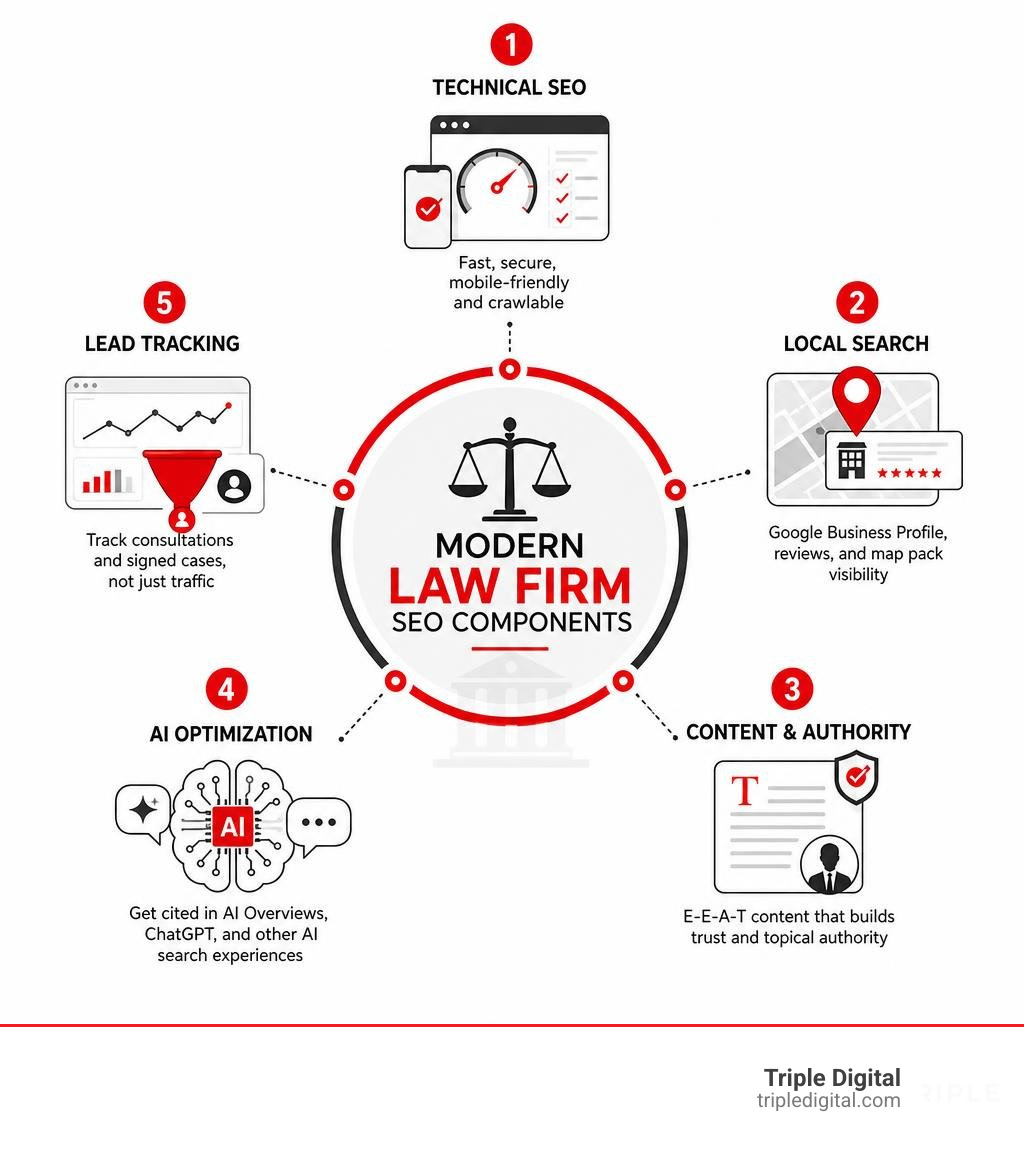
Modern law firm SEO is the practice of optimizing a law firm’s entire digital presence — website, content, local profiles, and authority signals — so potential clients find you first when they need legal help.
Here’s what it covers at a glance:
- Technical foundation — fast, mobile-friendly website with proper schema markup
- E-E-A-T content — attorney-authored pages that meet Google’s highest trust standards
- Local SEO — Google Business Profile, reviews, and map pack visibility
- Topical authority — practice area pages and blog clusters that dominate your niche
- AI search optimization — getting cited in ChatGPT, Perplexity, and Google AI Overviews
- Link building — earning backlinks from legal directories, bar associations, and press
- Conversion tracking — measuring signed cases, not just traffic
The legal industry has changed dramatically. According to the Clio Legal Trends Report, 57% of legal consumers now begin their search for representation online — and that number climbs above 70% for clients under 45.
Most people never scroll past the first page of results. And when they do find a firm, they contact just one to three attorneys before making a decision.
That means visibility isn’t just a marketing advantage. It’s the difference between a full caseload and an empty intake calendar.
Legal SEO isn’t the same as SEO for a restaurant or an e-commerce store. Google classifies legal content as YMYL — Your Money or Your Life — which means it applies its strictest quality standards to every page your firm publishes. Add in state bar advertising rules, hyper-competitive local markets, and the rise of AI-powered search, and you have one of the most demanding SEO environments in any industry.
This guide breaks down every component of a modern legal SEO strategy — from technical setup to AI search readiness — so your firm can build a sustainable pipeline of high-value cases.
Terms related to Modern law firm SEO:
Why Modern Law Firm SEO Requires a Specialized Approach
Many generalist marketing agencies treat a law firm like any other local business. They find a handful of high-volume keywords, write a few 500-word blog posts, and hope for the best. In 2026, that approach is a fast track to wasting your budget.
The legal sector is one of the most competitive digital marketing spaces in the world. For highly coveted practice areas like personal injury, criminal defense, family law, and immigration, paid search clicks can easily exceed $150 to $700+ per click. Because paid acquisition is so expensive, organic search rankings are incredibly valuable.
Additionally, Google classifies legal content under its YMYL (Your Money or Your Life) category. Because inaccurate legal information can lead to severe, life-altering consequences—such as missed deadlines, waived claims, or criminal convictions—search engines hold legal websites to a much higher standard of accuracy, safety, and verification. Understanding why SEO is important for attorneys requires looking at how search engines evaluate these high-stakes pages.
Furthermore, legal consumers search with varying levels of intent. A person searching for “what to do after a minor car accident” has informational search intent, whereas someone searching for “car accident lawyer in Houston” has transactional, ready-to-hire intent. A specialized approach aligns your content directly with these distinct stages of the client journey. Expline-by-line compliance with state bar advertising rules is also mandatory; a single misleading claim can result in severe disciplinary action. These unique constraints are among the top reasons to use law firm SEO built by specialists who understand the legal industry.
The Core Pillars of Modern Law Firm SEO
To build a high-performing legal search campaign, you must look at your digital footprint as an interconnected ecosystem. We break this down into a five-layer stack:
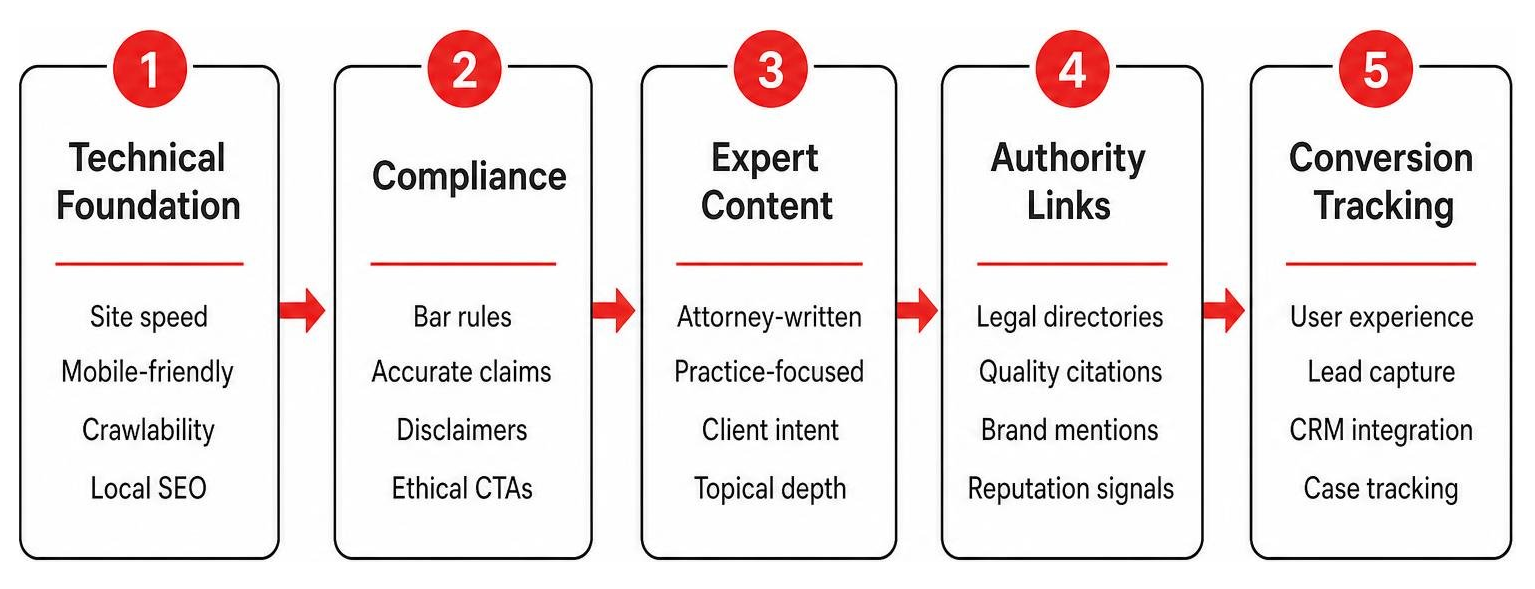
- Technical & Google Business Profile Foundation: Your site must load in under 3 seconds, be completely mobile-friendly, and feature a flawless Google Business Profile (GBP) to capture local map pack searchers.
- Bar Compliance Integration: Ensuring every page, title tag, and call-to-action complies with local bar regulations (such as avoiding non-verifiable comparative claims like “best attorney”).
- Practitioner Content: Replacing generic, unoriginal “commodity content” with authoritative, first-person legal explanations written or reviewed by credentialed attorneys.
- Legal Directory & Brand Authority: Building trusted signals across major legal networks like Avvo, Justia, and Martindale-Hubbell.
- Conversion & Intake Tracking: Optimizing your site’s user experience (UX) and connecting your lead forms to a CRM to track signed cases instead of vanity traffic metrics.
Satisfying Google’s Strict E-E-A-T Guidelines
Google’s Search Quality Evaluator Guidelines rely heavily on the E-E-A-T framework: Experience, Expertise, Authoritativeness, and Trustworthiness. For law firms, satisfying these guidelines is a core ranking factor.
- Experience: Demonstrating real-world, hands-on legal experience. This means writing about actual case types you have handled, local court procedures, and real-world legal scenarios.
- Expertise: Showcasing your formal credentials, bar admissions, awards, and specialized certifications.
- Authoritativeness: Establishing your reputation in the legal community through high-quality backlinks, guest publications, and citations in authoritative legal media.
- Trustworthiness: The most critical pillar. This is verified through clear contact information, secure website protocols (SSL), transparent business details, and honest, professional client reviews.
Failing to display these trust signals can trigger algorithmic penalties that suppress your search visibility. When looking at law firm SEO: what are the most important SEO ranking factors?, building verifiable, authentic E-E-A-T signals sits at the very top of the list.
Building Topical Authority Through Content and Entity Recognition
In the era of AI-powered search, search engines no longer just match keywords on a page. Instead, they use entity recognition to understand real-world concepts, people, organizations, and their relationships to one another.
To rank highly, your law firm must be recognized as a trusted “entity” across the web. This is achieved by building topical authority—proving to search engines that your website is the definitive, most comprehensive resource for your practice areas. Rather than publishing isolated, generic articles, you must construct structured content clusters that cover every angle of a legal topic.
Additionally, we must optimize for information gain. Google’s algorithms now penalize “commodity content”—recycled, unoriginal checklists that offer no unique value. Every page we publish must pass the information gain test by including first-hand legal insights, references to specific state statutes, or custom interactive tools. Utilizing advanced SEO: authoritative content ensures search engines recognize your firm’s deep expertise. When drafting these resources, understanding the key to AI written content is critical: AI can assist with research, but human attorney review is non-negotiable to maintain accuracy and YMYL compliance.
Structuring Practice Area Pages for Maximum Impact
Your practice area pages are the commercial engines of your website. These pages target high-intent search terms where users are actively looking to hire an attorney.
Instead of grouping all your services onto a single, thin page, build dedicated, highly detailed pages for every sub-practice area. For example, a personal injury firm should not just have a generic “Personal Injury” page. It needs separate, 1,500 to 2,500-word pages for:
- Car Accidents
- Truck Accidents
- Motorcycle Accidents
- Pedestrian Accidents
- Wrongful Death
Each page must feature localized keywords, schema markup, relevant client testimonials, and a clear call to action. Utilizing structured keyword research for lawyers: getting more clients online allows us to identify the exact search terms your local audience is using. For specialized firms, tailoring your on-page architecture to SEO for personal injury attorneys ensures you capture high-value cases.
Developing a Compliant and High-Value Blog Strategy
A successful legal blog does not exist to talk about firm picnics or office updates. It exists to answer the specific, long-tail questions your potential clients ask before they ever step foot in a law office.
When developing your content roadmap, map your topics to the client acquisition funnel:
- Top of Funnel (Informational): “What are the immediate steps to take after a car accident?” or “How is child support calculated in Texas?”
- Middle of Funnel (Comparison): “What is the difference between mediation and litigation?”
- Bottom of Funnel (Transactional): “How to hire a Houston criminal defense attorney.”
Every blog post must comply with your state’s bar advertising rules. Avoid making comparative claims, promising specific case outcomes, or using deceptive language. For highly competitive areas, implementing top SEO tips for criminal defense lawyers in the AI search era will help keep your informational content highly visible and fully compliant.
Dominating Local Search and Google Business Profiles
For local law firms, the Google local map pack is the single most valuable piece of digital real estate. It captures roughly 42% of all clicks for local-intent legal searches (e.g., “divorce lawyer near me”).
To dominate the map pack, your Google Business Profile (GBP) must be fully optimized and verified. This involves:
- Selecting “Law Firm” or your specific practice area (e.g., “Personal Injury Attorney”) as your primary category.
- Ensuring your Name, Address, and Phone number (NAP) are 100% consistent across all legal directories, state bar listings, and website footers.
- Configuring all specific cities and counties you serve in your GBP settings.
- Posting regular updates, photos of your office, and answers to FAQs directly on your profile.
To stop wasting marketing spend on broad, non-converting traffic, you should master stop wasting money: the ultimate guide to local SEO for your law firm. This localized playbook is essential for helping you get found locally: a lawyer’s guide to local SEO success.
Optimizing for Generative Engine Optimization (GEO) and AI Overviews
Search behavior is shifting. In 2026, over 78% of legal search queries trigger an AI Overview at the top of Google, and millions of users ask legal questions directly to conversational platforms like ChatGPT and Perplexity.
To ensure your firm is recommended by these large language models (LLMs), you must implement Generative Engine Optimization (GEO). AI engines do not just pull random websites; they search for trusted entities with consistent digital citations, highly structured data, and authoritative, conversational answers.
We optimize your site for AI discovery by:
- Implementing advanced schema markup (including
LegalService,Attorney, andFAQPage). - Formatting content to answer natural, conversational questions directly.
- Securing citations and brand mentions across high-authority legal databases.
Understanding how to navigate this shift requires a dedicated guide to AI overview optimization for lawyers. By adopting these tactics, you can learn the 7 ways lawyers can win more cases from AI overview for lawyers.
Managing Reviews and Local Citations Ethically
Reviews are a massive ranking factor for local SEO and the ultimate conversion tool for prospective clients. 87% of consumers read reviews before choosing a local business, and legal clients are no exception.
Develop a systematic, ethical process to request reviews from satisfied clients at their point of peak satisfaction (such as the day their case is successfully resolved). When requesting reviews:
- Send direct, personalized links via SMS or email.
- Never offer incentives, discounts, or payments in exchange for reviews (this violates federal guidelines and state bar rules).
- Professionally respond to every review—both positive and negative—while strictly maintaining client confidentiality.
To maximize your local lead generation, check out these 5 GMB hacks not to miss to generate more leads to keep your business profile ahead of the local competition.
Ethical Link Building and Digital PR for Attorneys
Backlinks—links from other websites pointing to your site—act as votes of confidence in the eyes of search engines. In highly competitive legal markets, high-quality backlinks are the primary driver of long-term domain authority.
However, not all links are created equal. Buying cheap, spammy link packages from low-quality directories will get your site penalized by Google. Instead, focus on earning highly authoritative, ethically compliant links.
| High-Value Legal Backlinks | Spammy Directory Links (Avoid) |
|---|---|
| Verified state & local bar associations | Unmoderated, global link farms |
| Respected legal publications (e.g., Law360) | Cheap $99 bulk link packages |
| Local community sponsorships & charity events | Irrelevant niche blogs with no traffic |
| Guest articles on accredited law school sites | Automated profile creation links |
| Digital PR & news outlet citations (HARO/Qwoted) | PBNs (Private Blog Networks) |
Earning editorial backlinks through digital PR involves positioning your attorneys as expert legal sources for journalists. By responding to timely media queries on platforms like Qwoted or HARO, your firm can secure high-authority links from major news publications. Executing these campaigns is a core element of mastering law firm SEO: your blueprint for online success.
Measuring Success: Beyond Vanity Metrics to Signed Cases
Too many marketing agencies boast about “impressions,” “clicks,” and “organic traffic growth.” But you cannot pay your staff or lease your office space with clicks.
The only SEO metric that truly matters is signed cases and the return on investment (ROI) of your campaign. To measure this accurately, you must set up advanced lead attribution systems. By utilizing call tracking software (like CallRail) and integrating your website forms directly with your legal CRM (like Clio or Filevine), you can track every single lead from the exact organic search query or landing page that generated it.
We also use search engine data to monitor your site’s technical health and keyword positions. Understanding how can Google Search Console help with law firm marketing? is vital for identifying crawl errors, monitoring search impressions, and finding new high-intent keyword opportunities.
Transitioning to Modern Law Firm SEO: Agency vs. In-House
As your law firm grows, you will eventually face a decision: should you hire an in-house SEO specialist or partner with a specialized legal marketing agency?
While an in-house marketer can focus solely on your brand, they rarely possess the multi-disciplinary skillset required to run a modern SEO campaign. A successful strategy requires a technical developer, a local SEO specialist, an experienced legal content writer, a digital PR professional, and an analyst.
Partnering with a specialized agency gives you access to an entire team of experts and expensive enterprise tools (like Semrush, Ahrefs, and custom AI data mining software) for a fraction of the cost of hiring a full-time internal team. To budget effectively, you should understand how much should lawyers pay for SEO? based on your market’s competitive landscape. When evaluating potential partners, knowing SEO agency for lawyers: how to spot a legal marketing unicorn will help you avoid low-quality providers and find a data-driven partner.
Frequently Asked Questions About Legal Search Optimization
How long does it take to see results from modern law firm SEO?
SEO is a long-term investment, not an overnight switch. For most law firms in moderate-competition markets, you will begin seeing measurable improvements in organic traffic and local visibility within 3 to 6 months. Significant, consistent lead generation and signed cases typically occur between months 6 and 12.
In hyper-competitive metropolitan areas or practice areas (like personal injury in major cities), it can take 12 to 18 months of consistent authority building to break onto the first page. To understand how to structure your expectations and achieve faster wins, read through rank higher, get more clients: your SEO playbook for law firms.
What is the difference between traditional SEO and GEO for lawyers?
Traditional SEO focuses on ranking your website in Google’s traditional “blue links” by optimizing for search algorithms, keywords, and domain authority.
Generative Engine Optimization (GEO) is the practice of optimizing your digital footprint so that AI search engines (like ChatGPT, Perplexity, Gemini, and Google AI Overviews) package and recommend your firm as the trusted answer to conversational user queries. GEO relies heavily on structured entity data, schema markup, and authoritative citations across the web. You can explore the latest trends in our analysis of attorney generative AI rankings 2026.
How do state bar advertising rules affect SEO content?
Every public page on your law firm’s website is legally considered attorney advertising. This means your content must strictly adhere to state bar ethics rules. Common violations include making comparative superiority claims (e.g., using terms like “best lawyer” or “most successful firm” without objective verification) and promising specific outcomes.
Failing to comply can result in severe bar penalties and search engine trust drops. To protect your practice, make sure you know how to don’t get sued by bad SEO: finding top agencies for your law firm that prioritize compliance.
Scale Your Practice with a High-Performance Growth Engine
At Triple Digital, we don’t believe in vanity metrics, cookie-cutter strategies, or marketing fluff. We build highly targeted, data-driven SEO and lead generation systems designed to do one thing: put high-value cases on your desk.
Based in Houston, Texas, our team leverages advanced AI, deep search insights, and precise data mining to position your firm directly in front of the clients who need you most. Whether you are looking to dominate the local map pack, rank for competitive practice area terms, or optimize your practice for the next generation of AI search, we have the specialized expertise to scale your firm.
Stop losing high-value cases to local competitors. Schedule a consultation with our team today, and let’s build your firm’s high-performance growth engine.