




Why Is Website Development for Law Firms Crucial for Winning Retainers?
Investing in a purpose-built digital presence elevates your practice from a static directory entry into an active client acquisition engine. In the legal sector, prospective clients rarely browse casually. They arrive facing urgent personal or commercial challenges, seeking immediate reassurance, domain authority, and straightforward answers. A modern site establishes your firm’s credibility in seconds while positioning your attorneys as approachable authorities.
A strategic digital framework directly influences firm profitability. Understanding how web design can make your business more profitable means recognizing that every element—from typography hierarchy to micro-copy on consultation buttons—either builds confidence or introduces friction. When built correctly, your digital presence filters out unqualified traffic, captures high-intent leads around the clock, and shortens the intake cycle significantly.
Custom Agency Development vs. In-House DIY Platforms
When deciding how to build or overhaul your platform, firms often weigh generic drag-and-drop site builders against custom development tailored specifically to legal workflows. DIY platforms may offer templated ease, but they often restrict deep integration with legal practice management tools, custom CRM pipelines, and advanced intake funnels.
While DIY platforms appear cost-effective upfront, they frequently lead to bloated code, rigid templates, and security vulnerabilities that can compromise confidential intake data. Selecting a specialized partner to handle custom lawyer web design ensures your technical stack scales as your caseload expands, protecting your practice from code debt and costly redesigns.
| Feature / Metric | DIY Website Builders | Specialized Agency Development |
|---|---|---|
| Initial Time Investment | Heavy internal attorney/staff hours | Managed end-to-end by technical specialists |
| Custom Code & Flexibility | Limited to fixed templates and widgets | Tailored database structures and interactive tools |
| Page Load Speed | Often bloated with unused CSS/scripts | Optimized assets loading in under three seconds |
| Scalability & Silos | Clunky reorganization for new practice areas | Engineered architecture for modular content expansion |
| Intake Integration | Basic, disconnected web forms | Unified CRM, automated calendar, and triage chat |
For attorneys considering external expertise, knowing how to choose the right legal web design partner prevents costly rebuilds and keeps your internal team focused on casework.
Conversion-Focused Web Architecture
A high-performing site aligns technical structure with client psychology. Visitors seeking legal counsel often feel overwhelmed or anxious. Presenting dense walls of legalese or clinical credentials without context creates emotional distance and causes high bounce rates.
Conversion-focused architecture bridges this gap by combining empathetic language with structured proof of competency. Creating law firm websites that convert requires guiding the user along a clear pathway: acknowledging their specific legal problem, explaining available options in accessible terms, highlighting your firm’s relevant experience, and offering friction-free contact options.
Essential Pages and Content Architecture for Legal Practices
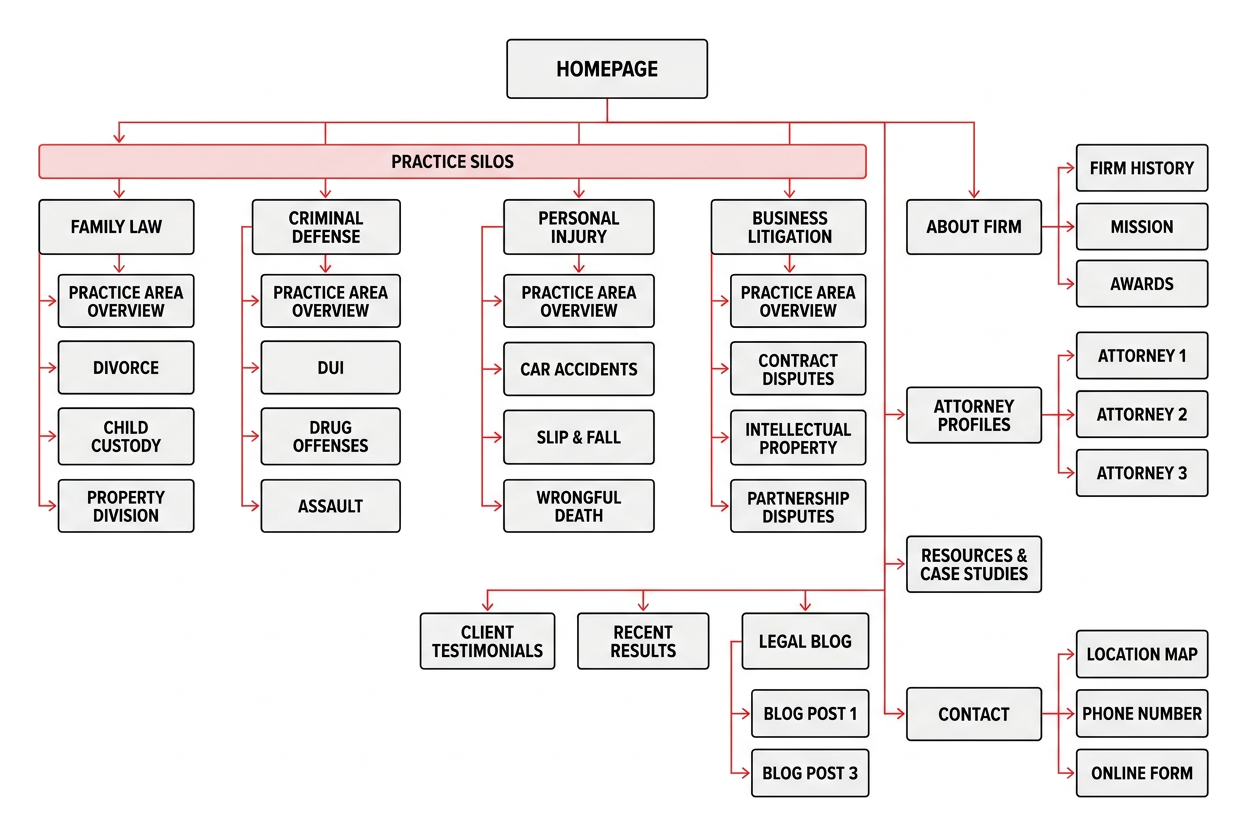
To maximize organic search visibility and user retention, your digital infrastructure must rely on a disciplined information architecture. Implementing effective web design for law firms means arranging pages into organized silos that search engines can easily index and visitors can effortlessly explore without hitting cognitive roadblocks.
High-Impact Core Pages and Practice Silos
Every legal practice website requires a distinct set of foundational pages engineered for specific stages of the client journey:
- Homepage: Delivers immediate clarity on geographic reach, primary legal disciplines, and primary calls to action without unnecessary clutter.
- Practice Area Silos: Dedicated, in-depth hub pages for each focus area, linked directly to granular sub-topics (e.g., distinguishing commercial litigation from breach of contract matters).
- Attorney Profiles: Beyond listing law schools and bar admissions, high-converting bios showcase real-world experience, published thought leadership, community involvement, and direct contact options.
- Informational Resource Centers: Educational libraries, comprehensive FAQ pages, and legal guides that address common procedural questions and clarify complex regulatory frameworks.
Social Proof, Testimonials, and Trust Signals
Trust signals validate your claims. Incorporating authentic client testimonials, verified reviews, professional awards, and professional memberships reassures prospective clients that their matter is in capable hands.

When displaying reviews, prioritize authenticity and ethical compliance according to local bar rules. Text-based reviews paired with video testimonials from past clients offer strong emotional reassurance to visitors navigating complex legal situations.
Technical Standards, Speed, and Conversion Tools
Even exceptional content fails if your technical foundation falters. Modern users expect seamless functionality across all screen sizes, and search engines prioritize sites that deliver superior technical performance. Professional website development design treats code quality, server optimization, and responsiveness as essential operational requirements rather than optional enhancements.
Technical Website Development for Law Firms: Speed, Mobile, and UX
With mobile devices accounting for more than half of all legal inquiries, a responsive, mobile-first build is non-negotiable. Pages and interactive elements must load in three seconds or less; lagging scripts cause immediate bounce-rate spikes. Optimizing Core Web Vitals—including Largest Contentful Paint (LCP), Interaction to Next Paint (INP), and Cumulative Layout Shift (CLS)—guarantees a stable browsing experience.
Our team at Triple Digital focuses on high-performance development, eliminating bloated code and optimizing every server query. For technical best practices and architectural benchmarks, review our complete lawyer website developer guide.
Integrated Intake Tools and AI Communication
Modern intake infrastructure captures qualified inquiries instantly, regardless of the time of day:
- AI-Driven Triage Chatbots: Engage visitors immediately, answering basic operational questions, gathering initial case facts, and routing qualified inquiries directly to intake staff.
- Direct Calendar Scheduling: Enable prospective clients to book introductory consultations in real time, eliminating endless phone tag.
- Secure Multi-Step Intake Forms: Replace long, intimidating forms with clean, logical step-by-step inputs optimized for mobile completion and encrypted data protection.
Search Engine Optimization and Content Strategies for 2026
Achieving lasting visibility in organic search requires blending technical SEO with consistent, high-value content publishing. Applying modern principles of legal website design ensures your site maintains top rankings across core practice disciplines and geographical service areas.

Structuring Content Velocity and Multimedia for Search Dominance
Publishing fresh, well-researched educational content at least twice per week keeps search engines indexing your site frequently and establishes broad topical authority.
Supplementing written guides with video explanations, educational infographics, and interactive FAQs extends on-page dwell time. These multimedia assets break down intricate legal procedures into digestible concepts, increasing overall engagement while signaling relevance to search algorithms.
Common Mistakes in Website Development for Law Firms
Many practices inadvertently undermine their digital investments by making avoidable design and technical missteps:
- Overloading Visuals: Relying on heavy stock imagery, decorative animations, or oversized video headers that push page load times far beyond the three-second threshold.
- Neglecting Mobile Usability: Using tiny tap targets, complex multi-tier menus, or rigid forms that frustrate users on mobile devices.
- Publishing Cliché Copy: Relying on generic claims like “we fight for you” instead of providing substantive legal guidance, clear case outlines, and concrete details.
- Hidden Contact Options: Burying phone numbers or intake links behind deep sub-menus instead of keeping them visible throughout the user experience.
If your firm is planning a digital refresh, understanding how to execute an effective legal website redesign ensures a smooth, stress-free rollout.
Frequently Asked Questions About Law Firm Web Development
How fast should a law firm website load to prevent losing potential clients?
Your website should load in three seconds or less on both mobile devices and desktop computers. Research shows that bounce rates rise sharply with every additional second of delay. Compressing media assets, leveraging modern caching protocols, and eliminating redundant scripts ensure your pages maintain optimal responsiveness.
How frequently should a law firm publish new content to maximize SEO?
Updating your resource section or blog with well-structured, helpful content at least twice per week provides consistent signals to search engines. Regularly addressing specific legal topics and client questions expands your organic keyword footprint and positions your attorneys as authoritative resources in your practice areas.
What communication features are essential for modern legal website conversion?
A modern legal website requires multi-channel communication capabilities. Essential tools include 24/7 AI-powered conversational chat, responsive contact forms, click-to-call buttons for mobile visitors, and integrated online scheduling software that allows clients to book introductory meetings directly.
Transform Your Digital Presence into a Sustainable Intake Engine
A modern law firm website is far more than an aesthetic portfolio—it is an automated intake system, a foundation for search authority, and the primary vehicle for establishing credibility with prospective clients. By combining lightning-fast load times, clear information architecture, humanized attorney profiles, and automated intake features, your firm can build trust early and turn casual visitors into long-term clients.
Ready to upgrade your firm’s digital infrastructure? Schedule a meeting with Triple Digital to build a high-performance legal website designed to scale your practice efficiently.